Pop’s Props Zing

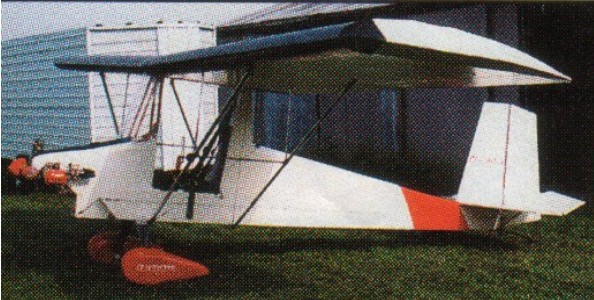
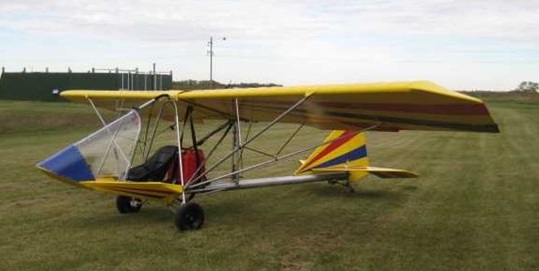
First flown in 1996, optional engines are the ½ VW or Rotax.

Engine: Kawasaki 340 LC, 35 hp
HP range: 28-40
Wing span: 25.5 ft / 7.77 m
Wing area: 118.8 sq.ft / 11.05 sq.m
Length: 17 ft
Height: 5.9 ft
MAUW: 500 lb / 226 kg
Empty weight: 249 lb / 112 kg
Fuel capacity: 3.5USG / 19 lt
Max speed: 70 mph / 112 kph
Cruise speed: 55 mph / 90 kph
Stall: 26 mph / 45 kph
Rate of climb: 675 fpm / 3.25 m/s
Range: 75 sm
Takeoff dist: 100 ft
Landing dist: 250 ft
Service ceiling: 6000 ft
Seats: 1
Landing gear: tailwheel
Plan price (1998): US$60

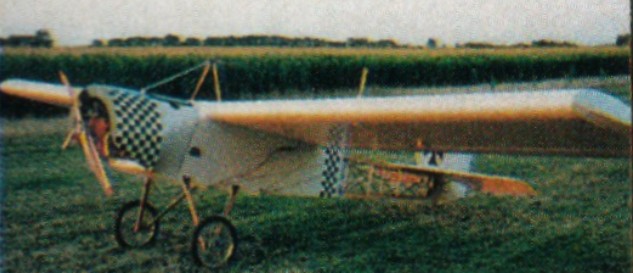
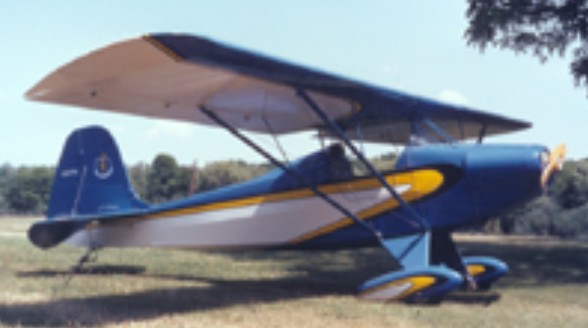
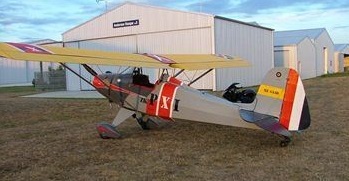
Pop’s Props Pinocchio

First flown in 1994, the prototype is powered by a twin-carburetted, two cylinder VW, with plans that will include optional motor mount illustrations for Kawasaki installation. The aircraft boasts three-axis controls and large tail surfaces. Wings carry full-span ailerons and can be detached for trailering. Its wire-bracing, spoked wheels and radial cowling gives the craft a very nostalgic look.

All wood construction. Estimated hp of the 2 cylinder VW is 40-45 hp. Construction. The fuselage is all wood incorporating 3mm plywood skin from firewall to seat back and aft of the seat on the centre section. From there, full length gussets all the way to the tail of all four corners.

Laminated bows help round out the fin and rudder and scallops accent the elevator and rudder trailing edges. The stabiliser leading edge is .8mm ply wrapped around wood formers to create a rigid D box and wire bracing tops off the lightweight but strong tail package.

The 16% Clark Y airfoil and 54” chord were chosen for the wings because of its superior stall speed characteristics and high lift capabilities. 30 dihedral was added for stability and 20 of incidence. Teleflex push-pull cables operate the full span ailerons safely and precisely. Leading edge is .8mm plywood wrapped around 3/4” foam nose ribs with 1/8” ply formers at each end and on all butt joints. Wire bracing not only makes for quick and easy wing removal but adds to the look of early aviation. Fuel is pulled from a 4.8 USG plastic tank tucked neatly above the pilot’s shins and filler is recessed into the rounded aluminium cover. Laminated foam cowl cheeks taper the round cowling into the fuselage which makes for a smooth flowing transition.

“Pinocchio’s” airframe requires no welding, no fibreglass work and the prototype was designed and constructed in approximately 500 hrs.

Speed max: 70 mph
Cruise: 60 mph
Range: 150 sm
Stall: 27 mph
ROC: 450 fpm
Take-off dist: 250 ft
Landing dist: 350 ft
Service ceiling: 2,000 ft
Engine: ½ VW, 45 hp
HP range: 35-50
Fuel cap: 4.8 USG
Weight empty: 254 lb
Gross: 500 lb
Height: 5.5 ft
Length: 16.5 ft
Wing span: 25.75 ft
Wing area: 115.8 sq.ft
Seats: 1
Landing gear: tail wheel
Tail span: 7’ without tips
Cockpit length: 46 1/2”
Cockpit width: 21 3/4”
Gear span: 46 1/2”
Payload: 230 lbs
Kit: Yes
Construction materials: Wood/fabric
Plans: Yes
Options: 2 cycle firewall forward capable.

Engine: Rotax 447, 40 hp
Wing span: 8 m
Wing area: 10.76 sq.m
MAUW: 226 kg
Empty weight: 115 kg
Fuel capacity: 19 lt
Max speed: 130 kph
Cruise speed: 100 kph
Minimum speed: 45 kph
Climb rate: 2.5 m/s
Fuel consumption: 2.5 lt/hr
Seats: 1
Plan price (1998): US$120
Kit price (1998): US$3995

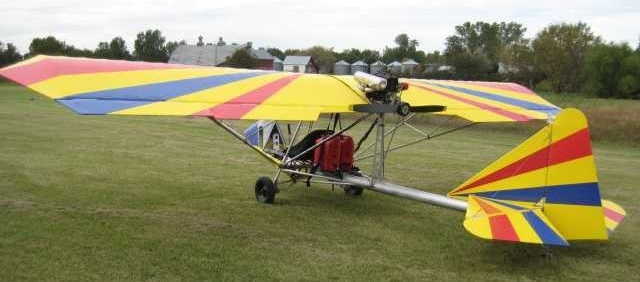
Pop’s Props Cloudster

The Cloudster is a parasol winged monoplane built in wood and covered in Dacron. The pilot sits astride the fuselage.

Engine: ½ VW, 35 hp
HP range: 28-45
Wing span: 30 ft / 9.20 m
Wing area: 138 sq.ft / 12.8 sq.m
Length: 16 ft
Height: 7.6 ft
MAUW: 500 lb / 226 kg
Empty weight: 250 lb / 112 kg
Fuel capacity: 2.5 USG / 10 lt
Speed max: 96 kph / 50 mph
Cruise: 80 kph / 40 mph
Minimum speed: 38 kph
Range: 60 sm
Stall: 26 mph
Service ceiling: 2,000 ft
ROC: 3 m/s / 500 fpm
Take-off dist: 175 ft
Landing dist: 200 ft
Seats: 1
Landing gear: tail wheel
Fuel consumption: 7 lt/hr
Plan price (1998): $65
Kit price (1998): $3225

Polliwagen Polliwagen

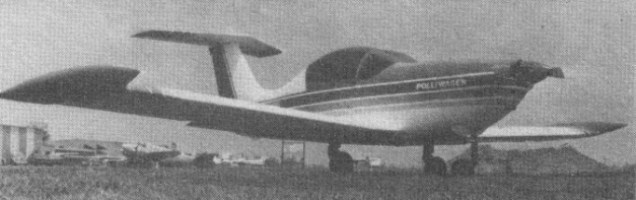
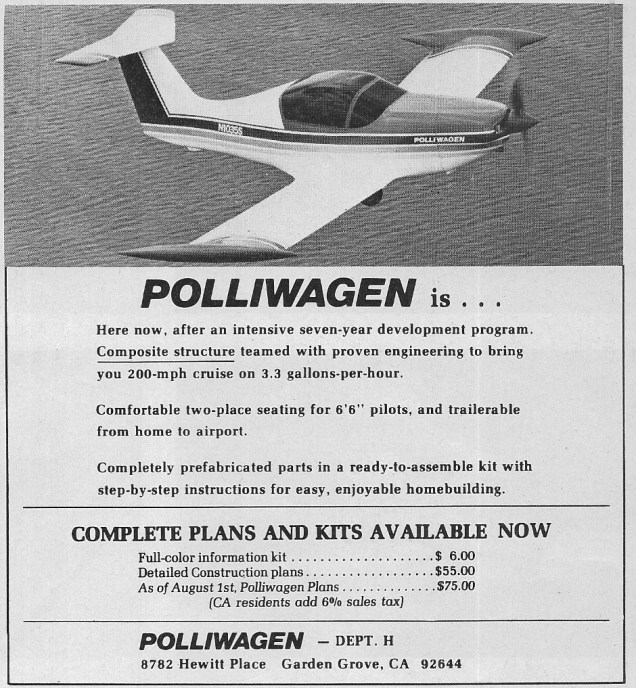
Designed by Argentine-born Joseph Alvarez in 1973, the Polliwagen derives its name from its appearance and its engine type. It is powered by a Revmaster R-2100-D turbocharged Volkswagen conversion. The Revmaster is closely cowled behind a two-position, constant-speed Maloof metal propeller of 59 inches diameter. The Polliwagen’s ex¬ceptionally clean lines give it an excellent speed-to-power ratio as well as fine aerodynamic handling characteristics. The wings are Wort¬mann FX-67-K-1 50 wing section with full-span trailing edge flaps and ailerons. Both the wings and fuselage make use of foam/epoxy com¬posite construction. Prefabricated parts are also offered in the Polliwagen kit including: molded windshield and canopy, landing gear, disc brakes, complete panels, composite structure wingtip fuel tanks, outward-breaking cabin structure, T-tail, etc.
First year built: 1978. Units delivered to June 1981: 300 kits, 65 flying. Price 1982: $5,500 (Excludes engine).

April 1982

Engine 78-hp Revmaster VW
Gross Wt. 1250 lb
Empty Wt. 650 lb
Fuel capacity 25 USG
Wingspan 26 ft
Length 16 ft
Wing area: 90 sq.ft
Top 200+ mph
Cruise 180 mph
Stall 51 mph
Climb rate 925 fpm
Range 1000 fpm
Takeoff run 500 ft
Landing roll 500 ft
Seats: 2

Podesva Tulak

The Tulák Dandy is a 2-seat high-winged ultralight monoplane of the classic construction (side by side seats).

The fuselage is welded lattice-work steel tubes, covered by fabric and partly by metal. Dual controls are fitted.
The wooden wings, with flaps and ailerons, are covered by fabric.

Powered by Rotax 503 or 912 and similar powerplants, at least 68 have flown.

Tulak Dandy
Span: 9,80 m
Length: 5,60 m
Wing area: 10,80 sq.m
Empty weight: 255 kg
Cruising speed: 100 − 140 km/h

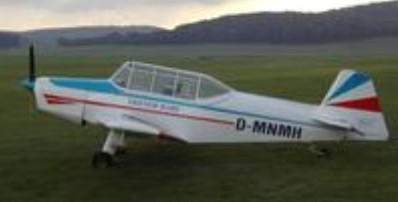
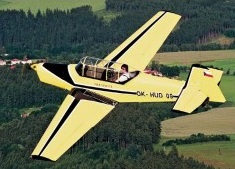
Podesva Trener Baby

Replica of the Czech Zlin 126 Trener, 2009 Price: 47000 EURO

Stall: 35 kt / 40 mph / 65 kmh
Cruise: 86 kt / 99 mph / 160 kmh
VNE: 113 kt / 130 mph / 210 kmh
Empty Weight: 296 kg / 653 lbs
MTOW Weight: 472 kg / 1041 lbs
Climb Ratio: 400 ft/min / 2,5 – 5 m/s
Take-off distance (50ft obstacle): 980 ft / 300 m
Landing distance (50ft obstacle): 980 ft / 300 m

Pober P-9 Pixie / Acro Sport Inc Pober Pixie

The single-seat Pober Pixie is another homebuilt designed by Paul Poberezny. It originally started as an effort to help pilots beat high operational costs and was designated Project Econoplane in 1974. Inspired by a Heath Parasol LN, the Pixie is a parasol monoplane powered by a Limbach VW engine rated at 50 to 75 hp. Full-span ailerons give excellent roll with little yaw on entry and recovery. This is a beginner’s project for construction, with highly detailed plans, and the cost level is low. Can be powered with a VW conversion or Continental A-65.

Pober P-9 Pixie Article

The fuselage is 4130 steel tube, wings are Sitka spruce, covering is with Stits Poly-fiber.

Gallery

Engine: VW, 55 hp
HP range: 50-75
Speed max: 133 mph
Cruise: 83 mph
Range: 290 sm
Stall: 30 mph
ROC: 500 fpm
Take-off dist: 300 ft
Landing dist: 300 ft
Service ceiling: 13,500 ft
Fuel cap: 12.3 USG
Weight empty: 543 lbs
Gross: 900 lbs
Height: 6.2 ft
Length: 17.25 ft
Wing span: 29.83 ft
Wing area: 134.2 sq.ft
Seats: 1
Landing gear: tail wheel

Acro Sport Inc Pober Pixie
Top speed: 130 mph
Cruise: 83 mph
Stall: 30 mph
Range: 290 nm
Rate of climb: 500 fpm
Takeoff dist: 300 ft
Landing dist: 300 ft
Service ceiling: 13,000 ft
Engine: Continental A-65, 65 hp
HP range: 50-75
Fuel capacity: 12.3 USG
Empty weight: 543 lb
Gross weight: 900 lb
Height: 6.2 ft
Length: 17.3 ft
Wing span: 29.8 ft
Wing area: 134.2 sq.ft
Seats: 1
Landing gear: tailwheel

P.M. & T. Honeybird

Single seat single engined high wing monoplane with conventional three axis control. Wing has unswept leading and trailing edges, and constant chord; conventional tail. Pitch control by elevator on tail; yaw control by fin mounted rudder; roll control by quarter-span spoilerons; control inputs through stick for pitch/roll and pedals for yaw. Wing braced from below by struts; wing profile NACA 23015; 100% double surface. Undercarriage has three wheels in tail dragger formation; suspension on tailwheel and axle flex/ rubber suspension on main wheels. Push right go right tailwheel steering connected to yaw control. Aluminium tube framework, with pod. Engine mounted below wing driving pusher propeller.

Pod made from Keviar/Carbon fibre. Composite construction wing uses aluminium tubing to British HT30TF specification, Styrofoam, and wood veneer covering.

The Honeybird is a sophisticated pod: it is non structural and is attached to an aluminium framework.

Although the Honeybird is a microlight by definition, it is being built under the aegis of the British homebuilders association, the PFA, whose engineering requirements insist on gravity rather than pumped fuel feed. The main fuel tank is therefore in the wing, with a reserve situated aft of the pilot.

The Honeybird is basically a homebuilt, which in 1982 had yet to make its first flight.

Engine: NGL WAE 342, 30hp at 6800rpm
Micro V belt reduction
Power per unit area 0.23 hp/sq.ft, 2.5 hp/sq.m
Fuel capacity 3.6 US gal, 3.0 Imp gal, 13.6 litre in main tank; 4.8 US gal, 4.0 Imp gal, 18.2 litre in reserve
Length overall 18.5 ft, 5.64 m
Height overall 6.5ft, 1.98m
Wing span 32.5ft, 9.91m
Constant chord 4.0ft, 1.22m
Dihedral 3 deg
Sweepback 0 deg
Tailplane span 7.0ft, 2.13 m
Fin height 4.0ft, 1.22m
Total wing area 130 sq.ft, 12.1 sq.m
Total spoileron area 3.0 sq.ft, 0.28 sq.m
Wing aspect ratio 8.1/1
Wheel track 7.0ft, 2.13m
Tailwheel diameter overall 4 inch, 10 cm
Main wheels diameter overall 12 inch, 30 cm
Empty weight 2601b, 118kg
Max take off weight 510 lb, 231kg
Payload 250 lb, 113kg
Max wing loading 3.92 lb/sq.ft, 19.1 kg/sq.m
Max power loading 17.0 lb/hp, 7.7kg/hp
Load factors +6.0 design
Never exceed speed 109mph, 175kph
Max cruising speed 68mph, 109kph
Stalling speed 34mph, 55 kph
Best glide ratio with power off 15/1