Having been an aero¬nautical engineer at Bell and after working also for the helicopter division of the French Aerospatiale company, William Adaska de¬signed the first Rally series microlight in 1977, using a McCulloch engine and hybrid con¬trols. It was followed in 1979 by the Rally 2.
The Rally 2B was followed in 1981 by the Rally 3, the first FAA kit certified 2-place “ultralight style” airplane. The annual pro¬duction rate in 1982 was 3000.
In January 1983, Rotec introduced the aerobatic Rally Sport. The Rotec Rally Sport which they claimed was the first production aerobatic ultralight on the market.
1983-4: Rotec Engineering Inc, PO Box 220, Duncan¬ville, Texas 75116, USA.
Rotec was a leading producer of ultralight aircraft with the introduction of the ultralight Rally 2B.
Adaska, ex-Bell and ex-Aerospatiale employee who had specialised until then in helicopters, went on to sell over 2000 Rallys.
Bill Adaska owner of Rotec used the sales pitch that if an individual bought 5 aircraft, selling 4 to friends they would get their aircraft for nothing.
I had the opportunity to train on the Rally 3 Big Lifter, and the Rally 2 B. Before I could fly them I had to do modifications to the aircraft to make it safe to fly. The clutch had a tendency to fail, leaving you without power to the prop. The motorcycle style throttle was located on the stick, with the ignition switch right above it, and when wearing gloves and turning the throttle you would inadvertently turn the switch off.
The manufacturer also purchased large quantities of no longer in production snowmobile engines and installed them on his craft. While this kept the cost down, parts for these engines were almost impossible to find.
The Rotec was really just a cheap copy of the Quicksilver MX. For example the rudder, elevator, and spoileron cables were just rope. To attach these to the control systems Adaska used plastic hooks, and you literally tied a knot in the rope to attach the hook! Plastic fittings were used on the elevator, rudder, and spoilerons. These would crack and break when exposed to UV and cold.
With all this said the craft did fly, was quite forgiving, and easy to repair, and with some changes is a safe, fun, affordable flying machine.
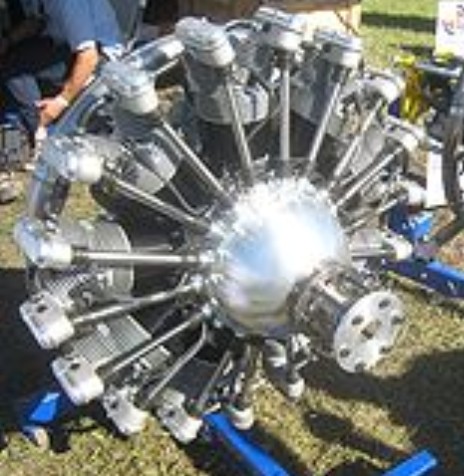
The Rotec R3600 is a nine-cylinder radial engine built by Rotec Engineering PTY LTD in Australia. Initially released in 2005, it was a followup of the 7-cylinder Rotec R2800 released five years earlier. Both this engine and its smaller cousin have been frequently used as both replacement engines for vintage World War 1 aircraft, and replica aircraft from the same vintage. Some notable aircraft this engine has been used in are the Fokker Triplane, Sopwith Camel and the Nieuport 17.
Note that these engines are not limited to only aircraft applications, JRL Cycles has converted an R3600 for use in a motorcycle.
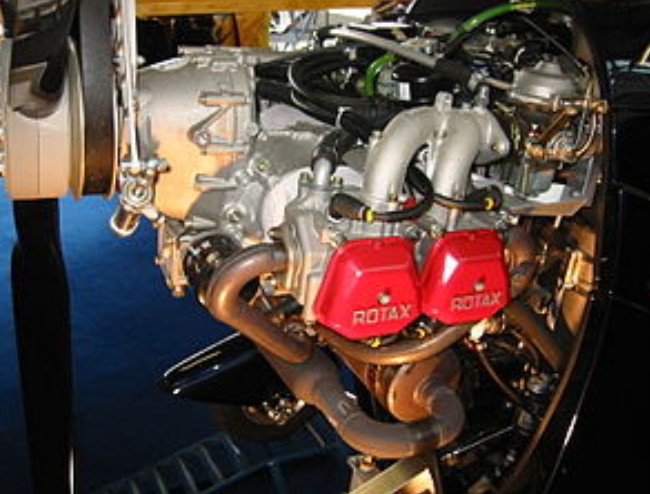
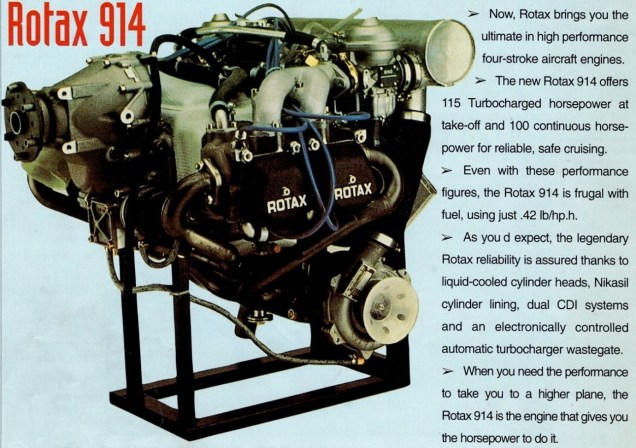
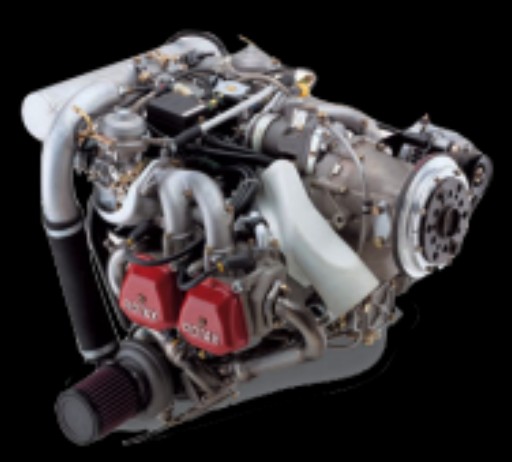
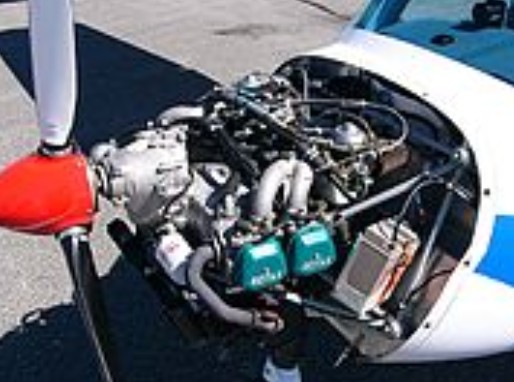
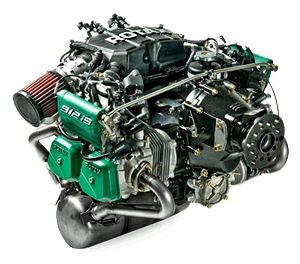
The Rotax 914 is an Austrian turbo-charged, four-cylinder, horizontally opposed aircraft engine with air-cooled cylinders and water-cooled cylinder heads. Designed and built by Rotax the engine commonly powers certified light aircraft, homebuilt aircraft, autogyros and military UAVs such as the MQ-1 Predator.
The Rotax 914 is an 80 HP engine block that Rotax has added a Garrett Turbo to and boosted it to 115 HP for 5 minutes then full time 100 HP. It has been a very popular engine for many years and is used by the US military in the Predator Drones. The 914 does provide continuous sea level performance of 100 HP to over 12,000 feet.
The Rotax 914F is certified to FAR-33 and JAR-E. For takeoff 115 hp at 2385 prop rpm is available for a 5 minute maximum, and 100 hp at 2260 prop rpm continuous.
Rotax 914F
Applications: Aero Adventure Pegasus Aerospool WT9 Dynamic Air Copter A3C Alisport Yuma Alpi Pioneer 300 Australian Aircraft Kits Hornet STOL AutoGyro MT-03 AutoGyro Calidus AutoGyro Cavalon B&F Fk14 Polaris Bauer BAD-12 Gyrotrainer Bushcaddy R-80 Bushcaddy R-120 The Butterfly Super Sky Cycle Celier Kiss Celier Xenon 2 Chayair Sycamore Criquet Storch Denel Dynamics Bateleur Diamond HK36 Super Dimona Dorna Parandeh Abi Dova DV-1 Skylark Dyn’Aéro MCR4S Dynali H2S ELA 07 Eurodisplay SR-01 Magic Europa XS FD-Composites ArrowCopter Flying Legend Hawker Hurricane Replica General Aviation Design Bureau T-32 Maverick Heli-Sport CH-7 Kompress helicopter IAI Heron Idea Hydropteron Just Superstol Magni M-14 Scout Magni M-24 Orion M&D Flugzeugbau Samburo MQ-1 Predator NAL Hansa Norman Aviation Nordic VI Norman Aviation Nordic 8 Mini Explorer Pagotto Brakogyro Phenix Aviation Phenix RMT Bateleur Roko Aero NG4 Rotor Flight Dynamics Dominator RotorSport UK Calidus RotorSport UK MT-03 Softeks V-24 Lastochka SlipStream Genesis Stemme S10 motor glider Titan T-51 Mustang Ultravia Pelican Wild DoubleEnder Wüst Seahawk
Specifications: 914 Type: four-cylinder, four-stroke liquid- / air-cooled engine with opposed cylinders Bore: 79.5 mm (3.13 in) Stroke: 61 mm (2.4 in) Displacement: 1,211.2 cc (73.91 cu in) Length: 561 mm (22.1 in) Width: 576 mm (22.7 in) Dry weight: 78 kg (170 lb) with electric starter, carburetors, fuel pump, air filters and oil system Valvetrain: OHV, hydraulic lifters, pushrods, rocker arms Fuel system: Dual CD carburetors, mechanical diaphragm pump Fuel type: Unleaded: 87 octane AKI (Canada/USA) / 90 octane RON (European) or higher Oil system: Dry sump with trochoid pump, camshaft driven Cooling system: Liquid-cooled cylinder heads, air-cooled cylinders Reduction gear: Integrated reduction gear 1:2.273; 1:2.43 optional Electronic dual ignition Power output: Maximum 84 kW (115 hp) at 5,800 rpm, with 5 minute time limit; 73 kW (100 hp) continuous
914 UL DCDI Cycle: turbo 4 stroke No cylinders: 4 Bore: 79.5 mm Stroke: 61 mm Compression: 8.75 Displacement: 1211 cc Cooling: air-liquid Ignition: Electronic Ducati Reduction: mechanical 2.27:1 torque limited Weight: 67.5 kg Max pwr: 115 hp at 5800 rpm Max torque: 123 at 4800 rpm Fuel consumption: 250 G/hp/hr Price 1998: 112 131,47 Fttc
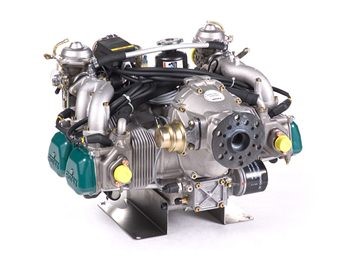
Rotax 912 Engine 80 HP (912) or 100 HP (912 UL) 4 Stroke, 4 Cylinder, horizontally opposed Water Cooled heads, air cooled barrels Dual brakeless, capacitor discharge ignition Twin Carburettors Prop drive via reduction gear Arguably the best engine available for Micro light aircraft today. Powerful and reliable, although expensive.
The Rotax 912 S is a 100 Horsepower engine. The 912 RST model uses the same 80 HP Rotax engine used in the 914. This engine has been fitted with a Mitsubishi Turbo that gives full time turbo boost. At full power this engine develops 122 Horsepower and is excellent for heavier loads or high altitudes.
912 UL 2V DCDI Cycle: 4 No cylinders: 4 Bore: 79.5 mm Stroke: 61 mm Compression: 9 Displacement: 1211 cc Cooling: liquid-air Ignition: Electronic Ducati Reduction: mechanical 2.27:1 torque limited Weight: 64.5 kg Max pwr: 80 hp at 5500 rpm Max torque: 103 at 4800 rpm Fuel consumption: 240 G/hp/hr Price 1998: 69 919,28 Fttc
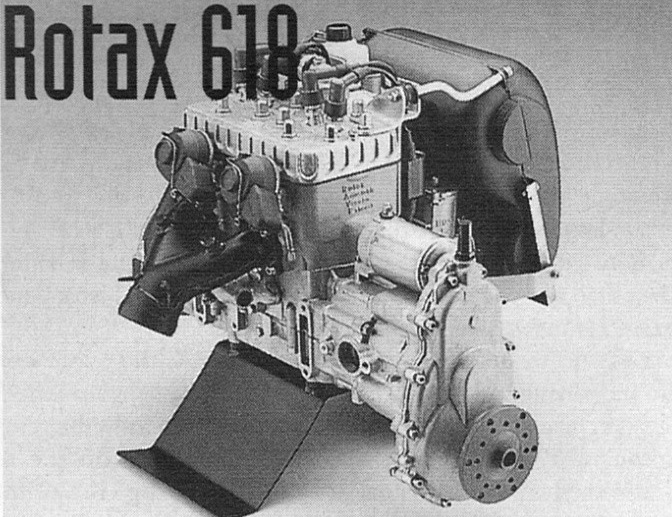
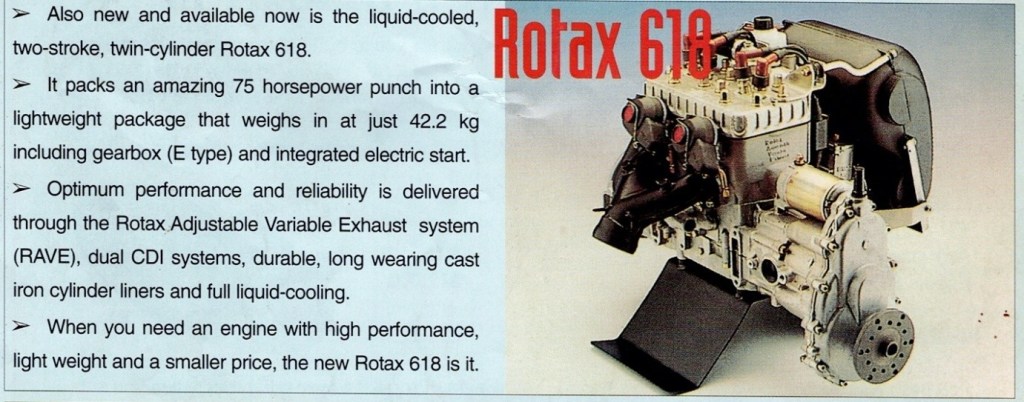
The Rotax 618 is a 73.8 hp (55 kW) two-stroke, two-cylinder, liquid cooled, gear reduction-drive engine that was formerly manufactured by BRP-Rotax GmbH & Co. KG. It was designed for use on ultralight aircraft.
The 618 features liquid-cooled cylinder heads and cylinders with a rotary valve inlet and an exhaust valve. Cooling is via one or two externally-mounted radiators. Lubrication is by use of pre-mixed fuel and oil at 50:1 or oil injection. The 618 has dual Ducati capacitor discharge ignition systems and is equipped with two piston-type carburetors. It uses a manifold-driven pneumatic fuel pump to provide fuel pressure.
The engine’s propeller drive is via a Rotax type C or E style gearbox. The standard engine includes a muffler exhaust system and an intake silencer and filter, with an after muffler also available to further reduce engine noise. The standard starter is an electric starter. An integral alternating current generator produces 12 volts and 200 watts.
The Rotax 618 is no longer in production.
Applications: Acrolite ARV Griffin Bede BD-5 Blue Yonder Merlin Earthstar Thunder Gull JT2 Early Bird Jenny Fletcher Hercules Joplin Tundra Kolb Mark III Kolb Slingshot Laron Wizard Microleve Corsario Microleve ML 450 M-Squared Breese Murphy Renegade Quicksilver GT500 Rainbow Aerotrike Sea-Bow International Sea-Bow Titan Tornado
Specifications: Rotax 618 Type: 2-cylinder, 2-stroke, rotary valve, oil-in-fuel or oil-injected lubrication, dual carburetors, dual ignition Bore: 76 mm (2.99 in) Stroke: 68 mm (2.68 in) Displacement: 617 cc (37.65 cu in) Dry weight: 59.1 kg 130.4 lb with electric starter, two carburetors, radiator, intake silencer, exhaust system and E gearbox Valvetrain: rotary inlet valve, exhaust valve Fuel type: premium unleaded: RON 90 octane or higher leaded or unleaded or AVGAS 100 LL Oil system: oil-in-fuel (pre-mix) at 50:1 Cooling system: liquid cooled Power output: 55 kW 73.4 HP SAE @ 6750 RPM Power-to-weight ratio: 0.56 hp/lb (1.07 kg/kW)
618 2V DCDI Cycle: 2 No cylinders: 2 Bore: 76 mm Stroke: 68 mm Compression: 5.75 Displacement: 618 cc Cooling: Liquid Ignition: Electronic Ducati Reduction: Gear ‘C’ or ‘E’ 2.62-4 Weight: 48.7 kg Max pwr: 74.8 hp at 6750 rpm Max torque: 80 at 6500 rpm Fuel consumption: 340 G/hp/hr Price 1998: 35 785,00 Fttc
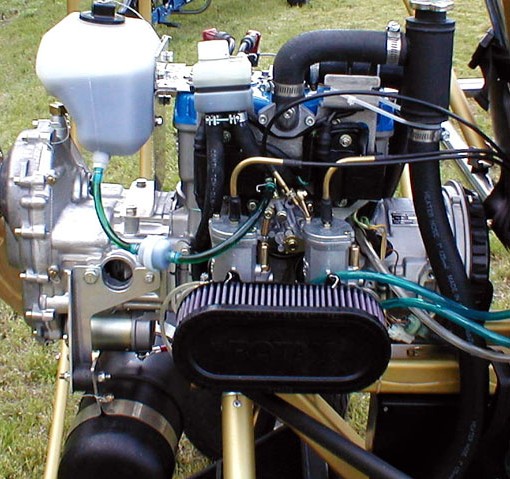
The Rotax 582 is a 48 kW (64 hp) two-stroke, two-cylinder, rotary intake valve, oil-in-fuel or oil injection pump, liquid-cooled, gear reduction-drive aircraft engine manufactured by BRP-Rotax GmbH & Co. KG. It is for use in non-certified aircraft operating in day visual flight rules.
The Rotax 582 is based upon the earlier Rotax 532 engine design and was designed for use ultralight aircraft. The 582 increased the bore from the 532 engine’s 72 to 76 mm (2.8 to 3.0 in) and increased the stroke from 61 to 64 mm (2.4 to 2.5 in). This increased the displacement from 521.2 cc (31.81 cu in) to 580.7 cc (35.44 cu in), an increase of 11%. The increased displacement had the effect of flattening out the 532’s torque curve and allowed the 582 to produce useful power over a wider rpm range. Reliability over the 532 was also improved.
Rotax 582 UL
The 582 features liquid-cooled cylinder heads and cylinders with a Rotary Intake Valve. Cooling is via an externally-mounted radiator. Lubrication is either by use of pre-mixed fuel and oil or oil injection from an externally-mounted oil tank. The 582 has dual independent breakerless, magneto capacitor discharge ignition (CDI) systems and is equipped with two piston-type carburetors. It uses a manifold-driven pneumatic fuel pump to provide fuel pressure. An optional High Altitude Compensation kit is available.
The engine’s propeller drive is via a Rotax type B, C or E style gearbox. The standard engine includes a muffler exhaust system with an extra after-muffler as optional. The standard starter is a recoil start type, with an electric starter optional. An integral alternating current generator producing 170 watts at 12 volts with external rectifier-regulator is optional. The engine includes an intake air filter and can be fitted with an intake silencer system.
Rotax 582
The manufacturer acknowledges the design limitations of this engine, warning pilots: “This engine, by its design, is subject to sudden stoppage. Engine stoppage can result in crash landings, forced landings or no power landings. Such crash landings can lead to serious bodily injury or death…This is not a certificated aircraft engine. It has not received any safety or durability testing, and conforms to no aircraft standards. It is for use in experimental, uncertificated aircraft and vehicles only in which an engine failure will not compromise safety. User assumes all risk of use, and acknowledges by his use that he knows this engine is subject to sudden stoppage…Never fly the aircraft equipped with this engine at locations, airspeeds, altitudes, or other circumstances from which a successful no-power landing cannot be made, after sudden engine stoppage. Aircraft equipped with this engine must only fly in DAYLIGHT VFR conditions.”
ROTAX 582 DCDI
Applications: Acrolite Advanced Aeromarine Buccaneer II Aero Adventure Aventura HP & Sport AeroLites AeroMaster AG AeroLites Bearcat Aeroprakt A-20 Aeros-2 Aeros Cross Country Aeros del Sur Manta Aerosette MH-46 Eclipse Aéro Services Guépard Guépe Airbet Girabet Airborne Edge Airborne Outback Airborne XT Air Command Commander Elite Air Creation GT Air Creation Racer Air Creation Skypper Air Creation Tanarg Airdrome Dream Fantasy Twin Airdrome Fokker DR-1 Airkraft Sunny Airsport Sonet Alliant Destiny Fusion Alliant Destiny XLT Anglin J6 Karatoo Antares MA-32 Antonov T-2M Maverick Apex Dolphin 3 Apollo Delta Jet Apollo Fox Apollo Jet Star Apollo Monsoon Apollo Racer GT Aquilair Kid Aquilair Swing Arnet Pereyra Sabre II ASAP Chinook Plus II ASAP RX 550 Plus Beaver ATEC 212 Solo Australian Lightwing GR 582 Aviasouz Cruise Aviasud Mistral Aviate Raptor Aviation Products Star Trike Avid Catalina Avid Flyer Avio Design Swan BAaer Guri BB Microlight BB-two seater Biplanes Of Yesteryear Mifyter Blue Yonder EZ Flyer Blue Yonder Merlin Brock KB-3 Buckeye Endeavor Buzzman L’il Buzzard Capella XS Capella T-Raptor Carlson Sparrow Celier Kiss CFM Shadow Chernov Che-25 Circa Reproductions Nieuport 12 CGS Hawk Club ULM Rotor Ptenets-2 Cosmos Phase II Cyclone AX2000 DAR 21 Vector II DAR-23 Denney Kitfox Model 2 DTA Evolution DTA Feeling Earthstar Thunder Gull JT2 Early Bird Jenny Ehroflug Coach II S Euro Fly Flash Light Eurofly Viper Excalibur Aircraft Excalibur Fantasy Air Allegro Fisher Classic Fisher Super Koala Fletcher Hercules Flightstar Flight Team Spider Fly Air Swallow Flying Machines FM301 Flylab Tucano Fly Synthesis Catalina Fly Synthesis Wallaby FMP Qualt 201 Freedom Lite SS-11 Skywatch FUL MA 30 Graffiti Gdecouv’R 582 General Aviation Design Bureau T-32 Maverick Gidroplan Che-22 Korvet Gidroplan Tsikada Golden Circle Air T-Bird Guerpont Autoplum Harmening High Flyer Heldeberg Marathon Houde Speedmax Humbert La Moto Du Ciel Hy-Tek Hurricane Hauler InterPlane Skyboy J & J Ultralights Seawing Joplin Tundra Jora Jora Junkers Profly Junkers Trike Kolb Kolbra Kolb Mark III Kolb Slingshot Kolb Tandem Kompol Jazz Krasniye Kryl’ya Deltacraft MD-50C Laron Wizard Layzell Merlin Light Miniature Aircraft LM-1 Light Miniature Aircraft LM-5 Lockwood Drifter MU582 Magni M-18 Spartan Mainair Blade Mainair Rapier Mariner Aircraft Mariner Masquito M58 Micro Aviation B22 Bantam Microleve Corsario Microleve ML 450 Microleve ML 500 Moyes Dragonfly M-Squared Breese Murphy Maverick Murphy Renegade Nickel & Foucard NF-2 Asterix Norman Aviation J6 Karatoo Norman Aviation Nordic II North American Rotorwerks Pitbull SS North Wing Apache North Wing Sport X2 Paladin Golden Eagle Para-Ski VX Para-Ski XS Peak Aerospace Me 109 Pegasus Quantum Personal Flight Sky-Tender Phantom X1 Polaris AM-FIB Polaris FIB Polaris Skin Powrachute Pegasus PowerTrike Evolution PowerTrike II Precision Tech Fergy Quad City Challenger II Quander Airpfeil Quicksilver GT500 Quicksilver Sport 2S Rainbow Aerotrike Rainbow Cheetah Raj Hamsa X-Air Ramphos Trident Rans S-6 Coyote II Rans S-7 Courier Rans S-9 Chaos Rans S-10 Sakota Rans S-11 Pursuit Rans S-12 Airaile Revolution Mini-500 helicopter Rolandas Kalinauskas RK-6 Magic Schmidtler Enduro Sea and Sky Cygnet Sea-Bow International Sea-Bow Six Chuter SR1 Six Chuter SR7 Skyfly S-34 Skystar Skyrider Sonic Skyrider Stingray SlipStream Genesis Solo Wings Aquilla Sport Copter Vortex Skywatch SS11 Spectrum Beaver RX 650 Sport Flight Talon Summit 2 Summit Steel Breeze S-Wing Swing TechProAviation Merlin 100 TeST TST-6 Duo Thruster T600 Sprint Tiger Club Development Sherwood Ranger Titan Tornado TL Ultralight TL-32 Typhoon Vol Xerpa ULM Pulsar World Seair Corp Seair Y2Fly Seahawk Zenith STOL CH 701
Specifications: Rotax 582 Type: two-cylinder, two-stroke, rotary valve, oil-in-fuel or oil-injected lubrication, dual carburetors, electronic dual ignition Bore: 76 mm (2.99 in) Stroke: 64 mm (2.52 in) Displacement: 580.7 cc (35.44 cu in) Dry weight: 50 kg 110 lb with electric starter, carburetors, fuel pump, air filters and reduction gear Fuel type: premium unleaded: RON 90 octane or higher leaded or unleaded or AVGAS 100 LL Oil system: oil-in-fuel (pre-mix) or oil injection Cooling system: liquid cooled Power output: 48 kW 64.4 HP SAE @ 6,500 RPM 1-minute Compression ratio: 11.5 (theoretical) – 5.75 effective
582 UL 2V DCDI Cycle: 2 No cylinders: 2 Bore: 76 mm Stroke: 64 mm Compression: 5.75 Displacement: 580.7 cc Cooling: Liquid Ignition: Electronic Ducati Reduction: Mechanical Gear ‘B’ ‘C’ or ‘E’ Reduction ratio: 2-4:1 Weight: 41.6 kg Max pwr: 64.8 hp at 6500 rpm Max torque: 75 at 6000 rpm Fuel consumption: 340 g/hp/hr Price 1998: 26 833,50 Fttc
The Rotax 503 is a 37 kW (50 hp), inline 2-cylinder, two-stroke aircraft engine, built by BRP-Rotax GmbH & Co. KG of Austria for use in ultralight aircraft.
The Rotax 503 features piston ported, air-cooled cylinder heads and cylinders, utilizing either a fan or free air for cooling. Lubrication is either by use of pre-mixed fuel and oil or oil injection from an externally mounted oil tank. The 503 has dual independent breakerless, magneto capacitor-discharge ignition (CDI) systems and can be equipped with either one or two piston-type carburetors. It uses a manifold-driven pneumatic fuel pump to provide fuel pressure. An optional High Altitude Compensation kit is available.
The engine’s propeller drive is via a Rotax type B, C, or E style gearbox. The standard engine includes a muffler exhaust system with an extra after-muffler as optional. The standard starter is a recoil start type, with an electric starter optional. An integral alternating current generator producing 170 watts at 12 volts with external rectifier-regulator is optional. The engine includes an intake air filter and can be fitted with an intake silencer system.
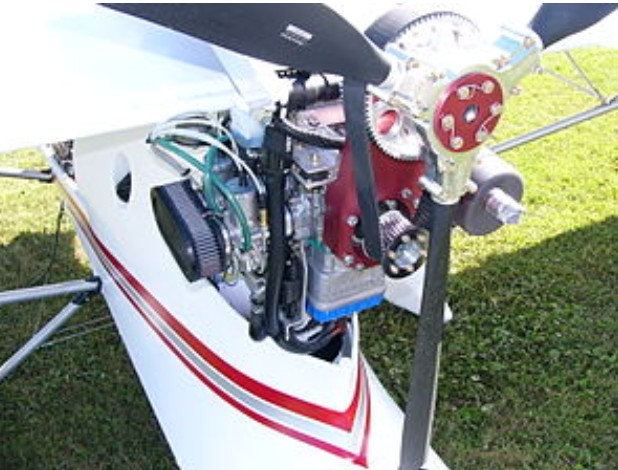
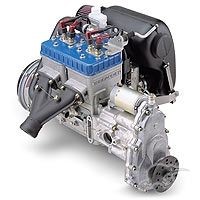
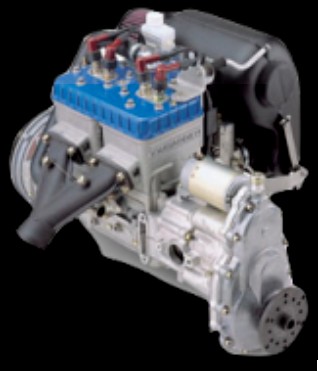
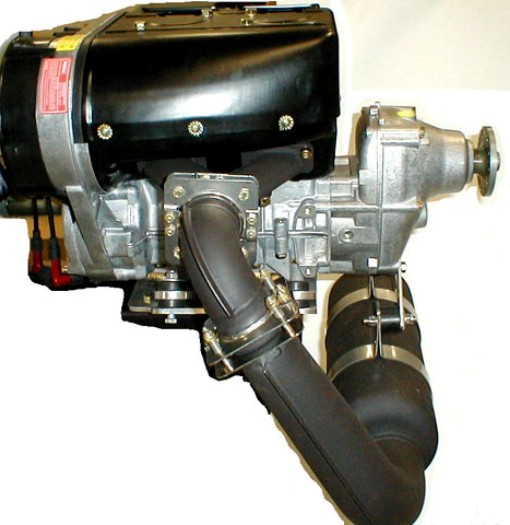
Rotax 503 DCDI
The manufacturer acknowledges the design limitations of this engine, warning pilots: “This engine, by its design, is subject to sudden stoppage. Engine stoppage can result in crash landings, forced landings or no power landings. Such crash landings can lead to serious bodily injury or death…This is not a certificated aircraft engine. It has not received any safety or durability testing, and conforms to no aircraft standards. It is for use in experimental, uncertificated aircraft and vehicles only in which an engine failure will not compromise safety. User assumes all risk of use, and acknowledges by his use that he knows this engine is subject to sudden stoppage…Never fly the aircraft equipped with this engine at locations, airspeeds, altitudes, or other circumstances from which a successful no-power landing cannot be made, after sudden engine stoppage. Aircraft equipped with this engine must only fly in DAYLIGHT VFR conditions.”
As of 2011 the Rotax 503 is no longer in production.
Applications: 21st Century Airships SPAS 13 A-B Helicopters A/W 95 Aces High Cuby II Acrolite Advanced Aeromarine Buccaneer SX Aero Adventure Aventura HP AeroLites Bearcat Aeroprakt A-20 Aeros-2 Aeros Cross Country Aero-Works Aerolite 103 Airbet Girabet Airborne Edge Airborne Redback Air Creation GT Air Creation Racer Air Creation Twin Airdrome Dream Fantasy Twin Airdrome Fokker D-VI Airdrome Fokker D-VIII Airfer Transan Alliant Destiny Fusion Alliant Destiny XLT Alpaero Choucas AmeriPlanes Mitchell Wing T-10 Anglin J6 Karatoo Antonov T-2M Maverick Antares A-10R503 SOLO Antares MA-32 Apex Eco 6 Aquilair Kid Australian Autogyro Skyhook Australian Ultralight Industries Bunyip Aviasud Mistral Avid Champion Avid Flyer BAaer Guri Bagalini Baganfibio BB Microlight BB-two seater Birdman Chinook 2S Best Off Skyranger Blue Yonder EZ Flyer Blue Yonder EZ Harvard Blue Yonder EZ King Cobra Blue Yonder Merlin Blue Yonder Twin Engine EZ Flyer Buckeye Eclipse Capella Javelin II Capella SS Carlson Sparrow Circa Reproductions Morane Saulnier N Circa Reproductions Nieuport CFM Shadow CGS Hawk Chadwick C-122 helicopter Club ULM Rotor Ptenets-2 Cosmos Bison Cosmos Echo Cosmos Phase II Cyclone AX2000 Danieli Piuma DAR-23 DTA Evolution Earthstar Thunder Gull Emerald Coast XL2 Sport Eurofly Fire Cat Eurofly Fire Fox Eurofly Fox Eurofly Viper Excalibur Aircraft Excalibur Facetmobile Fisher Avenger Fisher Super Koala Fisher FP-404 EXP Fisher FP-505 Skeeter Fisher FP-606 Sky Baby Fisher Youngster Fletcher Hercules Flightstar II Fly Air Swallow Flying K Sky Raider Flylab Tucano Fly Synthesis Wallaby Freebird II Freedom Lite SS-11 Skywatch GibboGear Butterfly Gidroplan Che-22 Korvet Golden Circle Air T-Bird Krasniye Kryl’ya Mandelevium MD-30 Krasniye Kryl’ya Deltacraft MD-40 Harmening High Flyer Harper Lil Breezy Heldeberg Convertible Heldeberg Marathon Heldeberg Spirit 103 Howland H-3 Pegasus Hy-Tek Clipwing Hy-Tek Hurricane Hauler InterPlane Skyboy ISON Airbike J & J Ultralights Seawing JDT Eros Joplin Tundra Kolb Firestar Kolb Mark III Kolb Slingshot Kubicek AV-1 Las Brisas Mohawk Let-Mont Piper UL Let-Mont Tulak Letov ST-4 Aztek Light Miniature Aircraft LM-1 Lockwood Drifter XP503 Loehle Sport Parasol Mainair Rapier Mariner Aircraft Mariner Micro Aviation Bantam Microleve ML 450 Midwest Hornet Mountaineer Trikes Solo 175 M-Squared Breese Murphy Maverick Murphy Renegade North American Rotorwerks Pitbull Ultralight North Wing Apache Pagotto Brako Pegasus Quantum Phantom X1 Phoenix Skyblazer Pipistrel Taurus Precision Tech Fergy Pterodactyl Ascender Polaris Skin Quad City Challenger II Quicksilver GT400 Quicksilver MX-2 Sprint RagWing RW26 Special II RagWing RW7 Duster RagWing RW8 PT2S RagWing RW11 Rag-A-Bond RagWing RW22 Tiger Moth Raj Hamsa Clipper Raj Hamsa Voyager Raj Hamsa X-Air Rainbow Aerotrike Rans S-4 Coyote Rans S-6 Coyote II Rans S-7 Courier Rans S-9 Chaos Rans S-12 Airaile Rans S-17 Stinger Rocky Mountain Wings Ridge Runner Rolandas Kalinauskas RK-7 Orange Rotor Flight Dynamics Dominator Skystar Kitfox XL Sabre 340 Sabre Wildcat St Andrews Viking Sapphire Aircraft Australia Sapphire LSA Sea-Bow International Sea-Bow Six Chuter SR1 Sky Seeker Powerchutes Sky Seeker SlipStream Genesis Sochen Phoenix Solo Wings Aquilla Solo Wings Windlass Sorrell Hiperlight Spartan DFD Aerotome Skywatch SS11 Spectrum Beaver Sport Copter Lightning Sport Flight Talon Stellar Astra Summit 2 Summit 103 Mini Breeze Summit Steel Breeze TC’s Trikes Coyote Teman Mono-Fly Tennessee Propellers Scout TeST TST-3 Alpin T Titan Tornado TL Ultralight TL-32 Typhoon ViS Sprint Vortech G-1 World Seair Corp Seair
Specifications: 503 Type: two-stroke air-cooled aeroengine Bore: 72 mm (2.84 in) Stroke: 61 mm (2.4 in) Displacement: 496.7 cc (30.31 cu in) Dry weight: 31.4 kg (69 lb) (dry, no exhaust system) Valvetrain: piston ports Fuel system: pneumatic pump pressurized Fuel type: regular autofuel Oil system: premixed in the fuel at 50:1 or oil injection Cooling system: fan or free air Reduction gear: Rotax ‘B’ gearbox: 2.00, 2.24 or 2.58 ratios; Rotax ‘C’ or ‘D’ gearbox: 2.62, 3.00, 3.47 or 4.00 ratios Power output: 37 kW (50 hp) at 6800 rpm Compression ratio: 10.8 (theoretical) Fuel consumption: 15 l/hr (4 US gph) Power-to-weight ratio: 1.18 kW/kg (0.72 hp/lb)
The 503 B-Box with Pull Start, DCDI, (dual carb, dual ignition) of 52 hp weighs 323 lb. Rotax 503 DCDI, B-Box w/Electric Start & Mag End: 343 lbs Rotax 503 DCDI, C-Box (dampener) w/ Pull Start: 331 lbs Rotax 503 DCDI, E-Box w/ Electric Start: 347 lbs
503 UL 2V DCDI Cycle: 2 No cylinders: 2 Bore: 72 mm Stroke: 61 mm Compression: 6.3 Displacement: 496.7 cc Cooling: Air Ignition: Electronic Ducati Reduction: Mechanical Gear ‘B’ ‘C’ or ‘E’ Reduction ratio: 2-4:1 Weight: 42.8 kg Max pwr: 49.5 hp at 6500 rpm Max torque: 55 at 6000 rpm Fuel consumption: 360 G/hp/hr Price 1998: 19 693,98 Fttc
447 UL 2V DCDI Cycle: 2 No cylinders: 2 Bore: 67.5 mm Stroke: 61 mm Compression: 6.3 Displacement: 436.5 cc Cooling: Air Ignition: Electronic Ducati Reduction: Mechanical Gear ‘B’ ‘C’ or ‘E’ Reduction ratio: 2-4:1 Weight: 38 kg Max pwr: 41.6 hp at 6500 rpm Max torque: 47 at 6000 rpm Fuel consumption: 360 g/hp/hr Price 1998: 14 378,54 Fttc
The Rotax 377 is a 35 hp (26 kW), twin-cylinder, two-stroke aircraft engine that was built by BRP-Rotax GmbH & Co. KG of Austria for use in ultralight aircraft.
The Rotax 377 features piston-ported, air-cooled cylinder heads and cylinders, utilizing either a fan or free air for cooling. Lubrication is by use of pre-mixed fuel and oil. The 377 has a single Bosch Flywheel Magneto Generator 12 volt ignition system and is equipped with a 36 mm Bing double float carburetor, with either a hand lever or cable choke.
The Rotax 185 is a 9 hp (7 kW), single cylinder, two-stroke, direct drive, industrial engine, built by Rotax of Austria for use in fire fighting water pumps that has also been adapted as an aircraft engine for use in ultralight aircraft.
The Rotax 185 was adopted as a replacement for the 5.5 hp (4 kW) Pioneer chainsaw engines used on the early Series I Ultraflight Lazairs. The 185 provides enough power to allow the Lazair to be flown on floats. Due to its design purpose as a water pump engine it proved reliable enough for use on ultralight aircraft.
In the Lazair application the 185 was used to drive two propellers stacked together in biplane configuration. This was not done for aerodynamic reasons but rather because the Lazair manufacturer had ample quantities of the nylon propellers on hand for its earlier engines and stacking them was more cost efficient than scrapping them and buying new propellers.
The Rotax 185 is no longer supported by Rotax as the rights to the design were sold to the Wildfire Group who use the engine in their Mark 3 High Pressure Centrifugal Fire Pump.
Type: two-stroke air-cooled engine Bore: 2.441 in (62 mm) Stroke: 2.4 in (61 mm) Displacement: 185 cc (28.7 cu in) Valvetrain: piston ports Fuel system: Tillotson pneumatic pump carburettor Fuel type: regular autofuel Oil system: premixed in the fuel at 40:1 Cooling system: free air Reduction gear: Custom made belt drive reduction units have been employed Power output: 9 hp (7 kW) at 5000 rpm Fuel consumption: 4 l/hr (1 US gph)



 All Aero