1997: 23115 Airport Rd, NE Bldg. B, Box 4, Aurora, OR 97002, USA.
UL builder
1997: 23115 Airport Rd, NE Bldg. B, Box 4, Aurora, OR 97002, USA.
UL builder
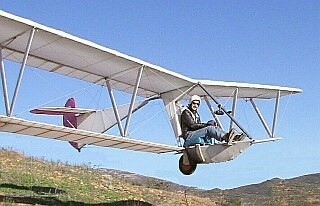
The Bug2 airchair biplane (or sesquiplane) first flew in Februauy of 1999. Bug 4 was intended to be an improved version of Bug2, and was considered superior.
The monoplane airchairs were a furthur development of the Bug4. Construction is of aluminum tubing and steel cable covered with a heat shrunk fabric.
Safety design aspects include:
Extensive frangible structure around the pilot for crash impact protection
4 point safety belts
A hand deployed emergency parachute which is intended to bring the glider and pilot down together, tail first, so that the pilot is protected by the tail and wing structure during the parachute landing

Construction of the Bug wheeled sailplane is from readily available materials without special welding, machining, or molds. The empty weight, for a not foot launchable glider, is substantially less than the ultralight regulatory weight limit; about the same weight as the pilot.

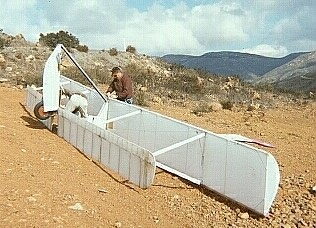
Quick assembly & roof rack transport make flying convenient. A Bug or Goat can be strapped down onto an ordinary hang glider rack, with no special saddles or pads.

Bug2 and Bug4 have demonstrated casual and comfortable airchair soaring, drogue chute landings in small fields, and novice instruction on training hills. They have been towed by trucks, winches, and ultralight airplanes. The Bugs have soared high, if not far, and have always returned for a safe landing. An airchair can be launched by ultralight aerotow, car tow, winch cable, or just by rolling down an open slope.
Accomplishments of these biplanes include:
Self launch soaring by rolling down hillsides
Self launch training by rolling down hillsides
Car top transport on non-specialized racks
The Bugs fly at about the same speeds as a hang glider, readily mixing with hang glider and paraglider traffic. No formal performance measurements have been made, but all are in the hang glider range and can stay up in good lift conditions. The Bug has soared thousands of feet above take off altitude.
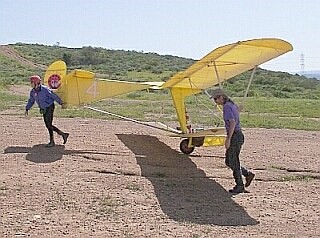
Sandlin has flown the Bug2 and Bug4 for soaring only, not aerobatics. He considers the structural redline (maximum safe airspeed) for flying to be 45 mph.
Bug2 and Bug4 performance has not been measured but seems to be about the same as a single surface hang glider. As of April 2010 only a single Bug4 is known to be currently flying .
Posting of the complete technical drawings of an aircraft on the Internet, freely available in the public domain for downloading and study.
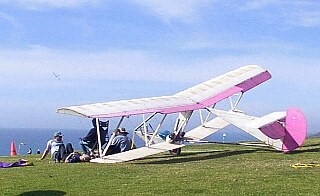
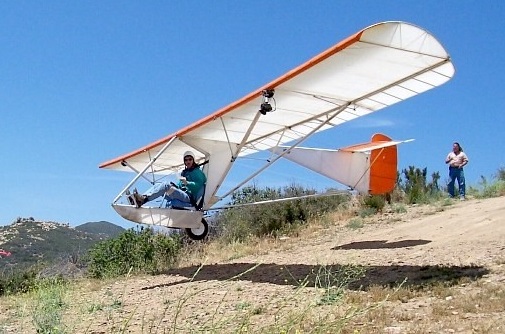
The Goat monoplane glider has been soaring in one version or another since the spring of 2003. The Goat is technically an ultralight sailplane (under United States weight rules) with conventional three axis controls, similar to the Bug4 and the commercial Super Floater. It is designed for slow speed recreational gliding and training. This glider ia an all purpose airchair, allowing comfortable open air soaring, good crash safety, quick assembly, and convenient car top transport.
The idea of an “airchair” is that it flies like a hang glider or paraglider but with improved stability, control, comfort, and crash safety. The glider can be kept at home and transported to the flying site on a simple car top rack. It can be assembled by one person in about 20 minutes. With a wing loading about the same as a hang glider, it flies and soars like a hang glider, making it compatible with many existing hang glider operations, using rolling launches, ground tows, or ultralight aerotows.
The varioius Goats feature:
Five or six major separable parts, the heaviest being the the wing panel at 35 to 42 lbs.
Emergency parachute, hang glider type, hand deployed 22 gore round canopy PDA, with bridle & swivel
16″ or 14″ diameter wheelbarrow or ultrlight aircraft wheel, tube tire
nose skid for braking (no wheel brake), tail skid at rear (or wheel)
drogue chute, hang glider type, 5 ft. diam. (flat octagonal) canopy, attached to main struts or flying cables, 27″ outboard from centerline on left side
tow hookup with weak link loop, to break at about 110% gross weight
Altimeter/variometer mounts on nose tube or strut, hang glider type
Quick assembly pins, handles & tapered ends for “drift pin” assembly, all fasteners attached to airframe
Flap panels in fixed position, or fixed trailing edge.
Four point seat belt
Conventional stick and rudder controls
There are no formal values established for performance, pilot weight, or maximum speeds or loads, because no rigorous tests have been performed to measure these values.
The Goat does not foot launch, but is either towed into the air or else launched by rolling down a hillside. Rolling launches are usually made at a site shared with hang gliders and paragliders. This glider flys very much like a hang glider and readily adapting to hang glider techniques and procedures. The Goat1 has made a cross country flight of more than sixty miles, reaching an altitude above 13,000 feet.
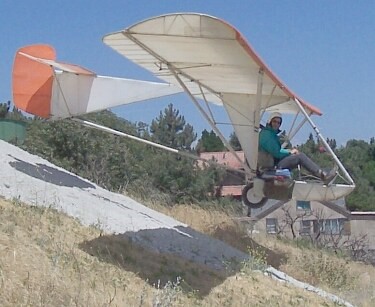
The Goat1 made it’s first flight on February 1, 2003, and since then has been flying as a weekend soaring glider. It has proven to be a pleasant and practical glider for slope launching and local flying. It is easy to tow behind an ultralight airplane. The struts fold onto the wing for transport. As of December, 2009, Goat1 had new fabric and removable, folding main struts,and is now called the Red Goat.

The biggest drawback to the Goat1 design was the large size and heavy weight of the main wing panel with regard to loading or unloading it onto a car top rack. The folded wing half weighs 42 pounds. The primary reason for the Goat2 design was to have a lighter wing panel to reduce the burden of assembly and loading.
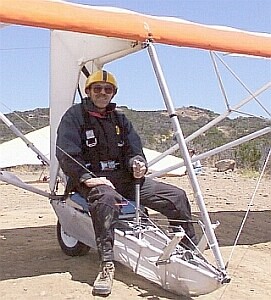
Goat2 is a simpler, lighter version of Goat1 with almost exactly the same significant dimensions. In contrast to Goat1, the wing and tail boom are cable braced (no struts) and a 14″ diameter ground roll tire is used instead of a 16″ tire. The elevator control lines now run directly to the elevator control arms without any push rod mechanisms, and the removal of the tail plane for storage and transport has been simplified.
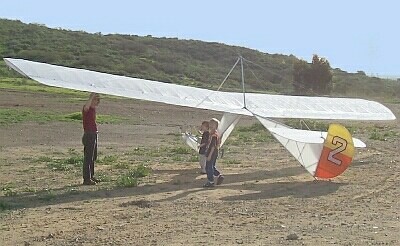
Goat3 has a smaller wing than the other Goats, with a fancier, sailplane style airfoil. The struts are removed for transport, and the wing does not have folding panels on the trailing edge. The seat back and shoulder belts are fixed in place on the nose section and do not require attention during assembly.
The reduced wing area of Goat3 forces flying faster, and the new airfoil doesn’t seem to be producing any dramatic performance improvement. As it stands, it looks as if the larger wing with the simpler airfoil (as used by Goat1 & Goat2) may be a suiperior combination for an airchair. Goat3 probably won’t stay up in light conditions as well as the others.
Goat2 was light and eliminated the bulky struts, but all those long cables created their own transport and assembly problems. This led eventually to the creation of Goat4, which retained the cable braced wing but simplified a lot of the assembly mechanics.
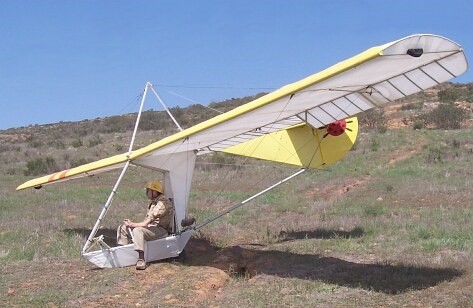
Goat4 is essentially a Goat2 wing with Goat3 nose and tail.
The gliders fly at about the same speeds as a hang glider, readily mixing with hang glider and paraglider traffic. No formal performance measurements have been made, but all are in the hang glider range and can stay up in good lift conditions. The Goats 1-4 have soared thousands of feet above take off altitude.
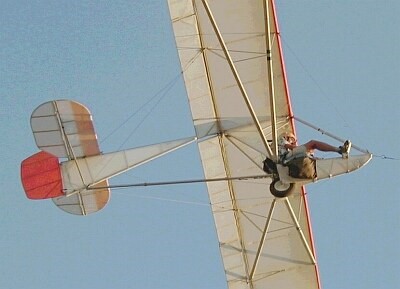
Slow flight provides the unique ability to self launch by rolling down open slopes, usually at the same mountain launch sites used by hang gliders and paragliders. This rolling launch has become a standard procedure for local weekend soaring. A launch slope of a vertical drop of about 17 feet over a rolling distance of 72 feet (so, the rolling distance is two wing spans for the Goat) is suitable.
Quick assembly & roof rack transport make flying convenient. A Goat can be strapped down onto an ordinary hang glider rack, with no special saddles or pads.
A Basic Ultralight Glider is not a hang glider (it cannot be foot launched) nor is it what is usually meant by an ultralight airplane (it has no engine). Its construction is “low tech”, at the hand drill and hacksaw level, for easy home building, from readily available materials (it is made mostly from aluminum tubing and steel cable with polyester fabric covering).
This is a home built glider, made with a low level of technology (no welding, no special machining, no molds or jigs, no spray rig) from readily available materials (mostly aluminum tubing, steel cable, aircraft bolts and heat shrink fabric). The Goat is a noncommercial project, with no product or plans for sale, but complete descriptive drawings of the Goat1 through Goat4 are on the Web. These drawings are freely available for whatever purpose the user may desire.
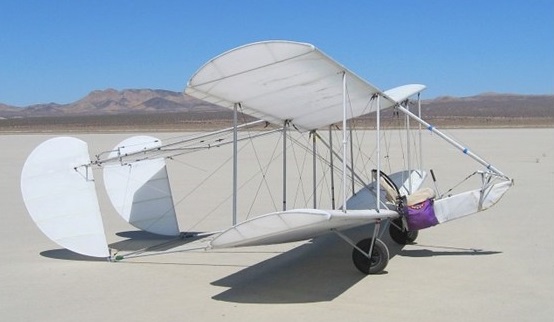
The Pig (Primary Instruction Glider) is an airchair, ultralight biplane sailplane with a two axis control system (rudders & elevator, but no ailerons). A center stick & rudder pedals provide a traditional control system.
The Basic Ultralight Gliders are best characterized by their light wing loading, which is about the same as that of a hang glider (around 1.7 lb. of gross weight for every square foot of wing area). Light wing loading results in slow flight, which is safe, comfortable, and allows soaring in small thermals (because of the ability to turn tightly).
The Pig features:
low wing loading for forgiving flight characteristics and rolling launches (1.5 lb/sqft.)
open air pilot seating (allows hand thrown emergency parachute)
center of lift landing gear (allows simple balance check for proper center of mass)
car top transport (major sections separate, wings and tail fold up)
one person assembly (37 minute setup for me in my backyard)
light weight airframe (about 148 lbs. with parachute)
nose skid for quick stops, nose down or tail down attitude for take off or landing
The Pig features simple construction from readily available materials, no molds, no welding, no special machining, no spray rig, no sail making, no sheet metal, etc. The airframe is made of bolted aluminum tubing with braided steel cables, covered with a light grade of conventional aircraft fabric (polyester fabric is cemented on, heat shrunk, then adhesive sealant is applied by brush).
All secondary structures (small ribs) are composites of foam, carbon rod, & fiberglass tape.

Low time pilots should use a glider that is easy to fly, forgiving, and robust, and which has good crash protection for the pilot. Controls and airframe must look and feel good, to engender the confidence that will reduce pilot stress and allow effective learning. The mechanics of launching and landing should be simple and non-athletic. Things should be happening slowly so the student has time to see mistakes and react to them. The Pig is a version of this slow/simple/safe aircraft.
The Pig has two wheels (40 cm. diam. standard kite buggy type), 8 feet apart, rudder turn control, no ailerons (stick moves fore and aft only). 6 degree wing dihedral angle for yaw/roll coupling, and Box kite structure for torsional rigidity.
The wing airfoil is a simple utility type that Sandlin made up (Pigfoil 3012, 12% thick at 30% chord) with a completely flat bottom. This airfoil is similar to that of some radio controlled trainer gliders, and much like a Piper Cub. This is for good low speed flying characteristics and easy construction. This airfoil can also provide a strong and stiff trailing edge which will tolerate rough assembly on irregular terrain (the wing section is assembled with the trailing edge on the ground).
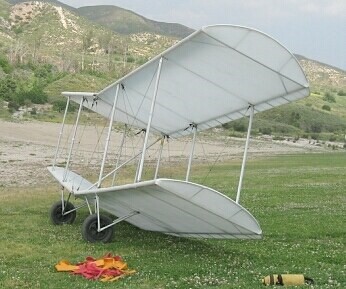
Folding wing design provides a large area wing in a small, light package, allowing transport & assembly by one person.

The eight main wing struts are mounted on swiveling eye bolts, so that during disassembly the struts can be detached at one end and rotated ninety degrees on the other. This allows each upper wing half to be lowered onto the lower wing half, making a compact stack for car top transport. A Pig can be strapped down onto an ordinary hang glider rack, with no special saddles or pads.

Room has been allowed behind the the pilot for installation of a small motor and pusher propeller at about the trailing edge of the wings. The engine frame might replace the two centerline struts, and there are other hard points nearby if required. The prop wash can exit through the box tail without hitting any control surface, avoiding a common source of vibration and drag. Adding a motor to the Pig would create a “motor floater”, a self launching airchair which could play the game of minimal power flight to the nearest thermal.
The two axis control system has proven to be adequate, simple to use, and fun for recreational flying. Launches have been made by line towing and by rolling off open hillsides.
The release handle fot the tow hook is in the middle of the nose tube.
Flying the Pig is simple, a two axis system like a hang glider, “fast-slow, right-left”, not requiring any coordination between the yaw and roll axes as does the three axis system. There is no yaw string, and the general instruction is: “nose level, turn with your feet”.
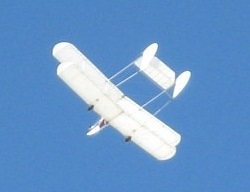
The initial use of the rudder induces a skid, quickly followed by banking of the wing. Generally, the control feel is quick and stable, and the controls function just as well as on any of the three axis airchairs. There are special two axis procedures, such as keeping the nose low while ground rolling in a cross wind, so the weight of the glider on the wheels will keep the wings level.
Its first high flight was made in September, 2008.
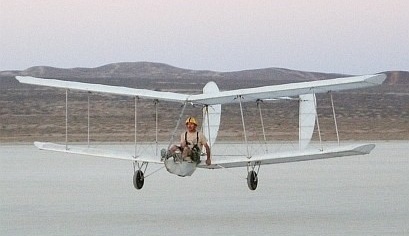
Nothing is for sale and there are no commercial intentions. The Pig1 technical drawings are available for on line viewing or download, Basic Ultralight Glider homepage, “Pig Drawings”. There are 81 drawings available in three different file formats.
Wingspan: 26 ft
Empty weight, with parachute: 147.5 lb
Gross weight: 308 lb
Wing area: 194 sq.ft
Wing loading: 1.6 lb/sq.ft


Mike Sandlin designed and built what he calls “airchair” basic ultralight gliders. The Pig1, Goats1 & 4, and Bug4, are home built, basic ultralight gliders. Technically these aircraft are ultralight sailplanes, but they are best described as “airchairs”, which are simple, slow flying gliders with the pilot sitting out in the open air rather than inside a fuselage.
The airchair dersigns are intended to provide open air soaring, forgiving flight characteristics, convenient transport, simple “garage technology” construction, and a high level of crash safety. In the United States, all unpowered ultralights, including paragliders, hang gliders, and airchairs are regulated under FAR Part 103, which allows gliders to be built and flown with no direct official oversight as long as they weigh less than 155 lbs.
The complete descriptive drawings of the Pig1, Goat4, Bug4, and some of their predecessors are free and available for downloading in CAD format. In addition, the the Goat4 drawings can be viewed on his Web. His activities are noncommercial and all of the materials on his website are available for whatever purposes the user may consider worthwhile.
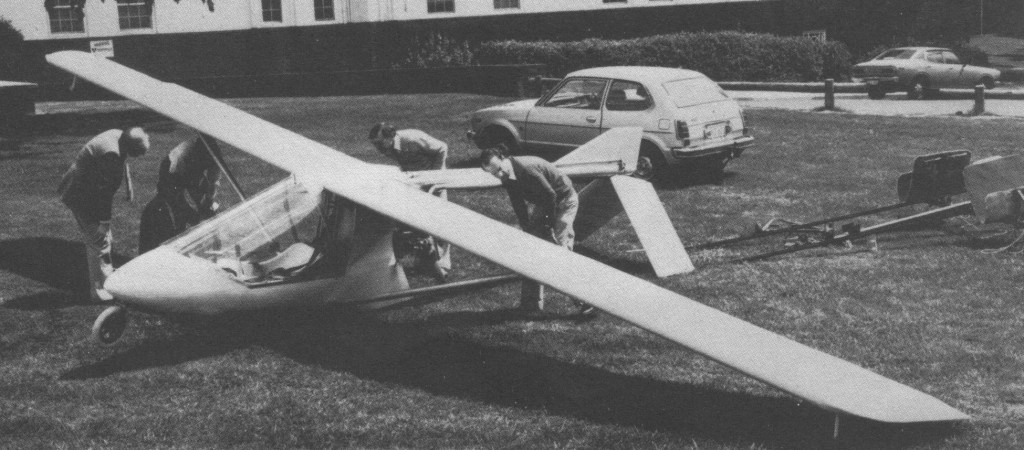
An Australian ultralight circra 1983.

Stall: 31 kt / 36 mph / 58 kmh
Cruise: 95 kt / 109 mph / 176 kmh
VNE: 108 kt / 124 mph / 200 kmh
Empty Weight: 270 kg / 595 lbs
MTOW Weight: 530 kg / 1168 lbs
Climb Ratio: 900 ft/min / 5 m/s
Take-off distance (50ft obstacle): 660 ft / 200 m
Landing distance (50ft obstacle): 660 ft / 200 m
S.A.I. Societe aeronautica Italiana s.r.l. (Italian aeronautical society Ltd)
Built the G-97 Spotter LSA
American Microlight Inc
Sadler Aircraft Company
Sadler Aircraft Corporation
Sadler Radial Engines P. O. Box 953 Coupeville WA
USA
1982: American Microflight Inc, 8225 East Montehello, Scottsdale, Arizona 85253, USA.
1984: American Microflight Inc, 7654 E.Acoma Dr, Dept G10, Scottsdale, AZ 85260, USA.
Sadler Aircraft Corp was previously known as American Microlight Inc. and Sadler Aircraft Company, developed A-22 Piranha lightly armed surveillance version of its microlight, also being developed by TUSAS in Turkey as Bat.
Sadler Aircraft
1793 NE Rocky Drive
Roseburg OR
97470
2009 Price: 85000 EURO
Stall: 34 kt / 39 mph / 63 kmh
Cruise: 100 kt / 115 mph / 185 kmh
VNE: 157 kt / 180 mph / 290 kmh
Empty Weight: 290 kg / 639 lbs
MTOW Weight: 450 kg / 992 lbs
Climb Ratio: 1100 ft/min / 6 m/s
Take-off distance (50ft obstacle): 720 ft / 220 m
Landing distance (50ft obstacle): 720 ft / 220 m
 All Aero