Schubert Der Fledermaus

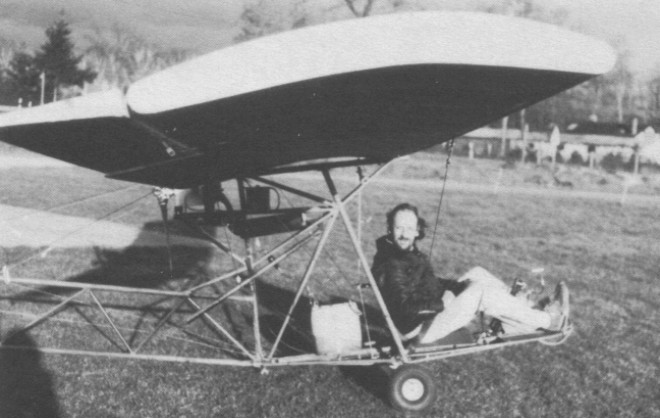
Der Fledermaus is a one-of-a-kind homebuilt designed and built by E. Alvin Schubert with specific parameters: ease of entry good visibility stability in flight, economy of building and operation, single-place only able to use a VW engine. He picked up a used 25-hp VW in 1960 and rebuilt it to deliver 36-hp with 88-mm cylinders and heads. All goals were achieved. Built circa 1975, it was registered N7873.

Gross weight 745 lbs
Empty weight 441 lb
Fuel capacity 7 Usgal
Wingspan 21 ft
Length 16 ft
Engine 25-hp VW uprated to 36 hp with 88mm cylinders
Vmax 120 mph
Cruise speed 90 mph IAS
Climb rate 600-800 fpm
Ceiling 10,000 ft
Takeoff run 600 ft
Landing roll 800 ft

Schwerdtfeger & Zimmermann Air Swing

Single seat single engined high wing mono¬plane with conventional three axis control. Wing has unswept leading and trailing edges, and constant chord; cruciform tail. Pitch control by elevator on tail; yaw control by fully flying rudder; roll control by ailerons; control inputs through stick for pitch/roll and pedals for yaw. Wing braced from above by kingpost and cables, from below by cables; wing profile double surface. Undercarriage has three wheels in tricycle formation with tailskid; suspension on all wheels. Push right go left nosewheel steering connected to yaw control. Brakes on main wheels. Aluminium¬-tube/steel tube framework, without pod. En¬gine mounted below wing driving pusher propeller.

Publicly shown for the first time at Aero 83 exhibition at Friedrichshafen, the Air Swing first flew in April 1983. Two prototypes were built, powered by a Lloyd 22 hp engine.

The Air Swing uses a double triangular frame whose front tube is extended above the wing where it is supported with a second strut, the two acting as a kingpost and forming an inverse V above the wing. The aircraft has an additional peculiarity in that it uses the large diameter boom which carries the empennage as the axis of rotation for its three bladed propeller.

Engine: Lloyd LS400, 22 hp at 5500 rpm
Propeller diameter 50 inch, 1.28 m
Toothed belt reduction, ratio 2.0/1
Max static thrust 177 lb, 80kg
Power per unit area 0.17hp/sq.ft, 1.8 hp/sq.m
Length overall 18.0 ft, 5.50 m
Height overall 7.2ft, 2.20m
Wing span 33.5ft, 10.20m
Constant chord 3.9 ft, 1.20 m
Sweepback 0 deg
Tailplane span 9.0ft, 2.75 m
Total wing area 132 sq.ft, 12.2 sq.m
Wing aspect ratio 8.5/1
Wheel track 5.2 ft, 1.60 m
Fuel capacity 5.3 US gal, 4.4 Imp gal, 20.0 litre
Empty weight 221 lb, 100 kg
Max take off weight 508 lb, 230kg
Payload 287 lb, 130kg
Max wing loading 3.85 lb/sq.ft, 18.8 kg/sq.m
Max power loading 23.1 lb/hp, 10.5kg/hp
Load factors; +6.0, 3.0 ultimate
Never exceed speed 71mph, 115kph
Economic cruising speed 50mph, 80kph
Stalling speed 29mph, 47 kph
Max climb rate at sea level 240 ft/min, 1.2 m/s

Schempp-Hirth / Göppingen

Sportflugzeugbau Göppingen (Sport Aircraft Göppingen)
Sportflugzeugbau Schempp-Hirth
Schempp-Hirth Flugzeugbau Gmbh

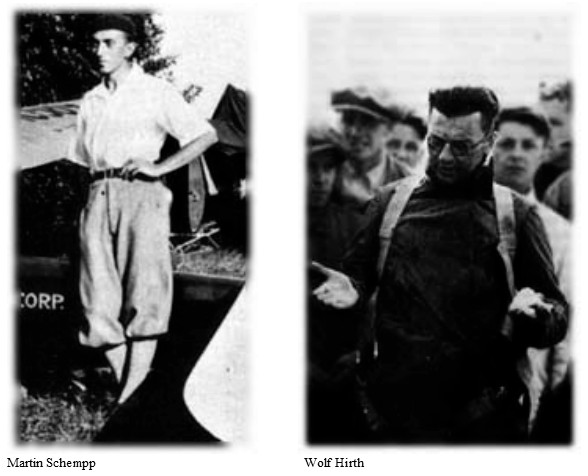
Martin Schempp and Wolf Hirth first met in 1928 and beginning in 1935, the team developed the Minimoa, the first high performance glider to sell more than 100 models. The production of Schempp-Hirth gliders began in the municipal building yard in Göppingen, near Stuttgart, where Martin Schempp founded the Sportflugzeugbau Göppingen (Sport Aircraft Göppingen) company in 1935.

In 1938 the company moved to Kirchheim/Teck and employed more than 300 people during the war time.

The first serial gliders were the aerobatic single seat trainer GÖ-1 ‘Wolf’ from Wolf Hirth and the renown GÖ-3 ‘Minimoa’ as well as the two seat GÖ-4 from Wolfgang Hütter. Occasionally there are single examples which are preserved and maintained as oldtimers which can still be found at airshows.

During the war, the production was forcefully expanded to build parts for, amongst other things, the ME-109, the “Giant” and for the Bachem “Natter”. Alongside the GÖ-4 there were also complete aircraft which were built, like the GÖ-8 and the 13,6m-“Habicht”.

The period after the war till 1955 was bridged with the production of plywood suitcases, leg prosthesis, furniture, weaving looms etc, yet also with fighter jet dummies (F-86) and sound studios for television stations.

The connection to the aviation industry was implemented early on with the production of the Matteson M-1 glider, the production of the powered aircraft GS-6a “Milan” and with works on engine pod and tail section of the “Trumpf” airship D-LEDA.

Licenced production such as “Emeraude” and “Smaragd”, subcontracting for “Kl-107” “, “Do-27”, “Do-28” and subsequently the production of the Standard Austria glider in several versions, ensured the employment of the about 50 employees till 1965.

In 1960s company renamed and built the Milan 656 light tourer, also French Piel Emeraude under licence. During early 1960s production of powered aircraft ceased, licence rights for Emeraude being transferred to Binder Aviatik KG.

Regaining a foothold in the world market was achieved with an own design, the SHK, by Rolf Kunz which was flown into third place in its first attempt at the 1965 World Championships in South Cerny/England.

After that the technology revolution from wood to fiberglass was completed in quick steps – at Schempp-Hirth under the directorship of Klaus Holighaus, who, with the maiden flight of his Cirrus in January 1967, was able to celebrate a successful debut.

Two years later, again in January, he already flew his first “Super Orchid”, the Nimbus-1. With this glider George Moffat won the 1970 World Championships in Marfa/Texas, USA.

With more than 700 produced examples, (of which 200 were produced by Grob), the Standard Cirrus was Schempp-Hirth’s second most successful aircraft in produced units. Further successes followed in 1972 and 1974 when Göran Ax in Yugoslavia and George Moffat in Australia became World Champions in the Open Class flying the Nimbus-2 (the production version of the Nimbus-1).

1974 also marked the maiden flight of the Janus, being the worlds first two seat glider in fiberglass construction. Constantly refined (e.g. 20 m CFK wings) it was only retired from production in 1996 after over 20 years. The last variants were the janus-Ce and janus-CT.

Also in 1974, there was the maiden flight of the single seat motorglider Nimbus-2M. Not only were the first experiences with retractable engines achieved, but also numerous world records were set, from the limited series production.

For the FAI introduced “15 m Racing Class”, Schempp-Hirth delivered the Mini-Nimbus, which came on to the market in many versions and was superseded in 1980 by the Ventus.

A new material had found its way, however, into the Kirchheimer production halls: the carbon fiber. What was included into the Nimbus-2C in a rather inconspicuous manner, proved itself to be the start of, at that time not appreciative of how large, an effective future in the production of high performance gliders. The thin wing profiles of the succeeding developments would not have been possible without the higher strength and stiffness of the carbon fiber.

The lengthening of the lifespan for fiberglass constructed gliders from 3000 to 6000 hours was for example, proven with a Nimbus-2 inner wing.

Serial introduction of carbon fiber was first included on the Nimbus-2C, Mini-Nimbus-C, Janus-C and Janus-CM. the optimal qualities of this new material were only utilized fully later on in the Ventus and Nimbus-3, in the production of the long and thin wings of these models.

Just a few months after its maiden flight, the Nimbus-3 won the 1981 World Championships in Paderborn.

Then the Ventus and Nimbus-3 won the 1983 World Championships in Hobbs/USA and subsequently the Nimbus-3 was also at the front in Rieti in 1985. Together with this, a string of national championships titles for both models and a number of world records for the Nimbus-3 were achieved.

Whilst the production of the single seat Nimbus-3 had to be discontinued after a fire in one of the production halls, this enabled the production of the Racing Class glider Ventus to be increased, allowing the increase in demand for its motorized variant Ventus-bT to be satisfied.

Constant refinement was also the key for the success of the Racing Class glider Ventus which debuted in spring 1986 as the model Ventus-c (on request with wing tip extensions for 17,6 m wingspan). Production of this model was ceased in 1994 after over 600 examples were produced (including self launchers and turbos).

January 1998 saw the delivery of the 4000th built Schempp-Hirth aircraft since the start of the company (including aircraft built under licence).

Today thousands of their gliders are flying around the world. Schempp-Hirth sailplanes include the Ventus A, an advanced 15-meter-class plane with carbon-fiber technology, thin wings, and a low-profile fuselage. The Ventus B is a 15-meter-class craft with a larger cockpit for tall pilots. The Nimbus 2C (open class) has a 20.3- meter wingspan with either carbon or carbon/fiberglass construction. The Janus B has an 18.2-meter wingspan for high-performance tandem two-place flying. The Janus C has a 20-meter span with carbon wings, seating for two, and competition-type performance. The Janus CM, with a 20-meter span, is a two-place motorglider with carbon wings and fully retractable engine. Schempp-Hirth’s newest sailplanes include the Discus, Duo Discus, Ventus and Nimbus, available in a variety of variations, including pure gliders and powered sailplanes.

January 1998 saw the delivery of the 4000th built Schempp-Hirth aircraft since the start of the company (including aircraft built under licence).

2014: Schempp-Hirth Flugzeugbau GmbH
Type Certificate: EASA.A.532

Scheibe Uli II

Tandem two seat single engined high wing mono¬plane with conventional three axis control. Wing has unswept leading and trailing edges and constant chord; conventional tail. Pitch control by fully flying tail; yaw control by fully flying rudder; roll control by half span ailer¬ons; control inputs through stick for pitch/roll and pedals for yaw. Wing braced from above by kingpost and cables; wing profile double surface. Steel tube framework, with optional pod. Engine mounted below wing driving pusher propeller. Wings use two aluminium tubes as spars, with ribs in foam, capped top and bottom with wood; all flying surfaces covered in Ceconite.

This tandem two seater version of the Uli made its first flights in February 1983 and by 1983 two prototypes had been built, which were undergoing certification. The aircraft is fitted with the four cylinder Konig 570cc engine and uses either a two blade or a three blade design of 51 inch (1.30 m) dia¬meter.

Length overall 18.1ft, 5.52m
Wing span 35.4 ft, 10.80 m
Constant chord 4.4 ft, 1.33 m
Sweepback 0 deg
Tailplane span 7.2 ft, 2.20 m
Total wing area 161 sq.ft, 15.0 sq.m
Wing aspect ratio 7.8/1
Wheel track 4.6 ft, 1.40 m
Engine: Konig SD570, 28 hp at 4200 rpm
Propeller diameter 58 inch, 1.47 m. 2-blade
Belt reduction, ratio 1.8/1
Max static thrust 177 lb, 80 kg
Power per unit area 0. 17 hp/sq.ft, 1.9hp/sq.m
Fuel capacity 5.3 US gal, 4.4 Imp gal, 20.0 litre
Empty weight 221 lb, 100kg
Max take off weight 618 lb, 280kg
Payload 397 lb, 180kg
Max wing loading 3.81 lb/sq.ft, 18.7 kg/sq.m
Max power loading 22.1 lb/hp, 10.0kg/hp
Load factors; +6.0, 3.0 ultimate
Economic cruising speed 37 mph, 60 kph
Stalling speed 28 mph, 45 kph
Best glide ratio with power off: 9/1
Take off distance 260 ft, 80 m

Scheibe Uli I

Single seat single engined high wing mono¬plane with conventional three axis control. Wing has unswept leading and trailing edges and constant chord; conventional tail. Pitch control by fully flying tail; yaw control by fully flying rudder; roll control by half span ailer¬ons; control inputs through stick for pitch/roll and pedals for yaw. Wing braced from above by kingpost and cables; wing profile double surface. Undercarriage has two wheels side by side with tailskid (three wheels in tricycle formation optional); glass fibre tails¬kid and glass fibre suspension on main wheels. No brakes. Steel tube framework, with optional pod. Engine mounted below wing driving pusher propeller. Wings use two aluminium tubes as spars, with ribs in foam, capped top and bottom with wood; all flying surfaces covered in Ceconite.

The prototype of the single seater Uli microlight flew for the first time at the end of 1982 and was shown at Aero 83 Salon at Friedrichshafen. At Aero 83 the Uli I was given a pod, as an option, and a tailwheel had replaced the tailskid. This machine uses welded steel tubes for the framework.

Length overall 18.0ft, 5.50m
Wing span 31.8 ft, 9.70 m
Constant chord 4.4 ft, 1.33 m
Sweepback 0 deg
Tailplane span 7.2 ft, 2.20 m
Total wing area 140 sq.ft, 13.0 sq.m
Wing aspect ratio 7.2/1
Wheel track 4.6 ft, 1.40 m
Engine: Hirth 383cc, 22 hp at 4000 rpm
Propeller diameter 51 inch, 1.30 m
Belt reduction, ratio 1.88/1
Power per unit area 0.16 hp/sq.ft, 1.7 hp/sq.m
Fuel capacity 5.3 US gal, 4.4 Imp gal, 20.0 litre
Empty weight 221 lb, 100kg
Max take off weight 442 lb, 200kg
Payload 221 lb, 100 kg
Max wing loading 3.25 lb/sq.ft, 15.9 kg/sq.m
Max power loading 20.1 lb/hp, 9.1kg/hp
Load factors; +6.0, 3.0 ultimate
Max level speed 50mph, 80kph
Never exceed speed 56mph, 90kph
Max cruising speed 37mph, 70kph
Economic cruising speed 30mph, 48kph
Stalling speed 27 mph, 43 kph
Max climb rate at sea level 400 ft/min, 2.0 m/s
Min sink rate 310 ft/min at 35 mph, 1.6 m/s at 56 kph
Best glide ratio with power off 9/1
Take-off distance 150ft, 45m
Landing dis¬tance 100 ft, 30 m
Range at average cruising speed 112 mile, 180km

Scheibe SF-40

A side by side two seater with a spaceframe fuselage, the wings are constructed in wood.

The SF-40 two-seat lightplane (first flown 1994), the originally offered in A and B versions with tailwheel undercarriages, but the later version was the SF-40-C with a nosewheel undercarriage.

Engine: Sauer, 60 hp
Wing span: 10.8 m
Wing area: 13.4 sq.m
MAUW: 450 kg
Empty weight: 220 kg
Fuel capacity: 40 lt
Max speed: 170 kph
Cruise speed: 150 kph
Minimum speed: 55 kph
Climb rate: 3 m/s
Certification: VZ
Seats: 2
Fuel consumption: 13 lt/hr

Scheibe

Scheibe-Flugzeugbau GmbH

Egon Scheibe was a young German aircraft engineer, who designed and built some of the most successful gliders before WW2. After the war, he founded Scheibe Flugzeugbau and built a large number of successful gliders, most notably the Bergfalke tandem 2-seater.

Formed at Dachau, near Munich, in 1951 by Egon Scheibe, who at first built gliders designed by Scheibe in Austria. This company had some success with the Mü 13E Bergfalke 1 and then produced a number of conventional gliders. His Sperling two-seat light high-wing monoplane first flew August 1955, and was developed with new wing and tail as SF-23A and built in numbers until 1963. SF-24A Motorspatz built from 1959. SF-25 Motorfalke licencebuilt from 1970 by Slingsby Sailplanes Ltd in UK as Type 61 Falke. SF-28A Tandem-Falke tandem two-seat motorglider no longer offered. Available were the SF-25C Falke 2000 and Rotax-Falke two-seat motorgliders, and the SF-40 two-seat lightplane (first flown 1994), the latter originally offered in A and B versions with tailwheel undercarriages, but the latest version was the SF-40-C with a nosewheel undercarriage. SF-34B Delphin was produced in France as the S.N. Centrair Alliance 34 two-seat glider, while the SF-36 R two-seat motorglider was also expected to go into production in France.

The firm had produced more than 2300 machines by 1983 plus numerous kits for homebuilders.

1983-98: Scheibe Flugzeugbau GmbH, August Pfaltz-Strasse 23, Postfach 1829, D 8060 Dachau bei Mfinchen, West Germany.

Scheibe Flugzeugbau GMBH eventually closed its doors in 2006, partly because of the lack of a successor for Egon Scheibe, but probably also due to the increasingly difficult trading conditions after the boom of Ultralight/Microlight aircraft that have taken over a large portion of the market for fun, relatively cheap, and easy to fly recreational aircraft. The Motorfalke design was subsequently taken over by the newly formed Scheibe Aircraft GMBH based in Heubach (Germany), which has certified the Turbo-Rotax powered version with the glider towing market in mind.