Striplin Aircraft
Ranger Aviation Inc
1982: P.O. Box 2001, Lancaster, CA 93534, USA.
Striplin Aircraft was renamed Ranger Aviation in 1983.
1983: Ranger Aviation Inc, PO Box 967, Bakersfield, California 93302, USA.
Striplin Aircraft
Ranger Aviation Inc
1982: P.O. Box 2001, Lancaster, CA 93534, USA.
Striplin Aircraft was renamed Ranger Aviation in 1983.
1983: Ranger Aviation Inc, PO Box 967, Bakersfield, California 93302, USA.
Single seat single engined mid wing monoplane with conventional three axis control. Wing has unswept leading and trailing edges, and constant chord; cruciform tail. Pitch control by elevator on tail; yaw control by fin mounted rudder; roll control by one third span spoilers; control inputs through stick for pitch/roll and pedals for yaw. Wing braced from below by struts; wing profile NACA Series 23000; double surface. Undercarriage has three wheels in tricycle formation; suspension on all wheels (type NC). Push right go right nosewheel steering connected to yaw control. Aluminium tube/fabric/ steel tube framework, with optional pod. Engine mounted at wing height driving pusher propeller.
The prototype Stratos made its first flights during the summer of 1982. It had been designed and built by Larry Burke, an engineer specialised in the study of fatigue problems and the breaking points of materials at Lawrence Livermore National Laboratory.
Commencing design studies on this single seater in December 1981, Larry included in his design target a minimum load factor of +6, 3g at 5001b (227kg) weight. The Stratos was designed to be a low profile fully triangulated strut braced aircraft that places the pilot ahead of the wing, almost giving 360 degrees visibility. The machine is expected to be on sale in ready built form during the summer of 1983 and Stratos Aviation has plans for a two seater which will be classified as an experimental aircraft in the United States.
The Stratos single seater is fitted with a Cuyuna 430R but the manufacturer intends that alternative engines shall be offered eventually as an option.
Engine: Cuyuna 430R, 30 hp at 5500 rpm
Propeller diameter and pitch 50 x 32 inch, 1.27 x 0.81 m
Belt reduction, ratio 2.0/1
Power per unit area 0.18 hp/sq.ft, 1.9hp/sq.m
Fuel capacity 5.0 US gal, 4.2 Imp gal, 18.9 litre
Length overall 19.0ft, 5.79 m
Height overall 4.5ft, 1.37m
Wing span 33.0ft, 10.05m
Constant chord 5.0 ft, 1.52 m
Sweepback 0 degrees
Total win area 166 sq.ft, 15.4 sq.m
Total spoiler area 4.0 sq.ft, 0.36 sq.m
Wing aspect, ratio 6.5/1
Empty weight 250 lb, 113kg
Max take off weight 500 lb, 226kg
Payload 250 lb, 113kg
Max wing loading 3.01 lb/sq.ft, 14.6 kg/sq.m
Max power loading 16.7 lb/hp, 7.5 kg/hp
Load factors +6.0, 3.0 design
Max level speed 63 mph, 101 kph
Never exceed speed 70 mph, 112.5 kph
Cruising speed 63 mph, 101 kph
Stalling speed 27 mph, 43 kph
Max climb rate at sea level 750 ft/min, 3.8 m/s
Min sink rate 250 ft/min at 35 mph, 1.3 m/s at 56 kph
Best glide ratio with power off 8/1 at 35 mph, 56kph
Take off distance 100ft, 30 m
Land¬ing distance 100ft, 30m
Service ceiling 16,500 ft, 5030 m
Range at average cruising speed 150 mile, 241 km
1983: 21200 Superior St., Chatsworth, CA 91311, USA.
UL builder
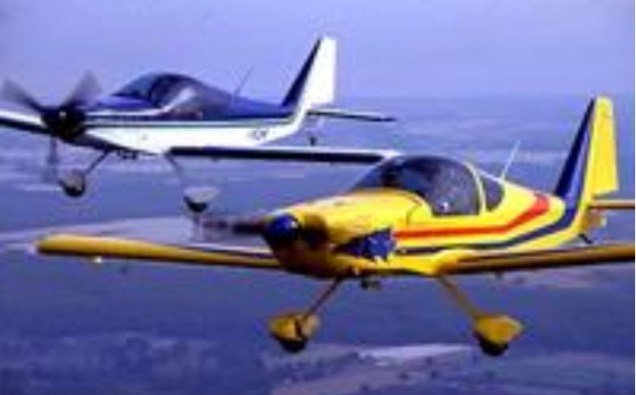
Century
Stall: 32 kt / 37 mph / 60 kmh
Cruise: 121 kt / 140 mph / 225 kmh
VNE: 167 kt / 193 mph / 310 kmh
Empty Weight: 290 kg / 639 lbs
MTOW Weight: 600 kg / 1323 lbs
Climb Ratio: 1200 ft/min / 6 m/s
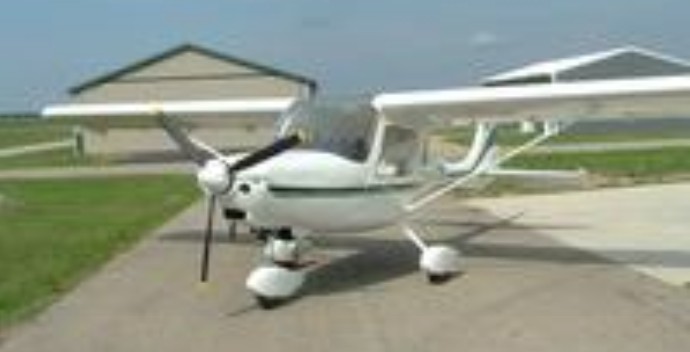
Rally
Stall: 35 kt / 40 mph / 65 kmh
Cruise: 107 kt / 123 mph / 198 kmh
VNE: 145 kt / 167 mph / 269 kmh
Empty Weight: 345 kg / 760 lbs
MTOW Weight: 599 kg / 1320 lbs
Climb Ratio: 1200 ft/min / 6,5 m/s
Storm Aircraft Rally LSA
New price: $107,900
Engine: Rotax 912 ULS, 100 hp
TBO: 1500 hr
Fuel: 100/mogas
Propeller: 70-inch, 3-blade FP
Landing gear type: Tri./Fixed
Max ramp weight:1320 lb
Gross weight: 1320 lb
Landing weight: 1320 lb
Empty weight, std: 760 lb
Useful load, std: 560 lb
Usable fuel, std: 21 USG
Payload, full std. fuel: 434 lb
Wingspan: 30 ft. 1 in
Height: 7 ft
Wing area: 125 sq. ft
Wing loading: 10.6 lbs./sq. ft
Power loading: 13.2 lbs./hp
Wheel size: 5.00 x 5 in
Seating capacity: 2
Cabin doors: 2
Cabin width: 43.7 in
Cabin height: 40 in
Cruise speed 75% power @ 24,000 ft.: 107 kt
Fuel consumption 75% power: 6 USgph
Vso: 35 kt
Best rate of climb (SL): 800 fpm
Service ceiling: 12,000 ft
Takeoff ground roll: 360 ft
Takeoff over 50-ft. obstacle: 600 ft
Landing ground roll: 450 ft
Landing over 50-ft. obstacle: 1000 ft

Engine: Rotax 503, 46 hp
HP range: 20-75
Height: 7.5 ft
Length: 20 ft
Wing span: 31 ft
Wing area: 150 sq.ft
Fuel capacity: 10 USG
Empty weight: 300 lb
Gross weight: 860 lb
Top speed: 67 mph
Cruise: 50 mph
Stall: 18 mph
Rate of climb: 500 fpm
Takeoff dist: 100 ft
Landing dist: 100 ft
Service ceiling: 13,500 ft
Seats: 2
Landing gear: tailwheel
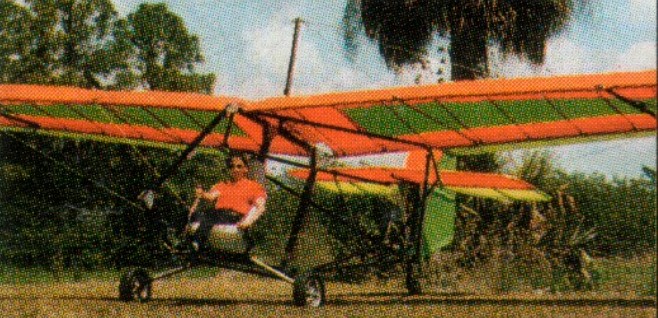
The UL Solution could be upgraded to two place.
Engine: Rotax 277, 28 hp
Height: 7.5 ft
Length: 20 ft
Wing span: 28 ft
Wing area: 150 sq.ft
Fuel capacity: 5 USG
Empty weight: 247 lb
Gross weight: 507 lb
Top speed: 55 mph
Cruise: 40 mph
Stall: 18 mph
Range: 60 sm
Rate of climb: 350 fpm
Takeoff dist: 100 ft
Landing dist: 150 ft
Service ceiling: 9000 ft
HP range: 10-52
Seats: 1
Landing gear: tailwheel
1996: PO Box 7534, Ft.Myers, Florida, USA.
UL builder
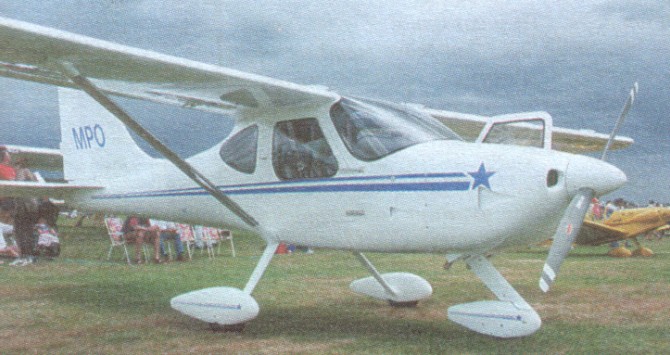
Arlington Air¬craft Development Inc (AADI) had originally devel¬oped the GlaStar and licensed production to Stoddard Hamilton. Designed with aluminium wings, sta¬biliser and rudder, but a fibreglass fuselage and fin, with a pipe cage around the two-seat cockpit – to which the wings and engine are directly mounted. The design allows a conversion from tricycle to taildragger configuration in a couple of hours. The standard design also allows the wings to fold (a five-minute operation) for easy hangarage, and removal of the tail stabaliser for transporting. Options purchased for this aircraft include the auxiliary wingtip tanks, giv¬ing a total of 195 litres useable, and 600 x 6 tyres.
First flying on 29 November 1994, the new GlaStar was announced at the 1994 Sun n’ Fun airshow in Lakeland, Florida, and first displayed as an almost-finished prototype at Oshkosh. Featuring a foldable high wing, convertible landing gear options and a baggage compartment. More than 100 builders placed deposits on the new kit in advance of the prototype’s November first flight.
Behind its original 125 h.p. Continental IO-240 engine, the GlaStar prototype exceeded its design goals on every parameter in 1995. By the fall of 1995, complete GlaStar kits were being shipped, and the first customer-built GlaStar took flight after less than three-months of construction. 1995 saw major enhancements to all models of the Glasair.
In 1996, the GlaStar prototype, having logged some 400 trouble-free hours in its first eighteen months, was equipped with a new 160 h.p. Lycoming O-320 engine installation. With a constant-speed propeller, this powerplant gave better cruise speed, climb performance and short-field wizardry. In 1997 the GlaStar was tested on floats — both Aerocet 2200 straight floats and Wipline 2100 amphibs. Designed from the outset as a floatplane, the GlaStar exceeded all expectations. In addition, the 180 h.p. Lycoming O-360 engine was installed in the GlaStar.
Included in the FAA 51% list, GlaStar builders got a tremendous boost in 1998 with the introduction of new “Jump-Start” accelerated-assembly options. Taken together, the Jump-Start Wing and Fuselage options shaved up to 50% off the typical build-time.
Original manufacturer of the Glasair and Glastar, Stoddard Hamilton closed its doors in 2000 after more than 20 years in business. Both aircraft types were split from the Stoddard Hamilton camp when the clo-sure occurred.
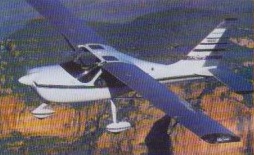
Thomas W. Wathen, former Chairman and CEO of Pinkerton’s, Inc., purchased the assets of Stoddard-Hamilton and AADI and formed Glasair Aviation, LLC in 2001 for the continued manufacturing and sale of both the Glasair and Glastar product lines.
New owner Thomas Walthem was committed to getting all three kits back into production. He initially purchased the Glasair side of the business but after find¬ing the overheads of the line were not self supporting approached Arlington Air¬craft Development Inc (AADI) to purchase the GlaStar line. As a single entity, the Glasair and Glastar kit aircraft under the banner of New Glasair/GlaStar.
Mr. Wathen, who sits on the President’s Counsel of the EAA and owns historic Flabob Airport in Riverside, California, selected Mikael Via to be President and Chief Operating Officer (COO) of the new companies. According to Mr. Wathen, Via is to be responsible for daily operations of Glasair Aviation and will help Wathen determine the long-term direction and growth of the company. Via, is a private pilot and builder/owner of a Glasair Super II RG.
In 2009 still produced kits to construct the GlaStar two-seat high-wing cabin monoplane (first flown 1994 and many hundreds sold).
Engine: Lycoming IO-320-D, 160 hp
HP range: 100-180
Height: 7 ft
Length: 22 ft
Wing span: 35 ft
Wing area: 128 sq.ft
Fuel cap: 34 USG
Weight empty: 1100 lbs
Gross: 1900 lbs
Speed max: 170 mph
Cruise: 167 mph
Range: 750 sm
Stall: 45 mph
ROC: 2000 fpm
Take-off dist: 230 ft
Landing dist: 300 ft
Service ceiling: 20,000 ft
Seats: 2
Landing gear: nose or tail wheel
Engine: Lycoming O-320
Wing span: 10.67 m
Wing area: 11.78 sq.m
MAUW: 889 kg
Empty weight: 499 kg
Fuel capacity: 129 lt
Max speed: 273 kph
Cruise speed: 269 kph
Minimum speed: 72 kph
Climb rate: 10 m/s
Seats: 2
Fuel consumption: 30 lt/hr
Kit price (1998): £21,950
Tom Hamilton began flight testing the Glasair TD in 1979. Originally powered by a 115 h.p. Lycoming O-235 powerplant, the TD prototype featured conventional landing gear and a gross weight of 1,600 lbs.
Glasair debuted at the EAA Convention in Oshkosh 1980 with the first premolded composite kit aircraft ever offered. All the major airframe components pieces such as the fuselage, wing, cowling, and tail feathers were already fabricated in two halves. All the builder needed to do was install the ribs or bulkheads and seam the halves together. All the parts came direct from the factory with a mirror-smooth gel coated finish. Thus, the Glasair kit offered tremendous time savings compared to the scratch-built projects that were then available.
In addition, the production kits featured a 3″ higher canopy for improved cockpit comfort and visibility, as well as the more powerful 160 h.p. Lycoming O-320 engine. 150 builders in 1980 alone ordered the Glasair as their kitplane.
In 1981 the EAA awarded Tom Hamilton the prestigious Raspet Award for outstanding contribution to the design of light aircraft.
The retractable tricycle gear Glasair RG was introduced in 1983, and at the same time, kit completeness for both the RG and the TD was greatly improved. The introduction of prefabricated rudder pedal assemblies, aileron and elevator bellcranks, control stick yokes and various other metal parts completely eliminated the need for welding or complex metalworking skills on the part of the Glasair builder.
The fixed tricycle gear Glasair FT was developed in 1984. Making the new landing gear retrofittable to existing TDs, S-H converted the original production prototype, N89SH, to the new gear configuration. The new FT gave up only 2 m.p.h. of speed to the tail dragger.
With some 700 Glasair kits in the field in 1986, enter the Glasair II, which was simultaneously introduced in TD, FT and RG models. The main areas of improvement over the original Glasair I centered on cockpit ergonomics and labor savings. A complete retooling of most of the composite parts resulted in an additional 3″ of cabin width and 1-1/2″ of cabin height.
These changes also resulted in a larger baggage compartment. S-H’s labor-saving campaign resulted in, among other things, premolded mounting joggles for such components as the wingtip fairings, cowling, and so on; factory-made cutouts for the canopies and windshield; and premolded scribe lines in parts that required builder cutting. The end result was a more comfortable, more practical, better engineered aircraft that was more enjoyable to build as well as to fly.
1986 also marked the introduction of the Glasair III, two-place sportplane on the planet. Powered by its 300 h.p. Lycoming IO-540 to cruise speeds in excess of 265 m.p.h., the kit featured all the new labor-saving innovations of the Glasair II kits.
Also in 1986, S-H became an employee-owned company, Arlington, Washington.
1988: Stoddard-Hamilton Aircraft Inc
18701 58th Ave NE
Arlington
WA 98223
USA
In 1989 the Glasair II-S models were introduced — ‘S’ for stretched. The original II fuselage was lengthened by 14″, providing easier installation of the more powerful 180 and 200 h.p. engines builders were installing, as well as improving the appearance of the aircraft.
As before, tail dragger, fixed tricycle and retractable tricycle gear were all offered on the II-S. 1989 also marked the founding of Stoddard International, Inc., a sister company organized to produce composite parts for the Boeing Company.
SI has manufactured a variety of parts for the 737, 747, 757, 767 and the new 777. SI was one of the first companies in the nation to be approved under the new D1-9000 specification, a manufacturing quality control specification.
S-H introduced the Glasair III Turbo in 1990. A complete firewall-forward package, this option pushed the standard Glasair III airframe up into the Flight Levels at speeds of well over 300 m.p.h.
GlasFloats were developed in 1992. Available in straight and amphibious versions, these all-composite, leak-proof floats opened up new vistas of adventure for builders of light aircraft such as the Kitfox and Avid Flyer.
The Glasair III LP was displayed at the NASA exhibit in Oshkosh in 1993. The result of S-H’s participation in a NASA-funded Small Business Innovation Research (SBIR) grant, the LP was the first lightning-protected composite kit aircraft. Under the terms of the SBIR grant, the research results produced in the course of this project became part of the public domain, and future certified composite aircraft such as the Cirrus and the Kestrel utilize technology based on S-H’s findings. S-H continues to participate in several other SBIR grants and NASA advanced research programs on such topics as composite manufacturing techniques and aircraft crashworthiness.
The Glasair Super II was also introduced in 1993. The II-S fuselage was lengthened by 6″, the wing was moved aft 1-1/2″, and the horizontal tail surfaces were increased in size by 30%, producing an aircraft of peerless handling characteristics with a CG envelope wide enough to accommodate a wide variety of engine and equipment choices. Available in any of three gear configurations, the Super II offers an unbeatable combination of performance, utility and economy.
The new GlaStar was announced at the 1994 Sun n’ Fun airshow in Lakeland, Florida, and first displayed as an almost-finished prototype at Oshkosh. Featuring a foldable high wing, convertible landing gear options and a baggage compartment. More than 100 builders placed deposits on the new kit in advance of the prototype’s November first flight.
The Glasair III Prop Jet also debuted at Oshkosh ‘94. Built by Composite Turbine Tech, Inc., of Toledo, Washington, this aircraft mated a 450 s.h.p. Allison 250 B-17 turbine engine to a standard Glasair III airframe.
Behind its original 125 h.p. Continental IO-240 engine, the GlaStar prototype exceeded its design goals on every parameter in 1995. By the fall of 1995, complete GlaStar kits were being shipped, and the first customer-built GlaStar took flight after less than three-months of construction. 1995 also saw major enhancements to all models of the Glasair.
Kits for both the III and the Super II underwent upgrades, as previously optional equipment was incorporated into the standard kits. Ever-increasing degrees of factory prefabrication, part quality and kit completeness continue to be the hallmark of the Glasair line.
In 1996, the GlaStar prototype, having logged some 400 trouble-free hours in its first eighteen months, was equipped with a new 160 h.p. Lycoming O-320 engine installation. With a constant-speed propeller, this powerplant gave better cruise speed, climb performance and short-field wizardry. In 1997 the GlaStar was tested on floats — both Aerocet 2200 straight floats and Wipline 2100 amphibs. Designed from the outset as a floatplane, the GlaStar exceeded all expectations. In addition, the 180 h.p. Lycoming O-360 engine was installed in the GlaStar.
1997: 18701 58th Ave, N.E. Arlington, WA 98223, USA.
Following a sophisticated computational fluid dynamics analysis of its aerodynamic qualities at speeds in the Mach .6–.7 range, the Glasair III got an enlarged rudder, a new cowling and a mighty turbocharger to become the Glasair Super III in 1998. Designed to produce 350 h.p. at altitudes of up to 37,000 feet, the new powerplant testing on the prototype had been flown to 35,000 feet at airspeeds of greater than 320 knots. At 32,000 feet, the aircraft was still capable of climbing at over 2,000 feet per minute.
GlaStar builders got a tremendous boost in 1998 with the introduction of new “Jump-Start” accelerated-assembly options. Taken together, the Jump-Start Wing and Fuselage options shaved up to 50% off the typical build-time.
Original manufacturer of the Glasair and Glastar, Stoddard Hamilton closed its doors in 2000 after more than 20 years in business. Both aircraft types were split from the Stoddard Hamilton camp when the clo-sure occurred.
Thomas W. Wathen, former Chairman and CEO of Pinkerton’s, Inc., purchased the assets of Stoddard-Hamilton and AADI and formed Glasair Aviation, LLC in 2001 for the continued manufacturing and sale of both the Glasair and Glastar product lines.
New owner Thomas Walthem was committed to getting all three kits back into production. He initially purchased the Glasair side of the business but after find¬ing the overheads of the line were not self supporting approached Arlington Air¬craft Development Inc (AADI) to purchase the GlaStar line. As a single entity, the Glasair and Glastar kit aircraft under the banner of New Glasair/GlaStar.
Mr. Wathen, who sits on the President’s Counsel of the EAA and owns historic Flabob Airport in Riverside, California, selected Mikael Via to be President and Chief Operating Officer (COO) of the new companies. According to Mr. Wathen, Via is to be responsible for daily operations of Glasair Aviation and will help Wathen determine the long-term direction and growth of the company. Via, is a private pilot and builder/owner of a Glasair Super II RG.
More than 3,000 kits were in the field and some 1,700 aircraft flying in countries around the world by 2008.
In 2009 produces kits to construct the very popular Glasair two-seat low-wing monoplane in various models (first flown 1979 and thought to have been the first pre-molded composite kitplane), plus kits for the GlaStar two-seat high-wing cabin monoplane (first flown 1994 and many hundreds sold). Other aircraft have included the Turbine 250/III turboprop two-seater, and T-9 Stalker two-seat turboprop variant of Glasair III as trainer (first flown 1988).
 All Aero