Taylor Micro-Imp

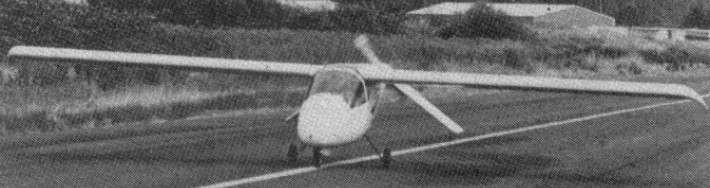
In 1978, with the success of the Mini-IMP program, Molt Taylor and his friend, Jerry Holcomb began construction of the prototype Micro-IMP aircraft. It was intended as an alternative to the then-new “Quickie” aircraft, a Burt Rutan design, which was being offered by Quickie Aircraft Company of Mojave, CA. Like the Quickie, the Micro-IMP was intended to be a very light-weight, low-power and low cost sport plane. Molt and Jerry chose to use a new building material that they had developed for the primary structure, a special resin-impregnated, fiberglass-reinforced paper that they called TPG (Taylor-Paper-Glass).

The Micro-IMP was basically a smaller, lighter version of the Mini-IMP and embodied most of the Mini-IMP features and design ideas. It featured a fully retractable tri-cycle landing gear, full span, reflexing flaperons, a NASA GA-PC(1) airfoil, a unique two-position propeller and a fully trimmable inverted “V” tail.

Molt had intended to have Wicks Aircraft Company, a leading supplier of materials for experimental aircraft builders, provide complete kits for the Micro-IMP, with all the parts pre-printed on the TPG paper stock, so that the builder would only have to cut out the pieces and laminate them with the cloth. The kit would have included all instrumentation and materials to build the airplane. The engine which powered the prototype was a 25-hp Revmaster converted 620cc Citroen 2CV automobile engine which has been produce in the millions in Europe. The engine, which was intended to put out about 32-38 h.p. simply couldn’t be persuaded to put out more than about 16-18 h.p. and thus the prototype was severely underpowered. A planned 800 cc version of the engine never got produced.

The Citroen 2CV engine has been extensively modified to provide an excellent, low cost, durable, aircraft power plant and includes such features as solid state magneto, anti-reversion exhaust manifolding, injection carburetor, electric starting with alternator, etc.

The Micro-IMP was finished in 1981 and was last flown at a demonstration during Oshkosh 1982. At that time, the airframe was hung up in the rafters at Molt’s shop awaiting inspiration, time and money to install another, more powerful engine.

Due to other events, notably the Bullet 2100 project and Molt’s declining health, the Micro-IMP was not developed further. Jerry Holcomb went on however to develop, build and fly a refinement of the Micro-IMP design which he named the “Perigee”. Information packages were sold but plans and kits never materialized.

Prior to Molt’s death, the “hulk” of the Micro-IMP was sold to a teenager in the local area and its whereabouts at this time is unknown.

Designed in 1975, first built in 1976.

The limited tooling for the Micro-IMP and the production rights to the design were in the possession of the Mini-IMP Aircraft Company. A large collection of Molt’s original drawings and shop sketches for the Micro IMP have been found. These drawings along with a large number of B/W photographs were being made available on a compact disk. While there are no plans at this time for Mini-IMP Aircraft Co. to develop the design, they were interested in a joint venture with interested individuals or companies to further refine and market this aircraft.

Engine: 620cc Citroen 2CV, 25 hp
Gross Wt. 700 lb
Empty Wt. 360 lb
Fuel capaci¬ty 7 USG
Wingspan 27’
Length 15’
Max speed: 120 mph
Cruise 110 mph
Stall 45 mph
Climb rate 500 fpm
Takeoff run 800 ft
Range 500 miles
Undercarriage: retractable
Taylor Aero Industries Bird

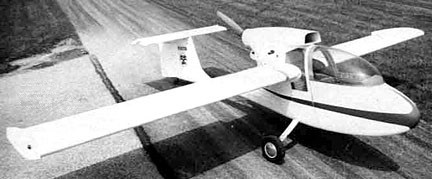
Taylor Bird N303TB

Circa 1980 Clarence Gilbert Taylor and son Bruce built the two place, mid wing ‘Bird’, registered N303TB, with a 75hp Subaru pusher (converted auto engine). Single tail boom with T-tail.

An update of the original Bird that appeared at Oshkosh in 1976.

Engine: 75hp Subaru
Wingspan: 26’0″
Length: 18’0″
Useful load: 600 lb
Max speed: 115 ph
Cruise speed: 105 mph
Stall speed: 45 mph
Range: 420 mi
Seats: 2

Taylor JT-2 Titch

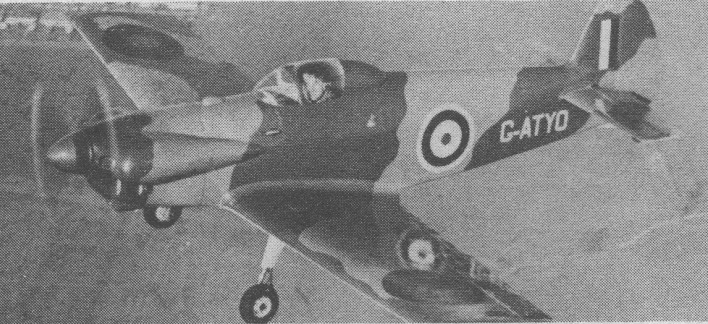
The Taylor JT.2 Titch was designed in 1964 to meet Rollason’s Midget Racer competition, placed second overall. A prototype built by John Taylor was first flown at Rochford on 22 January 1967 with a Continental C85-12F engine. It crashed in May 1987, killing Taylor. The plans then being sold by his widow.

Titch G-BCSY at Sywell 1975

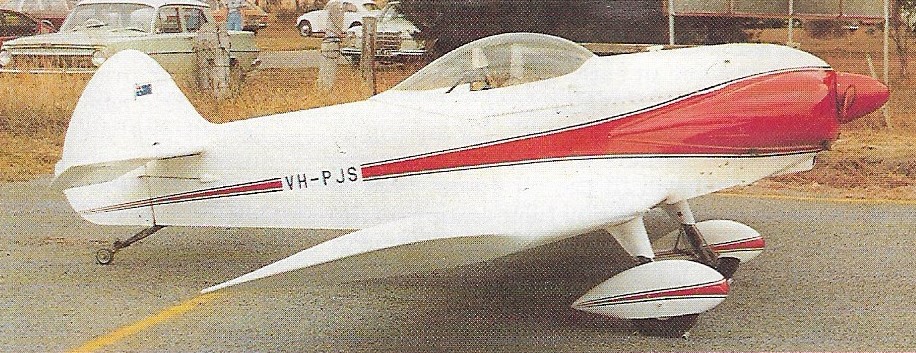
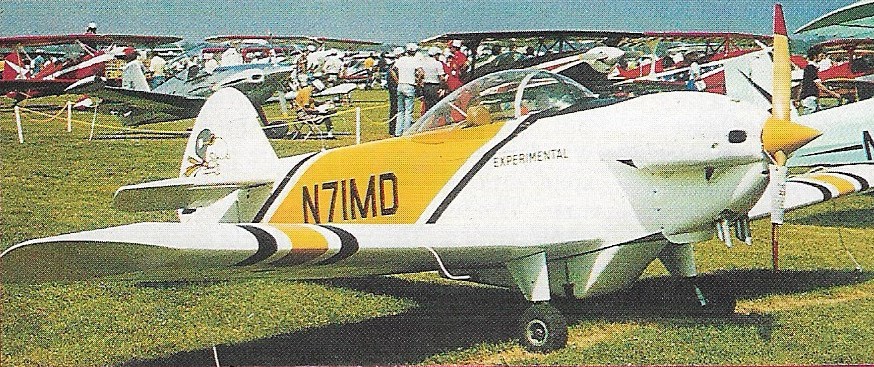
The Taylor Titch has a reputation as a pleasant-to-fly aerobatic plane. Its stall occurs at a very high angle of attack and is straightforward, with no wing drop and a height loss of only 50 feet. This single-place monoplane features all-wood wings with plywood and fabric covering. Its fuselage is also an all-wood structure that includes double-curvature plywood covering and aluminum cockpit side panels. When the low-powered Taylor Monoplane became known in the United States, requests were made for permission to fit larger engines than the design permitted. This led to the introduction of the Titch. The Titch is stressed for any engine from 40 to 90 hp, the only provision being a reposition of the engine bulkhead for engines of 65 hp or more. This allows for the use of VW, Lycoming or Continental powerplants.

Engine: Continental, 85 hp
HP range: 60-100
Speed max: 200 mph
Cruise: 160 mph
Range: 380 sm
Stall: 48 mph
ROC: 1600 fpm
Take-off dist: 350 ft
Landing dist: 900 ft
Service ceiling: 18,000 ft
Fuel cap: 10 USG
Weight empty: 500 lbs
Gross: 760 lbs
Height: 4.8 ft
Length: 16.7 ft
Wing span: 18.9 ft
Wing area: 68 sq.ft
Seats: 1
Landing gear: tail wheel

Engine: VW 2100
Cruise: 115 mph
ROC: 800 fpm
Range: 250 sm
Span: 18 ft 9 in
Length: 16 ft 1.5 in
Empty wt: 455 lbs
Max wt: 710 lbs

Taylor JT-1 Monoplane

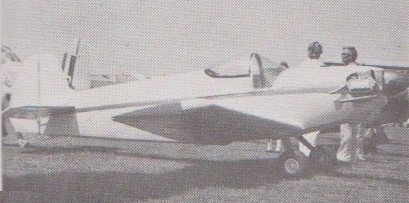
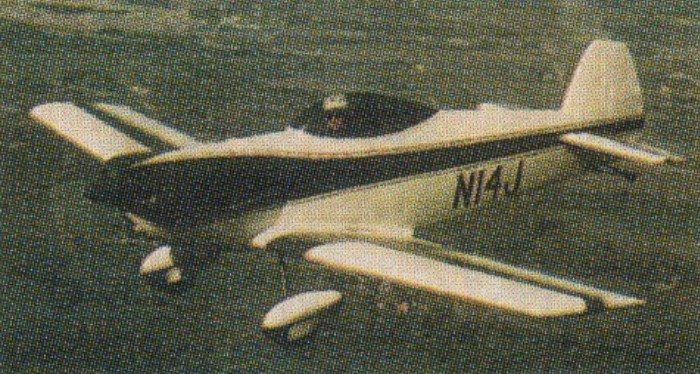
Designed by John Taylor, the Monoplane is a single seat, cantilever, low wing. acrobatic aircraft built with the object of producing an airframe for not more than £100 Sterling. The wing is a constant chord structure with an RAF 48 aerofoil section, and consists of a centre section and outer panels. Each panel has two spruce and plywood spars, wooden ribs and a plywood covered leading edge D nose, the remainder of the wing being fabric covered. Split trailing edge flaps are fitted. The fuselage is a conventional wooden structure hav¬ing spruce longerons and frames and plywood covering. The wing centre section is built integral with the fuselage. The fin and tailplane are plywood covered wooden structures, while the rudder and elevators are fabric covered wooden structures. The main undercarriage consists of cantilever legs fitted with coil springs for shock absorption. The wheels have Avro Anson tailwheel tyres. A leaf spring tail skid with a steerable skid pad is fitted. A 6 Imp. gallon fuel tank is installed behind the firewall. The prototype flew with a 37 h.p. JAP engine, but converted Volkswagen engines are also suitable. Since the first prototype flew in June 1960, no modifications of any kind have been incorporated.

Variation: Ladd Taylor Chihuahua

Gallery

Engine: VW 1500cc
HP range: 40-60
Speed max: 115 mph
Cruise: 100 mph
Range: 290 sm
Stall: 35 mph
ROC: 950 fpm
Take-off dist: 350 ft
Landing dist: 750 ft
Service ceiling: 13,500 ft
Fuel cap: 7.5 USG
Weight empty: 430 lbs
Gross: 660 lbs
Height: 4.1 ft
Length: 15 ft
Wing span: 21 ft
Wing area: 76 sq.ft
Seats: 1
Landing gear: tail wheel

Engine: VW 1600cc
Cruise: 90 mph
Climb: 500 fpm
Range: 250 sm

Engine: JAP, 38 hp
Wing span: 21 ft 0 in (6.4m)
Wing Area: 72 sq. ft
Length: 15 ft 0 in (4.57 m)
Height: 4 ft 10 in (1.47 m)
Empty Weight: 400 lb
Max TO wt: 610 lb (276 kg)
Wing Loading: 8.5 lb/sq.ft
Max level speed: 105 mph (169 kph)
Cruise Speed: 92 mph
Stall Speed: 34 mph
Climb: 650 fpm
Range: 230 miles

Taylor, John F.

John F.Taylor designed JT.1 Monoplane single-seat monoplane and JT.2 Titch single-seat racing monoplane, first flown 1959 and 1967 respectively. Plans for both aircraft remain available from Mrs T. Taylor.
1980: Mrs John F. Taylor, 25 Chesterfield Cres, Leigh-on-Sea, Essex, England.
1995: 79 Springwater Rd, Leigh-on-Sea, Essex SS9 5BW, England.

Tapanee Levitation

The Tapanee Levitation 4 is a Canadian four-seat STOL aircraft designed to be homebuilt by Michel Lequin for Tapenee Aviation of Quebec. A larger version of the companies earlier Pegazair bushplane, the Levitation is a high-wing monoplane with V-strut bracing, first flown in 2002. Powered by a 180 hp (134 kW) Lycoming O-360 flat-six piston engine with a two-blade propeller. The Leviation has a fixed conventional landing gear with a tailwheel and a cabin holding a pilot and three passengers in two rows of side-by-side seating. By December 2004 five kits had been sold.

Variants:
Levitation 2
Levitation 4

Specifications:

Levitation
Engine: Lycoming O-360, 180 hp / 134 kW
Propeller: Hartzell 80 in
Length: 7.47 m (24 ft 6 in)
Overall Height: 2.44 m (8 ft 0 in)
Wingspan: 10.21 m (33 ft 6 in)
Wing area: 180 sq.ft / 16.72sq.m
Wing Loading: 13.9 lb/sq.ft
Gross weight: 2500 lbs / 1133 kg
Empty Weight: 621 kg (1368 lb)
Usefull load: 1138 lbs
Stall Speed: 38 Mph / 62 km/h
Cruise speed: 115-120 Mph
VNE: 159 Mph / 255 km/h
Range at cruise: 575 sm / 925 km
Gross wgt takeoff dist: 400 ft
Landing Distance: 300 ft
Climb rate at Gross: 700 fpm / 3.6 m/s
Power Loading: 13.9 lb/hp
Cabin Length: 109 in
Cabin width at elbow: 48 in
Usable fuel: 55 US Gallons
Fuel Optional, Wings: 36 USG
Baggage Area: 25 cu.ft
Seats: 4

Tapanee Pagazair-100

A conventional sheet metal, tubing and fabric high wing tail dragger. It was available as a kit or plans.

Engine: Continental O-200, 100 hp
HP range: 85-115
Length: 22.5 ft
Wing span: 29 ft
Wing area: 150 sq.ft
Fuel capacity: 36 USG
Empty weight: 791 lb
Gross weight: 1450 lb
Top speed: 122 mph
Cruise: 105 mph
Stall: 28 mph
Range: 660 sm
Rate of climb: 900 fpm
Takeoff dist: 250 ft
Landing dist: 300 ft
Seats: 2
Cockpit width: 40 in
Landing gear: tailwheel