1997: 134 Cessna Dr, Trenton, SC 29847, USA.
UL builder
1997: 134 Cessna Dr, Trenton, SC 29847, USA.
UL builder
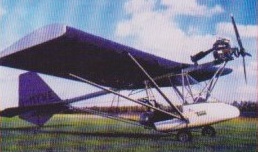
A two-seat microlight developed from T.300.
Originating in Australia, by 1998 the tube and fabric design had been built in the UK for a number of years, and marketed in the UK as the Nova T600 N.
A tricycle version on the Commandair was exported from Australia to the UK as the Nova T600 T.
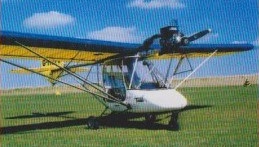
Nova T600 T
Engine: Rotax 503, 52 hp
Wing span: 9.60 m
Wing area: 15 sq.m
MAUW: 360 kg
Empty weight: 150 kg
Fuel capacity: 40 lt
Max speed: 130 kph
Cruise speed: 100 kph
Minimum speed: 65 kph
Climb rate: 5 m/s
Certification: BCAR S
Seats: 2
Fuel consumption: 13 lt/hr
Price (1998): £12,350
Commandair
Engine: Rotax 503, 52 hp
Wing span: 9.60 m
Wing area: 15 sq.m
MAUW: 360 kg
Empty weight: 15- kg
Fuel capacity: 40 lt
Max speed: 130 kph
Cruise speed: 100 kph
Minimum speed: 65 kph
Climb rate: 5 m/s
Certification: BCAR S
Seats: 2
Fuel consumption: 13 lt/hr
Price (1998): £13,350
UK
Markets T.300 side-by-side two-seat open microlight, T.500 derivative with enclosed rear fuselage, and T.600 Nova two-seat microlight developed from T.300, all in completed and kit forms.
1998:
Malt House
Ginge
OX12 8QS Oxon
United Kingdom
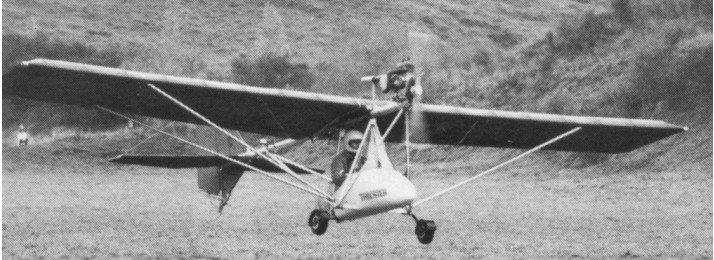
The fifth design of Steve Cohen, first appearing in 1982. A unique wing design allows each wing to rack and fold inside the double surface dacron skins for trailering. A fibreglass pod keeps the pilot warm on wintery days and the strut braced high wing tail dragger design makes it a good rough strip performer. A two-place/utility version is available which sports a new pod for passenger and pilot and power is supplied from a 60 hp Rotax 503 via a geared reduction drive.
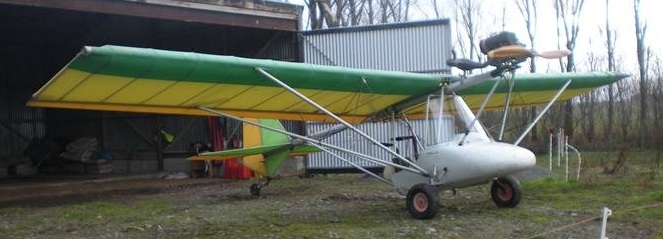
The Thruster 85 has a shorter wing span and the fabric of the lower wing sewn onto the ribs. Conventional 3 axis controls, single or two place.
In 1998 the two seat Thruster returned to production.
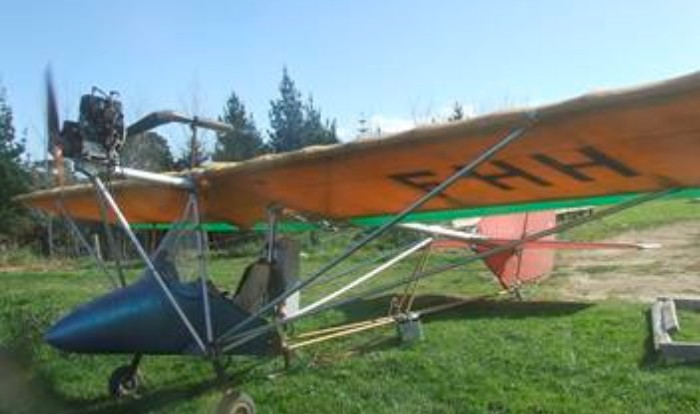
The T.300 is a side-by-side two-seat open microlight, and T.500 derivative with enclosed rear fuselage.
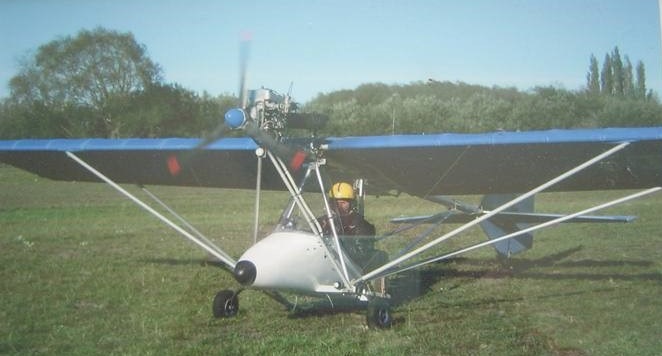
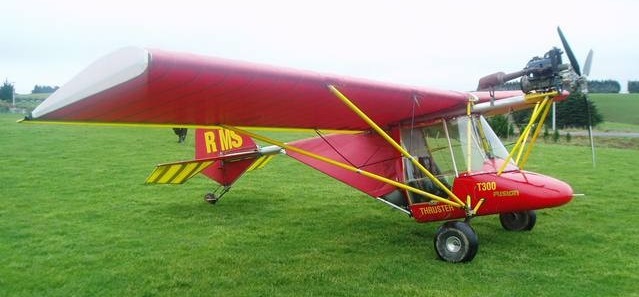
Thruster
Engine: Fuji Robin 440, 50 hp
Wing span: 29 ft 5 in / 8.97 m
Length: 18 ft 5 in / 5.61 m
Wing area: 150 sq.ft / 13.94 sq.m
Empty wt: 260 lbs / 117.9 kg
Fuel capacity: 25 ltr
Cruise speed: 50 kts@ 50% power
Stall: 27kts
ROC: 1000-1500 fpm
Range: 150 sm
Thruster 85
Engine: Rotax 377, 40 hp
Wing span: 7.8m
Length: 5.3m
Empty wt: 135 kg
MTOW: 227 kg
Range: 306 km
Seats: 1
Fuel capacity: 25 ltr
Cruise: 55kts
Stall: 33 kts
Engine: Rotax 503
Seats: 1
Wing span: 7.8m
Length: 5.3m
Fuel capacity: 25 ltr
T300
Engine: Rotax 582
Prop: Warp Drive 3 Blade Ground Adjustable
Seats: 2
Tyres: 8.00 x 6
T500
Engine: Rotax
Seats: 2
Thruster TST
Engine: Rotax 503, 58 hp @ 6300 rpm
Wing span: 31 ft 6 in / 9.6 m
Length: 18 ft / 5.5 m
Height: 6 ft 6 in / 2.0 m
Empty weight: 331 lb / 150 kg
MTOW: 788 lb / 358 kg
Cruise 90%: 63 mph / 55 kt
Cruise 70%: 52 mph / 45 kt
Stall: 40 mph / 35 kt
Vne: 92 mph / 80 kt
TO dist 50 ft: 360 ft / 110 m
Rate of climb: 500 fpm / 150 m/min
Landing roll: 327 ft / 100 m
Fuel capacity: 9 Imp Gal / 40 lt
Fuel burn: 15-22 lt/hr
Endurance w/res; 1.5 hr
Max X-wind: 15 kt
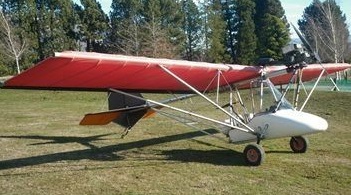
Developed from an earlier model, the Utility, the Gemini incorporates a folding wing design and strut bracing. The Gemini 503 TC is a refined version with full instruments as standard, and tested to +6.6 and -3.3g at 400 kg.
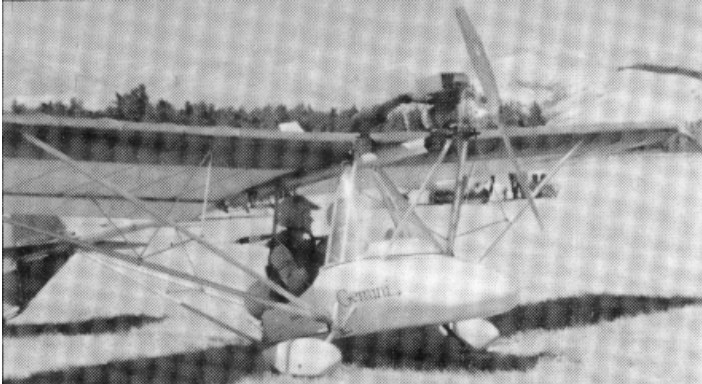
The Utility was developed into the Gemini.
1985: Thruster Aircraft Aust Pty Ltd. 458 The Boulevarde, Kirrawee NSW 2232. Australia.
UL builder
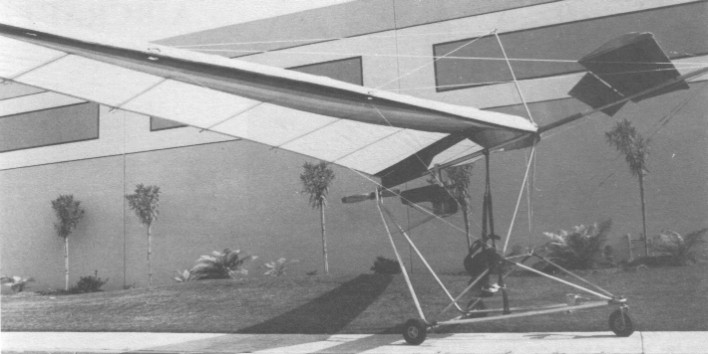
Single seat single engined high wing monoplane with hybrid control. Wing has swept back leading edge, and tapering chord; no tail, canard wing. Pitch control by elevator on canard; yaw control by tip rudders; no separate roll control; control inputs through weight shift for pitch and tiller for yaw. Wing braced from above by kingpost and cables, from below by cables; wing profile; 30% double surface. Undercarriage has three wheels in tricycle formation; no suspension on nosewheel and glass fibre suspension on main wheels. Push right go right nosewheel steering independent from yaw control. No brakes. Aluminium tube framwork without pod. Engine mounted below wing driving pusher propeller.
Those Flying Machines Pegasus Article
The Pegasus is a hybrid control machine, with the pilot in a swing seat connected to the elevator on the canard. A tiller arrangement sometimes called a yoke, operates tip rudders to give yaw control, with roll control by induced.
Pegasus comes in two forms, the Pegasus I with single cylinder engine and the Pegasus II with a twin. For the single, there is only one engine option, the 215 cc Cuyuna 215 developing 20 hp, but Pegasus II buyers can choose from Kawasaki or Cuyuna twin cylinder units.
Options include hand and ballistically deployed parachutes, a strobe and for the Kawasaki only electric start. The company’s main marketing effort is now being directed toward the Pegasus II, which is listed at $4695 ready to fly in standard form in 1983.
Pegasus
Engine: Cuyuna 202
Prop: 132 cm x 81 cm pitch
Wingspan: 9.8m
Weight: 113kg
Fuel capacity: 19 ltr
Cruise speed: 35 kts
Stall: l9kts
Construction time: 40 hr
Pegasus II
Engine: Cuyuna 430, 35hp at 5800rpm
Propeller diameter and pitch 54 x 36 inch, 1.37 x 0.91 m
V belt reduction, ratio 2.2/1
Max static thrust 238 lb, 108 kg
Power per unit area 0.19 hp/sq.ft, 2.1 hp/sq.m
Fuel capacity 4.2 US gal, 3.5 Imp gal, 15.9 litre
Length overall 15.4 ft, 14.70 m
Height overall 9.9ft, 3.00m
Wing span 35.2ft, 10.72m
Total wing area 182 sq.ft, 16.9 sq.m
Empty weight 203 lb, 92 kg
Max take off weight 503 lb, 228kg
Payload 300 lb, 136kg
Max wing loading 2.76 lb/sq.ft, 13.5 kg/sq.m
Max power loading 14.4 lb/hp, 13.5 kg/hp
Load factors; +6.0, 2.0 ultimate
Max level speed 60 mph, 97 kph
Never exceed speed 55 mph, 88 kph
Cruising speed 37 mph, 59 kph
Stall¬ing speed 25 mph, 40 kph
Max climb rate at sea level 450 ft/min, 2.3 m/s
Best glide ratio with power off 7/1
1982: Those Flying Machines, 1911 W 139th Street, Gardena, California 90249, USA.
1983: 705 E. Gardena Blvd., Gardena, CA 90247, USA.
UL builder
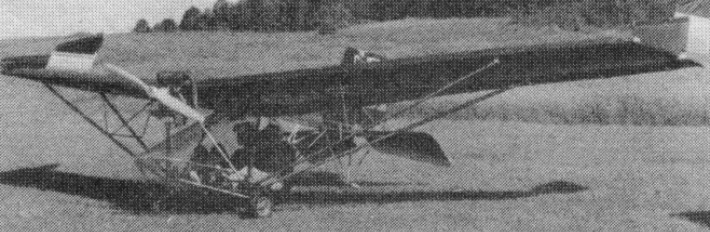
A taildragger configuration and heavy-duty bungee sprung landing gear. The Canadian-built two-seater can also be fitted with floats or skis made at Thor Air’s Weston Ontario factory. The Thor 1-2 is basically a beefed-up version of the Thor 1, heavier tub¬ing and the cockpit frame is slight¬ly different. The Thor 1-2 features side-by-side seating, dual control sticks and rudder pedals and a center-mounted throttle. A full windshield, gold and black anodized aluminum tubing, in-cabin pulp start, remote choke, adjustable padded seat and a removable gas tank are also standard. The THOR-12-47 is basically the same as THOR-11-28 except Two-Place. The undercarriage is the same as Thor-11-28. 1984 PRICE: $7,482.
Thor 1-2
Empty wt 320 lbs
Wingspan 32 ft 4 in
Wing area 167 sq ft
Height 7 ft 8 in
Length 13 ft 8 in
Fuel 5 gal
Engine Rotax 447, 42 hp @ 6,600 rpm
Stall: 27 mph
Cruise 30-55 mph
Top speed 63 mph
Vne 70 mph
Gross Wt 750 lbs
Climb rate, 500 fpm
Thor 12-47
Engine: Rotax 503, 47 hp, geared drive
Wingspan 32.3’
Wing area 167 sq.ft
Empty weight 320 lbs
Gross weight 700 lbs
Cruise speed 3055 mph
Stall speed 27 mph
Climb 700 fpm
Takeoff run 70-130 ft
Landing roll 50-100 ft
 All Aero