Aviation Composites Mercury

After mixed results with the MicroLight prototype, carmaker Lotus still wanted to build a business for the ultralight canard pusher, and when the arrangements with Rutan didn’t work out, they sought backing to continue alone. When that wasn’t approved, Lotus went looking for partners and teamed up with the Eipper company, a big ultralight builder in those days (now no longer in business) to distribute it in the USA, while Malcolm Lawrence’s Aviation Composites of Thatcham in Berkshire, was to distribute it in the UK and Europe.

Lotus originally planned to build the basic structure themselves, with Aircraft Composites finishing and distributing it. It was then decided that the materials (epoxy glass) and the quality control techniques were not part of the Lotus core business, and Aircraft Composites agreed to take over the development and build, with the help of Peter Jackson’s Specialised Mouldings (a well-known firm in motorsport).

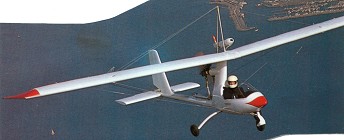
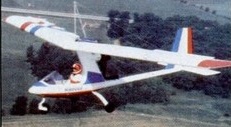
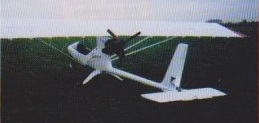
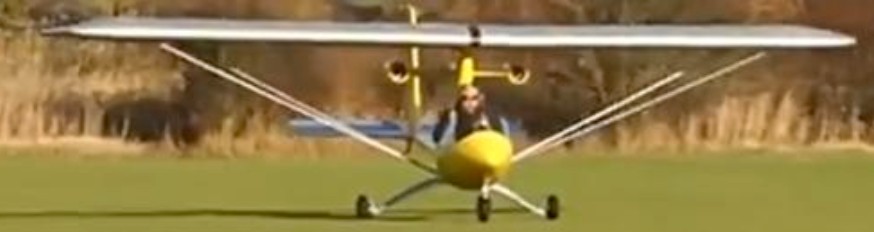
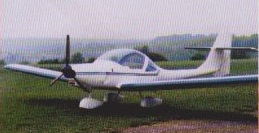
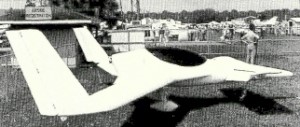
Since Lotus was struggling to cope with the aftermath of Colin Chapman’s death, Aircraft Composites moved into taking over the whole project. Instead, Aviation Composites used the design’s features as a basis for a different aircraft. The company employed VariEze builder Ivan Shaw, and built a similar but much heavier version, the two-seat Mercury prototype (G-INAV c/n AC001).

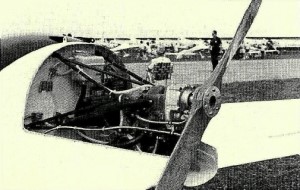
The Mercury featured an all-composite canard configuration with a four-cylinder Magnum pusher engine. The Mercury incorporated various modifications from the Rutan design and Shaw had several problems with it. First of all, it apparently exhibited some not-so-attractive flight characteristics, and its development program suffered a number of developmental problems, among them, the failure to obtain an acceptable engine. When the Magnum engine proved unsatisfactory, and a 40 hp Norton rotary engine was fitted instead. However, testing the brand new aircraft engine of a motorcycle company on an airframe that hasn’t yet been properly flight-tested was not a good idea.
Initially, the aircraft was to be available by February 1986 and Aviation Composites intended to obtain UK certification in the motor-glider category before introducing the type to the US market. However, these setback seriously compromised the fledgling company’s chances to offer a proven model on the market any time soon. Aviation Composites therefore approached Scaled Composites requesting developmental help. While assisting Ivan Shaw, now the company’s production manager on the program, with flight testing (the plane was test-flown by Douglas B. Shane, one of Rutan’s own test pilots), Scaled discovered a poor spin recovery characteristic, and found out the virtue of using of engine power to aid in recovery from a deep stall in a canard pusher-type, using this successfully on several occasions during high angle of attack testing of the Mercury.

Once Aviation Composites realized that changes would be necessary to obtain adequate spin recovery characteristics, the next step should have been to equip the aircraft with a spin recovery parachute and to develop an appropriate aerodynamic fix for the problem. Instead, they discontinued support of the flight testing and further development, and sued RAF for all of their expenses to date—allegedly amounting to several million dollars—claiming that they should have more thoroughly tested the Model 97 in 1983 to find a possible flaw in spin recovery.

The case was scheduled for trial in federal court during January ’91. Burt Rutan best summed up the situation when he declared: “there seems to be no basis, however, these exercises have an enormous effect on our time and distract from our ability to concentrate on things more productive and enjoyable.” The case dragged on (way beyond Lotus being taken over by GM in 1986) and was eventually dropped. The backers disappeared, and Aircraft Composites went into bankruptcy. As for the original MicroLight prototype, it was lost in an accident in which the owner and test pilot of the aircraft were killed, giving some credence to Aircraft Composites’ claim that the design was faulty.

Engine: Norton 40 hp
Maximum speed est: 87 kt
Range est: 290 nm
Seats: 2
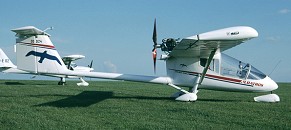
Aviasud AE-209 Albatross / Micronef ULM Albatros

Aviasud Engineering from Fréjus, France developed a 2-seat highwing ULM-aeroplane with push-propeller. Production of the AE-209 Albatros started in 1992, and the Albatros was available with the 2-stroke Rotax 582 or the 4-stroke Rotax 912 engine. The Albatros classique is equipped with a tail wheel; the Albatros tricycle is equipped with a nose wheel or tail wheel. The wings can be folded, which reduces the needed parking space in the hangar.

After Aviasud went defunct, Micronef ULM had the Albatros built under contract in Poland.

Micronef ULM Albatros 503

Seats: 2
Stall: 35 kt / 40 mph / 64 kmh
Cruise: 67 kt / 78 mph / 125 kmh
VNE: 100 kt / 115 mph / 185 kmh
Empty Weight: 230 kg / 507 lbs
MTOW Weight: 450 kg / 992 lbs
Climb Ratio: 825 ft/min / 4 m/s
Glide Ratio: 9/1
Take-off distance (50ft obstacle): 820 ft / 250 m
Landing distance (50ft obstacle): 920 ft / 280 m

Micronef ULM Albatros 503
Engine: Rotax 503, 52 hp
Wing span: 9.7 m
Wing area: 13.9 sq.m
MAUW: 450 kg
Empty weight: 213 kg
Fuel capacity: 60 lt
Max speed: 155 kph
Cruise speed: 130 kph
Minimum speed: 64 kph
Climb rate: 3.35 m/s
Certification: VZ
Seats: 2
Fuel consumption: 15 lt/hr
Price (1998): 220 221 Fttc

Aviasud AE-206 Mistral / Aeriane Mistral / Ultraleger Industria Aeronáutica Ltda Mistral

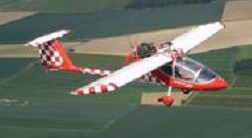
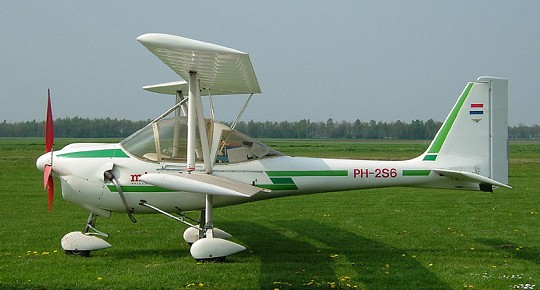
The Aviasud AE-206 Mistral was designed by Francois Goethals and Bernard d’Otreppe and developed by Aviasud Engineering in Fréjus, France, was flown first in 1985. A three-axis, tricycle landing gear, microlight biplane powered by a Rotax 532 engine, the Mistral is a side-by-side two-seated ULM (Ultra Light Motorised aircraft) with forward swept wings.
Manufactured by Aviasud Industries in Fréjus, France, the first delivery took place in April 1986. Over two hundred have been built in France. The Mistral was manufactured in Brasil under licence by Ultraleger Industria Aeronáutica Ltda. The Mistral remained in production by Ultraleger until 2004. Their Mistral B and C were powered by a 65 hp 2 cylinder, 2 stroke liquid cooled Rotax 582 UL-DCDI engine.
On 4 May 1987 a Mistral was flown to the geographic North Pole by Nicolas Hulot.
Following the closure of Aviasud, the Mistral was built by Aeriane circa 1998. Almost entirely built in composites, the entire lower wing acts as ailerons.

Aeriane Mistral

Stall: 35 kt / 40 mph / 65 kmh
Cruise: 72 kt / 83 mph / 133 kmh
VNE: 89 kt / 103 mph / 165 kmh
Empty Weight: 215 kg / 474 lbs
MTOW Weight: 390 kg / 860 lbs
Climb Ratio: 600 ft/min / 3,85 m/s
Glide Ratio: 10,8
Take-off distance (50ft obstacle): 620 ft / 190 m
Landing distance (50ft obstacle): 1100 ft / 335 m

Aeriane Mistral
Empty weight: 215 kg
Wing span: 9.4 m
Wing area: 16.4 sq.m
Fuel capacity: 60 lt
Certification: Vz
Engine: Rotax 582, 64 hp
MAUW: 390 kg
Seats: 2
Max speed: 160 kph
Cruise speed: 133 kph
Minimum speed: 60 kph
Climb rate: 3.85 m/s
Fuel consumption: 15 lt/hr

Aviasud Industries

Aviasud Industries began constructing aircraft in 1980. Produced the AE 206 Mistral two-seat mostly composites-built biplane (first flown 1985), with a twin-engined version principally for advertising and surveillance named Mistral Twin. Also developed AE 209 Albatros (first flown 1991) as two-seat mostly composites ultralight monoplane.

Aviasud Sirocco / Aériane Sirocco / ACLA Sirocco NG / Midland Ultralights Sirocco 377GB

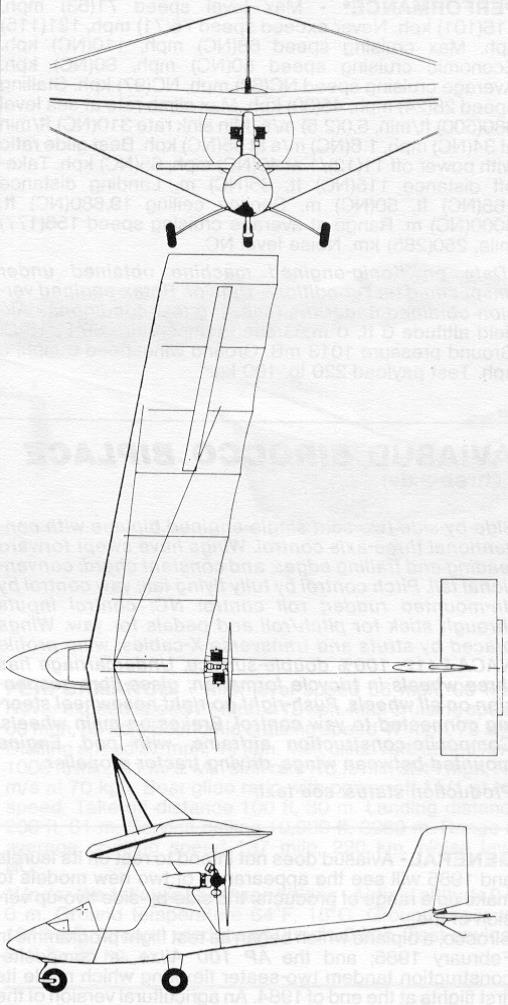
Single seat single engined high wing monoplane with conventional three axis control. Wing has swept back leading and trailing edges, and constant chord; conventional tail. Pitch control by fully flying tail; yaw control by fin mounted rudder; roll control by halfspan spoilers; control inputs through stick for pitch/roll and pedals for yaw. Wing braced from above by kingpost and cables, from below by cables; wing profile modified TK7315 McCready; double surface. Undercarriage has three wheels in tricycle formation with additional tailskid; steel spring suspension on nosewheel and glass fibre suspension on main wheels. Push right go right nosewheel steering connected to yaw control. Brake on nosewheel. Glass fibre/polyester fuselage, partially enclosed. Engine mounted below wing driving pusher propeller. Leading edge in stratified glass fibre/epoxy and tail in stratified glass fibre/polyester; fuselage spar bi-directional stratified.

Designed by Frangois Goethals and Bernard d’Otreppe who are both engineers, and laid out with the help of a computer, this Sirocco is a result of the experience acquired with the Libellule and although it is of a similar configuration it is a completely new machine, despite the confusion generated by its initial title of Libellule MkIL It is one of the very few microlights which has undergone a complete flight test programme, both static and in flight, Frangois being a specialist in fluid mechanics and Bernard d’Otreppe in the study of composite structures. Out of this programme has come what they believe is the optimum wing profile for the Sirocco, the TK 7315 from the American Paul McCready, with 14% chord thickness.

Amongst the original ideas used on the machine is a foldable wing which can be stored in a tube 19.0ft x 10 inch (5.80 x 0.25 m). The fuselage comes down to 19. 0 x 2.0 x 5.0 ft (5.80 x 0.60 x 1.50 m) which makes for easy transport on a trailer, while alternatively, the wing can be carried on a roof rack and the rest of the machine towed on its own undercarriage. Fitted with an adjustable rudder bar to allow for pilot’s height, the Sirocco also has a trimmer for the elevator. Its spoilers seem particularly efficient and it can roll from 45O one side to 45 O the other side in 4 seconds. The Sirocco, the prototype of which made its first flight on the 26 July 1982, has been on sale since January 1983. Options include an instrument panel, VHF or CB radio equipment and a ballistically deployed parachute.

Construction: Aluminium, Fibreglass, Dacron.

Francois Goethals and Bernard D’Otreppes’ company Aviasud built the Sirocco between 1983 and the early 1990.

In 1984 the kit cost $8553 to $11,302 with three engine options.

Aeriane Sirocco

It was then taken over by Aériane, then the Sirocco license was sold to the ACLA company based in the Netherlands, which produced a modernized version as the Sirocco NG.

Midland Ultralights Ltd built the Sirocco 377GB to BCAR Section S in 1984.

The Sirocket comes from a legendary ULM:
There was a major transformation of the prototype Sirocco NG by Dave Stephens and Dean Arnold to create the jet Sirocket classified in the British category of Single Seat Derugalated (SSDR).

Engine: Konig 43RD (430 cc) 27 hp.
Static thrust: 150 lbs.
Empty wt: 252 lbs.
Wing span: 33 ft 2 in.
Wing area: 167 sq.ft.
Length: 19 ft.
Fuel cap; 5 USG.
Max wt: 544 lbs.
Stall: 24 mph.
Max speed: 63 mph.
Vne: 71 mph.
Climb rate: 500 fpm @ 41 mph.
Design limit: +6.7, -3.6g.
Glide ratio: 12-1.
Wing loading: 3.26 lbs/sq.ft.
Power loading: 20.15 lbs/hp.

Engine: JPX PUL425, 26hp at 4600rpm.
Propeller diameter and pitch 39 x 18 inch, 1.00 x 0.45 m.
No reduction.
Max static thrust 150 lb, 68 kg.
Power per unit area 0.17hp/ft., 1.9hp/sq.m.
Fuel capacity 5.3 US gal, 4.4 Imp gal, 20.0 litre.
Length overall 19.0 ft, 5.80 m.
Height overall 8.9 ft, 2.70 m.
Wing span 33.2 ft, 10. 12 m.
Constant chord 4.6 ft, 1.38 m.
Dihedral 0 degs.
Sweepback 10 degs.
Tailplane span 7.2 ft, 2.20 m.
Fin height 3.7ft, 1.10m.
Total wing area 151 sq.ft, 14.1sq.m.
Total spoiler area 6.9 sq.ft, 0.64 sq.m.
Fin area 4.3 sq.ft, 0.40 sq.m.
Rudder area 4.1 sq.ft, 0.38 sq.m.
Total elevator area 15.6 sq.ft, 1.45 sq.m.
Wing aspect ratio 7.3/1.
Wheel track 5.9 ft, 1.80 m.
Wheelbase 4.7 ft, 1.40 m.
Nose¬wheel diameter overall 12 inch, 30 cm.
Main wheels diameter overall 12 inch, 30 cm.
Floats, 10.2ft, 3.10m.
Empty weight 232 lb, 105kg.
Max take off weight 461 lb, 209 kg.
Payload 229 lb, 104 kg.
Max wing loading 3.05 lb/sq.ft, 14.9 kg/sq.m.
Max power loading 17.7 lb/hp, 8.0kg/hp.
Load factors; +6.7, 3.6 ultimate.
Max level speed 71 mph, 115 kph.
Never exceed speed 75 mph, 120 kph.
Max cruising speed 65 mph, 105 kph.
Economic cruising speed 53 mph, 85 kph.
Stalling speed 24 mph, 40 kph.
Max climb rate at sea level 680 ft/min, 3.5 m/s.
Min sink rate 240 ft/min at 31 mph, 1.2 m/s at 50 kph.
Best glide ratio with power off 12/1 at 40 mph, 65 kph.
Take off distance 115 ft, 35 m.
Land¬ing distance 165 ft, 50 m.
Service ceiling 10,500 ft, 3200 m.
Range at average cruising speed 186 mile, 300 km.

Engine: Rotax 377.
Prop: 140cm.
Wingspan: 10.12m.
Length: 5.85m.
Weight: 128 kgs.
Fuel capacity: 40 Ltr.
Econ cruise speed: 35 kts.
Stall: 22 kts.

Aeriane Sirocco
Empty weight: 135 kg
Wing span: 10 m
Wing area: 14 sq.m
Fuel capacity: 40 lt
Engine: Rotax 447 ES, 35 hp
MAUW: 240 kg
Seats: 1
Max speed: 120 kph
Cruise speed: 100 kph
Minimum speed: 45 kph
Climb rate: 5 m/s
Fuel consumption: 5 lt/hr
Price (1998): 500 000 FB hc

Midland Ultralights Ltd Sirocco 377GB
Wing area: 13.99 sq.m
Span: 10.31 m
Standard mean chord: 1.357 m
Empty wt dry: 138 kg
MTOW: 238 kg
Fuel capacity: 20 lt
Pilot/baggage weight min: 120 lb / 55 kg
Pilot/baggage weight max: 200 lb / 91 kg
Vne: 86 mph
Manoeuvering speed: 53 mph
ROC: 800 fpm
Stall: 27 mph

Midland Ultralights Ltd Sirocco 377GB

Aviasud Ultralights

The Aviasud company was founded by Frangois Goethals and Bernard d’Otreppe to build and distribute the first model of the single seater Libellule three axis control design by Bernard Broc. This machine went into small scale production (three per month) in November 1981 and was replaced at this plant with the Sirocco, the prototype of which made its first flight on the 26 July 1982.
1982: Aviasud Engineering SARL, Domaine de la Suvitre, route de la Bouverie, 83480 Puget sur Argens, France.
1984: PO Box 89, Beasley, TX 77417, USA.
Following the closure of the Aviasud factory, the Mistral was constructed by Aériane, and the Albatros by Micronef ULM (1998).

Aviakit Hermes

The composite two seat Hermes can take a Rotax 582 or Jabiru engine.

Engine: Rotax 912, 80 hp
Wing span: 10 m
Wing area: 15.7 sq.m
MAUW: 450 kg
Empty weight: 255 kg
Fuel capacity: 60 lt
Max speed: 180 kph
Cruise speed: 145 kph
Minimum speed: 60 kph
Climb rate: 6 m/s
Seats: 2
Price (1998): 245 000 Fttc
Plan price (1998): 2850 Fttc
Kit price (1998): 99 600 Fttc