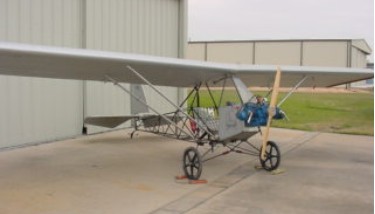
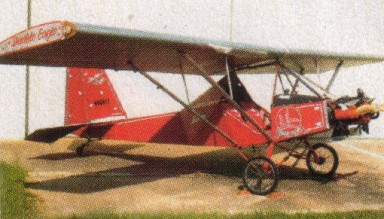
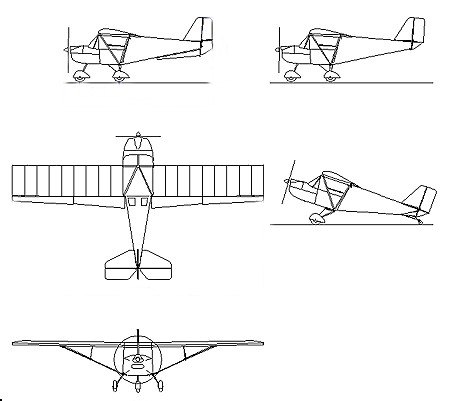
The Double Eagle Airplane is a “plans built” design powered by the widely available stock VW engine, that will carry 2 people with a useful load around 515 Lbs. It can be built and flown under the Light Sport Aircraft Category. This is a strong and simple airplane designed using traditional and proven aviation tubular steel technology. It is easy to build and there has developed around it a strong core of builders that offer help and support for building the aircraft. There is also a full kit developed by John Bolding in consultation with the designer that makes building this design even faster. The Double Eagle Aircraft is a welded fuselage made of aircraft tubing and represents one of the strongest and lightest 2 place airframes on the market today. The design was originally created as a “super” legal eagle for a heavy friend of Leonard’s. When this friend died before the project was finished, Leonard converted it into an Ultralight Trainer for pilots wanting instruction on flying the Legal Eagle. When the FAA changed the rules creating the LSA category this design was certified as a LSA homebuilt design.
Leonard developed the Double Eagle as his 11th airplane project as an outgrowth of the need to have a trainer for his very popular Legal Eagle Ultralight. The Double Eagle started to form up in 2002 and was first widely seen at the 2003 Oshkosh show. A repeat performance in 2004 broadened its popularity, and many kits started out the door. “DE” was getting special treatment in 2007 because of an invitation that Leonard Received from the EAA to display the Double Eagle at the Air Venture 2007 Air Show. It seems that EAA membership has been asking for an affordable Light Sport Aircraft and most others while fine airplanes tend to run upwards of $50,000. Since the Double Eagle can be certified in this category and costs under 10-12 thousand dollars (even paying retail, and getting some building help), it is very affordable the invite went out. The aircraft is sporting a new Culver prop and has many cosmetic improvements and tweaks in celebration of the event.
Specifications Engine: VW 1835 cc, 60 hp Horsepower range: 60-65 Weight: 385 lb (dry) Height: 6 ft 8 in Wing Span: 28 ft 3 in Gross Weight: 900 lb Wing Cord: 55 inches Useful Load: 515 lb Wing Area: 127 sq. ft. Wing Stress Load: 4 G’s Fuselage: 18 ft Fuel Cap: 14 USG Fuel Cap LSA: 10 USG Take Off distance: 250 ft Landing distance: 350 ft Rate of climb: 500 fpm Stall speed: 35 mph Cruise speed: 70 mph Economy cruise: 55 mph Range: 230 sm Seats: 2 Cockpit width: 48 in
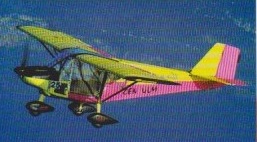
Designed by Philippe Prevot in Toulouse, France, the aim was to produce a high performance microlight airplane of the simplest possible construction to be assembled, inspected and repaired by anybody. Using the geometric strength of a triangle, he patented his cabin frame design. Structural studies were done by the most ENSICA aeronautical school, that confirmed both the strength and light weight of the craft using only straight tubes and no welding. Designed to utilise only straight 2017/2024 aluminium tube with no welding, it is of all alloy construction with tail covered in dacron cloth and the wings and fuselage section come as pre sewn socks of that are slid into place then tightened. The tricycle undercarriage has hydraulic disc brakes. Ninety-eight Sky Rangers were then manufactured in France from 1992 to 1997 under license by SYNAIRGIE. In 1998 manufacture of the V.FUN model of the Skyranger-2, under the French license from Best Off, was moved to AEROS in the Ukraine. The V.FUN-CLASSIC aircraft model with a tail dragger option is available. Aeros aviation engineers who before worked for Antonov Design Bureau added to the design and sales were still made by Best Off as well. Powered by a Simonini from Italy, the 92hp, 6200 rpm in line 2 stroke, is coupled to a 3 blade, 72 inch propeller. The engine has 2 large mufflers fitted making it very quiet in the cockpit and from the ground. It cruises at 80 mph using 10 litres /hr with a four hour endurance. The Skyranger climbing rate is from 3 m/s with 50 hp to near 6 m/s with 80 hp and two people need only 20 minutes to fold the wings. Starting from 2004, the V.MAX basic model with lower wing fence was produced, which fully complies with BCAR’S standards.
600+ SkyRangers are flying all around the world, with over 100 in the United States
Engine: Rotax 582, 64 hp Max weight: 472.5 kg Empty weight: 235 kg Payload (fuel inc): 237.5 kg Std fuel tank: 40 lt Wing area: 14.1 sq.m Take off roll dist: 100 m Landing roll dist: 120 m Gliding ratio (90 km/h): 10 Cruise speed: 130 km/h Vne: 195 km/h Stall speed flaps 3 pos: 64 km/h Rate of climb (450 kg): 4 m/sec Fuel consumption 80%: 14 lt Service ceiling: 4500 m Load factors: 4g/-2g
J2.2 Engine: Rotax 912, 80 hp Max weight: 472.5 kg Empty weight: 250 kg Payload (fuel inc): 220.5 kg Std fuel tank: 40 lt Wing area: 14.1 sq.m Take off roll dist: 90 m Landing roll dist: 120 m Gliding ratio (90 km/h): 10 Cruise speed: 140 km/h Vne: 195 km/h Stall speed flaps 3 pos: 64 km/h Rate of climb (450 kg): 5 m/sec Fuel consumption 80%: 12 lt Service ceiling: 5000 m Load factors: 4g/-2g
Engine: Rotax 912S, 100 hp Max weight: 472.5 kg Empty weight: 255 kg Payload (fuel inc): 217.5 kg Std fuel tank: 40 lt Wing area: 14.1 sq.m Take off roll dist: 70 m Landing roll dist: 120 m Gliding ratio (90 km/h): 10 Cruise speed: 150 km/h Vne: 195 km/h Stall speed flaps 3 pos: 64 km/h Rate of climb (450 kg): 5 m/sec Fuel consumption 80%: 12 lt Service ceiling: 5000 m Load factors: 4g/-2g
Vmax Engine: Simonni Victor 2, 92 hp. ROC: 1,500 ft/min.
SkyRanger VMAX Engine: Rotax 912, 80 hp Maximum Take-Off Weight: 540 kg Wing Area: 14.1 sq.m Wing Span: 9.5 m Max Chord: 1.7 m Length Overall: 5.5 m Fuselage Width: 1.09 m Tail Span: 2.24 m Height Overall: 2.4 m Height to Cabin Top: 1.75 m Undercarriage Track: 1.6 m VNE: 124 mph Max Level Speed: 100 mph Cruise Speed: 80 mph Stall Speed: 37 mph Max Climb Rate (MAUW): 860 ft/min Best Glide Ratio: 9:1 at 60 mph Take-off Distance 50 ft: 254 m Landing Distance 50 ft: 250 m Range at Cruise Speed: 330 miles
SkyRanger Swift Engine: Rotax 912, 80 hp Maximum Take-Off Weight: 540 kg Wing Area: 12.8 sq.m Wing Span: 8.5 m Max Chord: 1.5 m Length Overall: 5.72 m Fuselage Width: 1.09 m Tail Span: 2.42 m Height Overall: 2.4 m Height to Cabin Top: 1.75 m Undercarriage Track: 1.6 m VNE: 126 mph Max Level Speed: 114 mph Cruise Speed: 90 mph Stall Speed: 40 mph Max Climb Rate (MAUW): 1000 ft/min Best Glide Ratio: 9:1 at 60 mph Take-off Distance 50 ft: 254 m Landing Distance 50 ft: 250 m Range at Cruise Speed: 330 miles
Single seat single engined high wing monoplane with conventional three axis control. Wing has unswept leading and trailing edges, and constant chord; cruciform tail. Pitch control by elevator on tail; yaw control by fin mounted rudder; roll control by quarter-span spoilers; control inputs through stick for pitch/roll and pedals for yaw. Wing braced from above by kingpost and cables, from below by cables; wing profile Clark Y derived; 100% double surface. Undercarriage has three wheels in tail dragger formation; no suspension on tailwheel and axle flex suspension on main wheels. Push right go right tailwheel steering connected to yaw control. No brakes. Aluminium tube framework without pod. Engine mounted below wing driving pusher propeller. All aluminium tubing to British HT3OTF specification. In February 1982 the Besam partnership was advertising a full three axis control microlight promising that it would be available ‘soon’. Some explanation of these absences was provided in July when Besam announced that its premises had been first burgled and then set on fire, destroying the working drawings and damaging the prototype to the point where it was easier and safer to start again from scratch.
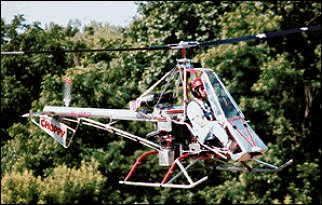
A single seat open frame helicopter. The frame is 4130 steel main frame and bolt-together aluminium tube. A modern version of the Adams-Wilsom Choppy helicopter. Single-seat open-frame helicopter with a Min Speed Hover speed. Video covers flight and testing. All new aluminum tube tail design. New replaceable landing gear. Easy build design for the true homebuilder. Scratch build entirely from plans; CAD plans $95 in 2009. Limited components available.
Engine: 66 hp Rotax 582 or Hirth. Rotor blades: Fleck all 2706 aluminium extrusion Main rotor: 21.5 ft / 6.55m Tail rotor: 36 in Cruise: 65 mph / 105km/h Top speed: 85 mph / 137km/h. Empty wt: 320 lb / 144kg Useful load: 350 lbs. Gross wt: 670 lbs. Width: 5 ft 8 in Height: 6 ft 8 in / 2.03m Length: 15 ft 9 in / 4.80m

 All Aero