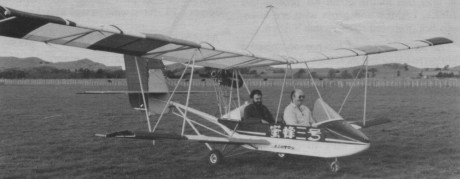
The Bee 2, designed and manufactured by the Beijing Institute of Aeronautics and Astronautics is a two-seat microlight. The Rotax 477-powered Chinese microlight cruises at 40 mph, stalls at 27.5 mph and covers a 120 mile range.
The Bee 2, designed and manufactured by the Beijing Institute of Aeronautics and Astronautics is a two-seat microlight. The Rotax 477-powered Chinese microlight cruises at 40 mph, stalls at 27.5 mph and covers a 120 mile range.
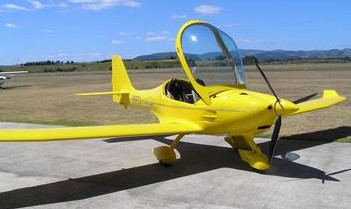
Development of this high-performance cruiser started in 1997, and Otto Funk developed the main wing structure with its special Fowler flap system in co-operation with the University of Stuttgart using its laminar wind tunnel. The rest of the airframe was designed by Peter Funk, whereby standard parts of the FK9 Mk3 were used as far as possible. The construction of the Polaris began in 1998 and the prototype of the FK14 was flown first in May 1999.
The FK14 is constructed in a mix of aluminium and fibreglass composite materials. The cockpit area is built of a crash-resilient tubular steel frame. The wings have a composite leading edge, with spars of carbonfibre covered in sheet aluminium.
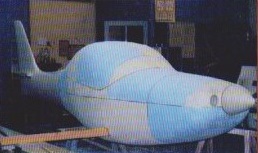
Production of the airframes takes place in Krosno, Poland; assembly of the airframes and the final production of the aircraft in the factory in Speyer in Germany.
Engine options: Rotax 912 / 912-S
Empty weight: 284kg
Max. demonstrated take off weight: 544 kg
Demonstrated ultimate loads: + 6,4g / -4,0g (520kg)
Wingspan: 9,04 m
Length: 5,69 m
Height: 2,00 m (trigearversion)
Vstall: 35 kt / 40 mph / 64 Km/h
Vne: 157 kt / 180 mph / 290 km/h
Cruise (75%): 235 km/h / 243 km/h
Take off run over 15m obstacle: 205m / 180m
Best climb: 1100 / 1500 ft/min at 145km/h
Engine: Rotax 912, 80 hp
Wing span: 8.8 m
Wing area: 9.0 sq.m
Empty weight: 200 kg
MAUW: 450 kg
Max speed: 290 kph
Minimum speed: 65 kph
Seats: 2
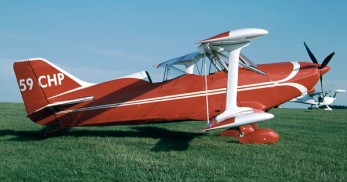
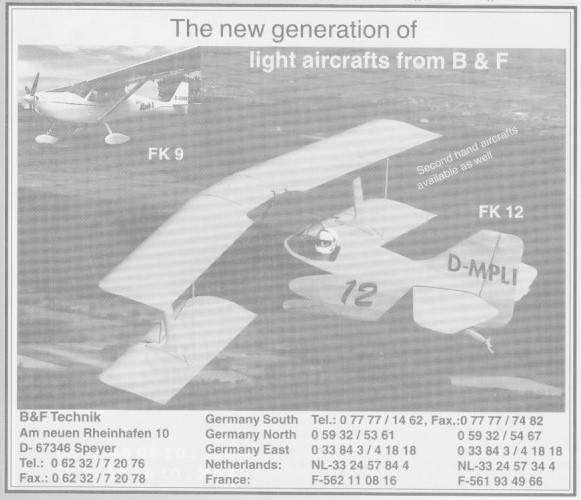
Peter Funk started in 1994 with the development of an Ultralight biplane, which went in production at the end of 1997 as the FK-12 Comet.
The FK12 Comet is an ultra-light two-seat aerobatic biplane design using modern materials.
It has good flight performance with optimised laminar flow wings with 4 full length ailerons (flaperons) making it highly agile with good viability. The wings fold down in a few minutes giving it a width of only 2.42m for storage.

The FK12 has a max. speed of 220 km/h and engines used are Rotax 912 or 912S of 80-100hp. Price 2009: 46000 EURO

Engine: Rotax 912, 80 hp
Wing span: 6.7 m
Wing area: 13.4 sq.m
Empty Weight: 265 kg / 584 lbs
MTOW Weight: 450 kg / 992 lbs
Fuel capacity: 42 lt
Cruise: 103 kt / 118 mph / 190 kmh
VNE: 119 kt / 137 mph / 220 kmh
Stall: 35 kt / 40 mph / 65 kmh
Climb Rate: 1200 ft/min / 6,9 m/s
Take-off distance (50ft obstacle): 460 ft / 140 m
Landing distance (50ft obstacle): 520 ft / 160 m
Fuel consumption: 12.8 lt/hr
Certification: Vz
Seats: 2
Price (1998): 91 600 DM

Created by apprentices at the Airbus school at Speyer, the engine is situated behind the pilot and drivs one prop on either side of the fuselage via toothed belts.
Engine: Suzuki Swift, 50 hp
Empty weight: 200 kg
Wing span: 8.8 m
Wing area: 8 sq.m
Fuel capacity: 80 lt
Certification: vVz
MAUW: 450 kg
Seats: 2
Max speed: 280 kph
Cruise speed: 200 kph
Minimum speed: 60 kph
Climb rate: 6.5 m/s
Fuel consumption: 8.5 lt/hr
Price (1998): 75 000 DM
Kit price (1998): 33 000 DM
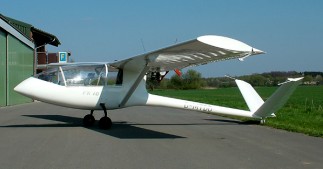
The FK-Leichtflugzeuge FK-10 is a product of B&F Technik Vertriebs GmbH. The FK10 was designed by Otto Funk as a two-seat version of the FK6 and was built in 1994 in the trainee workshop of the MBB Company in Speyer. A Göbler-Hirth 2704 engine powers this fibreglass ultralight. Just one B&F FK10 was built.
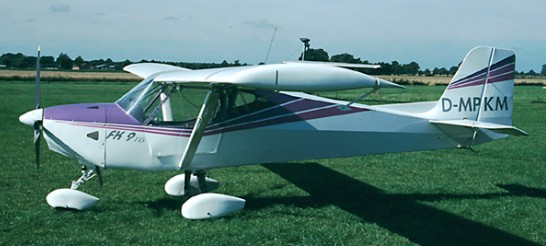
The FK-Leichtflugzeuge FK-9 is a product of B&F Technik Vertriebs GmbH. Production of the airframes takes place in Krosno, Poland; assembly of the airframes and the final production of the aircraft in the factory in Speyer in Germany. Introduced in 1989, the FK9 was a combined design of Otto, and his son Peter.
The 2-seat FK9 utilized the wing concept of the FK6.
To build the FK9 Peter Funk founded in 1990, together with his partner Dirk Breitkreuz, the company B&F Technik. Production of the FK9 Mk.1 begun in the following year. About 40 MLA’s of FK9 Mk 1 version were built until the airplane was re-designed and replaced in production in 1995 by the FK9 Mk 2 version. The FK9 Mark 2 shares its wings with the microlight motor glider FK3, complete with the complex flap and aileron controls, but uses a welded steel spaceframe fuselage. Both the Rotax 503 and 582 are suitable.

The FK9 Mark 2 shares its wings with the microlight motor glider FK3, complete with the complex flap and aileron controls, but uses a welded steel spaceframe fuselage. Both the Rotax 503 and 582 are suitable.
The FK.9 Mk 3 appearened in 1997. The Mark 3 is a Mark 2 with a composite fuselage. The shell is stressed to take a Rotax 912.
By 2010 the Mk.IV was in production. The Mk.IV can have a factor fitted glider tow hook, and folding wings for storage. They can be registed as LSA.
Fk-Lightplanes is the first manufacturer to offer the Mercedes engine system in a serial aircraft. For this the FK9 Smart was created. This design is not just an FK9 fitted with a Mercedes Smart engine. This concept uses the lightweight FK9 Utility airframe, with more sophisticated paintwork and furnishings than the basic version. The streamlined technology implemented includes practical systems and instruments; superfluous details have been deliberately excluded. Configuration and equipment are serial installations but the plane comes ready to fly. This allows a serial price that is below a similarly equipped Rotax FK9.
FK9 Mark 2
Empty weight: 190 kg
Wing span: 9.85 m
Wing area: 11.6 sq.m
Fuel capacity: 42 lt
Certification: Vz
Engine: Rotax 503, 50 hp
MAUW: 450 kg
Seats: 2
Max speed: 180 kph
Cruise speed: 165 kph
Minimum speed: 65 kph
Climb rate: 5 m/s
Fuel consumption: 10 lt/hr
Price (1998): 57 000 DM
FK 9 Mark 3
Empty weight: 270 kg
Wing span: 9.85 m
Wing area: 11.6 sq.m
Fuel capacity: 42 lt
Certification: Vz
Engine: Rotax 912, 80 hp
MAUW: 450 kg
Seats: 2
Max speed: 240 kph
Cruise speed: 195 kph
Minimum speed: 65 kph
Climb rate: 5.50 m/s
Fuel consumption: 10.8 lt/hr
Price (1998): 86 500 DM
FK 9 Mk IV
Engine: Rotax 912 / 912-S
Empty weight: 268 kg
Max. demonstrated take off weight: 544 kg
Demonstrated ultimate loads: +6,1 / -3 g (520kg)
Wingspan: 9,85 m
Length: 5,85 m
Height: 2,15 m (trigearversion)
Vstall: 64Km/h
Vne: 230 km/h
Cruise (75%): 192 km/h / 197 km/h
Take off run over 15m obstacle: 220 / 175m
Best climb: 1000 / 1500 ft/min at 95km/h
FK 9 Mk IV Utility
Stall: 35 kt / 40 mph / 64 kmh
Cruise: 106 kt / 122 mph / 197 kmh
VNE: 116 kt / 134 mph / 215 kmh
Empty Weight: 257 kg / 567 lbs
MTOW Weight: 520 kg / 1146 lbs
Climb Ratio: 1500 ft/min / 8 m/s
Take-off distance (50ft obstacle): 570 ft / 175 m
Otto Funk started in 1984 with the development of the 1-seat ultralight fibreglass FK6. With this design the UL-market was entered.
First flown in 1985 the FK.6, a single-seat high-wing monoplane, was available for construction from plans.
FK-Lightplanes is a product of B&F Technik Vertriebs GmbH. Production of the airframes takes place in Krosno, Poland; assembly of the airframes and the final production of the aircraft in the factory in Speyer in Germany. Otto Funk (=FK) designed in 1959 on behalf of Heinkel in Speyer the metal glider Greif 1a (FK1). This was the start of a range of light aircraft developed by the Funk family.
To build the FK9 Peter Funk and Dirk Breitkreuz founded in 1990 the company B&F Technik.
1998:
am Neuen Rheinhafen I0
D-67346 Speyer/Rhein
Germany
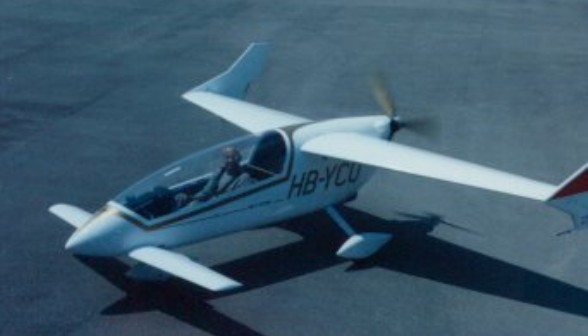
Engine: VW 1600, 33 kW
Propeller: Bezzola Nr. 7
Propeller diameter: 1.38 m
Climb: 2100 rpm
Level: 2300 rpm
Wingspan: 5.60 m
Length: 5.20 m
Height: 1.85 m
Wingarea: 6.00 sq.m
MTOW: 420 kg
Empty weight: 295 kg
Fuel: 46 lt
Vne (never exceed): 250 km/h
Vs (stall, clean): 85 km/h
Vy (best rate of climb): 95 km/h
Rate of climb: 1.80 m/s
T/O 15m: 650 m
Enduranace: 4.0 hr
Seats: 1
Landing Gear: trigear, fixed
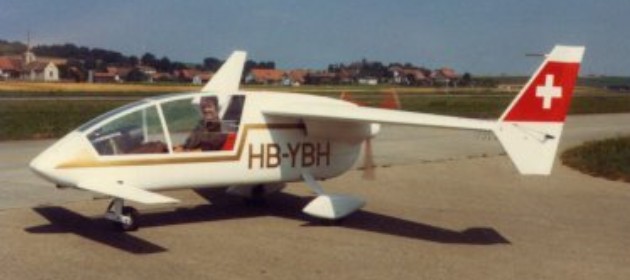
Engine: VW 1600, 33 kW
Propeller: Bezzola Nr. 6
Propeller diameter: 1.38 m
Climb: 2100 rpm
Level: 2300 rpm
Noise Chapt. 6: 65.0 dB
Wingspan: 5.60 m
Length: 4.70 m
Height: 1.80 m
Wingarea: 6.00 sq.m
MTOW: 410 kg
Empty weight: 290 kg
Fuel: 46 lt
Vne (never exceed): 210 km/h
Vs (stall, clean): 80 km/h
Vy (best rate of climb): 90 km/h
Rate of climb: 1.8 m/s
T/O roll: 600 m
Enduranace: 4.0 hr
Seats: 1
Landing Gear: trigear, fixed
 All Aero