Engine: Rotax 582, 65 hp Hp range: 65-100 Top Speed: 100mph. Cruise Speed: 90 mph. Stall Speed: 40 mph. Range: 620 sm. Rate of climb: 800 fpm Takeoff Distance: 150 ft. Landing Distance: 225 ft. Service Ceiling: 12,000 ft. Empty Weight: 613 lbs. Gross Weight: 1300 lbs. Fuel capacity: 24 USG Height: 7 ft. Length: 23 ft. Wingspan: 28 ft. Wing Area: 158 sq. ft. Number of Seats: 1 Cockpit width: 30 in
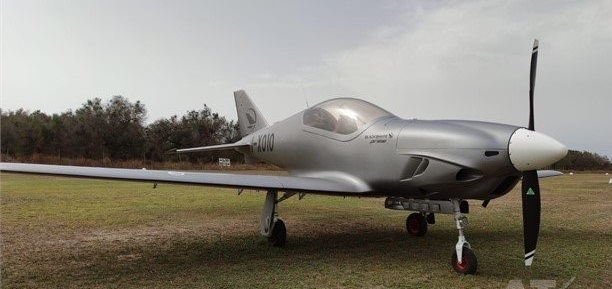
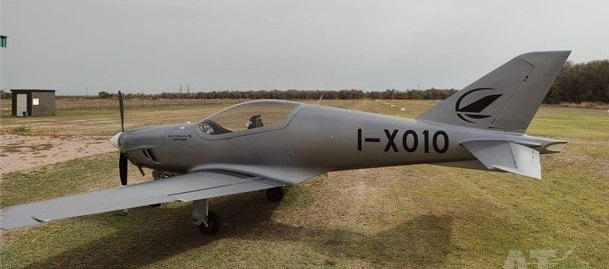
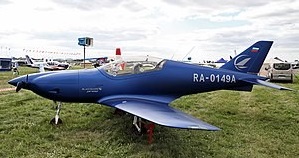
The Blackshape Prime started as the Millennium Master, but the design was later acquired and further developed by Blackshape. The aircraft was designed to comply with the Fédération Aéronautique Internationale microlight rules. It features a cantilever low-wing, a two-seats-in-tandem enclosed cockpit under a bubble canopy, retractable tricycle landing gear and a single engine in tractor configuration.
The aircraft is made from pre-preg carbon fibre. Its 7.94 m (26.0 ft) span wing has an area of 9.96 sq.m (107.2 sq ft) and double slotted flaps. The standard engine available is the 100 hp (75 kW) Rotax 912ULS four-stroke powerplant, driving a two bladed constant speed propeller, which gives it a maximum level speed of 300 km/h (186 mph) and a cruise speed of 275 km/h (171 mph). The 115 hp (86 kW) Rotax 914 was also available as an option.
The aircraft first flew in 2007 and was introduced at the Aero show held in Friedrichshafen in 2009. It is supplied as a complete ready-to-fly-aircraft by Blackshape srl, the company founded in Monopoli by Luciano Belviso and Angelo Petrosillo.
Powerplant: 1 × Rotax 912ULS, 75 kW (101 hp) Propeller: 2-bladed MT-Propeller MTV-33-1-A constant speed Wingspan: 7.94 m (26 ft 1 in) Wing area: 9.51 m2 (102.4 sq ft) Length: 7.18 m (23 ft 7 in) Height: 2.41 m (7 ft 11 in) Empty weight: 296.5 kg (654 lb) Gross weight: 472.5 kg (1,042 lb) Fuel capacity: 66 litres (15 imp gal; 17 US gal) Maximum speed: 300 km/h (190 mph, 160 kn) Cruise speed: 275 km/h (171 mph, 148 kn) Stall speed: 65 km/h (40 mph, 35 kn) flaps down Never exceed speed: 305 km/h (190 mph, 165 kn) Wing loading: 49.68 kg/m2 (10.18 lb/sq ft) Crew: one Capacity: one passenger
With tail dragger or tricycle gear configuration, the BK1 is a design to carry up to 6 ft 4 in 250lb pilot, 30 lbs of baggage, at 130 mph for 400 miles with an hour reserve. At the time it could be built from scratch for under $10K. In 2005 a BK-1 was flown 1200 miles to Oshkosh in 10 flight hours, with 2 fuel stops. The BK-1 also appeared at Sun-N-Fun 2006 and Oshkosh 2006.
Engine: Great Plains 1835 Volkswagen, 60 hp Wing Span: 19 feet 4 inches Length: 15 feet 4 inches Cockpit Width: 24 inches Cockpit Height: 40 inches (curved canopy) Leg Room: 50 inches (firewall to seat back bulkhead) Fuel Capacity: 15 USgallons Empty Weight: 430 pounds Gross Weight: 800 pounds Fuel: 90 Pounds (15 USGallons) Pilot Size: Up to 250 lb – 6 foot 4 inches tall Baggage: up to 30 lb Takeoff Distance: 700 feet Landing Distance: 700 feet Rate of Climb: 750 fpm @ 65 mph IAS (initial) Max Continuous Cruise: 130 mph Fuel burn max cruise :3.5 USgallons per hour. Range 400 miles with reserves. Economy Cruise: 100 mph Economy fuel burn: 2.5 USgallons per hour. Economy range: 500 miles with reserves. Top Speed: 145 mph
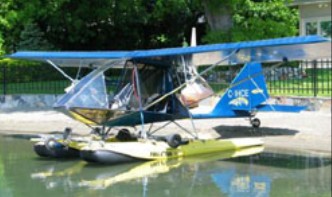
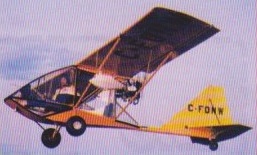
First flown in 1988 the Chinook single seat single engined high wing monoplane had conventional three axis control. Wing has unswept leading and trailing edges, and constant chord; conventional tall. Pitch control by elevator on tail: yaw control by fully flying rudder; roll control by one third span ailerons; control inputs through stick for pitch/roll and pedals for yaw. Wing braced from below by struts; wing profile double surface. Undercarriage has two wheels with tailskid; bungee suspension on tailskid and bungee suspension on main wheels. Push right go right nosewheel steering connected to yaw control. No brakes. Aluminium tube framework, totally enclosed. Engine mounted at wing height driving pusher propeller. The Chinook WT 11 was a completely new design, bearing no relationship to the Atlas, and powered by a Rotax 277 engine. Developed by a homebuilder from Poland, Vladimir Talanczuk, the Chinook had over 150 are on order, with around 10 delivered by 1983. The Chinook WT 11 uses a steerable tailskid. The emphasis with the Chinook is very much on attracting pilots used to conventional light aircraft, and the manufacturer points out that the controls will fall naturally to hand for such pilots, with floor mounted stick and conventionally operated rudder pedals and steering. A set up time of 15 min from trailer is claimed, with two persons. Option of Rotax 377 on WT-11. Aircraft Sales and Parts, established in 1988, was ultimately started by Brent Holomis (now, President of ASAP) who began his ultralight flying in the original Birdman Chinook WT2S. His dreams were to resurrect the Chinook aircraft of the early 1980’s. In late 1989, after nearly 2 years of redesign work was completed with the assistance of engineers from the University of Alberta, he was able to introduce the new Chinook Plus 2, with the wider cabin, the stronger undercarriage, the new modified wings and tail along with the more resilient ceconite fabric.
Chinook Plus 2 Speed max: 95 mph Cruise: 83 mph Range: 298 sm Stall: 32 mph ROC: 1200 fpm Take-off dist: 250 ft Landing dist: 450 ft Service ceiling: 15,000 ft Engine: Rotax 582, 65 hp HP range: 44-75 Fuel cap: 9 USG Weight empty: 380 lb Gross: 900 lb Height: 5.83 ft Length: 17.67 ft Wing span: 32 ft Wing area: 154.5 sq.ft Seats: 2 tandem Landing gear: tail wheel.
Chinook PLUS 2 Stall: 28 kt / 32 mph / 51 kmh Cruise: 63 kt / 72 mph / 116 kmh VNE: 100 kt / 115 mph / 185 kmh Empty Weight: 191 kg / 420 lbs MTOW Weight: 476 kg / 1050 lbs Climb Ratio: 1000 ft/min / 5 m/s Glide Ratio: 10:1 Take-off distance (50ft obstacle): 200 ft / 61 m Landing distance (50ft obstacle): 300 ft / 91 m Price 2009: 17995 USD
Chinook PLUS 2 Engine: Rotax 582 Stall: 28 kt / 32 mph / 51 kmh Cruise: 72 kt / 83 mph / 134 kmh VNE: 100 kt / 115 mph / 185 kmh Empty Weight: 209 kg / 460 lbs MTOW Weight: 476 kg / 1050 lbs Climb Ratio: 1200 ft/min / 6 m/s Glide Ratio: 10:1 Take-off distance (50ft obstacle): 200 ft / 61 m Landing distance (50ft obstacle): 300 ft / 91 m Price 2009: 19995 USD
Chinook PLUS 2 Engine: HKS 700E Stall: 28 kt / 32 mph / 51 kmh Cruise: 65 kt / 75 mph / 121 kmh VNE: 100 kt / 115 mph / 185 kmh Empty Weight: 218 kg / 480 lbs MTOW Weight: 476 kg / 1050 lbs Climb Ratio: 1200 ft/min / 6 m/s Glide Ratio: 10:1 Take-off distance (50ft obstacle): 200 ft / 61 m Landing distance (50ft obstacle): 300 ft / 91 m Price 2009: 20995 USD
Chinook Plus 2 Engine: Rotax 912 Stall: 30 kt / 35 mph / 56 kmh Cruise: 72 kt / 83 mph / 134 kmh VNE: 100 kt / 115 mph / 185 kmh Empty Weight: 236 kg / 520 lbs MTOW Weight: 476 kg / 1050 lbs Climb Ratio: 1400 ft/min / 7 m/s Glide Ratio: 10:1 Take-off distance (50ft obstacle): 100 ft / 30 m Landing distance (50ft obstacle): 350 ft / 107 m Price 2009: 27500 USD
Chinook WT-11 Construction: Aluminium, Dacron. Engine: Rotax 277 (268 cc) 28 hp. Propeller diameter and pitch: 50 x 30 inch, 1.27 x 0.76 m. V belt reduction, ratio 2.0/1. Max static thrust 175 lb, 79 kg. Length overall: 17.5 ft, 5.33 m. Height overall 5.5ft, 1.68m. Wing span 35.0ft, 10.67m. Constant chord 3.9 ft, 1.20 m. Sweepback 0 degs. Total wing area 138 sq.ft, 12.8 sq.m. Wing aspect ratio 8.9/1. Glide ratio: 10-1. Power per unit area 0.20 hp/sq.ft, 2.2 hp/sq.m. Fuel capacity 5.0 US gal, 4.2 Imp gal, 18.9 litre. Empty weight 230 lb, 104 kg. Max take off weight 590 lb, 268 kg. Payload 360 lb, 163 kg . Max wing loading 4.28 lb/sq.ft, 20.9 kg/sq.m. Max power loading: 21.1 lb/hp, 9.6kg/hp. Load factors; >+5.5, > 2.0 ultimate. Max level speed 63 mph, 101 kph. Never exceed speed 90 mph, 145 kph. Cruising speed 55 mph, 88 kph. Stalling speed: 25 mph, 40 kph. Max climb rate at sea level 750 ft/min, 3.8 m/s.
Chinook HKS – Engine: HKS 700E, 60 hp. Length: 18 ft Height: 5 ft 10 in Wing Span: 32 ft Wing Area: 154.5 sq.ft Seats: Tandem Empty Weight: 460 lb Gross Weight: 1050 lb Fuel Capacity: 9 USG Strut Tanks (Opt 14 USG Wing Tanks) Design Load Factors: +4/-2G Vne: 115 mph Top Level Speed: 90 mph Cruise Speed: 75 mph Power Off Stall clean:35 mph Power Off Stall, Flaperons: 32 mph Rate of Climb: 1000-1200 fpm Take of Distance: 200-250 ft Glide Ratio: 10:1 Service Ceiling: 15,000 ft
Engine: Rotax 582, 65 hp Vne: 115 mph Top Level Speed: 95 mph Cruise Speed: 83 mph Power Off Stall clean: 35 mph Power Off Stall Flapersons: 32 mph Rate of Climb: 1200 fpm Take of Distance: 200 ft Glide Ratio: 10:1 Service Ceiling: 15, 000 ft Propeller: 2 or 3 blade Wooden or Composite Diameter: 67″ in Max
Engine: Rotax 503, 50 hp Empty Weight: 406 lbs Length: 17 ft 8 in Height: 5 ft 10 in Wing Span: 32 ft Wing Area: 154.5 sq.ft Seats: Tandem Gross Weight: 1050 lbs Fuel Capacity: 10 USG Design Load Factors: +4/-2G Vne: 115 mph Top Level Speed: 85 mph Cruise Speed: 72 mph Power Off Stall clean: 35 mph Power Off Stall Flapersons: 32 mph Rate of Climb: 1000 fpm Take of Distance: 250 ft Glide Ratio: 10:1 Service Ceiling: 15,000 ft Propeller: 2 or 3 blade Wooden or Composite Diameter: 67″ in Max
Chinook 912 Engine: Rotax 912, 80HP Prop: 2 or 3 blade Wooden or Composite Diameter: 64″ in Maximum Diameter Length: 18 ft Height: 5 ft 10 in. Wing Span: 32 ft Wing Area: 154.5 sq.ft Seats: Tandem Empty Weight: 520 lbs Gross Weight: 1050 lbs Fuel Capacity: 9 USG Strut Tanks (Opt 14 USG Wing Tanks) Design Load Factors: +4/-2G Vne: 115 mph Top Level Speed: 95 mph Cruise Speed: 80 mph Power Off Stall clean: 36 mph Power Off Stall Flaperons: 33 mph Rate of Climb: 1300 fpm Take of Distance: 150 ft Glide Ratio: 10:1 Service Ceiling: 15,000 ft.
ASAP Chinook Plus Empty weight: 172 kg Wing span: 9.75 m Wing area: 14.40 sq.m Fuel capacity: 2 x 34 lt Engine: Rotax 503, 52 hp MAUW: 407 kg Seats: 2 Max speed: 135 kph Cruise speed: 115 kph Minimum speed: 51 kph Climb rate: 5 m/s Fuel consumption: 9.5 lt/hr Kit price (1998): Can$7250
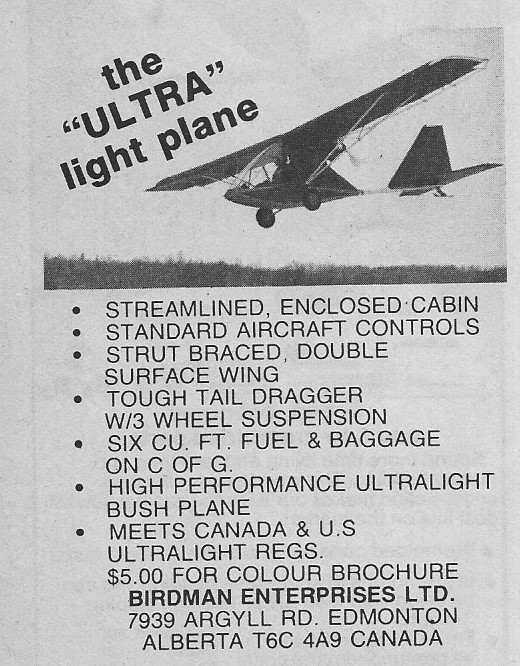
Birdman Enterprise’s first Ultralight design was called the Atlas and was similar in concept to the Eipper formance Quicksilver. Like the Quicksilver, it was offered with two control systems, the hybrid Atlas XC or the three axis Atlas 3A.
Amongst the early enthusiasts who were amongst the first to buy, build or fly a hang glider during early seventies who later went on to become manufacturers was Ken Messenger who founded Birdman.
Birdman Enterprises has been making hang‑gliders since 1972 and ultralights since 1977.

 All Aero