Canadian Light Aircraft Sales & Services Inc / CLASS / Club Aeronautique Delisle Incorporated / CADI / Bushcaddy International Inc

The company started as a flight training operation called Club Aeronautique Delisle Incorporated (CADI), based in Lac Saint-Jean, Quebec. It was founded by Jean Eude Potvin who designed the CADI R-80 and put it into production as a kit aircraft in 1994. He went on to design and build the R-120 and L-160.

Club Aeronautique Delisle Incorporated / CADI
1998:
3690, avenue Grande-Decharge
G0W 1LO Delisle
Qebec
Canada

Sean Gilmore and Marlene Gill started a flight training venture at Montréal/Saint-Lazare Aerodrome, operating a CADI R-80 aircraft. Impressed with the design they became distributors for Potvin, handling marketing outside of Quebec. In 1998 Potvin expressed a desire to retire and Gilmour and Gill bought CADI, including the rights to the R-80, R-120 and L-160 aircraft designs. They renamed the company Canadian Light Aircraft Sales and Service, commonly called CLASS. Between 1998 and 2001 Potvin still produced parts, as CLASS assumed production. Potvin retired in 2001.

To preserve the CADI name the aircraft line was called BushCaddy, a play on the abbreviation and the meaning of one who carries. To expand production the company moved to larger accommodation at nearby Les Cedres, Quebec. By 2005 they had five employees with Gilmore doing the design and engineering work and Gill handling the marketing and financial aspects. Gilmore designed the Bushcaddy L-162 Max and L-164.
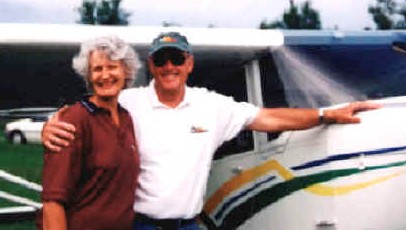
2009 Company owners Sean Gilmore and Marlene Gill

2009: 177-179 Joseph Carrier, Vaudreuil-Dorion, Qc., J7V 5V5, Canada

In about 2010 Gilmore and Gill retired and sold the company to Tony Watkin, an Australian who relocated it to Lachute, Quebec and renamed it after the aircraft line itself, Bushcaddy International Inc.

In November 2012 the company moved production to the Cornwall Regional Airport at Summerstown, Ontario and also accepted a contract with the airport to operate the UNICOM radio service.

Canadian Airmotive CAM 100 / Firewall Forward CAM 100

The Firewall Forward CAM 100 is a 100 hp (75 kW) four-cylinder, four-stroke liquid-cooled piston aircraft engine built by Firewall Forward Aero Engines. Originally designed and built by Canadian Airmotive as the CAM 100 and later marketed by The Cam-Fire Engine Group, it is based on a Honda Civic automotive piston engine. Unit cost was US$8,450 in 2005.

Applications:
Blue Yonder Merlin
Denney Kitfox V
Murphy Rebel
Zenith Zodiac CH 601

CAM 100
Type: Four-cylinder, four-stroke piston engine
Bore: 74 mm (3.07 in)
Stroke: 86.5 mm (3.41 in)
Displacement: 1488 cm3 (90.7 cu in)
Length: 32 inches (810 mm)
Width: 19.5 inches (500 mm)
Height: 25 inches (640 mm)
Dry weight: 226.2 pounds (102.6 kg)
Valvetrain: overhead camshaft
Fuel type: 90 Octane petrol or 100LL aviation petrol
Cooling system: Uses a water-glycol mixture with a camshaft belt driven water pump.
Reduction gear: 2.4:1 reduction ratio (6,000 rpm engine, 2,500 rpm propeller).
Starting system Electric gear reduction starter.
Power output: 100hp (74.6 kW) at propeller flange.
Specific power: 130 kW/L (1.10 hp/cu in)
Compression ratio: 9.6:1
Specific fuel consumption: 0.43 lb/bhp/hr at 80% power

Firewall Forward CAM 100
Cycle: 4 stroke
No cylinders: 4 inline
Bore: 74 mm
Stroke: 86.5 mm
Compression: 9.6
Displacement: 1488 cc
Cooling: liquid
Ignition: Electronic
Reduction: Crantee Belt 2.4/1
Dimension: 570 x 641 x 813 mm
Weight: 101.9 kg
Max pwr: 105 hp
Price 1998: $7950

Canada Air RV ARV Griffin          

Engine mounts were available for Subaru, Continental, and CAM-100.

By 1998 twenty kits had been delivered.

Engine: Divers
Wing span: 10.8 m
Wing area: 10.7 sq.m
MAUW: 681 kg
Empty weight: 340 kg
Fuel capacity: 140 lt
Max speed: 238 kph
Cruise speed: 215 kph
Minimum speed: 73 kph
Climb rate: 8.5 m/s
Seats: 2
Fuel consumption: 25 lt/hr
Kit price (1998): $21,450

Engine: Continental O-200, 100 hp.
HP range: 65-100.
Speed max: 135 mph.
Cruise: 121 mph.
Stall: 45 mph.
Range: 828sm.
ROC: 850 fpm.
Take-off dist: 250 ft.
Landing dist: 450 ft.
Service ceiling: 18,000 ft.
Fuel cap: 37 USG.
Weight empty: 640 lbs.
Gross: 1500 lbs.
Height: 8 ft.
Length: 21 ft.
Wing span: 35.5 ft.
Wing area: 115 sq.ft.
Seats: 2.
Landing gear: nose or tail wheel.

Campbell-Jones Ladybird

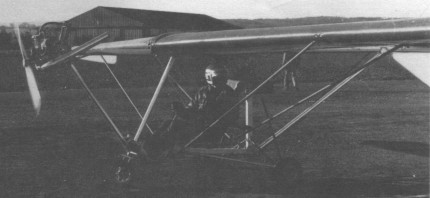
Single seat single engined high wing mono¬plane with conventional three axis control. Wing has swept back leading edge, unswept trailing edge and tapering chord; cruciforin tail. Pitch control by elevator on tail; yaw control by fully flying rudder with additional fin; roll control by wing warping; control inputs through stick for pitch/roll and pedals for yaw. Wing braced from below by struts; 100% double surface. Undercarriage has three wheels in tricycle formation; coil spring suspension on nose¬wheel and disc spring suspension on main wheels. Push right go right nosewheel steer¬ing connected to yaw control. Brake on nosewheel. Aluminium tube framework, without pod. Engine mounted at wing height driving tractor propeller.
Although the Ladybird is the first microlight to carry his name Mike Campbell Jones is no stranger to the micro¬light industry, having worked at one time or another for Hiway and Huntair in Britain, and Fulmar and the EMC 2 company in Belgium.
The Ladybird does not set out to be a high performance aircraft, at least not in terms of climb rate and speed. Instead, Mike has tried to create a light, simple machine with a good glide ratio and pleasant handling. The pro¬totype Ladybird was shown at the Long Marston fly in during August ’82 and was generally well received; however it was obviously in need of refinement and since then push rods and bell cranks have re¬placed control cables, the rudder has been down sized to eliminate over sensitivity and a differential movement has been built into the wing warping mechanism, to give the ‘up’ wing more movement than the ‘down’. The Ladybird’s most unusual feature is its wing warping mechanism, however, this mechanism is not just for roll control; a separate lever allows the pilot to twist both wings equally to adjust the speed range, thus permitting the pilot to select a slower stall speed in preparation for a tricky landing.
In 1983, the aircraft was powered by a Hiro engine, but Mike was not satisfied with its reliability and was consider¬ing substituting the 330 Robin for production aircraft.

Engine: Hiro Delta Mk I, 22 hp at 7500 rpm.
Propeller diameter: 54 inch, 1.37m.
Gearbox reduction, ratio 3.0/1.
Max static thrust 130 lb, 59 kg.
Power per unit area 0.16hp/sq.ft, 1.7hp/sq.m
Fuel capacity 4.8 US gal, 4.0 Imp gal, 18.2 litre.
Empty weight 250 lb, 113kg.
Max take off weight 475 lb, 215kg.
Payload 225 lb, 102 kg.
Max wing loading 3.49 lb/sq.ft, 17.1 kg/sq.m.
Max power loading 21.6 1b/hp, 9.8kg/hp.
Load factors +6.0, 3.0 design
Length overall 18.0 ft, 5.50 m.
Height overall 7.4ft, 2.26m.
Wing span 36.1ft, 11.00m.
Chord at root 4.6ft, 1.40m.
Chord at tip 3.0ft, 0.90m.
Dihedral: 2deg.
Sweepback: 7.5deg
Tailplane span 6.3 ft, 1.91 m.
Fin height 2.0 ft, 0.61 m.
Total wing area 136 sq.ft, 12.6 sq.m.
Fin area 1.5sq.ft, 0.14 sq.m.
Rudder area 9.5sq.ft, 0.88 sq.m.
Tailplane area 10.0 sq.ft, 0.93 sq.m.
Total elevator area 22.0 sq.ft, 2.04 sq.m.
Wing aspect ratio 9.64.
Wheel track 5.0 ft, 1.52 m.
Wheelbase 5.5 ft, 1.68 m.
Nosewheel diameter overall 13 inch, 33 cm.
Main wheels diameter overall 13 inch, 33 cm.
Floats, dimensions length 12 ft, 3.7 m.
Max level speed 55 mph, 88 kph.
Never exceed speed 65 mph, 105 kph.
Max cruising speed 50 mph, 80 kph.
Economic cruising speed 45mph, 72kph.
Stalling speed 25 28mph, 40 45kph.
Best glide ratio with power off 13/1 at 45 mph, 72 kph.
Take off distance 150 ft, 45 m.
Land¬ing distance 100ft, 30m.
Service ceiling 3000ft, 910m.
Range at average cruising speed 100 mile, 161 km.

Campana AN 4 Campana

A composite side by side two seater.

Engine: Limbach L 2000, 80 hp
Wing span: 11.08 m
Wing area: 14.31 sq.m
Empty weight: 255 kg
MAUW: 450 kg
Fuel capacity: 140 lt
Fuel consumption: 12 lt/hr
Max speed: 230 kph
Cruise speed: 210 kph
Minimum speed: 63 kph
Climb rate: 4.3 m/s
Seats: 2
Certification: CASA
Price (1998): 336,000 Fttc
Kit price (1998): 195,000 Fttc

CAG Toxo

CAG Toxo is available with bigger engines in VLA version.

Toxo ultralight
Stall: 35 kt / 40 mph / 64 kmh
Cruise: 119 kt / 137 mph / 220 kmh
VNE: 189 kt / 217 mph / 350 kmh
Empty Weight: 284 kg / 626 lbs
MTOW Weight: 450 kg / 992 lbs
Climb Ratio: 1400 ft/min / 7,5 m/s
Glide Ratio: 16
Take-off distance (50ft obstacle): 160 ft / 49 m
Landing distance (50ft obstacle): 250 ft / 76 m

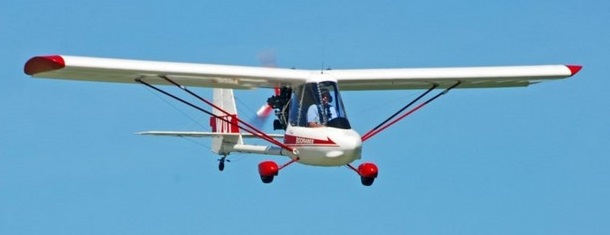
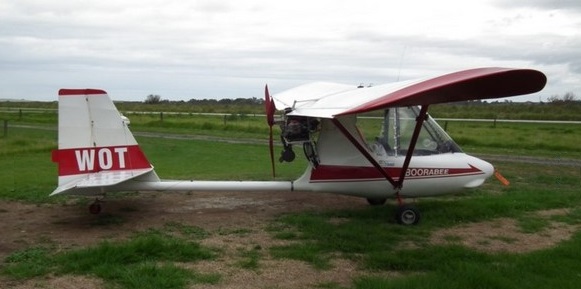
Cadet Boorabee

Mk1

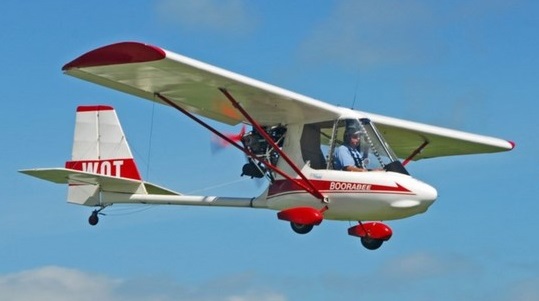
Tom Cadet designed and built the Mk1 Boorabee in 1992. The Mk1 Boorabees flew with a Rotax 503and the first aircraft has had at least 3 different engines including an HKS fitted in 2010.

The original fuselage pod mould for the Boorabee was made from the two halves taken from a crashed Rotec Panther, then modified by making the front more pointed and taking the aft section up to the wing. Tom also added a sheet alloy floor pan. A Maxair Drifter contributed the aluminium tube boom and empennage.

Dave Donohoe, a colleague of Tom Cadet, developed the Boorabee’s airfoil. This wing was mated to a new fuselage mould to use a 4 x 3 inch rectangular boom and Dave called the result the Shuttle.
For the Boorabee’s wing, Tom used fibreglass/Kevlar ribs with a glass/Kevlar leading edge. The main spar caps are 40 x 1.6mm drawn alloy tubes with 1.2mm sheet web plates; the rear spar is a 44 x 1.6mm tube.

Boorabees are extremely docile aircraft with few if any vices. The Mk1s are really powered gliders without air brakes (better than 12:1 glide) they tend to float so it requires a special technique to spot land them.

Cadet built two Mk1 Boorabees then made new moulds and simplified the design for the Mk2.

Three versions of the Boorabee appeared. The Mk 1 has a 30ft wing span. That of the Mk 2 was reduced to 29ft, and a new mould was made to improve the shape of the fuselage pod. Alloy shear plates were used to simplify wing construction, and flaperons adopted. Kevlar was used extensively to lighten the aircraft. Both the first Mk 1 and Mk 2 were registered in 1993.

Mk1

A lengthened pod, offering more foot space for the rear-seat passenger, was introduced with the Mk 3, which also had the shorter wing.

The choice of powerplant was usually the Rotax 582 or 618. A Rotax 503 was used by Bob Evans of Evans Head for his Mk 2, completed as a single seater with a more rounded tail.

There were nine Boorabees built in total before Cadet gave the fuselage plug to Dave Donohoe who modified it for a rectangular boom tube. Dave’s Shuttle shared the same wing but the boom, tail, undercarriage and controls were vastly different. Cadet loaned the moulds to persons he trusted, and gave them the CAD plans at no cost.

For several years, Tom freely provided scale drawings to those interested in building a Boorabee, the use of his moulds, and builder support. A dozen or so Boorabees were completed by local builders.

Mk1

As with all pusher aircraft, the airflow around the rear of the fuselage was a problem, causing slight instability in yaw as well as reduced thrust from the propeller. After experiments on the Mk 1s a line of vortex generators on the fuselage immediately solved the issues. Because the two blades of the original propeller disturbed the air at the wing trailing edge in unison, resulting in uncomfortable vibration at certain speeds, a three-blade propeller was found to be necessary. Apart from these annoyances the Boorabee proved very successful, with hundreds of hours logged by each aircraft.

No more Boorabees were built because it required a great deal of effort by Cadet for builder assistance and it became very difficult to get the 5″ boom tube and necessary drawn tubing to build the wing. He still had the moulds years later.

The first Boorabee has flown thousands of hours.

Boorabee Mk1
Engine: HKS 700 E 60hp
Wingspan: 9.2 m / 30 ft
Length: 5.85 m
Empty Weight: 284 kg
Maximum Take Off Weight: 554 kg
Fuel Capacity: 94 litres
Never exceed: 90 Kts
Cruise Speed: 60Kts
Stall Speed: 30 Kts
Take off roll: 200 meters
Rate of Climb: 500 ft per minute
Endurance: 10 hours
Seats: 1

Mk 2
Wing span: 29 ft

Mk 3
Wing span: 29 ft