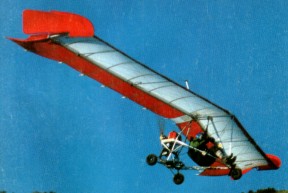
Cascade Ultralights Kasperwing

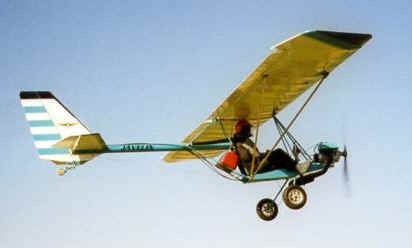
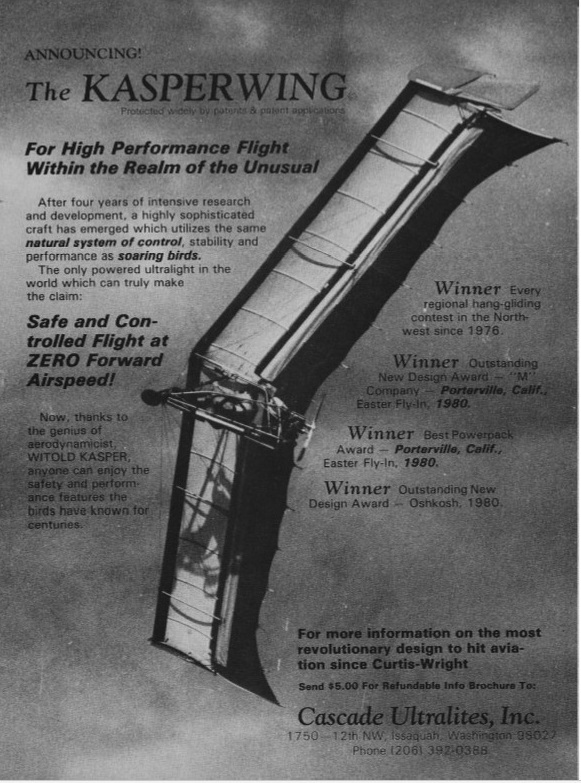
Witold Kasper never got his designs into production and it was left to someone else to harness the potential of Kasper’s “vortex lift” theory. Steve Grossruck, a US hang-glider designer, applied the Kasper wingtip controls to a Fledge hang-glider and found himself with a wing that would not stall or spin. It was also stable about all three axis at all speeds, and had a sink rate of 160 fpm with a 150 lb pilot. In keeping with the Kasper “vortex lift’ theory, the wing could be flown with hands-off stability in a vertical descent. Yaw and roll control proved to be totally independent of the craft’s forward speed.

Cascade Ultralights Kasperwing Article

The theory proven, it was decided to add power – initially with a 250cc Honda Odyssey of 23hp but later with a 242cc Zenoah 23hp engine. A special harness was designed to further realise the potential flight performance predicted by Kasper’s theories. The harness allowed faster weight shifting and enabled the pilot to make the precise trim changes required for vertical descents and safe landings.
This ability to “mush” down or fly below the stall without spinning or dropping its nose provides an ability to “parachute” vertically at about 600-800 fpm riding on a span-wise vortex of air which shears off at the leading edge of the wing, forming a low pressure area.
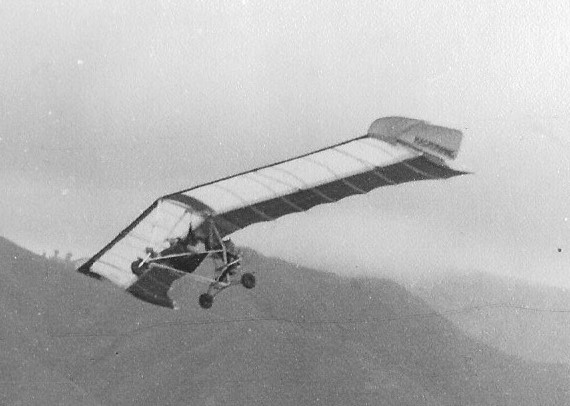
In 1980 the Kasperwing was the outstanding new design at Oshkosh and hang-glider versions have consistently won contests in the Northwest American States. The Kasperwing is the only microlight that is still controllable at zero forward speed. It then flies in a so-called “mush” without risk of spinning or loss of control. The rate of descent, 900 feet per minute, is rapid, but the experienced pilot can translate to forward momentum at any time during such a descent.
Engine: 242 cc123 hp Zenoah G-25B 1-cylinder two-stroke
Wing Span: 34 ft
Wing Area: 180 sq. ft
Length: 12 ft 8 in
Cruise speed: 35 – 45 mph
Stall speed: 18 – 22 mph
Max. rate of climb: 550 – 650 fpm
Empty weights: 150 lb
Max. pilot weight: 220 lb
Fuel consumption: 1 USG/hr
Range: 85 miles.

Engine: Rotax 277.
Prop: 152 cm.
Wing span: 10.67m.
Length: 3.86m.
Weight: 111 kg.
Fuel cap: 19 lt.
Cruise: 39 kts.
Stall: 20 kts.
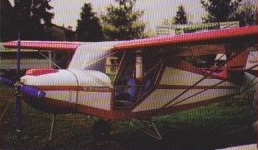
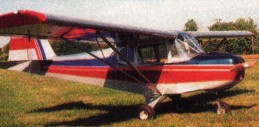
Carpenterie M 81 Butterfly

The M 81 uses mixed wood and steel construction, all covered in heat-shrunk Dacron.

Engine: Rotax 912, 80 hp
Wing span: 9.6 m
Wing area: 15.5 sq.m
MAUW: 450 kg
Empty weight: 255 kg
Fuel capacity: 40 lt
Fuel consumption: 15 lt/hr
Max speed: 150 kph
Cruise speed: 120 kph
Minimum speed: 65 kph
Climb rate: 3 m/s
Seats: 2
Price (1998): 30,000 DM
Kit price (1998): 20,000 DM

Carlson Sparrow

Sparrow II

The Carlson Aircraft Sparrow Ultralight is a three axis aircraft conforming to FAA 103 regulations.
The Sparrow II is a two seat version of the Sparrow ultralight with optional folding wings.

Gallery

Sparrow II
Engine: Rotax 582, 66 hp.
Speed max: 130 mph.
Cruise: 110 mph.
Range: 300 sm.
Stall: 36 mph.
ROC: 1750 fpm.
Take-off dist: 75 ft.
Landing dist: 150 ft.
Fuel cap: 10 USG.
Weight empty: 510 lbs.
Gross: 1050 lbs.
Height: 7.75 ft.
Length: 18 ft.
Wing span: 31.5 ft.
Wing area: 140 sq.ft.
Seats: 2.
Landing gear: nose wheel.

Sparrow II XTC
Engine: Subaru, 82 hp.
HP range: 66-85.
Speed max: 130 mph.
Cruise: 110 mph.
Range: 400 sm.
ROC: 1100 fpm.
Take-off dist: 150 ft.
Landing dist: 250 ft.
Service ceiling: 13,000 ft.
Fuel cap: 22 USG.
Weight empty: 600 lbs.
Gross: 1250 lbs.
Height: 7.75 ft.
Length: 18 ft.
Wing span: 31.17 ft.
Wing area: 140 sq.ft.
Seats: 2.
Landing gear: nose wheel.
Optional Continental C-85 or Rotax 912 engine.

Sparrow Sport Special
Engine: Rotax 503, 52 hp.
Speed max: 120 mph.
Cruise: 85 mph.
Range: 300 sm.
Stall: 31 mph.
ROC: 1750 fpm.
Take-off dist: 85 ft.
Landing dist: 175 ft.
Service ceiling: 12,000 ft.
Fuel cap: 10 USG.
Weight empty: 360 lbs.
Gross: 710 lbs.
Height: 5.3 ft.
Length: 16.8 ft.
Wing span: 26.8 ft.
Wing area: 117 sq.ft.
Seats: 1.
Landing gear: tail wheel.

Sparrow Ultralight
Engine: Rotax 277, 28 hp.
Wing span: 30.2 ft.
Wing area: 120 sq.ft.
Length: 16.75 ft.
Height: 6.75 ft.
Weight empty: 115 kg / 254 lbs.
MTOW Weight: 229 kg / 504 lbs
Fuel cap: 5 USG.
Cruise: 50 kt / 58 mph / 93 kmh.
Range: 200 sm.
Stall: 26 mph / 23 kt / 42 kmh
VNE: 55 kt / 63 mph / 101 kmh
ROC: 750 fpm.
Take-off dist: 140 ft.
Landing dist: 195 ft.
Service ceiling: 10,000 ft.
Seats: 1.
Landing gear: nose wheel.

Capella Javelin / T-Raptor

The Capella Javelin is a family of American open cockpit, high wing, tractor configuration, conventional landing gear-equipped ultralight aircraft that were designed by J. Reid Howell and produced in kit form by Capella Aircraft of Austin, Texas and intended for amateur construction.

First flying in 1998, the single seat Javelin I was designed to comply with the American FAR 103 ultralight regulations, including that category’s maximum 254 lb (115 kg) empty weight. The 2001 cost was US$6000 without engine, propeller, instruments or covering supplies.

The design features an open frame fuselage of welded 4130 steel tubing, with the pilot’s and passenger’s seats bolted to the frame. The horizontal stabilizer and tail fin are also constructed of welded steel tubes. The wing is framed from riveted aluminium tubing with all flying surfaces covered in doped aircraft fabric. The wing is equipped with full span ailerons.

The conventional landing gear includes sprung-steel main gear and a similarly sprung steerable tail wheel. The open cockpit design provides good visibility while taxiing.

The standard engine supplied by the manufacturer for the single seat version was the 28 hp (21 kW) Rotax 277, but it was reported that the aircraft was underpowered with that engine installed. The throttle control is of a unique motorcycle grip type.

Original factory kit options included a cockpit pod and windshield, brakes and steel tube powder coating.
The single-seat Javelin was developed into a tandem two-seater, designated the Javelin II and then further developed into the T-Raptor ultralight trainer. The T-Raptor uses a wider and more enclosed fuselage, with optional bubble-windowed doors, to allow cool weather flying and was intended to be marketed to ultralight schools.

Capella Aircraft went out of business in late 2007, and the type is no longer in production.

Variants:

Javelin I
Single seat open cockpit ultralight
Engine: 1 × Rotax 277, 28 hp (21 kW)
Wingspan: 28 ft 0 in (8.53 m)
Wing area: 112 sq ft (10.4 sq.m)
Length: 18 ft 0 in (5.49 m)
Height: 6 ft 0 in (1.83 m)
Empty weight: 240 lb (109 kg)
Gross weight: 575 lb (261 kg)
Fuel capacity: 5 US gallons (19 litres)
Maximum speed: 63 mph (101 km/h, 55 kn)
Cruise speed: 60 mph (97 km/h, 52 kn)
Stall speed: 26 mph (42 km/h, 23 kn)
Range: 140 mi (220 km, 120 nmi)
Service ceiling: 12,500 ft (3,800 m)
Rate of climb: 400 ft/min (2.0 m/s)
Seats: one

Javelin II
Two seats-in-tandem open cockpit ultralight trainer powered by a 50 hp (37 kW) Rotax 503 engine. It was reported as being in development in 1998 and forecast to be available at the end of 1998.

T-Raptor
Two seats-in-tandem ultralight trainer powered by a 50 hp (37 kW) Rotax 503, 64 hp (48 kW) Rotax 582 or 60 hp (45 kW) HKS 700E four stroke engine. The T-Raptor has an expanded-width steel cage to provide a more enclosed cockpit and is a development of the Javelin II.

Capella Aircraft Corp Capella

Capella Single Seat

Desined by J. Reid Howell
The Capella SS first flew in 1988.
Folding wing optional.

The FW2T has a dacron covered spaceframe fuselage, while the strut braced wings are fabricated from sheet dural, pop riveted.

FW2T

The Capella XLS first flew in 1990.
Capella Aircraft Corp received certification in Germany for the Capella XLS model FW2C80 and Capella SS model FW1C50.
The Capella XS first flew in 1990.
The Capella Fastback first flew in 1995.

Capella Fastback

Capella SS
Engine: Rotax 503, 50 hp.
HP range: 40-50.
Speed max: 112 mph.
Cruise: 102 mph.
Stall: 34 mph.
ROC: 980 fpm.
Take-off dist: 130 ft.
Landing dist: 130 ft.
Service ceiling: 10,000 ft.
Fuel cap: 7 USG.
Weight empty: 360 lbs.
Gross: 650 lbs.
Height: 5.67 ft.
Length: 17.33 ft.
Wing span: 27.5 ft.
Wing area: 110 sq.ft.
Seats: 1.
Landing gear: nose or tail wheel.

Capella XLS
Engine: Rotax 912, 80 hp.
HP range: 65-80.
Speed max: 121 mph.
Cruise: 119 mph.
Stall: 41 mph.
ROC: 1450 fpm.
Take-off dist: 200 ft.
Landing dist: 150 ft.
Service ceiling: 10,000 ft.
Fuel cap: 22 USG.
Weight empty: 560 lbs.
Gross: 1100 lbs.
Height: 5.67 ft.
Length: 18.4 ft.
Wing span: 28.5 ft.
Wing area: 114 sq.ft.
Seats: 2.
Landing gear: nose or tail wheel.

Capella XS
Engine: Rotax 582, 65 hp.
HP range: 65-80.
Speed max: 116 mph.
Cruise: 111 mph.
Stall: 41 mph.
ROC: 1200 fpm.
Take-off dist: 175 ft.
Landing dist: 115 ft.
Service ceiling: 10,000 ft.
Fuel cap: 10 USG.
Weight empty: 480 lbs.
Gross: 1100 lbs.
Height: 5.67 ft.
Length: 18.4 ft.
Wing span: 28.5 ft.
Wing area: 114 sq.ft.
Seats: 2.
Landing gear: nose or tail wheel.

Capella Fastback
Engine: Rotax 912, 80 hp.
HP range: 65-80.
Speed max: 121 mph.
Cruise: 120 mph.
Stall: 36 mph.
ROC: 1450 fpm.
Take-off dist: 200 ft.
Landing dist: 150 ft.
Service ceiling: 10,000 ft.
Fuel cap: 10/22 USG.
Weight empty: 560 lbs.
Gross: 1100 lbs.
Height: 5.7 ft.
Length: 18.5 ft.
Wing span: 28.5 ft.
Wing area: 114 sq.ft.
Seats: 2.
Landing gear: tail wheel.

Capella FW2T
Engine: Rotax 912, 80 hp
Wing span: 8.63 m
Wing area: 10.62 sq.m
MAUW: 450 kg
Empty weight: 265 kg
Fuel capacity: 52 lt
Fuel consumption: 14 lt/hr
Max speed: 180 kph
Cruise speed: 155 kph
Minimum speed: 58 kph
Climb rate: 3.8 m/s
Certification: VZ
Seats: 2
Kit price (1998): $13,795

Capella Aircraft Corp

Capella Aircraft Corporation was an American aircraft manufacturer based in Austin, Texas. Formed about 1988, the privately held company specialized in the design and manufacture of light aircraft in the form of kits for amateur construction, including for the US FAR 103 Ultralight Vehicles rules.

1995-8: 4211-C Todd Ln., Austin, TX 78744, USA.

Capella produced a number of aircraft designs, all of a strut-braced, high wing configuration. The first series were all enclosed cockpit designs, starting with the Capella SS, a single seat model introduced in 1988. In 1990 the Capella XS two-seat conventional landing gear model followed, along with a tricycle gear model, the Capella XLS. The Capella Fastback was introduced in 1995.

In 1998 the open cockpit single-seat Capella Javelin I was introduced as a FAR 103 ultralight. This was followed by the Capella Javelin II the same year and finally the Capella T-Raptor, all variants of the basic Javelin design.

The company went out of business about 2007.