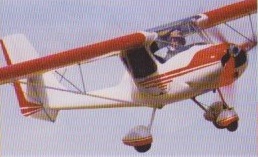
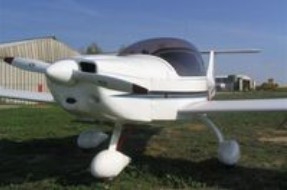
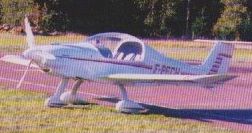
The Starlet was designed by Australian aero engineer John Corby of Sydney, N.S.W, Australia, for a competition held by English company Rollason Aircraft Ltd in 1964. The design was placed eighth, although it became first from the competition to be built. The prototype (VH-CBS) first flew on August 9th, 1967. The Corby Starlet is a semi-aerobatic sports aircraft made of an all-wood onstruction. The fuselage is a combination of spruce longerons and frames and is sheeted with plywood. The wing is a single-piece structure, consisting of a solid laminated spar and built-up ribs. The remainder of the wing, including the ailerons, is open-structure and fabric covered. The D-nose leading edge is plywood covered. The main undercarriage consists of spring-steel legs bolted to a stiffened frame in the fuselage, immediately behind the firewall. An 8 Imp. gallon fuel tank is located in the fuselage, immediately behind the firewall. Powered usually by a VW conversion, the Starlet will take any suitable engine up to 75 hp and 72 kg (160 lb) in weight, and is aerobatic with limitations of +4.8 and 1.8G. Fuel consumption in the Starlet is between 10 and 14 litres per hour, depending on the power settings used, with an economic cruise of 110 knots. The Starlet can carry 15 lbs in a locker behind the seat, still normally within centre of gravity limits. Extra freight in most single seat homebuilts is usually either worn or sat upon to keep the C of G in the same place. Economic cruise is around 85 knots. At almost full throttle (3400 revs) the aircraft will approach VNE (138kts). The stall in a glide came at 35 knots. Some Starlets have been outfitted with 2180’s (75-80 hp) and these cruise at VNE (185) and climb at 1900 fpm.
Corby CJ-1 Starlet Engine: VW or Jabiru Horsepower: VW 45 – 75 hp Jabiru 80 hp Propeller: Wood 54 inch Overall Length: 15.1 ft (4.6 m) Height: 4.8 ft (1.46 m) Wingspan: 18.5 ft (5.63 m) Wing Area: 68.5 sq ft (6.36 sq m) Wing Loading: 10.9 lbs/sq ft (4.9 kg/sq m) Cabin Width: 21.75 inch (.55 m) Empty Weight: 450 lbs (203.6 kg) Gross Weight: 750 lbs (339.4 kg) Useful Load: 300 lbs (135.7 kg) Fuel Capacity: 11.1 gal (42 l) Maximum Speed: 139 kts @ sea level Cruise Speed: 113 kts Stall (or Min.) Speed:@ gross weight 30 kts Service Ceiling: 14,500 ft (4419 m) Takeoff Distance: 350 ft (106 m) Landing Distance: 450 ft (137 m) Rate of Climb (gross): 1000 fpm Maximum Range: 425 nm “G” Loading: +4.5g (+6.75g ultimate), -4.5g Landing Gear: FG (Tailwheel) Seats: 1
Corby Starlet Engine: VW conversion, 70 hp Engine range: 160 lbs or less 75 hp Fuselage Length: 14 ft 9 in Height: 4 ft 10 in Width: 21.75 in Span: 18 ft 6 in Wing Area 68.5 sq.ft Wing loading 10.2 lb/sq.ft Power loading 11.6 lbs per hp Empty Weight 450 – 500 lbs Gross weight one piece wing: 750 lbs Gross weight two piece wing: 650 lbs Takeoff distance 350 ft Landing distance 450 ft Fuel capacity 11 gals US/ 9.7 Imp. Gals/44 lbs/20 kg Stall (power off) 35 mph Top speed (level) 160 mph Normal Cruise 115-130 mph Fuel burn Cruise 3.5 gph US / 21 lbs per hr VNE (Mph) 159 (tested to 185) Rate of Climb 850 fpm Range 425 sm Servive ceiling: 14,500 ft Roll Rate 270 dps (approx.) Take-off dist 50 ft: 1200 ft Landing dist 50 ft: 1200 ft Design Load +/- 4.5 proof (+/- 6.75 ultimate) Utility or Semi Aerobatic MAC 45 in Incidence 2.5 deg – 1 deg Tip Airfoil: NACA 43012A Aileron Deflection +15 deg – 15 deg Horizontal tailplane Span: 6 ft 6 in Area: 13.75 sq. ft. Elevator deflection +30 deg – -20 deg Vertical Tailplane Area: 7.4 sq. ft. Rudder Deflection +/- 25 deg Horsepower range: 30 to 60 Engine Weight 130-160 lbs C.G. Range: 20 – 25% MAC or 8.7 in to 11.4 in” aft of Wing LE Number of Seats: One Building Time: 1400+
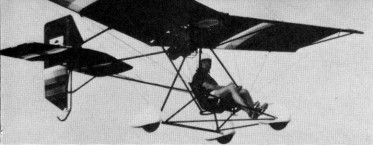
The Condor II is a single seat single engined high wing mono¬plane with conventional three axis control. Wing has unswept leading and trailing edges, and constant chord; cruciform tall. Pitch control by elevator on tail; yaw control by fully flying rudder; roll control by one third span spoilerons; control inputs through stick for pitch/roll and pedals for yaw. Wing braced from above by kingpost and cables, from below by cables; wing profile; single¬ surface. Undercarriage has three wheels in tricycle formation; torsion bar suspension on nosewheel. No ground steering. No brakes. Aluminium¬ tube framework, with optional pod. Engine mounted below wing driving pusher propeller. All rigging wires are stainless steel with a vinyl coating and double swaging, and the aluminium tubing is ano¬dized clear and ‘covered with stabilised Dacron’. Lift off and landing speeds are quoted as 20 24 mph (32 39 kph) and 20 25 mph (32¬40kph) respectively. Options include floats, ballistically de¬ployed parachute, strobe, pod and electric start; normally, starting is by recoil, with an in flight restart facility. Price in 1982 of $5245. Condor Aircraft describe the Condor III as a beefed up version of the Condor II, designed for heavier payloads, and accordingly the company quotes a much higher maximum take off weight for this side by side two seater with single centre stick. The Condor III+2 is a two-seat version. Dual stick and rudder three-axis controls, dual throttle.
Condor II Engine: Kawasaki TA440, 40 hp at 6000 rpm. Prop¬eller diameter and pitch 56×36 inch, 1.42×0.91m. Toothed belt reduction, ratio 2.0/1. Max static thrust 238 lb, 108 kg. Power per unit area 0.24hp/sq.ft, 2.6 hp/sq.m . Fuel capacity 5.0 US gal, 4.2 Imp gal, 18.9 litre. Length overall 10.0 ft, 3.05 m. Height overall 9.7ft, 2.96m. Wing span 32.0ft, 9.75m. Constant chord 5.3 ft, 1.60 m. Sweepback 0 deg. Total wing area 168 sq.ft, 15.6sq.m. Wing aspect ratio 6.3/1. Empty weight 240 lb, 109kg. Max take off weight 545 lb, 247kg. Payload 305 lb, 138kg. Max wing loading 3.24 lb/sq.ft, 15.7 kg/sq.m. Max power loading 13.6 lb/hp, 6.2 kg/hp. Load factors +5.0, 3.0 design. Max level speed 55 mph, 88 kph. Never exceed speed 60 mph, 97kph. Max cruising speed 55mph, 88kph. Economic cruising speed 42mph, 68kph. Stalling speed 19 mph, 31 kph. Max climb rate at sea level 775 ft/min, 3.9 m/s. Best glide ratio with power off 7/1. Take off distance 40 ft, 12 m. Landing distance 75 ft, 23 m.
Condor III Engine: Kawasaki 440 A or B, 40 or 50 hp. 2:1 reduction drive to 56×36 prop. Wing span 33.0ft, 10.06m. Constant chord 5.1 ft, 1.55 m. Total wing area 168 sq.ft, 15.6sq.m. Wing aspect ratio 6.5/1. Empty weight 252 lb, 114kg. Max take off weight 657 lb, 298kg. Payload 405 lb, 184kg. Max wing loading 3.91 lb/sq.ft, 19.1kg/sq.m. Max power loading 16.4 lb/hp, 7.5kg/hp. Never exceed speed 65 mph, 105 kph. Max cruising speed 51 mph, 82 kph. Economic cruising speed 38 mph, 61 kph. Stalling speed 24 mph, 39 kph. Max climb rate at sea level 600ft/min, 3.0m/s. Take off distance 60ft, 18m. Landing dis¬tance 90 ft, 27 m.
Condor III+2 Wingspan 32’. Wing area 168 sq.ft. Length 10’. Empty weight 286 lbs. Gross weight 684 lbs. Cruise speed 45 mph. Stall speed 25 mph. Vmax 55 mph. Vne 75 mph. Takeoff roll 90’. Landing roll 90-120’. Fuel capacity 5 USG. Engine: Kawasaki 440 2:1 reduction drive to 56×36 wood prop. 50- or 75-hp version was available.
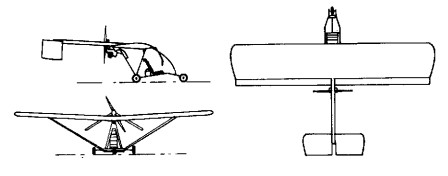
Single seat single engined high wing monoplane with hybrid control. Wing has unswept leading and trailing edges, and constant chord; inverted V tail. Pitch/yaw control by elevon; roll control by full span ailerons; control inputs through stick for pitch/yaw/ roll. Wing braced from below by struts; wing profile; double surface. Undercarriage has three wheels in tricycle formation; suspension on all wheels. Nosewheel steering independent from yaw control. No brakes. Aluminium tube framework, without pod. Engine mounted below wing driving pusher propeller. In 1983 this machine was still in its prototype stage and therefore its characteristics and performances are not fully known. However, R J Davies has two original ideas in this new design. Firstly, the full span ailerons can be operated together to serve as flaps. Secondly, the motor on the Firebird Flyer (a Spitfire 250FA of 28hp or possibly later a water-cooled 220LC of 35 hp) drives a two bladed pusher propeller, which rotates about the axis of the tubular metal boom which carries the tail.
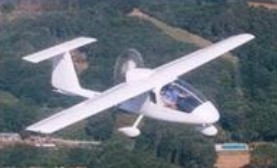
Eyeing entry into the U.S. market in 2012 was the Colyaer Freedom S100, a long-wing, composite Spanish entry that was ASTM-certified (#44) but lost its distributor. In 2012 a Lakeland, Fla., dealer was working on reintroducing it to America.
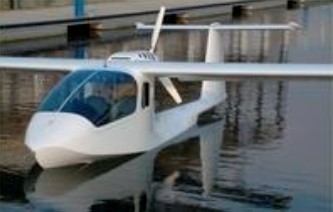
The Colyaer Gannet S100 is a seaplane that shares the wing, tail and upper fuselage of the Colyaer Martin 3. It has a water rudder and an optional reversible prop. On both airplanes, the engine is in the rear, which means less noise and greater visibility. Both the Colyaer Martin 3 and the Colyaer Gannet S-100 are made of Kevlar, which has a better strength-to-weight ratio than fiberglass, making the airplane both strong and light.
Stall: 35 kt / 40 mph / 65 kmh Cruise: 97 kt / 112 mph / 180 kmh VNE: 140 kt / 162 mph / 260 kmh Empty Weight: 270 kg / 595 lbs MTOW Weight: 450 kg / 992 lbs Climb Ratio: 1000 ft/min / 5 m/s Glide Ratio: 20 Take-off distance (50ft obstacle): 140 ft / 43 m Landing distance (50ft obstacle): 140 ft / 43 m
Ultralight Motorglider also with shorter wingspan model 110 with better cruise; 200km/h. The Colyaer Gannet S100 is a seaplane that shares the wing, tail and upper fuselage of the Colyaer Martin 3. On both airplanes, the engine is in the rear, which means less noise and greater visibility. Both the Colyaer Martin 3 and the Colyaer Gannet S-100 are made of Kevlar, which has a better strength-to-weight ratio than fiberglass, making the airplane both strong and light.
Stall: 35 kt / 40 mph / 65 kmh Cruise: 97 kt / 112 mph / 180 kmh VNE: 140 kt / 162 mph / 260 kmh Empty Weight: 270 kg / 595 lbs MTOW Weight: 450 kg / 992 lbs Climb Ratio: 1000 ft/min / 5 m/s Glide Ratio: 23 Take-off distance (50ft obstacle): 390 ft / 120 m Landing distance (50ft obstacle): 390 ft / 120 m

 All Aero