Vortech G-1

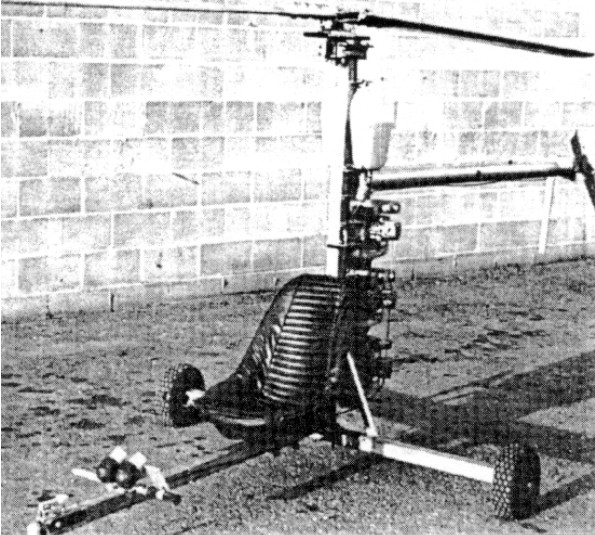
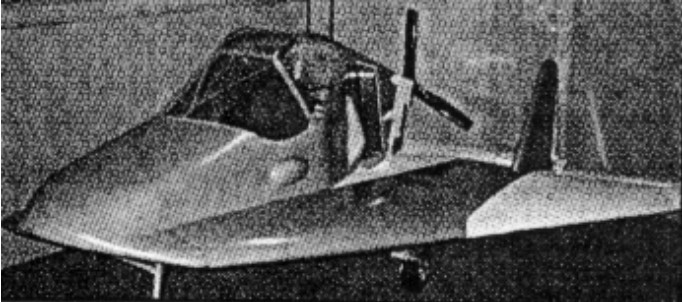
The G-1 Ultrtalight Helicopter, created in the early 1970s by Art Weilage, was tested and sold as low-cost kits by Compcop, Inc. Vortech offers the original construction prints to hobbyists curious about this design, or who want to study the concept as inspiration for a design of their own.
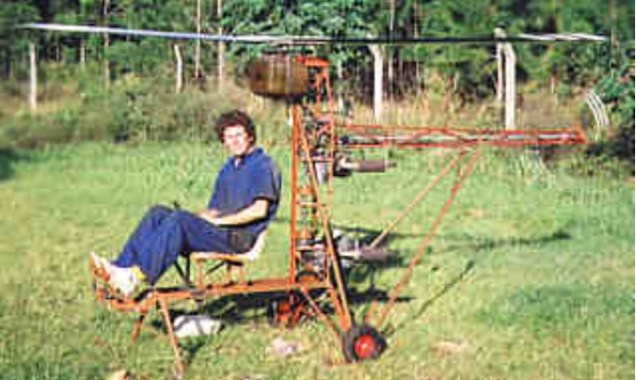
Developed, tested and sold in the 1970’s by Compcop, the G-1 was designed to fill the need for an affordable, easy-to-build ultralight helicopter. The entire helicopter can be built at home with ordinary tools at a low cost. No license is required to fly the G-1 because it is in the license-free “Ultralight Aircraft” category (see FAR Part 103). The construction manual provides all the details needed to build the G-1 with an engine of 40 h.p. or higher. The three McCulloch go-cart engines can be replaced with a single engine such as the Rotax 447. Aluminium construction.

Carries one person. Takes off and lands vertically. Flies forward, backward, sideward, & hovers.

Engines: 3 x McCulloch MC101 42 hp
Empty wt: 150 lb
Max wt: 420 lb
Rotor span: 12ft
Height: 5.5ft
Length: 12ft
Max speed: 80 mph
Cruise: 55 mph
Climb rate: 1,000 fpm
Range: 120 sm
Service ceiling: 10,000 ft
Seats: 1

Engine (typical) Kawasaki or Rotax, 40+ hp
Length 12 ft
Width 5.7 ft
Height 5 ft 6 in
Main rotor diameter 12 ft
Tail rotor diameter 2 ft
Empty weight 150 lbs
Gross weight 420 lbs
Useful payload 270 lbs
Fuel capacity 5 USgals
Fuel consumption 4 USgals/hour
Speed (max.) 80 mph
Altitude (max.) 10,000 ft asl

Engine: 3 x McCulloch, 9.5 hp
Rotor span: 3.66 m
MAUW: 190 kg
Empty weight: 66 kg
Fuel capacity: 19 lt
Max speed: 128 kph
Cruise speed: 80 kph
Fuel consumption: 12 lt/hr
Seats: 1
Plan price (1998): $34.95
Volmer VJ-24 SunFun

VJ-24E

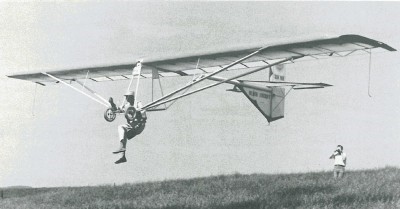
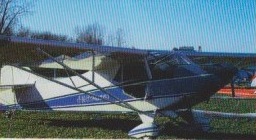
The VJ-24 is Volmer Jensen’s hang glider design built from aluminum. This motorglider is constructed of aluminum tubing plus fabric, and originated as a foot-launched glider. SunFun is made from pop riveted aircraft aluminium with the wings leading edge formed in styrene foam. Covering is polyester aircraft fabric doped. Control is by aileron, elevator and rudder. A permanent seat is built into the hanger structure.

Volmer VJ-24 SunFun Article

The VJ-24 was first flown in about 1975 and showed excellent controllability with a joystick. Plans were available from Volmer Aircraft for $100.00. Materials have been estimated at $2400, with a building time of 250 hours.

The VJ-24 uses pip pins and thumb screws to assemble in 10 minutes without tools.

Designated the VJ-24E, the Sunfun is essentially a simplified version of the Swingwing hang glider or powered hang glider. The wings are fabric-covered aluminum tube and are a rectangular-planform type braced by V struts. The two wheels are for ground handling only, so the Sunfun is foot-launched and foot-landed. A 10-hp engine and fuel tank are installed beneath the wing and behind the pilot so that takeoff can be performed without benefit of a steep hill. Wingspan is 36 feet 6 inches, and total weight is 110 pounds. The Volmer VJ 24E Sunfun has a useful load of about 200 pounds, burns about 1.5USG per hour.

A minimum powered glider, the VJ-24W is a modified version of VJ-24E Sun Fun hang glider with wheeled landing gear, tractor engine, independent rudder control, manufactured by Airway Aircraft Inc., 905 Airway Ave., Glendale, CA 91201, USA.

Fairing behind pilot cuts drag. Independent three-axis controls. Construction is all metal with Dacron cover. Yamaha KT100 or McCulloch 101 engine. Two main wire wheels, tail skid undercarriage.

Gallery

VJ-24
Wingspan: 36 ft
Wing chord: 4 ft 6 in
Wing area: 160 sq.ft
Empty weight: 110 lb
Speed range: 18-25 mph

VJ-24
Speed max: 40 mph
Cruise: 30 mph
Range: 30 sm
Stall: 17 mph
ROC: 350 fpm
Take-off dist: 100 ft
Landing dist: 100 ft
Engine: Yamaha, 15 hp
Fuel cap: 1.5 USG
Weight empty: 210 lbs
Gross: 410 lbs
Height: 5.75 ft
Length: 198.5 ft
Wing span: 36 ft
Wing area: 163 sq.ft
Seats: 1
Landing gear: tail wheel

VJ-24W Sun Fun
Wing span: 36.5 feet
Wing area: 163 square feet
Empty weight: 165 pounds
Max gross weight: 345
Engine: Yamaha KT-100, 97.6cc, 15 hp.
Reduction unit: 2,75:1
Prop: 57 in
Wingspan: 36 ft
Wing area: 160sq.ft
Aspect ratio: 8:1
Length 18’
Empty weight 200 lbs
Payload 200 lbs
Gross weight 400 lbs
Wing loading 2.5 lbs/sq.ft
L/D 10:1
Cruise speed 30mph
Stall speed 18mph
Vmax 40 mph
Takeoff run 100’
Landing roll 100’
Climb Rate 350 fpm
Fuel Capacity 1.5 USG

Chord length: 4.5 ft
Wing span: 36.5 ft
Wing area: 163 sq,ft
Aspect ratio: 6.75
Weight: 110 lb
Pilot weight: 160-200 lb
Takeoff speed: 13 mph
Stall speed: 15 mph
Max speed: 30 mph
Best glide ratio (L/D): 9.5
Best L/D speed: 17 mph
Min sink: 158 fpm

Volmer Aircraft

Volmer S. Jensen was born in Milwaukee in 1909. He began to design and build sailplanes in 1925 at age 16. using plans published in the Boy Mechanic Magazine. He built a second one the following year from additional plans from the same source, and in 1927 he built his first glider with aerodynamic controls, an enclosed cockpit and a wheeled landing gear. The latter was based on the MIT glider Eddie Allen had taken to Europe in the mid-20s to compete against the Germans.

Volmer had moved to Seattle in 1925 to serve an apprenticeship as a machinist, and in 1928 he built a cantilever wing glider for a wealthy sportsman named Thomas Stimson. Volmer called it his VJ-4 and would utilize that numbering system for the remainder of his long aircraft design and construction career.

Throughout the late 1920s and 1930s his designs consisted of a series of increasingly sophisticated gliders, including the VJ-10 he built in 1939 which was the first two-place, side-by-side sailplane in the United States. During this period, Volmer was employed by a succession of aircraft companies, including Boeing, Consolidated, and Northrop, so his glider design and building were done in his spare time.

1946: Acquired Jarvis Aircraft Co assets.
Plans and component kits marketed by Herr Engr Corp, Lakeland FL.

To EAA members he is best known as the designer of the Volmer VJ-22 Sportsman, the first amphibian made available for home construction. To sailplane enthusiasts, he is revered as one of the pioneers of U. S. glider design and construction, with his first original design dating back to 1928. Hang glider pilots are amazed to learn that he built his first weight-shift biplane glider in 1925 when he was 16 … and ultralight pilots recall that he added an engine to his Sunfun hang glider in 1975.

Produces plans to construct VJ-22 Sportsman two-seat amphibian (first flown 1958) and VJ-24W SunFun single-seat open microlight (earlier VJ-23 Swingwing is recognised as having been the first modern microlight).

1995-8: Box 5222, Glendale, CA 91201, USA.

Volmer Jensen was the builder of the model of the Starship Enterprise that was used in the filming of the TV series and movies! (although it was designed by cabin Waco owner, Matt Jeffries.)

Volmer Jensen,
Burbank CA.
USA

Vol Mediterrani VM-1 Esqual / Esqual Aerocomp AB VM-1

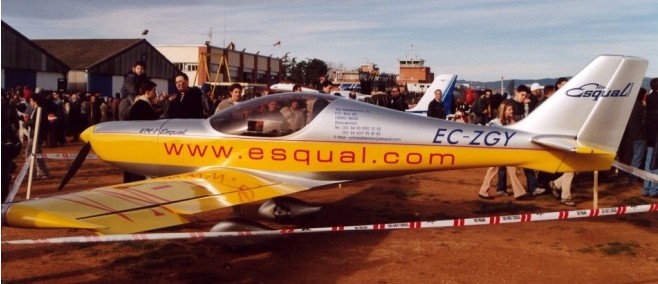
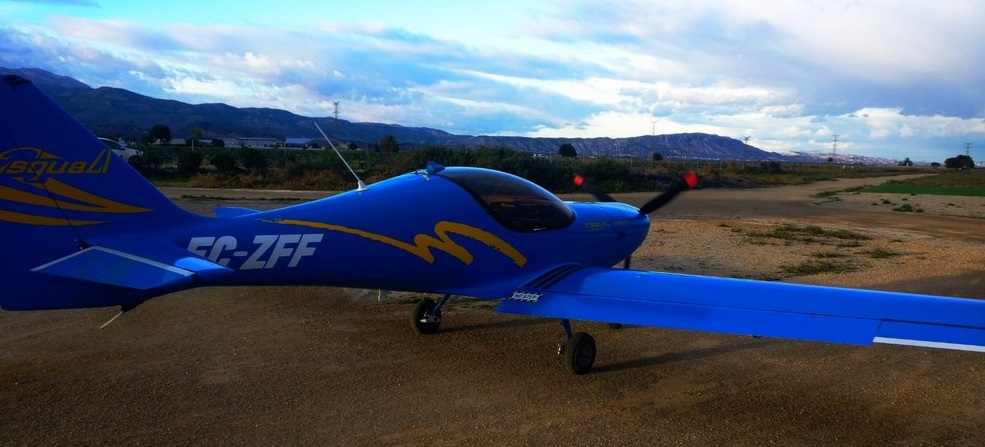
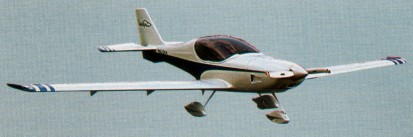
The VM-1 Esqual is a two seat light plane manufactured in composite with high density PVC foam and Epoxy resins. Laminated in a mould and vacuum cured in an oven at constant controlled temperature and humidity.

The fuselage is monocoque. The safety reinforced cockpit has twin axle composite beams all around its frame. The low cantilever wing has positive changing flaps (as high lift devices). The wing structure has a composite sandwich skin with a main double “T” composite spar and an accessory spar near the trailing edge.

Vol Mediterrani VM-1 Esqual

The cockpit seats are side by side. The rudder pedals are adjustable in flight. Electric operated flap and mechanical trim are standard, electric trim is an option. Independent ventilation openings are standard, a cabin heater is an option. The luggage compartment (with 50lts capacity) is located behind the seats and can be accessed during flight.

Vol Mediterrani VM-1 Esqual

The landing gear of the Esqual has a classic tricycle gear which is made of 7175 T6 aluminium grade. The main gear legs are suspended in the main carry through beam together with the reinforced wing spar zone. The main wheels are equipped with independent hydraulic brakes for steering. The nose gear leg is supported in the engine mount and equipped with a free swivel nose wheel.

2009 Price: 75000 EURO

Engine: Rotax 912 ULS (100 HP)
Wing span: 9.10 m
Wing area: 9,0 m²
Length 6.08 m
Height 1.94 m
Empty Weight: 265 kg / 584 lbs
Maximum weight: 544 Kg
Fuel capacity: 2 x 50 lts
VNE: 173 kt / 199 mph / 320 kmh
Stall: 33 kt / 39 mph / 62 kmh
Cruise: 135 kt / 155 mph / 250 kmh
Climb Rate: 1800 ft/min / 9 m/s
Glide Ratio: 1:19
Take-off distance (50ft obstacle): 450 ft / 138 m
Landing distance (50ft obstacle): 660 ft / 200 m
Roll rate (45/45º) 2 sec
Cockpit width 110 cm

Voliamo S. Franscesco

S. Franscesco 3

The S. Franscesco side by side two seater has a spaceframe fuselage and fabric covered wooden wings.

The prototype first flew in 1976.

S. Franscesco 3
Engine: Limbach, 80 hp
Wing span: 9.7 m
Wing area: 12 sq.m
MAUW: 450 kg
Empty weight: 280 kg
Fuel capacity: 50 lt
Max speed: 170 kph
Cruise speed: 140 kph
Minimum speed: 60 kph
Climb rate: 3 m/s
Seats: 2
Fuel consumption: 10 lt/hr

VULA Skypup / Wood Sky Pup

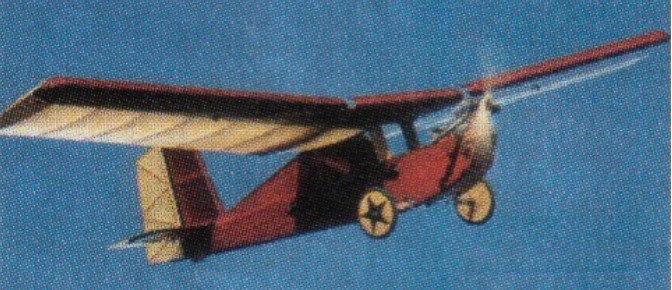
First flown in 1980 and introduced in 1982, the Sky Pup is a single seater designed as an FAR 103 Ultralight Vehicles compliant aircraft with an empty weight within that category’s 254 lb (115 kg) empty weight limit. The aircraft was intended to require the minimum financial investment and the designer intended that the airframe would be able to be completed for US$1000 using locally available materials. In 2001 that Sky Pups had been completed for US$2000, including the engine. A single-seat, high wing, cantilever, single engine, conventional landing gear ultralight aircraft that was designed by Steven K. Wood of Whitewater, Colorado for amateur construction.

The aircraft fuselage and wings are constructed from epoxy-glued Douglas fir, with foam wing ribs all covered in doped fabric or Dacron. The wing is a three-piece design, allowing quick disassembly for transport or storage. The landing gear suspension is made from maple wood. The Sky Pup can be built with an open cockpit or fully enclosed, allowing flying in cooler weather. The Sky Pup is available as plans only (for US$70). The power range specified is 18 to 28 hp (13 to 21 kW), with the largest engine specified the 28 hp (21 kW) Rotax 277. The 20 hp (15 kW) 2si 215, 28 hp (21 kW) Hirth F-33 and 22 hp (16 kW) Zenoah G-25 have also been used. Approxamately 350 were built.

The design was professionally engineered and incorporates a very clean cantilever wing that results in a 12:1 glide ratio. The control system is two-axis, using only elevator and rudder controls, roll being introduced by rudder via a generous dihedral angle. The elevator is stick-controlled, while the rudder is controlled via conventional aircraft pedals. The aircraft is stall and spin proof. Reported construction times are 450-600 hours.

Plans were initially sold direct by the designer and, in the early 2000s, by the Vintage Ultra and Lightplane Association. Later the designer’s son marketed the plans and this is the current source.

Sky Pup
Engine: 1 × Zenoah G-25 , 22 hp (16 kW)
Propeller: 2-bladed wooden
Length: 16 ft 0 in (4.88 m)
Wingspan: 31 ft 0 in (9.45 m)
Height: 4 ft 4 in (1.32 m)
Wing area: 130 sq ft (12 sq.m)
Empty weight: 195 lb (88 kg)
Gross weight: 400 lb (181 kg)
Fuel capacity: 5 US gallons (19 litres)
Maximum speed: 69 mph / 111 km/h / 60 kt
Cruise speed: 55 mph / 48 kt / 89 km/h
Stall speed: 26 mph / 23 kt / 42 km/h
Range: 150 mi / 130 nmi / 241 km
Rate of climb: 450 ft/min / 2.3 m/s
Takeoff dist: 200 ft
Landing dist: 100 ft
Service ceiling: 5000 ft
Lift-to-drag: 12:1
Seats: one
Landing gear: tailwheel