Denny Aerocraft Co

Denny Aerocraft Co was the original Idaho source for the Denny Kitfox two-seat cabin homebuilt with good short-field characteristics, first flown 1984 and hugely successful. Manufactured under license in Australia, Brazil, Philippines, Portugal, and South Africa, and developed into improved variants. See Skystar Aircraft Corporation.

Denney Aerocraft produced the first Kitfox kit in November of 1984 in a small factory in Boise, Idaho. The Kitfox was designed as a lightweight, two-place sport aircraft with excellent STOL (Short Takeoff and Landing) performance and the ability to operate from short and unimproved airfields. The Kitfox features folding wings and is easily trailered, allowing owners to share hangar space or keep their Kitfox’s at home in a single car garage. Six Model 1 Kitfox’s were delivered that first year. Since 1984, over 4,000 Kitfox kits have been delivered to builders throughout the United States, Canada, and over 42 foreign countries. Under Dan Denney’s leadership, the Kitfox evolved from the original Model 1 to continually improved versions referred to as the Models 2, 3, 4, and Classic 4.

In June 1992, Phil Reed / SkyStar Aircraft Corporation purchased the rights to produce the Kitfox kit from Denney Aerocraft. (1995: 100K N.Kings Rd, Nampa, ID 83687, USA.) SkyStar immediately began development of a completely new Kitfox, the Series 5. This larger aircraft was designed to fit the needs of a growing segment of the marketplace that wanted a “Weekend Cruiser.” These pilots wanted a recreational airplane that combined the best attributes of the Kitfox with greater useful loads, certified engines, increased cabin space, and larger cargo capacity. The Series 5, which offered both a taildragger (the Outback/Safari) and a tri-gear (the Vixen/Voyager) configuration, answered these requests and became one of the most successful introductions in the history of the kit plane industry.
In January of 2000, an employee group acquired SkyStar Aircraft. SkyStar announced the new Kitfox Series 6, an airplane that incorporated all of the best features of all versions of the Series 5. The Series 5 evolved into the Series 6, and then the Series 7.
In October of 2005, Skystar encountered financial difficulties and ceased operations. In April of 2006, the assets of Skystar were acquired by Kitfox Aircraft LLC, a newly formed organization operated by John and Debra McBean. The McBean’s own and operate Sportplane LLC, a Kitfox specialty supply firm they founded after John’s departure from Skystar in 2003.

Delta Technology DS-26 Nomad

A high-wing monoplane with conventional tail surfaces. The ailerons and elevators are operated by a control stick, while the rudder is operated by pedals. Aluminum tubing is used throughout. The wings are built from premolded leading edge forms and preformed sheet metal structural parts. Wing and tail covering is 1.8-ounce Dacron. Complete kits require final assembly. POWERPLANT: Unitrek 140-10 mounted in pusher position aft and below the main wing. A 1:1.98 reduction unit turns a two-blade wooden Ritz propeller. Fuel is carried in a high density polyethylene tank directly behind the pilot seat on GG. LANDING GEAR: Monowheel main gear with tail skid wheel. The main wheel measures 10 inches, and the rudder-connected tail wheel is 4 inches in diameter. The DS-26 allowed 28-50 hp Rotax engines. Doped double surface wing-covering, conventional three axis airplane controls, full 3600 roll cage, all metal aircraft type structure, 20 minute set-up.
Units delivered to June 1981: 189. Price 1982: $3,860.

Delta Technology DS-26 Nomad Article

In 1984 Delta Technology had completed all design modifications on all three of the company’s Nomad and Honcho ultralights.

”The Nomad 11, Honcho 11 and Super Honcho are now ready to go, and with the completion of our new production facility, we are prepared to deliver in two to four weeks,” a company spokesman said. ”Our intent is to offer a special introduction price on.a limited number of aircraft in order to stimulate interest and awareness in the newly completed models,” he added.

Delta also reduced the price on all three models by $1,000. The Honcho 11 was $3,980, the Nomad 11 $4,380 and the Super Honcho $4,980.

The Honcho 11 features all-metal construction, traditional, strutted wing design, energy-absorbing 360 degree roll-cage fuselage, conventional three-axis controls, strong wing structure with differential ailerons, hydraulically dampened independent suspension and a 10-year lifespan on double-surface wing coverings.

This offer was good until July 31, 1984; however, a limited quantity of aircraft were available. A production number and delivery date was to be issued upon receipt of payment in full or a 50 percent deposit.

DS-26A
Wingspan, 36 ft. 1 in.
Wing area, 147.34 sq.ft.
Aspect ratio, 8.84:1.
Overall length, 22 ft.
Empty weight, 152 lbs.
Usable payload (include fuel), 210 lbs.
Wing loading, 2.46 lbs/sq.ft.
L/D power-off glide ratio, 14.5:1.
Cruise speed (85% power), 35 mph
Stall speed, 24 mph.
Approach speed, 31 mph.
Flair speed, 24 mph.
Liftoff speed, 30 mph.
Takeoff roll distance, 225 ft.
Rate of climb, 185 fpm.
Fuel capacity, 2.5 USG.
Range at cruise, 106 sm.
Engine displace¬ment, 8.2 cu.in.
Rated HP, 10 hp. S
tatic thrust, 85 lbs.

DS-26B
Engine: Solo 335, 20 hp.
Wing span: 11m.
Lenght: 5.62m.
Empty wt: 72kg.
MAUW: 185kg.
Range: 150km.

Delda Delta Dart II / Delta Dart Flugzeugbau Delta Dart II

Delta Dart II

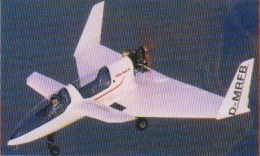
The delta wing of the Delta Dart II uses composite construction.

Delta Dart II
Empty weight: 245 kg
Wing span: 6.24 m
Wing area: 14.4 sq.m
Fuel capacity: 70 lt
Certification: Vz
Engine: BMW 90, 90 hp
MAUW: 450 kg
Seats: 2
Max speed: 250 kph
Cruise speed: 205 kph
Minimum speed: 55 kph
Climb rate: 4.5 m/s
Fuel consumption: 7.5 lt/hr
Price (1998): 85,000 DM

Debreyer JCD-03 Pelican

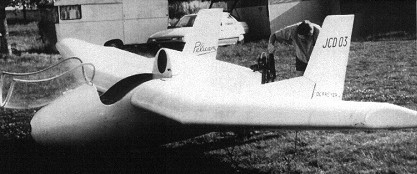
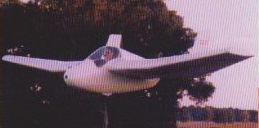
The “Pélican” flying wing was designed by Jean-Claude Debreyer based on the AV-36. Unlike that machine, however, it is not designed for soaring but only for inexpensive powered flight. The designer’s goal was to produce a machine that was easy to build, ultra-light and low in cost, which explains the choice of the flying wing configuration, the low aspect ratio of the wing and the tandem landing gear. The prototype was built of wood with a few laminated parts; the wing section was the same as that of the AV-36 (Fauvel F4 17%). The two-stroke engine, mounted at the rear of the short fuselage, between the two fins, drives a two-bladed propeller directly. The Air Est Services, based in eastern France, offers a kit version, built of composite materials, named JCD-03. It can be equipped with a 12 hp Solo engine or a 24 hp Koenig which gives a considerable improvement over the original performance figures.

The Pelican is transformed into the Eagle by substituting a 24 hp direct drive Konig for the Solo.

Air Est JCD-03 Pelican

Wing span: 7.92 m
Length: 3.10 m
Wing area: 12.0 sq.m
Airfoil: Fauvel F4 17%
Empty weight: 85 kg
Max. weight: 175 kg
Engine: Solo 15 ch
Propeller diameter: 75 cm
Takeoff run: 150 / 200 m
Stall speed: 45 km/h
Cruise speed: 75 km/h
Endurance: 3 hours

Air Est JCD-03 Eagle
Empty weight: 90 kg
Wing span: 7.2 m
Wing area: 12 sq.m
Fuel capacity: 20 lt
Engine: Konig SC 430, 24 hp
MAUW: 200 kg
Seats: 1
Max speed: 130 kph
Cruise speed: 90 kph
Minimum speed: 40 kph
Climb rate: 3 m/s
Fuel consumption: 8 lt/hr
Kit price (1998): 45 000 F sm

Dea-Aircraft Yuma

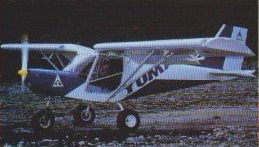
Manufactured in Italy, the Yuma is of all metal construction..

Engine: Rotax 912, 80 hp
Wing span: 8.2 m
Wing area: 12.5 sq.m
MAUW: 450 kg
Empty weight: 282 kg
Fuel capacity: 87 lt
Max speed: 175 kph
Cruise speed: 150 kph
Minimum speed: 40 kph
Climb rate: 4.5 m/s
Seats: 2
Fuel consumption: 16 lt/hr
Certification: Italy
Price (1998): 73,000,000 L
Kit price (1998): 40,000,000 L

D.AZ Termerair

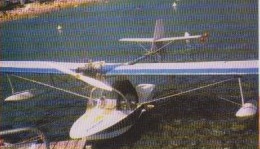
Appearing at the 1997 show at Blois the Termerair featres a fuselage in tube and fabric with laminated floats.

Engine: Rotax 582, 64 hp
Wing span: 10.50 m
Wing area: 16 sq.m
MAUW: 495 kg
Empty weight: 235 kg
Fuel capacity: 55 lt
Max speed: 140 kph
Cruise speed: 110 kph
Minimum speed: 60 kph
Climb rate: 3.5 m/s
Seats: 2
Fuel consumption: 12 lt/hr
Price (1998): 192,000 Fttc