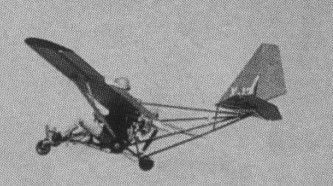
Dave Donohoe, a colleague of Tom Cadet, developed the Boorabee’s airfoil. This wing was mated to a new fuselage mould to use a 4 x 3 inch rectangular boom and Dave called the result the Shuttle. Similar in overall appearance, the Shuttle has a single wing strut and a different tail and undercarriage and control system. After the undercarriage of the Shuttle proved weak, some Shuttles adopted that of the Boorabee.
The Shuttle design was abandoned after Dave’s second aircraft, powered by a 1600cc Jabiru, developed aileron flutter. The wings were damaged extensively, but Dave was able to land the aircraft. Vibration from the Jabiru, coupled with a control system that was too slack, caused the flutter.
Dmitriev’s airplane is neither an outgrowth of a hang glider nor an enclosed cockpit design. First, it’s in-credibly tiny only 10.9 feet long, 16.4 feet in wingspan, and four feet high at the tail. Its wing area is only 18.9 square feet. It’s light, even by ultra¬light standards 110 pounds, as Dmitriev had it outfitted in July 1992. But Dmitrievs diminutive craft is most striking in its use of big airplane features to get maximum performance from its flying surfaces. Its wing has airliner style flaps and leading edge slats, giving it more lift and thereby reducing takeoff and landing speeds. A slight but noticeable forward sweep to the wing makes it more controllable at low speeds. And extra joints in the elevators and rudder increase the effectiveness of their small surfaces. It all comes apart and folds up for storage. Each wing section detaches and then folds in half, the tail group comes off and folds, and even the aluminum tubes connecting the tail section are designed to telescope. The result is a package you can store in a closet, rightfully earning it the nickname of “suitcase ultralight.” The X 14d’s leading edge slat and triple slotted flaps are controlled by a single mechanical lever on the pilot’s left side, the flaps and slats extend and retract in unison. Fully extended, they greatly magnify the lift of the X 14d’s tiny wings and reduce the speed needed to get airborne. They also allow a slower landing. On the down side, flaps also increase drag, so they’re retracted into the wing structure for cruising. Similar slotted surfaces are evident at the tail, but their functions are different. Horizontal elevators at the rear deflect the air passing over them, controlling the air¬plane’s pitch axis; Dmitriev added joints in the elevators to increase their effectiveness without increasing their size. The upright rudder, which controls yaw axis gets a similar segmented treatment. Aiding the X 14d’s ailerons are spoilers, or short slats, that rise from the upper surface of the wing just forward of the ailerons. In Dmitriev’s design, each spoiler ex¬tends automatically when the aileron behind it is fully deflected, enhancing roll control.at low speed. Primary flight functions, including throttle setting, elevator position, and aileron position, are con¬trolled from a hand hewn control yoke. Seated forward of the wing, With legs nearly straight ahead the pilot hss an unimpeded view, though his ears are just inches from the engine din. Dmitriev is hardly a test pilot, and he said his longest flight in Kirghizia lasted just 8.5 minutes, when his engine quit. He says the highest he has flown it is 350 feet much too close to the cold, hard ground for testing a plane’s behavior in steep turns or stalls.
Engine: 24 hp. Length: 10.9 ft. Wingspan: 16.4 ft. Height: 4 ft. Wing area: 18.9 sq.ft. Empty wt: 110 lbs.
Victor Dmitriev was a teacher, truck driver, and aviation enthusiast in the Soviet Union. He pored over every bit of available information on American sport planes and taught himself how to design aircraft when the Soviet state considered such knowledge secret. Over the course of 24 years he built 30 aircraft, scrounging materials from the trash, now and then buying real aircraft parts through an illegal under-ground network. He modified a Czechoslovakian motorcycle engine for an airplane power plant. His de-sign studio, assembly plant, and hangar were all located in the four room apartment his family shared with two others in Beslickek (formerly Frunze) in Kirghizia, a republic between Kazakhstan and China. Dmitriev built a whole series of tiny X planes over the years. “I built very many wings,” he said. “Without flaps. With one flap. With two flaps. With three flaps.” Victor’s first attempt to build an airplane, in 1968, used a version of the Rogallo wing, a triangular kite-like device popular with early hang gliders. It didn’t work, but he was undeterred. In 1970, he got an aircraft off the ground; in 1979, he flew his first circle. Dmitriev made contact with other closet airmen who helped one another. He said they sometimes sold aircraft parts under the table, and when he couldn’t find parts, he made them. He carved his own propellers with hand tools. He covered the wing and tail surfaces with parachute fabric, then shellacked and painted it for a smooth, drum tight surface. He made lightweight wing struts by shaping pieces of wood, cutting them in half, hollowing them out, and gluing them back together, and then epoxying on a layer of fiberglass cloth. His work surfaced in the West in 1990 when the magazine Aviation Week & Space Technology published a photo of his machine. In 1991, he sent photographs of the X 14d in flight to the Experimental Aircraft Association (EAA) in Oshkosh, Wis., which published them in the magazine it sends to its members.
Distar Air is a Czech aircraft manufacturer based in Ústí nad Orlicí. The privately held company specializes in the design and manufacture of light aircraft in the form of kits for amateur construction as well as ready-to-fly aircraft.
Distar Air was formed to continue the production of Urban Air designs, including the Distar Samba XXL touring aircraft and the Distar UFM-13 Lambada motorglider.
The company is owned by Společnost DISTAR CZ a.s., a diversified manufacturing concern that also produces machinery, engines and stone quarrying.
Distar Air has licensed production of the Samba to Airo Aviation in Dubai who produce the aircraft as the Airo 5.



 All Aero