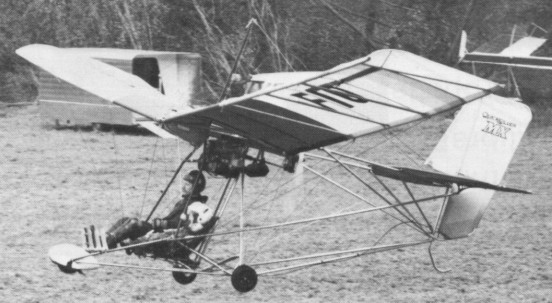
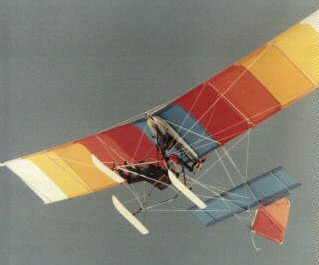
Jack Hutchinson, under contract to Eipper, was charged with developing a new ultralight. The 1981 Phoenix Air Race was the unveiling of the new 15 hp Yamaha powered MX. Units delivered, by June 1981: 185.
Since 1981 the Quicksilver MX has progressively replaced the earlier Quicksilver Double quick and Seaquick types which were all hybrid control like the type E.
The motor fitted until the end of 1982 was the twin cylinder in line 429 cc Cuyuna 430R giving 30hp at 5500 rpm and fitted with a toothed belt reduction drive. However, in November 1982, Eipper Aircraft announced that apart from the Quicksilver E the other models in the range would henceforth be offered with the Bombardier Rotax engine, since the Austrian manufacturer had a production facility in Canada.
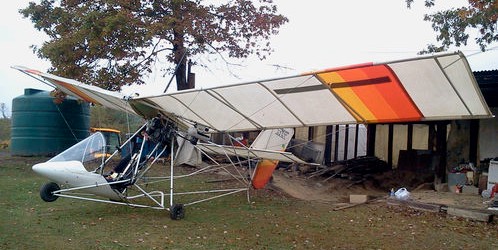
Wing and fuselage structures are similar to the Quicksilver. Control is accomplished by Eipper’s multi-axis aircraft-style system. Pitch, yaw and resulting roll control are achieved with control rods running to the elevator and rudder surfaces and linked to a yoke-mounted control wheel-stick combination. Additional roll control is achieved by wing-mounted spoilerons activated by foot pedals. The spoilerons may be used independently for quick roll rate or simultaneously to create steep descents at low airspeeds. POWERPLANT: One Rotax two-cycle, air-cooled engine mounted in pusher position under the wing. Dual ignition system. Power transmitted via 2:1 reduction to a 52×32” prop of laminated wood. LANDING GEAR: Similar to Quicksilver. Blue anodised aluminium tubing. Eipper present their kit-set Quicksilver on handy vacuum-packed boards. Non-steerable nosewheel. First year built; 1980.
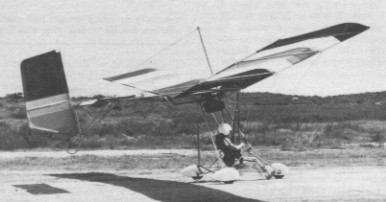
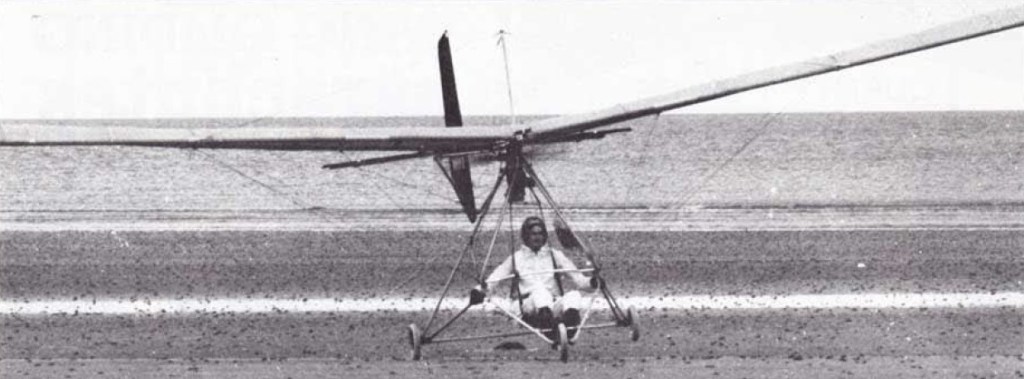
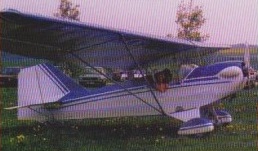
Single seat single engined high wing monoplane with unconventional three axis control (conventional three axis optional). Wing has unswept leading and trailing edges, and constant chord; cruciform tail. Pitch control by elevator on tail; yaw control by fully flying rudder; roll control by one third span spoilers; control inputs through stick for pitch/yaw (pitch/roll optional) and pedals for roll (yaw optional). Wing braced from above by king¬post and cables, from below by cables; wing profile; single surface. Undercarriage has three wheels in tricycle formation with additional tailskid; torsion bar suspension on all wheels. No ground steering. nosewheel brake. Aluminium tube framework, with optional pod. Engine mounted below wing driving pusher propeller.
On offer with the option of a glass fibre nosecone with windscreen since January 1982, the Quicksilver W can also be fitted, on request, with a kit to convert the control system to conventional, so that the spoilers and elevators are operated by a stick and the rudder through the rudder bar. This kit is retrofittable. In the United States, the W is delivered in kit form requiring 40h for assembly without any special tools at a price of $4995 in 1982. Options other than those already listed include floats for $995, transport bag, skis, brakes, parachute, aircraft style throttle (in place of the motor cycle type) and wheel fairings.
The MX II is a side by-side two seater. Brakes on main wheels. No pod. Appearing at the begin¬ning of 1982, the two seater from Eipper Aircraft is a victim of the US legislation, as its empty weight of 3001b (136kg) places it on the wrong side of laws limiting ultralights in the USA to 254 lb (115 kg) empty weight. However, it enjoyed considerable success in Europe, notably in France and the UK, where more liberal laws have allowed its classification as a microlight and therefore do not require the pilot to hold a private pilot’s licence. The standard version uses the unconventional control system from the MX, with the stick working the elevators and the rudder and, like the single seater, the MXII turns perfectly by induced roll and so can be flown happily without the pedals. The aircraft can be supplied with one or two sets of pedals, each set operating the spoilers either together as air brakes or separately. A conversion to conventional control is available, which is useful for training pilots who wish to fly other conventional control machines; machines so converted, however, lose the useful air brake facility. Initially powered by the Cuyuna 430R 30 hp engine, the MXII adopted since the beginning of 1983 the two cylinder Rotax 503, giving 46 hp. The MX and the MXL use as standard the Rotax 377 twin-cylinder in line of 368 cc, developing 33.5 hp at 6500 rpm. The prototype MX Super and the two seater MXII were fitted with the Rotax 503 twin cylinder in line engine of 497 cc, developing 46 hp at 6500 rpm.
By that time the single-seat Quicksilver had evolved to become the three-axis-control MX, and a waiver to the FAA’s Part 103 ultralight regulation allowed two-seat trainers. The MX II became one of the first. Arrival of the legal two-seat trainers put an end to speaking-from-the-ground flight instruction.
With the termination of the two-seat ultralight training, legal paid flight instruction in machines such as the MXL II Sport is no longer available. But checking out licensed pilots in an N-numbered MXL II Sport so they could safely solo single-seat Quicksilver ultralights would be a lot of fun, and it would justify building a new copy of the old MXL II, a relic that introduced thousands of people to recreational flying.
Designed for those who want higher performance than the standard MX can offer, the MXL has conventional three axis control with inputs through stick for pitch/roll and pedals for yaw, and a double surface wing with a more cambered profile. Dihedral is reduced from 150 to 7.50 and a span decreased from 32 ft (9.75 m) to 30 ft (9.14 m). The tail surfaces are re designed and the whole structure reinforced. It appeared for the first time in 1982 as a prototype, fitted with a twin cylinder Cuyuna 430R, but was sold with the Rotax 377 twin cylinder in line engine of 368cc giving 33.5 hp. This model is conventional control in its standard form, as opposed to the MX which only has this as an option; the stick works the spoilers and the elevators, the rudder bar operates the rudder. Otherwise, options are the same as for the other single seaters.
The price for the kit in the USA in 1982 was $5695.
The Quicksilver MX Super is a single seat single engined high wing monoplane with conventional three axis control. Wing has unswept leading and trailing edges, and constant chord; cruciform tail. Pitch control by elevator on canard; yaw control by fully flying rudder; roll control by spoilers; control inputs through stick for pitch/roll and pedals for yaw. Wing braced from above by kingpost and cables, from below by cables; wing profile single surface. Undercarriage has three wheels in tricycle formation, with additional tailskid; torsion bar suspension on all wheels. No ground steering. Aluminium tube framework, with pod. Engine mounted below wing driving pusher propeller. This is a distinct single seat, three¬ axis, conventional control development of the MX. It retains the single skin wing but with several important modifications, including reduced span. The structure has been reinforced to permit the MX Super to accomplish positive g aerobatics. On one of the pro¬totypes the spoilers 4 x 2.4 inch (10 x 70 em) of the standard MX have been increased to 4 x 6.11 inch (10 x 21 cm). Various engines have been tried on the MX Super, such as the Cuyuna 430R, giving 45 hp when fitted with twin carbs, and the Rotax 377 and 503. Though Eipper Aircraft was not actively marketing this model, it had been used for several public demonstra¬tions, including one by Lyle Byrum, who used his parachute to finish his demonstration at Salinas, Florida in October 1982.
The quoted price for the MX Super, as a kit requiring 30 h for completion, was in the order of $6500 in 1982.
The MX Sprint was designed for the entry-level pilot while retaining the excitement & handling a proven pilot demands. The MX Sprint has fast roll response and handles crosswinds easily with its conventional three-axis controls. Yet it retains the docile and predictable slow flight characteristics that made the original MX famous. With a six-month written limited warranty, the MX Sprint features a Rotax 447 engine, conventional 3-axis controls, a 66″ propeller, a flexible driveshaft coupler for reduced vibration, tapered stabilizer, tubular-braced tail, triangulated kingpost assembly, partial double surface wings, extra ribs, and an easy-to-assemble kit (Average 30 to 40 Hours).
The MX II Sprint is ideal for the recreational flier and flight schools. Its high lift, partial double surface wings give it an exceptionally short take-off roll and predictable handling at very low flight speeds. These characteristics make the MX II Sprint easy.
The MX II Sprint’s simple design and bolt together construction make preflight inspections and routine maintenance easy. As with all other Quicksilvers, its assembly-style kit will have you flying in days, not weeks or months. Floats are suited to the MX II Sprint’s high lift wing.
The MX II Sprint features the six month limited warranty, dual cdi electronic ignition, dual carburetor engine, steerable nose wheel standard, main wheel brakes, high lift, partial double surface wings, extra ribs for firm airfoil, conventional 3-axis controls, 68″ propeller for more power with less noise, new, wider cabin for greater pilot comfort, inflight adjustable trim control, tapered stabilizer, tubular braced tail, excellent crosswind capability, easy-to-assemble kit (average 40 to 60 hours), and the airspeed indicator is included.
Some people wanted even more performance than the MX Sprint, so the MX Sport was introduced.
The MX Sport was designed to enhance the envelope with a shortspan double-surface wing with full-span ailerons and conventional three-axis controls. Its 42 horsepower Rotax 447 engine and large 66-inch propeller give the Sport an exceptional climb rate.
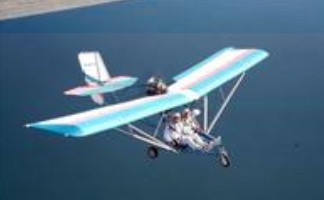
The MX Sport comes standard with Quicksilver’s six-month written limited warranty.
All Quicksilver kits feature easy-to-assemble construction – we do all the fabrication, you just bolt it together.
The MX Sport features a Rotax 447 engine, conventional 3-axis controls, 66″ propeller for more performance with less noise, flexible driveshaft coupler for reduced vibration, tapered stabilizer, tubular-braced tail, triangulated kingpost assembly, double surface wings, extra ribs for firm airfoil, excellent crosswind capability,
short takeoff, very fast control response, an easy-to-assemble kit (average 30 to 40 hours), and 6-month written warranty.
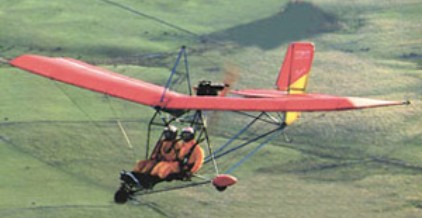
The MXL II Sport two-seat light recreational aircraft is for the pilot looking for easy handling and precise control response. Double surface wings and conventional three-axis controls combine to make this an excellent all around aircraft. Recreational pilots like its greater speed range while flight schools are especially fond of its smooth and predictable flight characteristics. The in-flight adjustable trim makes long flights more carefree.
The MXL II Sport features a six month limited warranty, dual cdi electronic ignition, dual carburetor engine, steerable nose wheel standard, main wheel brakes, double surface wings, extra ribs for firm airfoil, conventional 3-axis controls, 68″ propeller for more power with less noise, wider cabin for greater pilot comfort, inflight adjustable trim control, tapered stabilizer, tubular braced tail, excellent crosswind capability, easy handling and responsive control, short takeoff and landing, easy-to-assemble kit (average 40 to 60 hours), and the airspeed indicator is included.
The MXL II Sport can be built as an Experimental/Amateur-Built and flown as a Light Sport Aircraft.
The Sport 2S open cockpit development program began with the goal of producing the best side-by-side trainer ever. Featuring strutted wings, wider cockpit, rugged aluminum steerable nosewheel, and larger wheels, the Sport 2S combines the many suggestions and comments of ultralight enthusiasts and professionals with Quicksilver’s designing, engineering, and R & D testing to fullfill that goal.
The Sport 2S provides the solid feel of a strut braced plane with the desirable flying characteristics that have made Quicksilvers so popular.
An improved wing cover design makes the Sport 2S even faster to build. You are ready to fly with only a few weekends and some basic tools. Aircraft grade hardware and custom fittings allow for exceptional ease of assembly, maintenance, and breakdown for storage. In about thirty minutes you can go from trailer to flight. The Sport 2S boasts a wealth of new features, including, dual cdi electronic ignition, dual carburetor engine, rugged aluminum steerable nose wheel, main wheel brakes, double surface wings with streamlined struts, extra ribs with mylar leading edge insert for extra firm airfoil.
The max takeoff weight has increased to 996 lbs, with conventional 3-axis controls, a 68″ propeller for more power with less noise, wider tail boom accommodates up to 72″ propeller, even wider cockpit for greater pilot comfort, inflight adjustable trim control, tapered stabilizer, tubular-braced tail, excellent crosswind capability, quick breakdown for transport, easy-to-assemble kit (average 40 to 60 hours), airspeed indicator included, and a six-month written warranty.
Quicksilver MX
Engine: Cuyana 2-cyl 2-stroke 430 cc, 30 hp.
Wing Span: 32 ft (9.6 m)
Wing Area: 160 sq. ft. (14.4 sq. rn)
Aspect ratio 6.4.
Cruise speed: 43 mph
Stall speed: 23 mph
Max. rate of climb: 800 fpm
Empty weight: 220 lb (100 kg)
Max. pilot weight: 240 lb (108 kg)
Quicksilver MX
Engine: Rotax 377, 33.5hp at 6500rpm.
Propeller diameter and pitch 52×32 inch, 1.32×0.81 m.
V belt reduction, ratio 2.0/1.
Max static thrust 170 lb, 77 kg.
Power per unit area 0.21 hp/sq.ft, 2.27 hp/sq.m.
Fuel capacity 5.0 US gal, 4.2 Imp gal, 18.9 litre in main tank; 5.3 US gal, 4.4 Imp gal, 20.0 litre in reserve (optional on French version).
Length overall 18.1 ft, 5.51 m.
Height overall 9.8ft, 2.93m.
Wing span 32.0ft, 9.75m.
Constant chord 5.0ft, 1.52 m.
Dihedral 15 degs.
Sweepback 0 degs.
Tailplane span 9.1 ft, 2.75 m.
Total wing area 160 sq.ft, 14.9 sq.m.
Rudder area 11.3 sq.ft, 1.05sq.m.
Tailplane area 19.5 sq.ft, 1.82sq.m.
Total spoiler area 1.5sq.ft, 0.14 sq.m.
Total elevator area 11.8 sq.ft, 1.10sq.m.
Wing aspect ratio 6.4/1.
Wheel track 5.9ft, 1.75 m.
Wheelbase 5.5ft, 1.66 m.
Nosewheel diameter overall 12 inch, 30 cm.
Main wheels diameter overall 12 inch, 30 cm.
Empty weight 235 lb, 107kg.
Max take off weight 525 lb, 238 kg.
Payload 290 lb, 131 kg.
Max wing loading 3.28 lb/sq.ft, 16.0 kg/sq.m.
Max power loading 15.7 lb/hp, 7.0kg/hp.
Load factors ultimate; +5.0, 3.0.
Max level speed 52mph, 84kph.
Never exceed speed 63mph, 101 kph.
Max cruising speed 46 mph, 74 kph.
Economic cruising speed 38mph, 61kph.
Stalling speed 24 mph, 38 kph.
Max climb rate at sea level 800 ft/min, 4.1 m/s @ 37 mph.
Best glide ratio with power off 6.5/1 at 28 mph. 45 kph.
Take off distance 69 ft, 21 m.
Landing distance 60 ft, 18 m.
Service ceiling 10.000 ft. 3050 m.
Range at average cruising speed 95 mile, 153 km.
MX Sprint
Engine; Rotax 447, 40 hp @ 6500 rpm
TBO; 250 hr
Propeller; 66 in x 34 in
Length; 18 ft 1 in
Height; .8 ft 10 in
Wingspan; 28 ft 0 in
Wing area; 156 sq ft
Wing loading; 3.36 lb/sq ft
Power loading; 13.12 lb.hp
Seats; 1
Empty weight; 250 lb
Useful load; 275 lb
Payload w/full fuel; 245 lb
Max takeoff weight; 525 lb
Fuel capacity; 5 U.S. gal
Takeoff distance, ground roll; 65 ft
Takeoff distance, 50 ft obst; 200 ft
Rate of climb; 900 ft/min
Max level speed, sea level; 54 mph
Max operating altitude; 14,000 ft
Landing distance 50 ft obstacle (with brake); 200 ft
Landing distance ground roll (with brake); 60 ft
Cruise speed/range @ 55% power (5000 rpm); 44 mph/84 mi
Cruise speed/range @ 65% power (5300 rpm); 47 mph/84 mi
Cruise speed/range @ 75% power (5500 rpm); 50 mph/80 mi
Cruise speed/range @ 100% power (6500 rpm); 54 mph/52 mi
Fuel flow @ 55% power; 2.5 gph
Fuel flow @ 65% power; 2.7 gph
Fuel flow @ 75% power; 3.0 gph
Fuel flow @ 100% power; 4.5 gph
Vx (Best angle of climb); 33 mph
Vy (Best rate of climb); 36 mph
Va (Design maneuvering); 48 mph
Vne (Never exceed); 65 mph
Vs (Stall, power off); 24 mph
Landing approach speed (1.3 Vs); 31 mph
Landing gear: nose wheel.
Cockpit width: 32 in
LSA: yes
Eipper / Quicksilver Mfg MX Sport
Engine; Rotax 447, 40 hp @ 6500 rpm
Recommended TBO; 250 hr
Propeller; 66 in x 34 in
Length; 18 ft 1 in
Height; 8 ft 10 in
Wingspan; 28 ft 0 in
Wing area; 156 sq ft
Wing loading; 3.36 .lb/sq ft
Power loading; 13.12 lb.hp
Seats; 1
Empty weight; 254 lb
Useful load; 271 lb
Payload w/full fuel; 241 lb
Max takeoff weight; 525 lb
Fuel capacity; 5 U.S. gal
Takeoff distance, ground roll; 75 ft
Takeoff distance, 50 ft obst; 250 ft
Rate of climb; 850 ft/min
Max level speed, sea level; 58 mph
Max operating altitude; 14,000 ft
Landing distance, 50 ft obst; 300 ft
Landing distance, ground roll; 70 ft
Cruise speed/range SL @ 55% power (5000 rpm); 45 mph/90 mi
Cruise speed/range SL @ 65% power (5300 rpm); 49 mph/91 mi
Cruise speed/range SL @ 75% power (5500 rpm; 53 mph/88 mi
Cruise speed/range SL @ 100% power (6500 rpm); 59 mph/65 mi
Fuel flow @ 55% power; 2.5 gph
Fuel flow @ 65% power; 2.7 gph
Fuel flow @ 75% power; 3.0 gph
Fuel flow @ 100% power; 4.5 gph
Vx (Best angle of climb); 34 mph
Vy (Best rate of climb); 37 mph
Va (Design maneuvering); 54 mph
Vne (Never exceed); 74 mph
Vs (Stall, power off); 27 mph
Landing approach speed (1.3 Vs); 35 mph
Landing gear: nose wheel.
LSA: yes
Quicksilver MX II
Engine: Rotax 503, 46hp at 6500rpm.
Propeller diameter and pitch 52 x 34 inch, 1.32 x 0.81 m.
V belt reduction, ratio 2.0/1.
Power per unit area 0.28 hp/sq.ft, 3.1 hp/sq.m.
Fuel capacity 5.0 US gal, 4.2 Imp gal, 18.9 litre in main tank; 5.3 US gal, 4.4 Imp gal, 20.0 litre in reserve (optional on French version).
Length overall 18.1 ft, 5.51 m.
Height overall 9.8ft, 2.93m.
Wing span 32.0ft, 9.75m.
Constant chord 5.0ft, 1.52 m.
Dihedral 15 degs.
Sweepback 0 degs.
Tailplane span 9.1 ft, 2.75 m.
Total wing area 160 sq.ft, 14.9 sq.m.
Rudder area 11.3 sq.ft, 1.05sq.m.
Tailplane area 19.5 sq.ft, 1.82sq.m .
Total elevator area 1.1 sq.ft, 0.11 sq.m.
Wing aspect ratio 6.4/1.
Wheel track 5.9ft, 1.75 m.
Wheelbase 5.5ft, 1.66 m.
Nosewheel diameter overall 12 inch, 30 cm.
Main wheels diameter overall 12 inch, 30 cm.
Total spoiler area 1.5 sq.ft, 0.14 sq.m.
Total elevator area 11.8 sq.ft, 1.10 sq.m.
Empty weight 300 lb, 136kg.
Max take off weight 700 lb, 317kg.
Payload 400 lb, 181 kg.
Max wing loading 4.37 lb/sq.ft, 21.3kg/sq.m.
Max power loading 15.2 lb/hp, 6.9kg/hp.
Load; +6.5, 3.5 ultimate.
Max level speed 45mph, 72kph.
Never exceed speed 73mph, 117 kph.
Max cruising speed 41 mph, 66 kph.
Economic cruising speed 36mph, 58kph.
Stalling speed 24 mph, 39 kph.
Max climb rate at sea level 393 ft/min, 2.0 m/s.
Min sink rate 393ft/min, 2.0m/s.
Best glide ratio with power off 6/1 at 28mph, 45kph.
Take off distance 100ft, 30m.
Landing dis¬tance 100ft, 30m.
Service ceiling 10,000ft, 3050m.
Range at average cruising speed 49 mile, 79 km.
Eipper / Quicksilver Mfg MX II Sprint R503
Engine; Rotax 503, 50 hp
Recommended TBO; 250 hrs
Propeller; 68″ x 32″
Length; 18 ft – 1/2 in
Height; .9 ft – 1 in
Wingspan; 32 ft – 7 in
Wing area; 180 sq ft
Wing loading; 4.0 lb/sq ft
Power loading; 14.4 lb/hp
Seats; 2
Empty Weight; 325 lbs
Useful load; 395 lbs
Payload w/full fuel; 359 lbs
Max takeoff weight; 720 lbs
Fuel capacity; 6 USgals
Takeoff distance, ground roll; 102 ft
Takeoff distance, 50 ft obstacle; 352 ft
Rate of climb; 595 fpm
Max level speed, sea level; 55 mph
Landing distance, 50 ft obstacle; 240 ft
Landing distance, ground roll; 75 ft
Glide Ratio; 4.5:1
Minimum sink rate; 630 fpm
Cruise 55% power (rpm/mph); 5000/39
Cruise 65% power (rpm/mph); 5300/46
Cruise 75% power (rpm/mph); 5600/51
Cruise 100% power (rpm/mph); 6500/55
Fuel flow 55% power (gph/mi); 3.2/73
Fuel flow 65% power (gph/mi); 3.8/72
Fuel flow 75% power (gph/mi); 4.4/69
Fuel flow 100% power (gph/mi); 5.8/56
Vx (Best angle of climb); 36 mph
Vy (Best rate of climb); 39 mph
Va (Design maneuvering); 64 mph
Vne (Never exceed); 75 mph
Vs1 (Stall, power off); 27 mph
Landing approach speed; 39 mph
Landing gear: nose wheel.
Cockpit width: 39 in
LSA: yes
Eipper / Quicksilver Mfg MXL II Sport – R503
Engine; Rotax 503, 50 hp
TBO; 250 hrs
Propeller; 68″ x 32″
Length; 216 in.
Height; 109 in.
Wingspan; 32.75 ft
Wing area; 180 sq ft
Wing loading; 4.0 lb/sq ft
Power loading; 14.4 lb/hp
Seats; 2
Empty Weight; 325 lbs
Useful load; 395 lbs
Payload w/full fuel; 359 lbs
Max takeoff weight; 720 lbs
Fuel capacity;6 USgals
Takeoff distance, ground roll; 155 ft
Takeoff distance, 50 ft obstacle; 435 ft
Rate of climb; 595 fpm
Max level speed, sea level; 61 mph
Landing distance, 50 ft obstacle; 300 ft
Landing distance, ground roll; 75 ft
Glide Ratio; 5.0:1
Minimum sink rate; 630 fpm
Cruise 55% power (rpm/mph); 5000/40
Cruise 65% power (rpm/mph); 5300/48
Cruise 75% power (rpm/mph); 5600/54
Cruise 100% power (rpm/mph); 6500/61
Fuel flow 55% power (gpm/mi); 3.2/73
Fuel flow 65% power (gpm/mi); 3.8/72
Fuel flow 75% power (gpm/mi); 4.4/69
Fuel flow 100% power (gpm/mi); 5.8/56
Vx (Best angle of climb); 37mph
Vy (Best rate of climb); 39 mph
Va (Design maneuvering); 64 mph
Vne (Never exceed); 75 mph
Vs1 (Stall, power off); 32 mph
Landing approach speed; 45 mph
Landing gear: nose wheel.
Cockpit width: 39 in
LSA: yes
Eipper / Quicksilver Mfg MXL II Sport – R582
Engine; Rotax 582, 64 hp
TBO; 250 hrs
Propeller; 68″ x 36″
Length; 210 in.
Height; 112 in.
Wingspan; 32.75 ft
Wing area; 180 sq ft
Wing loading; 4.0 lb/sq ft
Power loading; 11.25 lb/hp
Seats; 2
Empty Weight; 330 lbs
Useful load; 390 lbs
Payload w/full fuel; 354 lbs
Max takeoff weight; 720 lbs
Fuel capacity; 6 USgals
Takeoff distance, ground roll; 121 ft
Takeoff distance, 50 ft obstacle; 260 ft
Rate of climb; 1145 fpm
Max level speed, sea level; 67 mph
Landing distance, 50 ft obstacle; 300 ft
Landing distance, ground roll; 75 ft
Glide Ratio; 5:1
Minimum sink rate; 630 fpm
Cruise 55% power (rpm/mph); 5000/43
Cruise 65% power (rpm/mph); 5300/52
Cruise 75% power (rpm/mph); 5600/59
Cruise 100% power (rpm/mph); 6500/67
Fuel flow 55% power (gpm/mi); 4.1/63
Fuel flow 65% power (gpm/mi); 4.8/65
Fuel flow 75% power (gpm/mi); 5.6/63
Fuel flow 100% power (gpm/mi); 7.4/54
Vx (Best angle of climb); 37 mph
Vy (Best rate of climb); 39 mph
Va (Design maneuvering); 64 mph
Vne (Never exceed); 75 mph
Vs1 (Stall, power off); 32 mph
Landing approach speed; 45 mph
Quicksilver MXL
Engine: Rotax 377, 33.5hp at 6500rpm.
Propeller diameter and pitch 52×32 inch, 1.32×0.81 m.
V belt reduction, ratio 2.0/1.
Max static thrust 170 lb, 77 kg.
Power per unit area 0.22 hp/sq.ft, 2.4 hp/sq.m.
Fuel capacity 5.0 US gal, 4.2 Imp gal, 18.9 litre in main tank; 5.3 US gal, 4.4 Imp gal, 20.0 litre in reserve (optional on French version).
Length overall 18.1 ft, 5.51 m.
Height overall 9.8ft, 2.93m.
Wing span 30.0ft, 9.14m.
Constant chord 5.0ft, 1.52m.
Dihedral 7.5 deg.
Sweepback 0 deg.
Tailplane span 9.1 ft, 2.75 m.
Total wing area 150 sq.ft, 13.9 sq.m.
Total spoiler area 1.5 sq.ft, 0.14 sq.m.
Rudder area 11.3 sq.ft, 1.05 sq.m.
Tailplane area 16.1 sq.ft, 1.50 sq.m.
Total elevator area 11.8sq.ft, 1.10sq.m.
Wing aspect ratio 6.8/1.
Wheel track 5.9 ft, 1.75 m.
Wheelbase 5.5 ft, 1.65 m.
Nosewheel diameter overall 12 inch, 30 cm.
Main wheels diameter overall 12 inch, 30 cm.
Empty weight 252 lb, 114kg.
Max take off weight 550 lb, 249 kg.
Payload 298 lb, 135
Max wing loading 3.66 lb/sq.ft, 17.8 kg/m .
Max power loading 16.4 lb/hp, 7.3kg/hp.
Load factors; +5.8, 2.9 ultimate.
Max level speed 61 mph, 98 kph.
Never exceed speed 74 mph, 119 kph.
Max cruising speed 54 mph, 87 kph.
Economic cruising speed 45 mph, 72 kph.
Stalling speed 24 mph, 38 kph.
Max climb rate at sea level 850 ft/min, 4.3 m/s.
Best glide ratio with power off 6/1.
Take off distance 75 ft, 23 m.
Landing distance 75 ft, 23 m.
Service ceiling 10,000 ft, 3050 m.
Range at average cruising speed 113 mile, 181 km.
Quicksilver MXL II
Engine: Rotax 503
Empty wt. lbs: 330
Max wt. lbs: 720
Wing span: 32.75ft
Wing area sq.ft.:180
Wing loading lbs/sq.ft: 4
Power loading lbs/hp: 15.7.
Max speed mph: 60
Cruise mph: 53
Stall mph: 32
Vne mph: 75
Seats: 2
Eipper / Quicksilver Mfg Sport 2S
Engine; Rotax 582, 64 hp
Recommended TBO; 250 hrs.
Propeller; 68in x 36 in
Length; 18ft 1/2 in
Height; 8 ft
Wingspan; 31 ft
Wingarea; 174.1 sq ft
Wing loading; 5.74 lb/sq ft
Power loading; 15.63 lb/hp
Seats; 2
Empty weight; 430 lb
Useful load; 566 lb
Payload w/full fuel; 530 lb
Max takeoff weight; 996 lb
Fuel capacity; 6 U.S. gal
Takeoff distance, ground roll; 240 ft
Takeoff distance, 50 ft obstacle; 660 ft
Rate of climb; 500 ft/min
Max level speed, sea level; 69 mph
Landing distance, 50 ft obstacle (with brake); 484 ft
Landing distance, ground roll (with brake); 220 ft
Glide ratio; 5.5:1
Minimum sink rate; 660 ft/min
Cruise @ 55% power-5000 rpm; 55 mph
Cruise @ 65% power-5300 rpm; 58 mph
Cruise @ 75% power-5500 rpm; 61 mph
Cruise @ 100% power-6500 rpm; 69mph
Fuel flow @ 55% power (gph/mi); 4.5/73
Fuel flow @ 65% power (gph/mi); 5.0/69
Fuel flow @ 75% power (gph/mi); 5.6/65
Fuel flow @ 100% power (gph/mi); 7.5/53
Vx (Best angle of climb); 38 mph
Vy (Best rate of climb); 40 mph
Va (Design maneuvering); 70 mph
Vne (Never exceed); 87 mph
Vs1 (Stall, power off); 35 mph
Landing approach speed; 46 mph
Cockpit width: 45 in
LSA: yes
Quicksilver MX Super
Engine: Rotax 503, 46 hp.
Prop: Wood 54×34.
Wingspan: 28 ft 6 in.
Wing area: 160 sq.ft.
Empty wt: 335 lbs.
Max wt: 616 lbs.
Cruise: 50 mph.
Stall: 30 mph.
Vmax: 70 mph.
ROC: 690 fpm.
TO run: 100 ft.
Ldg roll: 50 ft.
Fuel capacity 3.0 US gal, 2.5 Imp gal, 11.4 litre.
Length overall 18.0 ft, 5.48 m.
Height overall 8.11ft, 2.70m.
Wing span 27.5ft, 8.35m.
Constant chord 5.0 ft, 1.52 m.
Total wing area 136sq.ft, 12.7sq.m.
Wing aspect ratio 5.5/1.
Empty weight 250 lb, 113 kg.
Max take off weig6t 520 lb, 236 kg.
Payload 270 lb, 122 kg.
Max wing loading 3.82 lb/sq.ft, 18.6kg/sq.m.
Never exceed speed 60 mph, 97 kph.


 All Aero