Wag-Aero was founded by Dick and Bobbie Wagner in the basement of their house in Lyons in the early 1960s. By 1965, Wag-Aero printed its first catalogue and continued to expand. In 1971, the company moved from Wagner’s basement to North Road. The original warehouse and manufacturing facility has been expanded by three additions. The airstrip was built at the top of the hill for the convenience of fly-in customers.
Wag-Aero’s first kit aircraft, the Sport Trainer, is a replica of the Piper J-3 Cub. Home builders can build this aircraft by ordering many required parts through Wag-Aero. Later, the Wag-A-Bond and the Sportsman 2+2 were added. The Sportsman 2+2 was one of the first four-place homebuilt aircraft which could be purchased via kit.
Aero Fabricators, was formed in the mid – 1970s. There are three departments within Aero Fabricators: welding, sheet metal fabrication, and seat belt manufacturing. The welding department remanufactures aircraft mufflers and engine mounts to FAA standards. They also produce many new manufactured aircraft exhaust systems, as well as structural components. The sheet metal department manufactures gas tanks, leading edges and metal skins and cowlings for many different aircraft, including our own kit aircraft. Both departments work together on the prefabrication of different items for our kit aircraft, including complete pre-welded fuselages. The seat belt division manufactures and repairs FAA approved seat belts and shoulder harnesses in many styles and colors and has been a leader in the industry in designing and manufacturing shoulder harness installation kits. In all, Aero Fabricators produces approximately 850 various components.
1995-8: 1216 North Rd, Box 181, Lyons, WI 53148, USA.
On September 1, 1995, Dick and Bobbie Wagner sold The Wag-Aero Group of companies to Bill Read and Mary Myers. In April 1997 Wag-Aero acquired the assets of Viking Aero Manufacturing to expand the product and manufacturing lines.
In October 2002 Wag-Aero acquired the assets of Ground Support Manufacturing, Inc. which further expanded our product and manufacturing lines into aircraft and airport related equipment. All products are now all manufactured in the facility in Lyons.
LSA/UL
Vulcan Traveller

Single seat single engined high wing mono¬plane with two axis control. Wing has swept back leading and trailing edges, and tapering chord; no tail, canard wing. Pitch control by fully flying canard; yaw control by tip rud¬ders; no separate roll control, control inputs through stick for pitch/yaw. Wing braced from above by kingpost and cables, from below by cables; wing profile; double ¬surface. Undercarriage has three wheels in tricycle formation; suspension on nose¬wheel and glass fibre suspension on main wheels. Push right go left nosewheel steering independent from yaw control. Brake on nosewheel. Aluminium tube framework, without pod. Engine mounted below wing driving pusher propeller.
These aircraft are Germa¬nisations of the Fledgling designed by Klaus Hill. The Vulcan uses the Fledge in conjunction with a canard. This company, however, has instead of using a one piece canard, the Traveler uses two mobile surfaces articulated separately from the aircraft’s two main horizontal tubes. Acting as elevators, these two surfaces are operated from the stick via a push rod.
The frame has been completely redesigned by Vulcan. The wings used are Fledge II or Fledge III, but Vulcan modifies them by adding trapezoidal vertical surfaces acting as winglets, to reduce tip vortices. Travelers are available under the name of Traveller II or Traveller III, depending upon the wing used, deli-vered built but without power pack. This is either a Lloyd 22 hp or the Cuyuna 430R 30hp.
Two propellers were on offer, one a fixed pitch two blade and the other a three blade ground adjustable pitch. Only 20 examples had been produced by March 1983 and sold purely in West Germany.
Traveller II
Height overall 6.4ft, 1.95m
Wing span 32.5ft, 9.90m
Chord at root 5.5ft, 1.68m
Chord at tip 4.5ft, 1.37 m
Nose angle 144 deg
Main wing area 163 sq.ft, 15.1 sq.m
Wing aspect ratio 6.5/1
Engine: Lloyd LS400, 22 hp at 5500 rpm
Propeller diameter 36 inch, 0.91 m
Max static thrust 177 lb, 80kg
Power per unit area 0.13hp/sq.ft, 1.45hp/sq.m
Fuel capacity 5.3 US gal, 4.4 Imp gal, 20.0 litre
Empty weight 137 lb, 62 kg
Max take off weight 442 lb, 200 kg
Payload 305 lb, 138 kg
Max wing loading 2.71 lb/sq.ft, 13.2 kg/sq.m
Max power loading 20.1 lb/hp, 9.1kg/hp
Never exceed speed 56mph, 90kph
Max cruising speed 47mph, 75kph
Economic cruising speed 35 mph, 56 kph
Stalling speed 22 mph, 35 kph
Max climb rate at sea level 680 ft/min, 3.5 m/s
Best glide ratio with power off 9/1
Take off distance 100ft, 30 m
Landing dis¬tance 65 ft, 20 m
Range at average cruising speed 124 mile, 200 km
Traveller III
Height overall 6.4ft, 1.95m
Wing span 32.5ft, 9.90m
Nose angle 144 deg
Main wing area 157 sq.ft, 14.6 sq.m
Wing aspect ratio 6.7/1
Engine: Lloyd LS400, 22 hp at 5500 rpm
Propeller diameter 36 inch, 0.91 m
Max static thrust 177 lb, 80kg
Power per unit area 0.14hp/sq.ft, 1.50hp/sq.m
Fuel capacity 5.3 US gal, 4.4 Imp gal, 20.0 litre
Empty weight 143 lb, 65 kg
Max take off weight 468 lb, 220 kg
Payload 342 lb, 155 kg
Max wing loading 3.10 lb/sq.ft, 15.1 kg/sq.m
Max power loading 22.1 lb/hp, 10.0kg/hp
Never exceed speed 56mph, 90kph
Max cruising speed 44mph, 70kph
Economic cruising speed 32 mph, 52 kph
Stalling speed 19 mph, 30 kph
Max climb rate at sea level 790 ft/min, 4.0 m/s
Best glide ratio with power off 10/1
Take off distance 100ft, 30 m
Landing dis¬tance 65 ft, 20 m
Range at average cruising speed 124 mile, 200 km
Vulcan
1983: Vulcan, Kiefernweg 13, D 8011 Poering bei Munchen, West Germany.
UL builder
VSTOL Aircraft SST2000
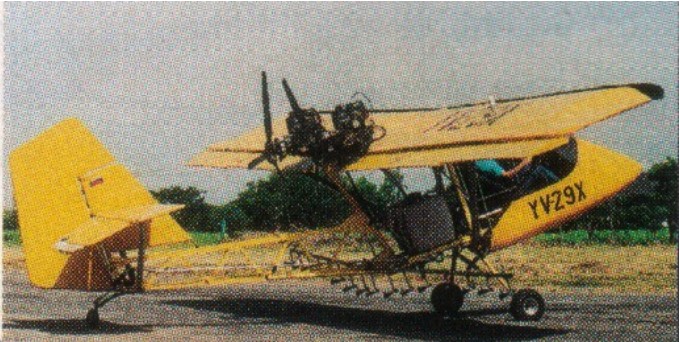
Tube and fabric construction.
Cruise: 60 mph
Stall: 22 mph
Range: 290 sm
Rate of climb: 1200 fpm
Takeoff dist: 100 ft
Landing dist: 200 ft
Engines: 2 x Hirth 3203, 65 hp
Fuel capacity: 24 USG
Empty weight: 900 lb
Gross weight: 1500 lb
Length: 22 ft
Wing span: 32.5 ft
Wing area: 165 sq.ft
Seats: 2
Cockpit width: 24 in
Landing gear: nose or tailwheel
VSTOL Aircraft Super Solution 2000
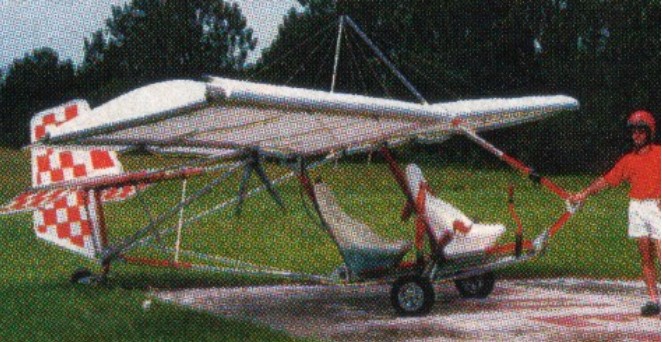
First flown in 1995, the Suer Solution has super tough landing gear. Kits did cost US$7500.
Engine: Rotax 503, 46 hp
HP range: 40-75
Top speed: 67 mph
Cruise: 50 mph
Stall: 22 mph
Rate of climb: 500 fpm
Takeoff dist: 100 ft
Landing dist: 150 ft
Service ceiling: 13,500 ft
Fuel capacity: 10 USG
Empty weight: 320 lb
Gross weight: 860 lb
Height: 7.5 ft
Length: 20 ft
Wing span: 31 ft
Wing area: 155 sq.ft
Seats: 2
Landing gear: tailwheel
VSTOL Aircraft XC2000T
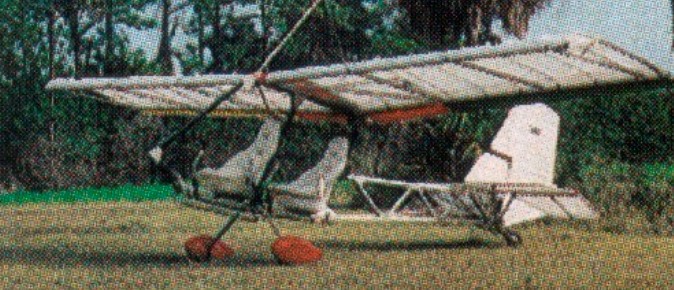
Designed for training and also available with a strut braced wing. The kit did cost US$8495.
Top speed: 75 mph
Cruise: 55 mph
Stall: 27 mph
Range: 110 sm
Rate of climb: 750 fpm
Takeoff dist: 150 ft
Landing dist: 200 ft
Service ceiling: 14,000 ft
Engine: Rotax 582, 65 hp
HP range: 40-75
Fuel capacity: 10 USG
Empty weight: 390 lb
Gross weight: 890 lb
Height: 8 ft
Length: 20 ft
Wing span: 30 ft
Wing area: 150 sq.ft
Seats: 2
Landing gear: tailwheel
VSTOL Aircraft Pairadigm
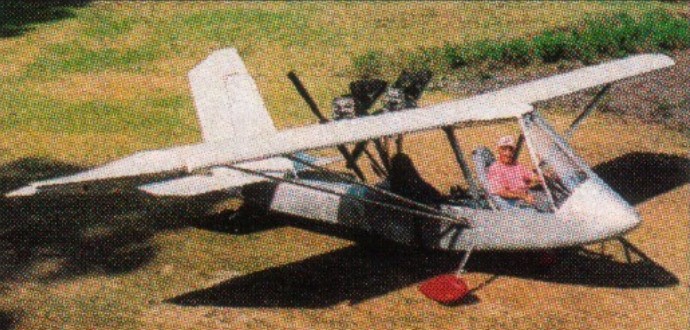
A tandem two-seat kit-built monoplane developed in Venezuela. First flown in January 1997.
Overlapping pusher propellers are mounted close in to the fuselage and the wingspan can be extended for special applications. Can be flown with or without the cabin doors. An optional ag-spray kit was available.
The kit did cost US$24,995.
Top speed: 100 mph
Cruise: 60 mph
Stall: 22 mph
Range: 250 sm
Rate of climb: 1200 fpm
Takeoff dist: 100 ft
Landing dist: 200 ft
Service ceiling: 15,000 ft
HP range: 52-100
Fuel capacity: 24 USG
Empty weight: 700 lb
Gross weight: 1400 lb
Height: 7.5 ft
Length: 22 ft
Wing span: 32 ft
Wing area: 160 sq.ft
Seats: 2
Landing gear: tailwheel
VSTOL Aircraft Corp
US agent for the Pairadigm tandem two-seat kit-built monoplane developed in Venezuela, and the single-seat Super Solution 2000.
1997: PO Box 7534, Ft. Myers, FL 33911, USA.
Vortech Kestrel

The Kestrel is a single-seat ultralight helicopter powered by small jet engines mounted on the tips of the rotorblades. This form of power eliminates the need for a tail rotor, simplifying and reducing the cost of construction.
If ordered separately, the jet-helicopter construction package is available for $23.95 (+$3 postage US, $8 foreign). This package includes the Vortech Catalog. The Kestrel was available as a kit, in 2001.
Length: 12 ft
Height: 7 ft
Empty wt: 180 lbs
Gross wt: 440 lbs
Payload (max) 260 lbs
Engines (2): G8-2-20 jets
Fuel: propane
Fuel consump: 12+ USgal/hr
Rotor dia: 25 ft
Speed (max): 95 mph (63 as ultralight)
Altitude (max): 12,500 ft
Vortech Skylark 1

Developed from the G-1 design, pilots have expressed amazement at this craft’s stability and manoeuvrability. The Skylark can be flown in the Experimental Aircraft category. Although this is one of the more affordable homebuilts, the airframe and all of its major components have been designed for quality, dependability and durability.
Full instrumentation Skylark kit minus engine and instruments: $19,995 in 2001.
Skylark construction plans in 2001:
Reduced-size prints (11″ x 17″ format): $75 (add $6 postage U.S. or $16 foreign)
Full size prints (18″ x 24″ format): $175 (add $7 postage U.S. or $22 foreign)
Features of the Skylark:
- Full helicopter flight: vertical take-offs & landings; forward, backward & sideward flight; hovering.
- Standard helicopter control system
-All-aluminum main- & tail-rotor blades - Aircraft-grade steel & aluminum airframe & major components, plus all AN hardware
- Full instrumentation

Engine Rotax 582, 65 hp
Main Rotor Diameter 19 ft
Disk area: 283 sq.ft
Tail Rotor Diameter 3 ft 6 in
Height 7 ft
Length 17 ft 6 in
Empty Weight 350 lbs
Gross Weight 725 lbs
Payload Weight 375 lbs
Fuel cap: 10 USG
Power Loading 10.8 lbs/hp
Disc Loading 2.5 lbs/sq ft
Maximum Speed 95 mph
Cruise Speed 70 mph
Rate Of Climb 1,000 fpm
Maximum Altitude 12,500 ft
Range: 120 sm
Seats: 1
 All Aero