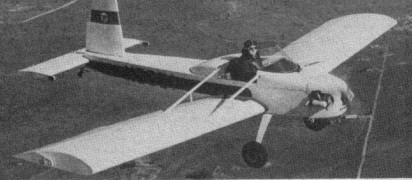
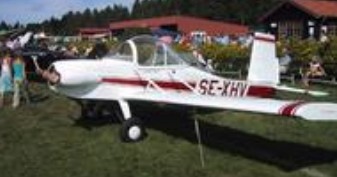
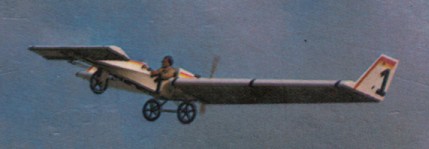
The Volksplane VP-1 is a single seat aircraft designed by W.S. Evans, and first flown in 1968. The bare angular look is due to the designer’s aim to build a simple aeroplane where appearance and performance were of secondary importance. The wings consist of two solid spruce spars, band sawn ¼ inch plywood ribs, internal wire bracing and fabric covering. The wing is made in two separate panels, bolted to the fuselage at the inboard end and externally braced by streamline tubular steel struts. The airfoil section is NACA 4412. The fuselage is a square wooden 3-bulkhead box structure, plywood covered. A single tube over the windscreen serves as an overturn bar. The empennage consists of a wooden all-flying tailplane, to which is fitted an anti-servo tab and a single all-moving rudder. Both the rudder and tailplane are fabric covered. No fin is fitted. The undercarriage is made up of bent 3/8” 2024-T3 aluminium alloy plate wire braced and bolted to the fuselage. Shock absorption is taken by the two 600 x 6 tyres. A 6½ Imperial gallon moulded fibreglass fuel tank is installed behind the firewall. Engines up to 50 h.p. may be fitted. The only welding in the entire airplane is in the control stick assembly, the flying struts and the stabilator horn. Both the VP-1 and VP-2 can be stowed at home and require no trailer for highway towing. Aerobatics are not approved in either the VP-1 or VP-2.
For a super-quick build some builders fly the primary structure alone; no cowls, canopy, turtleback, fairings, etc. Then they design and build lines at their leisure.
Side by side two seat single engined mid wing monoplane with conventional three axis control. Wing has swept back leading and trailing edges, and tapering chord; no tail, canard wing. Pitch control by elevator on canard; yaw control by tip rudders; roll control by two thirds span ailerons; control inputs through stick for pitch/roll and pedals for yaw. Wing braced from below by struts; main wing profile as Goldwing; but further modified; canard profile GU25; both double surface. Undercarriage has three wheels in tricycle formation; glass ribre suspension on all wheels. Push right go right nosewheel steering connected to yaw control. Brakes on main wheels. Aluminium tube/glass ribre fuselage, totally enclosed. Engine mounted below wing driving pusher propeller. The Goldwing II is Eurowing’s contender in the two seat three axis market. In 1983 the Goldwing II was about to commence its test flight programme in the hands of its designer, Craig Catto. Craig originally produced the design for the US firm Goldwing Ltd, who exhibited a prototype at the 1982 Oshkosh, but since then Eurowing has taken over development of the machine, the legal position regarding two ¬seaters being much more favourable in Britain than in the US.
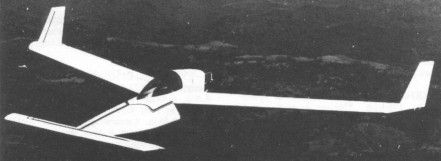
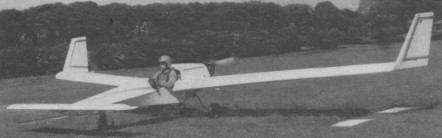
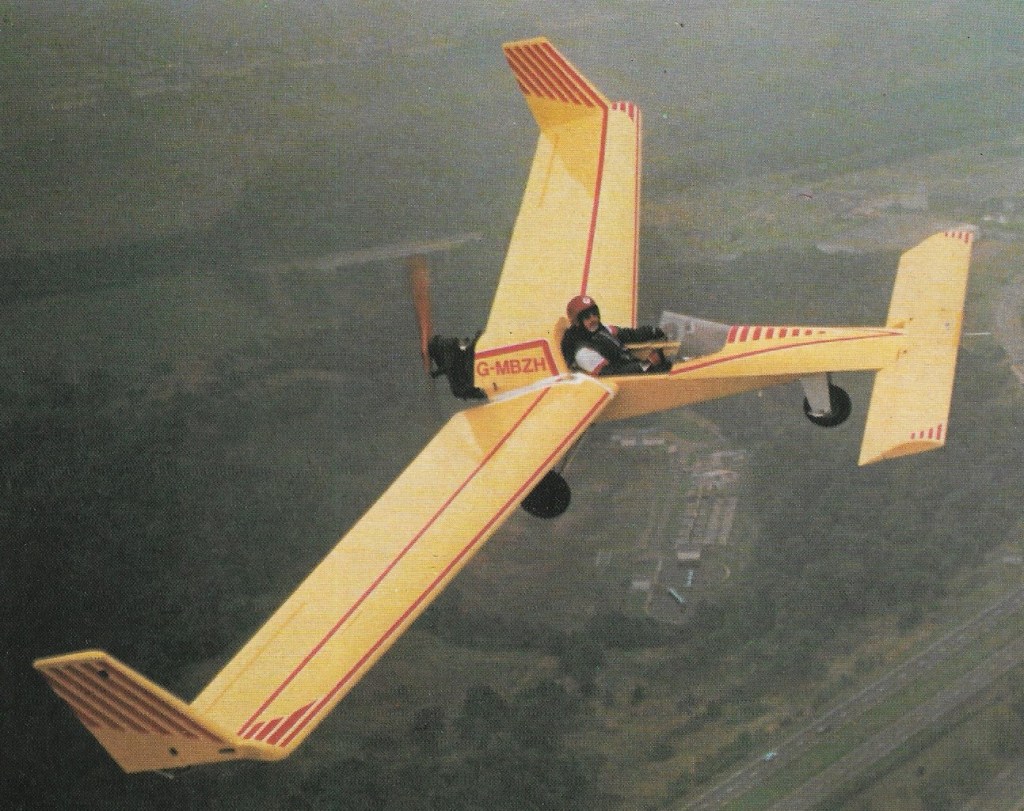
Single seat single engined mid wing mono¬plane with conventional three axis control. Wing has swept back leading and trailing edges, and tapering chord; no tail, canard wing. Pitch control by elevator on canard; yaw control by tip rudders; roll control by half-¬span up only ailerons and spoilers; control inputs through stick for pitch/roll and pedals for yaw. Cantilever wing; main wing profile, modified Liebeck; canard profile, GU25; both double surface. Undercarriage has three wheels in tricycle formation; glass fibre suspension on all wheels, brakes on main wheels, fuselage totally enclosed. Push right go right nosewheel steer¬ing connected to yaw control. No brakes. Aluminium tube glass fibre fuselage. Engine mounted above wing driving pusher propeller. Composite construction wing of foam and aluminium covered with glass fibre skin. While the Goldwing SP may look like nothing more than a Goldwing with an enclosed cockpit, in reality it is rather more than that. Not only is the fuselage differently constructed, using no aluminium except in the bulkhead, but the canard span is increased too. Together, these changes im¬prove both fuel consumption and aesthetics. There are other refinements too, such as nosewheel suspension and brakes on the mainwheels. Because of these alterations, the Goldwing SP is inherently heavier than its open counterpart, and is therefore not offered with the Robin engine. Standard engine for this machine is the Konig SC430, which in the form used by Eurowing develops 28 hp, 4 hp more than originally, thanks to redesigned pistons. The KFM 107 engine is an option. All Goldwing SPs, plus some later Goldwings, feature Eurowing’s patented vibration absorbing toothed belt reduction drive. Like the Goldwing from which it is de¬veloped, the SP is a Craig Catto design. However, unlike the open machine, the SP is made only by Eurowing there is no factory built US equivalent.
Engine: Konig SC430, 28hp. Toothed belt reduc¬tion. Max static thrust 165 lb, 75 kg. Length overall 12.0 ft, 3.66 m. Height overall 7.5ft, 2.29m. Wing span 30.0ft, 9.14m. Chord at root 4.5ft, 1.37 m. Chord at tip 3.0ft, 0.91m. Canard span 12.0ft, 3.66m. Canard chord 1.5 ft, 0.46 m. Fin height 3.0 ft, 0.91 m. Total wing area 148 sq.ft, 13.7 sq.m. Main wing area 130 sq.ft, 12.1 sq.m. Canard area 18 sq.ft, 1.7 sq.m. Main wing aspect ratio 6.9/1. Wheel track 5.0 ft, 1.52 m. Wheelbase 7.3 ft, 2.21 m. Nosewheel diameter overall 14 inch, 36 cm. Main wheels diameter overall 16 inch, 41 cm. Power per unit area 0.19hp/sq.ft, 2.0hp/sq.m ¬Fuel capacity 6.0 US gal, 5.0 Imp gal, 22.7 litre. Empty weight 290 lb, 132kg. Max take off weight 540 lb, 245kg. Payload 250 lb, 113kg. Max wing loading 3.65 lb/sq.ft, 17.9kg/sq.m. Max power loading 19.3 lb/hp, 8.8kg/hp. Load factors; +6.5, 3.0 ultimate. Max level speed 85 mph, 137 kph. Never exceed speed 90 mph, 145 kph. Max cruising speed 70 mph, 113 kph. Economic cruising speed 50 mph, 80 kph. Stalling speed 28 mph, 45 kph. Max climb rate at sea level 700 ft/min, 3.6 m/s. Min sink rate 180 ft/min at 35 mph, 0.9 m/s at 56 kph. Best glide ratio with power off 16/1 at 45 mph, 72 kph. Take off distance 220 ft, 65 m. Land¬ing distance 160 ft, 50 m. Range at average cruising speed 220 mile, 354 km.
Single seat single engined mid wing monoplane with conventional three axis control. Wing has swept back leading and trailing edges, and tapering chord; no tail, canard wing. Pitch control by elevator on canard; yaw control by tip rudders; roll control by half-span up only ailerons and spoilers; control inputs through stick for pitch/roll and pedals for yaw. Cantilever wing; main wing profile, modified Liebeck; canard profile, GU25; both double surface. Undercarriage has three wheels in tricycle formation; no suspension on nosewheel and glass fibre suspension on main wheels. Push right go right nosewheel steer-ing connected to yaw control. No brakes. Aluminium tube glass fibre fuselage, partially enclosed. Engine mounted above wing driving pusher propeller.
Composite construction wing of foam and aluminium covered with glass fibre skin.
Since 1981 Brian Harri¬son’s Eurowing company has been building the Goldwing under license from the US company Goldwing Ltd, but in those years he has made a number of modifications to the Craig Catto design, often with the help of Catto himself, to suit the aircraft better to European conditions. The principal changes concern the undercarriage and the engine. The narrow track undercarriage of the US version has been replaced by a more rugged wide track design with glass fibre suspension on the main wheels. Engines have been more of a problem. By replacing the Cuyuna with a 330 cc Robin, Eurowing was able to create a Goldwing which just satisfied the British microlight definition as regards wing loading. However, it only required the builder to be over generous with the glass fibre to the tune of 3 kg, and the wing loading would exceed the legal limit. The solution to this situation came with the KFM 107 and Konig SC430 engines, both of which are substantially lighter than the Robin.
Another small but significant modification has been to paint the canard with a matt finish. This has the effect of making water droplets form a continuous film which, unlike droplets on a shiny surface, does not spoil the airflow. The aircraft thus becomes much more manageable in the rain, a consideration which in Scotland, where Eurowing is based, is very important.
Manufactured in the US, the Goldwing Ltd Goldwing is a canard mono¬plane with sweptback main wings and movable control surfaces. The canard is used for pitch control only and is fitted with a separate elevator mechanism. The main wingtip rudders may be deployed simultaneously with the rudder pedals. Additional control surfaces include ailerons and spoilers. Composite construction is used throughout. The pilot is enclosed in an aerodynamic nacelle. POWERPLANT: Cuyuna 430D with recoil starter mounted in a pusher position behind the pilot nacelle. The engine has been modified for aircraft use with two extra main bearings, an extended crankshaft, lower compression ratio, separate ignition for each cylinder, special carburetor and tuned exhaust system. Direct drive is standard, turning a two-blade wooden propeller made by Goldwing. Fuel is carried in a plastic container located behind the pilot. A 2:1 reduction unit is optional. LANDING GEAR: Tricycle landing gear make use of moped shock absorbers with coil springs. The nosewheel is steerable, and there are no brakes. Main and nosewheels are 20 inches in diameter. First year built: 1978. Units delivered by June 1981 100+. The Goldwing UL is the same as standard Goldwing, with lower-power engine and lighter weight to comply with Ultralight Category parameters. POWERPLANT: 25-hp Zenoah. The Goldwing II is a two place. The Gold Duster is equipped with full spray equipment. At 290 lbs the standard Goldwing Ltd Goldwing falls into the FAA’s Ex¬perimental category; not Ultralight.
Eurowing Goldwing Engine: Robin EC34PM, 30 hp at 6200 rpm. Propeller diameter and pitch 54 x 30 inch, 1.37 x 0.76 m. V belt reduction, ratio 2.7/1. Max static thrust 190 lb, 86 kg. Length overall 12.0 ft, 3.66 m. Height overall 6.0ft, 1.83m. Wing span 30.0ft, 9.14m. Chord at root 4.5ft, 1.37 m. Chord at tip 3.0ft, 0.91m. Canard span 10.0ft, 3.05m. Canard chord 1.5 ft, 0.46 m. Fin height 3.0 ft, 0.91 m. Total wing area 145 sq.ft, 13.5 sq.m. Main wing area 130 sq.ft, 12.1 sq.m. Canard area 15 sq.ft, 1.4 sq.m. Main wing aspect ratio 6.9/1. Wheel track 5.0 ft, 1.52 m. Wheelbase 7.0 ft, 2.13 m. Nosewheel diameter overall 14 inch, 36 cm. Main wheels diameter overall 16 inch, 41 cm. Power per unit area 0.21 hp/sq.ft, 2.2 hp/sq.m. Fuel capacity 6.0 US gal, 5.0 Imp gal, 22.7 litre. Empty weight 290 lb, 132kg. Max take off weight 540 lb, 245kg. Payload 250 lb, 113kg. Max wing loading 3.72 lb/sq.ft, 18.1 kg/m . Max power loading 18.0 lb/hp, 8.2kg/hp. Load factors; +6.5, 3.0 ultimate. Max level speed 75 mph, 121 kph. Never exceed speed 90 mph, 145 kph. Max cruising speed 65 mph, 105 kph. Economic cruising speed 45 mph, 72 kph. Stalling speed 28 mph, 45 kph. Max climb rate at sea level 750 ft/min, 3.8 m/s. Min sink rate 200 ft/min at 35 mph, 1.0 m/s at 56 kph. Best glide ratio with power off 14/1 at 45 mph, 72 kph. Take off distance 200 ft, 60 m. Land¬ing distance 180 ft, 55 m. Range at average cruising speed 220 mile, 354 km.
Goldwing Ltd Goldwing Engine: 30 hp Cuyuna 430D. Engine displacement 429cc. Rated hp 30. Static thrust 150 lbs. Wing¬span 30’. Wing area 128 sq.ft. Aspect ratio 5.6. Overall length 12’. Empty weight 290 lbs. Wing loading 4.2 Ibs/sq.ft. L/D power-off glide ratio 16:1. Cruise speed (85% power) 60 mph. Stall speed 24 mph. Approach speed 40 mph. Flare speed 30 mph. Liftoff speed 26 mph. Takeoff roll distance 150 ft. Rate of climb 600 fpm. Fuel capacity 2½ gal. Range at cruise 100 mi. Max pilot wt: 240 lbs.

 All Aero