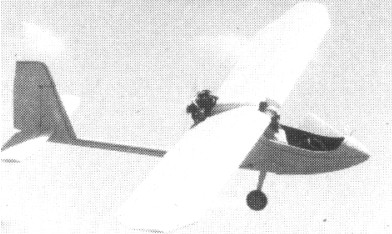
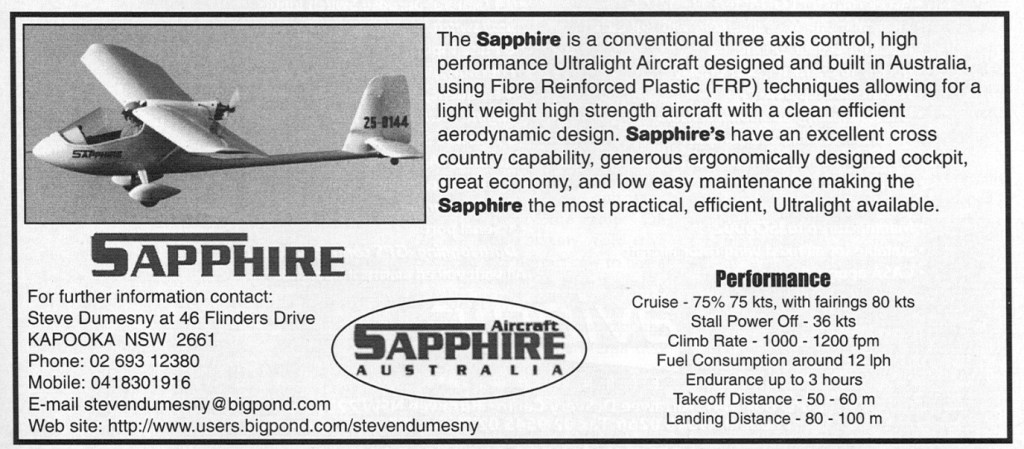
The Sapphire is designed as an efficient ultralight for use in a wide range of strip and weather conditions. Extensive testing over the last 2 years has resulted in only minor modifications having to be effected. The sleek glider like aircraft is constructed of fibreglass foam, aluminium and fabric wing and tail coverings. Cockpit is open but glider type fuselage and windscreen gives protection from the elements. Undercarriage is con¬ventional tail-dragger. Designed in Australia by Scott Winton, of fibreglass and aluminium construction, the 95/10 has wing tanks, rather than previous fuselage tank, and fabric covered wings in place of fibreglass on the earlier, heavier models. All are three axis control.
Outwardly reminiscent of the Long EZ, the new composite canard used the Burt Rutan design as a starting point. Added to the aerodynamic appeal is fully retractable landing gear, split canopies, a 205 hp engine and a longer, wider pre moulded fuselage. Named after the Berkut (Berkoot), a Russian Golden Eagle, by designer Dave Ronnenberg, the new craft uses a Lycoming 0 360 to provide a cruise of 208 knots indicated at 8000 feet on 2840rpm. Constructed of carbon fibre and fibreglass a balsa core sandwich with a safety epoxy matrix the canard pusher has an overall length of some 18 foot 6in. The cockpit features a sidearm controller/stick with HOTAS (Hands On Throttle and Stick Controls). Going through its test programme in 1991 with manufacturing company Experimental Aviation, the aircraft has a claimed range of 1,400 nm at 65 percent power. Other preliminary specifications include a 2000 fpm ROC, 54 knots minimum controllable airspeed gear down, an endur¬ance of 5.5 hours at 65 percent power, a ceiling of 35,000 feet, maximum useful load of 965 lbs and an empty weight of 1,035 lbs.
The prototype Berkut was designed and built by Dave H. Ronneberg and Kerry Beresford.
Like the Long EZ, the Berkut carries 2 people in tandem seats. The front seat occupant has access to all instrumentation and controls. The rear seat, normally holding the passenger, is equipped with a side stick and throttle, but no rudder pedals, brakes, or instruments.
Out of 57 kits sold by 1998, 7 were finished.
Builder Jerrold Jorritsma installed a General Electric T-58 jet engine in his Berkut.
It was destroyed following an engine failure in Loveland, CO, May 9, 2010.
Engine: Lycoming IO-360-B1A, 205 hp. HP range: 180-205. Height: 7.5 ft. Length: 18.5 ft. Wing span: 26.67 ft. Wing area: 110 sq.ft. Weight empty: 1035 lbs. Gross: 2000 lbs. Fuel cap: 58 USG. Speed max: 250 mph. Cruise: 209 mph. Range: 1228 sm. Stall: 62 mph. ROC: 2000 fpm. Take-off dist: 1000 ft. Landing dist: 1000 ft. Service ceiling: 29,500 ft. Seats: 2. Landing gear: retractable nose wheel.
1991: Experimental Aviation, 3021 Airport Avenue, Hangar 109, Santa Monica CA90405, USA. 1995-6: 3025 Airport Ave, Santa Monica, CA 90405, USA. A Chapter 11 reorganisation attempt followed the loss in 1995 of the company’s demo pilot and demonstrator in an accident at Santa Paula, California, and a lawwsuit from a former partner. In 1996 Experimental Aviation filed Chapter 11 bankruptcy. 1997-8: 3025 Airport Ave, Santa Monica, CA 90405, USA. Experimental Aviation was reconstituted as Renaissance Composite, operating from the same address (1998). Developed the Berkut as tandem two-seat compositesbuilt canard monoplane with pusher engine, first flown 1991 and made available in kit form.
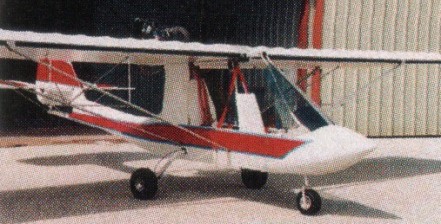
Four versions of this aircraft (LSA) were produced: the standard series and the wide body model, the stretch model and four stroke model. The kit for the Excalibur II features prebuilt tail surfaces, wings, ailerons end fuselage, and all the controls are already installed. Build time for the kit is estimated at 100 to 200 hours. Options include: 60-hp HKS 700E air-cooled 4-stroke or 4O-hp Rotax 447 air- cooled 2-stroke engine, instruments (ASI, altimeter, tach, dual CHT dual EGT, panel-mounted compass, ignition switch), standard or amphibious floats, fiberglass wheel pants, BRS ballstic emergency parachute, doors, strobe lights and paint materials. Construction is 6061-T6 and 2024-T3 aluminum tube airframe with chromoly steel weldments where needed, stainless steel pop rivets and AN or military spec hardware. Wings and surfaces are covered with Superflite fabric. No welding or machining is necessary and all the critical work is completed at the factory.
Standard Engine; Rotax 503 (52HP) Wingspan; 31 ft. 6 in. Chord; 60 in Length; 20 ft. 0 in. Height; 6 ft. 0 in. Wing area; 185 sq.ft. Empty weight; 450 lbs. Useful load; 500 lbs. MTOW; 900 lb Ultimate load factor; +6 -4 Build time; 100-200 hours Field assembly time; 20 min. VNE; 100 mph Top level speed; 90mph Cruise speed; 50-90 mph Stall speed; 30-35 mph Climb rate; 1200 fpm solo, 700 ft. dual Take off roll; 96 ft.solo, 196 ft. dual Glide ratio; 11:1 solo, 9:1 dual Service ceiling; 14,000 solo, 12,500 dual Range; 290 sm Fuel used at cruise; 2.3 gph to 4 gph Fuel capacity; 10 gal. (U.S.) Cockpit width Standard Body; 26 inches Seats: 2 Tandem Undercarriage; nose wheel LSA
Excalibur Wide Body Engine: Rotax 503, 52 hp HP range: 52-65 Cruise: 80 mph Stall: 33 mph Range: 290 sm Rate of climb: 1200 fpm Takeoff dist: 100 ft Landing dist: 300 ft Fuel capacity: 20 USG Empty weight: 450 lb Gross weight: 950 lb Length: 20 ft Wing span: 32 ft Wing area: 183 sq.ft Cockpit width: 31 in Seats: 2 Landing gear: nose wheel LSA
Excalibur Four Stroke Engine: Rotax 582, 65 hp Cruise: 80 mph Stall: 33 mph Range: 290 sm Rate of climb: 1200 fpm Takeoff dist: 96 ft Landing dist: 300 ft Fuel capacity: 20 USG Empty weight: 470 lb Gross weight: 950 lb Length: 20 ft Wing span: 31.5 ft Wing area: 183 sq.ft Cockpit width: 26 in Seats: 2 Landing gear: nose wheel LSA
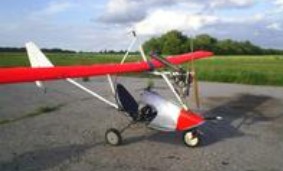
Very simple REAL Ultralight Aircraft for flyweight pilots. Delivered as kit package or ready to fly planes by Evgenij Kovalenko with several engine choices. 2009 Price: 6200 EURO
Evektor presented at Europe’s 2012 AERO show an electric-powered prototype, the EPOS. Even though strictly for showcase, 10 people offered to buy one on the spot.
Evektor s r.o. dates back to 1991, when it was established by three men creating a company focused on aerospace and automotive industries. The company headquarters is located at the international airport in Kunovice in South Moravia near to Austria and Slovakia. In 1992 Evektor established cooperation in the aerospace industry, sharing in the development of the light attack airplane L 159 and, in 1996, establishing cooperation in development of the Ibis Ae-270. In 1996 Evektor developed the braced high-wing two-seat FOX airplane (a variant of the German Ikarusflug Eurofox, with Evektor of the Czech Republic having undertaken important design work, and Aeropro of Slovakia building airframes for Fox and Eurofox) and began marketing the Fox. Also in 1996 Evektor purchased 100% of the Aerotechnik CZ company. After fusion with Evektor, the Aerotechnik company was transformed into share holding company Evektor-Aerotechnik in 1999.
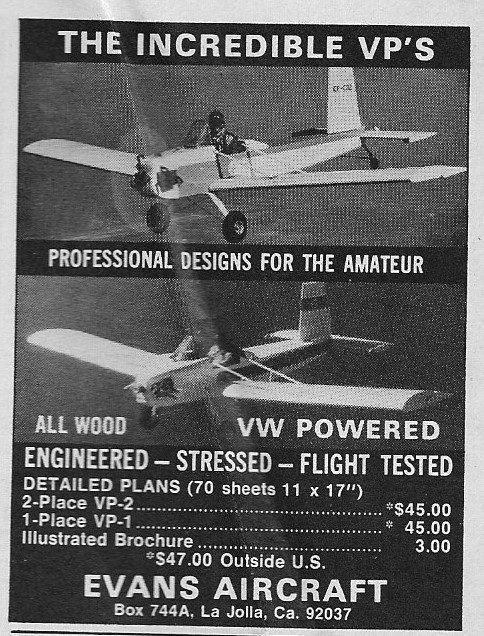
Following the success of the Volksplane VP-1, Evans designed the VP-2, capable of carrying two persons side by side. Construction is generally similar to the VP-1. The fuselage is of rectangular cross-section and consists of four wooden longerons, bulkheads and plywood skin. A fibreglass fairing is located behind the open cockpit. The fuselage width at the cockpit is approximately 35 inches. The wing is made up of two solid spruce spars. wooden ribs, compression struts and internal wire bracing. Each wing panel is fabric covered and externally braced to the fuselage with streamline steel tube struts. No flaps are fitted. The airfoil section is NACA 4415. The rudder consists of wooden ribs clamped to an aluminium tube mounted vertically in the rear fuselage. The all moving tailplane is a wooden cantilever structure, consisting of a simple box spar to which are glued wooden ribs. Both tailplane and rudder are fabric covered. The main wheels are carried on bent wire braced 2024-T3 aluminium alloy legs which are bolted to the fuselage. Shock absorption is taken by low pressure 600 x 6” tyres. Fuel is carried in a moulded II Imperial gallon fibreglass fuel tank aft of the firewall. VW engines up to 65 h.p. (2100cc) may be installed. The VP-2 with a passenger aboard is designed for “normal category” use, which allows non-aerobatic operation and all maneuvers incident to normal flying. Without a passenger, Utility category use is permitted, which includes stalls, lazy eights, chandelles and steep turns with a bank angle of more than 60 degrees. Aerobatics are not approved in either the VP-1 or VP-2.
Feb 1974
For a super-quick build some builders fly the primary structure alone; no cowls, canopy, turtleback, fairings, etc. Then they design and build lines at their leisure.
Engine Volkswagen (1834 cc), 60-hp. Gross Wt. 1040 lb. Empty Wt. 640 lb. Fuel capacity 14 USG. Wingspan 27 ft. Wing Area: l30 sq.ft. Wing Loading: 8.0 lb/sq.ft. Length 19 ft. Wing area: 130 sq.ft. Top speed: 95 mph. Cruise: 75 mph. Stall: 45 mph. Climb rate 500 fpm. Ceiling 10,000 ft. Takeoff run 700 ft. Landing roll 400 ft. Range 200 miles. Seats: 2
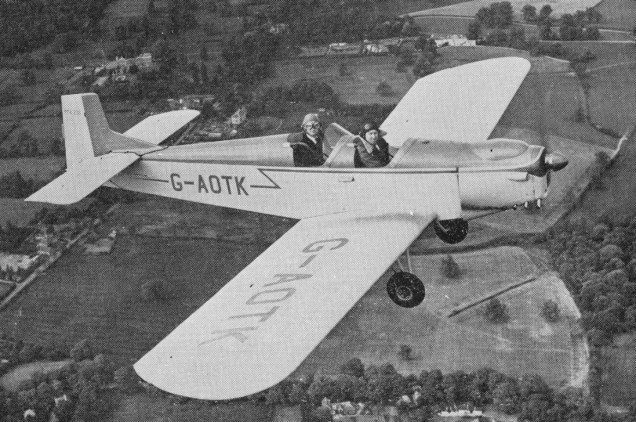
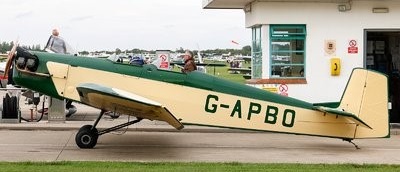
After designed the Turbulent, Roger Druine created the two-seat version, the D.5 Turbi. The prototype first flying in the late 1940s, powered by a Beaussier Bo2.
The Turbi tandem two-seater follows the same lines as the Turbulent and the construction is very similar. The rear turtle-decking on early models was fabric covered, but later models are plywood covered. Dual controls are fitted. The fuselage is of rectangular slab-sided construction with four spruce longerons and frames. The fin is built integral with the fuselage. The tailplane is non-adjustable and like the fin is plywood covered. The wings employ fixed slots, a box type main spar, drag spar, rear spar, lattice type ribs and plywood cover¬ing forward of the main spar. The remainder including the ailerons are fabric covered. The main undercarriage is of divided type and has coil springs for shock absorption. A variety of engines may be installed from 45 to 85 h.p.
Falconar plans show open cockpit with dual controls that can be flown solo from either the front or back seat, the original design was a dual windshield open cockpit. Early Turbi’s built in England were powered with the DH Gipsy Minor. The 4 cylinder 65hp Czech Walter LOM II AE has a dry weight of only 132 lbs – which is a similar configuration to the Gipsy Minor. Other popular engines can be a Continental or Lycoming 65 to 115 HP.
Built by the de Havilland Technical School students – Walter Mikron 60 hp
Druine D-53 Turbi. C/n (msn): PFA 229
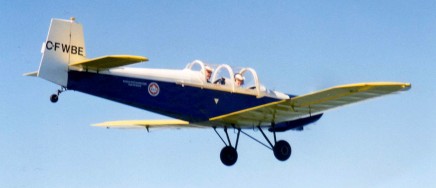
Falconar updated plans & kits for this light 2-seater tandem sportplane, in the LSA catergory. Options include enclosed cockpit either with single curvature windows or vacuum formed bubble canopy.



 All Aero