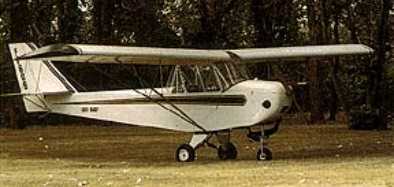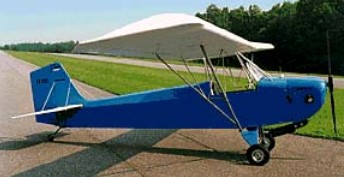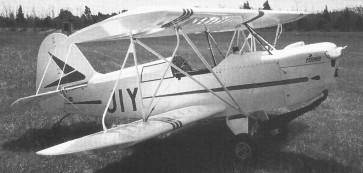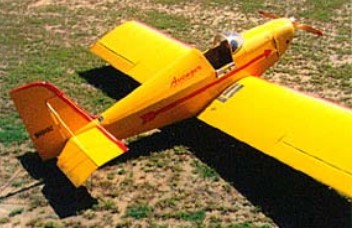
Fisher Avenger

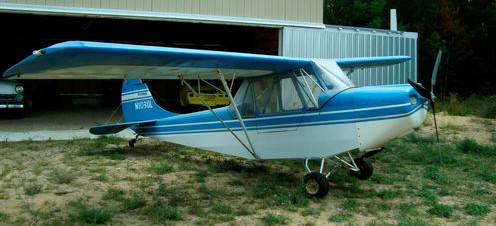
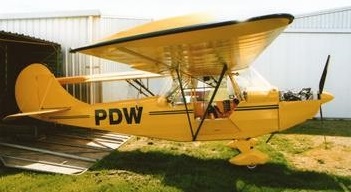
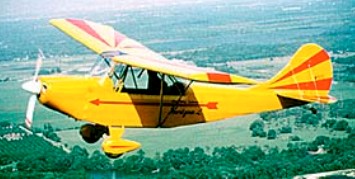
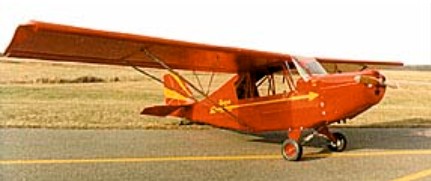
With the Rotax 503 or 1/2 VW the Avenger prototype will cruise at 80 mph at just 5,000 rpm on the Rotax 503, single carb 48 horsepower engine. With the removable canopy, the Avenger can be flown in the summer or the winter. Cabin heat can also be installed. Avenger V has 2″ narrower firewall for VW engines.
It was designed to be inexpensive and to have a significant amount of room. It easily accommodates a 6’4″, 240 pound pilot. An all wood design suitable for VW and Subaru engines, the Avenger first appeared in 1994 and by 2004 fifty had been sold. Plans cost US$150, or US$165 for the Avenger V plans. The kit for the Avenger V was US$2795.
Designed by Steve Turner & Steve Lamberg for all wood construction. Complete kits were available with quick 300 hour build to fly time.

Avenger UL
Engine: Rotax 477
Wingspan: 27′
Cord: 54″
Length: 16’3″
Gross Weight: 600 lbs.
Empty Weight: 250 lb
Velocity-Never Exceed: 95 mph
Cruise Speed: 60 mph
Stall Speed: 26-28 mph
Climb Rate: 400 fpm
Takeoff Run: 200′
Landing Roll: 200 ft.
Design Loads: +4 -2.5g
Construction Time: 400 hours

Avenger EXP
Engine: Rotax 503, 48 hp
HP range: 28-48
Wingspan: 27′
Cord: 54″
Wing area: 121.5 sq.ft
Length: 16’3″
Height: 5 ft
Gross Weight: 600 lbs.
Empty Weight: 280 lb
Fuel cap: 5 USG
Velocity-Never Exceed: 95 mph
Cruise Speed: 80 mph
Stall Speed: 26-28 mph
Climb Rate: 500 fpm
Range: 150 sm
Takeoff Run: 100′
Landing Roll: 200 ft.
Seats: 1
Landing gear: tail wheel
Design Loads: +4 -2.5g
Construction Time: 400 hours

Avenger V
Engine: 1835cc VW 60hp
HP range: 50-65
Span: 27′
Wing area: 121.5 sq.ft.
Length: 16’3″
Height: 5 ft
Gross: 650 lb
Empty Weight: 325 lb
Useful Load: 325 lb
Fuel cap: 5 USG
Speed max: 100 mph.
Cruise: 80 mph.
Stall: 31 mph
Landing Speed: 39 mph
Cruise: 75 mph
Rate of Climb: 700 fpm
Range: 250 sm.
Take Off Distance: 250 ft
Landing dist: 250 ft
Seats: 1
Landing gear: tail wheel.
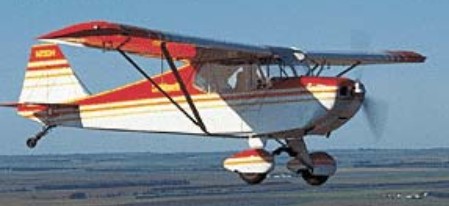
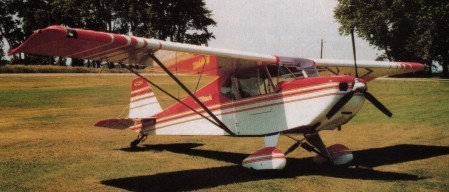
Fisher Dakota Hawk

First flown in 1993, the Dakota Hawk was based on a design by Erval Jackson. Equipped with dual controls, a steerable tail wheel, main gear shock absorbers and available are hydraulic brakes.
The I Beam wing spar and construction gives a 550 lb useful load, coupled with space for added instrumentation, avionics and optional wing tanks, make the Hawk agreeable choice for cross-country flight.
The Hawk’s folding wings are engineered with a simple yet secure locking mechanism, making set-up or take-down a 15-minute step.
Wings outstretched, the Dakota Hawk owns larger dimensions than any other Fisher model. A broadened fuselage generates a wider, roomier cabin, with space for two adults and a cargo of overnight baggage.
The Dakota Hawk is designed for a 4-stroke engine, accepting the likes of a 65, 85, 0-200 Continental, 912 & 912S Rotax or 6 cyl. Jabiru. Properly equipped, the Hawk’s cruise speed will register over 95 mph.
Load and performance ratings benefit from an augmented main wing spar, and proven geodetic construction throughout. A contoured vented cowling, high stance landing gear and available wheel pants contribute to the craft’s posture.
The kitprice in 1997 was US$9,300. By 2001, the standard kit cost US$10,500 with a quick build kit available for an additional US$2000.
By 2004, twenty-five had been sold.

Gallery

Engine: Rotax 912 80hp
Wingspan: 28’6″
Length” 19’9″
Height: 6 ft 1 in
Wing Area: 128 sq. ft.
Weight empty: 600 lbs.
Gross: 1150 lb
Fuel cap: 12 USG
Optional fuel total cap: 19.5 USG
Useful Load: 550 lbs.
Wing Load: 9 lbs/sq. ft.
Load Factor: +5.7 -2.28g
Velocity-Never Exceed: 120 mph
Max Speed: 100 mph
Cruise Speed: 90-100 mph
Stall: 35 mph.
ROC: 800 fpm.
Range: 250 sm
Glide Ratio: 8:1
Take-off dist: 350 ft.
Landing dist: 400 ft.
Seats: 2.
Landing gear: tail wheel.
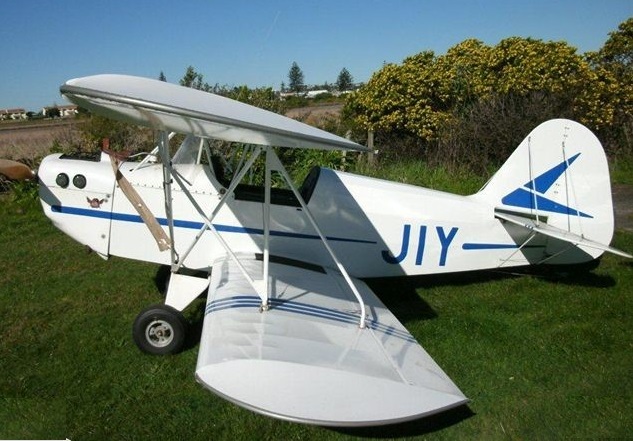
Engine: Rotax 912, 80 hp
Wing span: 8.7 m
Wing area: 12 sq.m
MAUW: 450 kg
Empty weight: 272 kg
Fuel capacity: 37.8 lt
Cruise speed: 145 kph
Minimum speed: 60 kph
Climb rate: 4 m/s
Seats: 2
Kit price (1998): US$10,695

Fisher Horizon 2

First flown in 1991, the amateur-built Horizon 2 was inspired by the O-1 Bird Dog and designed with the larger pilot in mind, so the cockpit has ample room for a 6’6″ person weighing 280 pounds and the tandem seating. Thirty had been sold by 2004. The wing of the Horizon 2 features a modified GA (W)-2 airfoil combined with slotted flaps and ailerons, giving the plane more control and less drag at all airspeeds. The wing is a quick-folding wing for storage.

The Horizon 2 is only similar to the Horizon 1 in that they are both tandem, two place, high wing aircraft, but that’s where the similarity ends. The Horizon 2 has a uniquely shaped fuselage, which gives it a cleaner, more efficient aerodynamic design accounting for the 20 mph increase in cruise speed over the Horizon 1. The aerodynamic design also allows a 360 degree field of vision.

Kits were available for US$7500 and plans sold for US$350 in 1997.

Horizon 2

Gallery

Horizon 2
Engine: Limbach, 80 hp.
HP range: 65-115.
Height: 5 ft 10 in
Length: 19 ft 8 in
Wing span: 26 ft.
Wing area: 113.6 sq.ft.
Fuel cap: 13 USG.
Weight empty: 570 lbs.
Gross: 1050 lbs.
Wing Load @ Gross: 9.3 lbs/sq. ft
Wing Cord: 54″
Velocity-Never Exceed: 120 mph
Speed max: 110 mph.
Cruise: 95 mph.
Range: 250 sm.
Stall: 35 mph.
ROC: 900 fpm.
Take-off dist: 250 ft.
Landing dist: 250 ft.
Seats: 2/Tandem dual controls.
Landing gear: tail wheel.
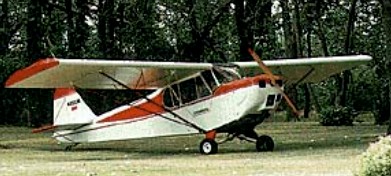
Construction: Wood/fabric, or Metal/fabric.
Design Loads: +4 -2.5g

Engine: Subaru
Propeller: Ground adjustable 3 blade
Wingspan: 26ft
Fuel capacity: 13 gallons
Top level speed: 120mph
Cruise speed: 95/100mph
Stall speed: 35/38 mph
Climb rate: 800/900 FPM
Take off run: 250/500ft
Landing roll: 250/300 ft

Fisher Horizon 1

The Horizon 1 first flew in 1990 and by 2004, fifty had been sold. Based loosely on the Bellanca Citabria and amateur construction, it can carry a payload equal to its weight and is an excellent platform for lightweight floats or skis. It has a large, roomy cockpit, tandem seating, optional two-cycle or four-cycle engines and a one man, two-minute wing fold system.
Kits were available and plans cost US$275 in 1997.

Horizon 1
Engine: Limbach, 80 hp.
HP range: 65-125.
Height: 5 ft 8 in
Length: 18’8″
Wing span: 25’3″
Wing area: 113.6 sq.ft.
Wing Cord: 54″
Fuel cap: 13 USG.
Weight empty: 520 lbs.
Gross: 1050 lbs.
Wing Load @ Gross: 9.2 lbs/sq. ft
Velocity-Never Exceed: 120 mph
Speed max: 95 mph.
Cruise: 85 mph.
Range: 250 sm.
Stall: 39 mph.
ROC: 800-900 fpm.
Take-off dist: 250-500 ft.
Landing dist: 250-350 ft
Seats: 2/Tandem dual controls.
Landing gear: tail wheel.
Construction: wood/fabric.
Design Loads: +4 -2.5g

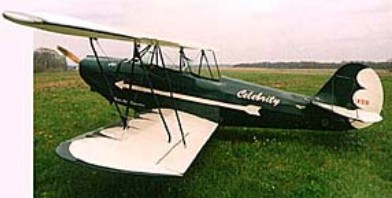
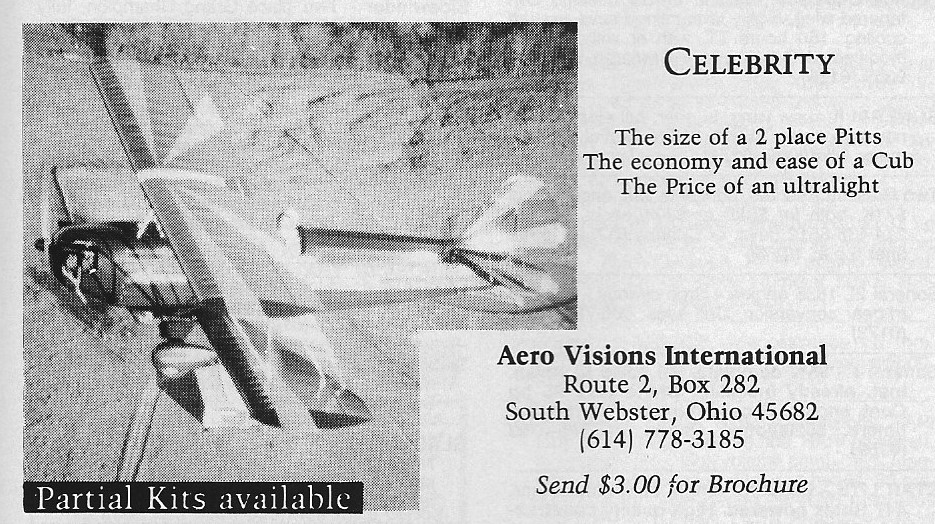
Fisher Celebrity / Aero Visions International Celebrity

First flown in 1989, the normal takeoff will vary with your choice of engine, but the prototype with 65 horsepower gets off the ground in 300 feet. The latest factory demo gets off the ground in about 250 feet using a C-90-100 horsepower.

The Celebrity is a biplane of wood construction with an optional steel fuselage, tandem seating (solo from the rear), fabric covered, light aircraft designed to be built in the experimental category. The Celebrity is designed for the first-time builder.

April 1991

Thirty had been sold by 2004 and the 2009 price was US$12,650.

Engine: Continental O-200, 100 hp.
HP range: 65-125.
Height: 5.95 ft.
Length: 17 ft 6 in
Wing span: 22 ft.
Wing area: 176 sq.ft.
Wing Gap: 38in
Aileron Area: 20 sq. ft.
Tail Span: 7ft
Fuel cap: 13 USG.
Weight empty: 272 kg / 600 lbs.
Gross: 1,230 lbs lbs.
VNE: 104 kt / 120 mph / 193 kmh
Speed max: 95 mph.
Cruise: 74 kt / 85 mph / 137 kmh
Range: 200 sm.
Stall: 35 kt / 40 mph / 64 kmh
ROC: 800-900 fpm
Take-off dist: 300 ft.
Landing dist: 350 ft.
Seats: 2/Tandem dual controls.
Landing gear: tail wheel.
Take-off distance: 300 ft / 91 m
Landing distance: 300 ft / 91 m
Design Loads: +4 -2.5g
Field Assembly Time: 30 min

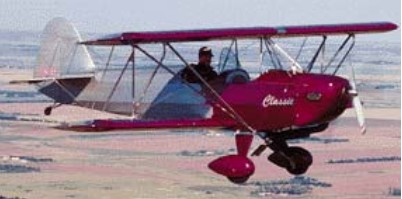
Fisher Classic

Sharing the flight characteristics of the 404, the two-place version of the FP-404 also carrys a passenger. First flown in 1987, dual controls give you the option of front or back position, and an 85 mph cruise speed.
This amateur-built biplane aircraft is complete with minimal instruments and bare-necessity controls. Featuring short wings, four ailerons and a semisymmetrical airfoil, the aircraft answers commands instantaneously. Geodetic wood construction and additional bracing contribute to structural strength, enough to withstand higher Gs than most light planes. The wings detach for east storage.
For experimental models, a 64 horsepower Rotax engine provides enough power for an 800 feet-per-minute climb.
In 1997 the kit price was US$6775. The 1998 kit price was US$7392. By 2004, 150 had been sold.

Engine: Rotax 582, 64 hp.
Range: 225 sm.
Stall: 38 mph.
ROC: 1000 fpm.
Take-off dist: 200 ft.
Landing dist: 300 ft.
Fuel cap: 8 USG.
Weight empty: 400 lbs.
Gross: 850 lbs.
Height: 5 ft 11 in.
Length: 16ft 9in.
Wing span: 22 ft.
Wing area: 154 sq.ft.
Seats: 2.
Landing gear: nose wheel.
Wing Gap: 41″ / 38″
Aileron Area: 18 sq. ft.
Tail Span: 84″
Drive Type: Geared
Reduction Ratio: 2.58:1
Max. Pilot Weight: 200 lbs.
Construction Time: 500 hrs.
Field Assembly Time: 30 min.
Velocity-Never Exceed Solo: 110 mph
Max Speed Solo: 90 mph
Cruise Speed Solo: 75-80 mph
Stall Speed Solo: 35 mph
Climb Rate Solo: 800 fpm
Glide Ratio Solo: 8:1
Velocity-Never Exceed Gross: 100 mph
Max Speed Gross: 90 mph
Cruise Speed Gross: 75-80 mph
Stall Speed Gross: 38-39 mph
Climb Rate Gross: 600 fpm
Glide Ratio Gross: 7:1

Fisher FP-606 Sky Baby

A replica of the popular Cessna 150 and 152, the FP-606 first flew in 1986, and by 2004, 25 were sold.
Winner of the EAA Best New Design Award for light planes in 1988, the FP-606 is a familiar form and geodetic construction giving the aircraft a solid feel.
A 2SI 460-35 engine powers the light plane version, with a 447 or 503 forming a formidable power plant for the experimental model. The fully enclosed cockpit features a door you can take off.
Available as either a trigear or taildragger, the FP-606 requires 15 minutes field assembly time. A five-USgallon fuel tank is standard on light-plane models, with a 7 1/2 gallon tank available for the experimentals. Brakes and electric starter are optional on both.

Engine; 2SI 460-35
Drive Type; Geared
Reduction Ratio; 2.58-to-1
Wingspan; 28′
Wing Area; 116 sq. ft.
Height; 71″
Length; 17’9″
Gross Weight; 500 lbs.
Empty Weight; 250 lbs.
Useful Load; 250 lbs.
Wing Load; 4.3 lb/sq ft
Fuel Capacity; 5 USgal.
Design Loads; +4.6 -2.3g
Velocity-Never Exceed; 90 mph
Top Level Speed; 65 mph
Cruise Speed; 55-60 mph
Stall Speed; 26 mph
Climb Rate; 700-800 fpm
Takeoff Run; 150′
Landing Roll; 150′
Range at Cruise; 150 mi
L/D (Glide Ratio); 9-to-1

Engine: Rotax 277, 28 hp.
HP range: 28-48.
Height: 5.9 ft.
Length: 17.4 ft.
Wing span: 29.85 ft.
Wing area: 120 sq.ft.
Fuel cap: 5 USG.
Weight empty: 254 lbs.
Gross: 500 lbs.
Speed max: 70 mph.
Cruise: 60 mph.
Range: 110 sm.
Stall: 26 mph.
ROC: 600 fpm.
Take-off dist: 125 ft.
Landing dist: 175 ft.
Seats: 1.
Landing gear: nose or tail wheel.

Fisher FP-505 Skeeter

First flown in 1984, this light plane combines a high wing and an open cockpit, loosely based on the Pietenpol Air Camper. The pylon-mounted high wing leaves the cockpit essentially unenclosed, offering the pilot spectacular visibility and the freedom of an open cockpit design. Powered by a 40 horsepower Rotax, the FP-505 has shock-absorbing gear and geodetic construction.
By 2004 50 had been sold.

Engine; 2SI 460-35
Drive Type; Geared
Reduction Ratio; 2.58-to-1
Wingspan; 28′
Wing Area; 112 sq. ft.
Length; 16’6″
Gross Weight; 500 lbs.
Empty Weight; 240-250 lbs.
Max. Pilot Weight; 200 lbs.
Fuel Capacity; 5 USgal.
Cruise Speed; 55-60 mph
Stall Speed; 26 mph
Climb Rate; 700-800 fpm
Glide Ratio; 9:1
Takeoff Run; 150′
Design Loads; +4.6 -2.3g
Construction Time; 500 hrs.
Field Assembly Time; 15 min.

Engine: Rotax 277, 28 hp.
Height: 5.8 ft.
Length: 16.5 ft.
Wing span: 28 ft.
Wing area: 112 sq.ft.
Fuel cap: 5 USG.
Weight empty: 245 lbs.
Gross: 500 lbs.
Wing loading: 4.46 lbs/sq.ft.
Power loading: 17.85 lbs/hp.
Speed max: 62 mph.
Cruise: 55 mph.
Vne mph: 90.
Range: 180 sm.
Stall: 26 mph.
ROC: 750 fpm.
Take-off dist: 150 ft.
Landing dist: 150 ft.
Service ceiling: 13,000 ft.
Seats: 1.
Landing gear: tail wheel.

Fisher FP-404

First flown in 1984, the FP-404 is a throw-back to seat-of-the-pants flying, complete with minimal instruments and bare-necessity controls. A single seat biplane amateur-built biplane, the 404 is a version of Fisher Classic, featuring short wings, full-span ailerons and a semisymmetrical airfoil. Geodetic wood construction and additional bracing contribute to structural strength, enough to withstand higher Gs than most lightplanes.
For experimental models, a 50 horsepower Rotax engine is more than enough power for 800 feet-per-minute climbs. The plane is as responsive as you are aggressive.
By by 2004 350 had been sold.

Engine; Rotax 503, 48 hp
Drive Type; Geared
Reduction Ratio; 2.58-to-1
Wingspan; 18′
Wing Area; 120 sq. ft.
Wing Gap; 2’8″
Aileron Area; 14 sq. ft.
Length; 14’6″
Height; 5’5″
Tail Span; 6’6″
Gross Weight; 540 lbs.
Empty Weight; 275 lbs.
Max. Pilot Weight; 200 lbs.
Fuel cap: 5.8 USG.
Wing loading: 4.5 lbs/sq.ft
Power loading: 11.25 lbs/hp.
Construction Time; 500 hrs.
Field Assembly Time; 15 min.
Velocity-Never Exceed; 90 mph
Top Level Speed; 80 mph
Cruise Speed; 72 mph
Stall Speed; 30 mph
Climb Rate; 800 fpm
Takeoff Run; 125′
Landing Roll; 200′
L/D (Glide Ratio); 8-to-1
Range: 140 sm.
Seats: 1.
Landing gear: tail wheel.

Fisher Super Koala

Super Koala

The Super Koala 2 seat development of the Koala adds another seat for side-by-side. The cockpit has dual controls and the wings detach for storage. Options are a 52 or 64 horsepower Rotax engine for cruise speeds of 65-85 mph, allowing hands-off flying.
First flown in 1983, by 2004 100 had been sold.

Super Koala
Engine; Rotax 503, 52 hp
Wingspan; 31′
Wing Area; 140 sq. ft.
Height; 5’7″
Length; 18’1″
Fuel Capacity; 8 USgal.
Fuel Consumption @ 75%; 3 USgal/hr.
Design Loads; +4.6 -2.3g
Drive Type; Geared
Gross Weight; 740 lbs.
Empty Weight; 350-375 lbs.
Construction Time; 500 hrs.
Field Assembly Time; 20 min.
Velocity-Never Exceed; 95 mph
Cruise Speed Solo; 75-80 mph
Stall Speed (w/flaps) Solo; 28 mph
Climb Rate Solo; 1000 fpm
Glide Ratio Solo; 9:1
Takeoff Run Solo; 150′
Landing Roll Solo; 200′
Cruise Speed Gross; 70-75 mph
Stall Speed (w/flaps) Gross; 30 mph
Climb Rate Gross; 700 fpm
Glide Ratio Gross; 9:1
Takeoff Run Gross; 200′
Landing Roll Gross; 250′

Super Koala
Engine; Rotax 582LC, 64 hp
Wingspan; 31′
Wing Area; 140 sq. ft.
Height; 5’7″
Length; 18’1″
Fuel Capacity; 8 USgal.
Fuel Consumption @ 75%; 4 USgal/hr.
Design Loads; +4 -2.2g
Drive Type; Geared
Gross Weight; 830 lbs.
Empty Weight; 375-400 lbs.
Construction Time; 500 hrs.
Field Assembly Time; 20 min.
Velocity-Never Exceed; 95 mph
Cruise Speed Solo; 75-80 mph
Stall Speed (w/flaps) Solo; 29 mph
Climb Rate Solo; 1400 fpm
Glide Ratio Solo; 9:1
Takeoff Run Solo; 125′
Landing Roll Solo; 200′
Cruise Speed Gross; 70-75 mph
Stall Speed (w/flaps) Gross; 32 mph
Climb Rate Gross; 1100 fpm
Glide Ratio Gross; 9:1
Takeoff Run Gross; 150′
Landing Roll Gross; 250′

Super Koala
Stall: 45 kt / 52 mph / 83 kmh
Cruise: 60 kt / 69 mph / 111 kmh
VNE: 95 kt / 109 mph / 176 kmh
Empty Weight: 201 kg / 443 lbs
MTOW Weight: 376 kg / 829 lbs
Climb Ratio: 1000 ft/min / 5 m/s
Glide Ratio: 9:1
Take-off distance (50ft obstacle): 430 ft / 130 m
Landing distance (50ft obstacle): 560 ft / 172 m
2009 Price: US$14,300