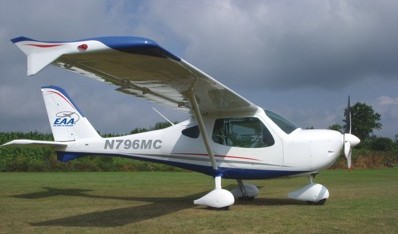
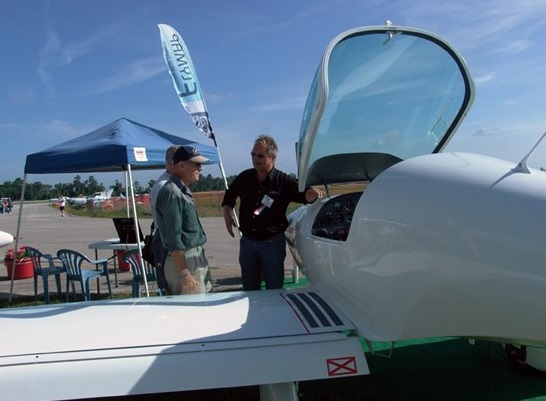
Created to complement the existing CTsw and CTLS, the MC offers utility and performance in a metal airframe. Constructed from Aluminum, steel and composites, the MC features a steel space frame, all aluminum flying surfaces and a composite cabin and cowling. The focus with the MC was to provide more utility with a giant cabin and easy-to-maintain modular construction. Designed with training and commercial fleet uses in mind, the MC visibility, baggage area and easy cabin entry are features. The metal flying surfaces of the MC are buck riveted and corrosion proofed for maintenance free flying. The steel pilot cage is covered with easy to remove composite shells to allow quick access to the landing gear and controls for annual or 100 hour inspections. The main landing gear is the Flight Design nobounce composite gear introduced on the CTLS. The cabin of the MC has a width of nearly 52 inches, 2-way adjustable seats and extra-wide cabin doors. The four-point safety harnesses, wing located fuel tanks and the BRS 1350 parachute system are standard. Standard features include 2 blade composite propeller, conventional three-axis controls, electric pitch trim system, cabin door gas struts, two large capacity baggage compartments, two cockpit storage compartments, electric pre-selector flap system, one piece molded windshield, steerable nose wheel, hydraulic brakes, durable, two-part urethane paint.
An ultralight composite aircraft, the Flight Design CT2K has been developed, and now has less weight, increased power and higher performance, with additional load-carrying capability. The design of the wing and the aircraft structure has been tested for a take-off weight up to 600 kg, so the Flight Design CT2K can comply with different certification criteria in different countries. 2009 CT2K price: 55862 EURO In spring 2003 CT2K was complimented with the CTSW (CTSW = CT Short Wing). Due to 80 cm shorter wings and increased ground effect CTSW has even greater aerodynamic stability and is easy to land. This aircraft had 5 km/h increased maximum level-flight speed while having slightly reduced climb speed. Both CT2K and CTSW were also available as VLA versions. 2009 price for the CTSW was 60000 EURO.
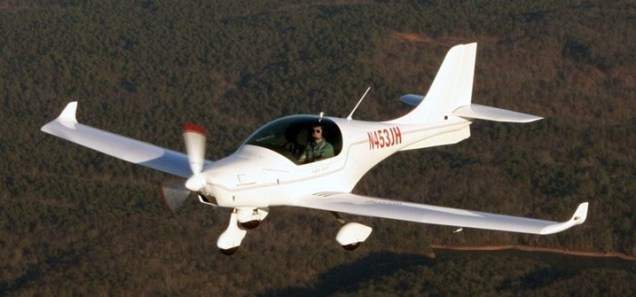
CT 180
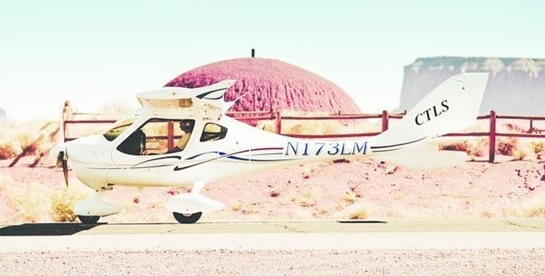
In 2012 Flight Design had 11 registrations in the US. CTLSi (with the fuel-injected Rotax 912iS engine) are selling well, and the CTLS, MC and CTLS-Club models continue in the popular lineup. 2012 Prices: US$156,500 (CTLSi); US$143,800 (CTLS); US$136,860 (CTLS-Club).
CTLS
CT 180 Engine: Rotax 912, 80 hp Wing span: 9.30 m Wing area: 10.80 sq.m MAUW: 450 kg Empty weight: 275 kg Fuel capacity: 100 lt Max speed: 225 kph Cruise speed: 210 kph Minimum speed: 64.4 kph Climb rate: 5 m/s Certification: VZ Seats: 2 Fuel consumption: 15 lt/hr Price (1998): 60 000 DM
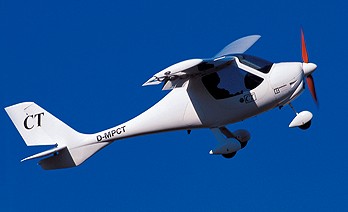
Flight Design CT Engine: Rotax 912S, 100@SL TBO: 1500 hrs. Fuel type:100/100LL Propeller: Neuform FP Landing gear type: Tri./Fixed Max ramp weight: 1320 lb Gross weight: 1320 lb Landing weight: 1320 lb Empty weight, std: 646 lb Useful load, std: 674 lb Useful fuel, std: 34 USgals Payload, full std. fuel: 470 lb Wingspan: 28 ft Overall length: 20 ft. 4 in Height: 7 ft. 11 in Wing area:107 sq. ft Wing loading: 12.3 lbs./sq. ft Power loading: 13.2 lbs./hp Wheel size: 6.00 x 6 in Seating capacity: 2 Cabin doors: 2 Cabin width: 49 in Cruise speed 75% power: 112 kt Max range (w/ reserve) 75% power: 600 nm Fuel consumption 75% power: 4.5 USgph Vso: 39 kt Best rate of climb SL: 960 fpm Service ceiling: 14,000 ft Takeoff ground roll: 295 ft Takeoff over 50-ft. obstacle: 525 ft 2006 price: US$92,900
The Smaragd / Emerald is a conventional low-wing aircraft with classical tail unit and tricycle landing gear, built from glass and carbon fiber reinforced plastic. The seats are next to each other arranged and adjustable. Behind the seats are the very roomy baggage compartment and the evacuation equipment. The wing anchorage is solved over interlinking cross-beam roots and a main pin as with modern Seglern, which permits an extremely simple disassembly. The main landing gear consists of rocker with hydraulically braked wheels of GRP kevlar. The tanks are arranged in the wing; 55 and/or 110 litres were available.
The Smaragd had it’s maiden flight on March 22nd, 2003 and was licensed on December 29th, 2003.
Emerald
The aircraft was designed and produced by Flaeming Air of Zehlendorf, Brandenburg, to comply with the Fédération Aéronautique Internationale microlight rules and US light-sport aircraft rules, with different models for each category. It features a cantilever low-wing, a two-seats-in-side-by-side configuration enclosed cockpit under a bubble canopy, fixed tricycle landing gear, or optionally conventional landing gear and a single engine in tractor configuration.
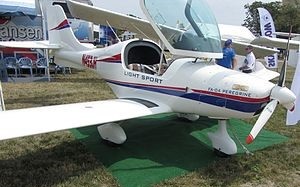
FA 04 Peregrine
The aircraft is made from composites, with its fuselage, wing spars, flaps and rudder made from carbon fibre. Its 10.05 m (33.0 ft) span wing has an area of 9.27 m2 (99.8 sq ft). The standard engines available are the 100 hp (75 kW) Rotax 912ULS, 120 hp (89 kW) Jabiru 3300 and the 100 hp (75 kW) Continental O-200 powerplants.
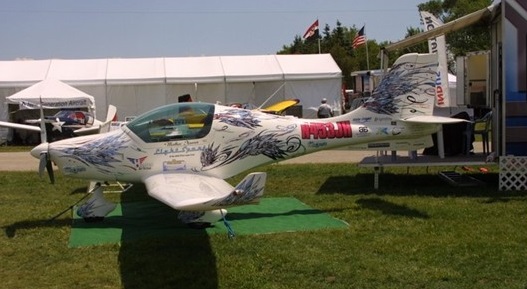
The Peregrine is the LSA version of the Smaragd, allowing a 600 kg max take-off weight. The Peregrine is close to the VLA/experimental version, having different wings to fit into the LSA rule plus some small details to suit the US customer. The US-LSA certification has been granted. The Peregrine fits into the US rules ASTM 2245. The FA 04 Peregrine LSA features fixed gear and fixed pitch prop.
The FA 04 can be used for aero-towing gliders up to 700 lb (318 kg) gross weight. The Flaeming Air FA 04 Peregrine is supplied as a complete ready-to-fly-aircraft.
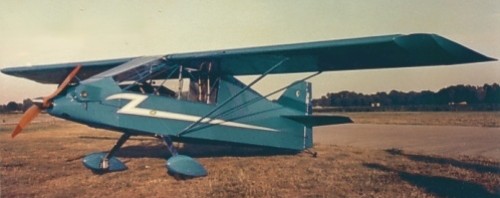
FA-04 Peregrine light sport aircraft
The FA-04 Peregrine factory-built Special Light Sport Aircraft (SLSA) is based on Flaeming Air’s FA-02 rugged VLA certified aircraft. The FA-04 can easily be configured from tricycle to tail wheel by a certified mechanic. The cockpit, 44 inch wide at the shoulders, has adjustable seats ergonomically designed, electric flaps, and hydraulic toe brakes with a hand brake option. A mechanical elevator trim or an optional electric trim is available.
Engine options for the SLSA are 80/100 hp Rotax 912 or 80 hp Jabiru 2200 and a 3-blade propeller, ground adjustable.
FA-04 Peregrine light sport aircraft – experimental lightsport aircraft
Variants:
FA 01 Smaragd (English: Emerald) Initial model for the European FAI microlight class, with a gross weight of 472.5 lb (214 kg).
FA 02 Kit aircraft with a gross weight of 650 lb (295 kg).
FA 04 Peregrine Light-sport model for the US market, with a gross weight of 600 lb (272 kg).
FA 04 SL Super-light model with an empty weight of 270 lb (122 kg), including a ballistic parachute.
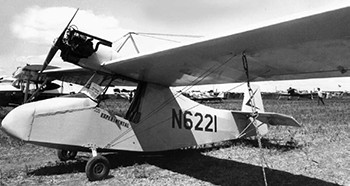
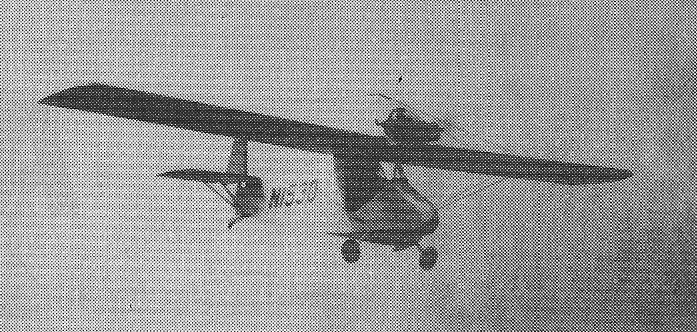
An ultra-light sporting single-seat high-wing monoplane designed by K. Flaglor of Asheville, North Carolina. The Scooter was originally powered by a Cushman golf cart engine, which was ultimately replaced by a 1,500-cc VW engine rated at 40 hp. At the 1967 EAA meet this high-wing, enclosed-cabin taildragger received both the “Outstanding Ultralight” and “Outstanding Volkswagen Powered” awards. Construction is of wood with a plywood covering, except for the aft section of the fuselage which is fabric covered. The VW engine is mounted over the cabin and turns a two-blade propeller. The Sky Scooter features all wood construction, generous wing area for STOL like performance. Easy to build and maintain.
The Scooter was later marketed by Rotor Wings & Flying Machines.
The plans for the Ace Aircraft Ace Scooter development of the Flaglor Scooter consisted of one sheet 17in x 22in, nine sheets 22in x 34in, and an illustrated construction manual containing 14 photographs used to show key assemblies and construction details. The Airfoil is drawn full size as are most of the fittings.
The Scooter is constructed primarily of marine spruce and plywood. Aircraft quality materials maybe used and are recommended for the spars. All fittings are designed for simple fabrication and are made of 4130 steel as is the motor mount tubing. The metal fairing and wing leading edge can be made of “hardware store variety” aluminium which was the case on the prototype.
The fuselage is composed of spruce longerons with plywood gussets aft and plywood sides in the cockpit area.
Ace Aircraft Ace Scooter
The landing gear is made of steel. All wing ribs are contour sawed 1/4in marine plywood, the main spars spruce as are the false and aileron spars. The wing uses a wood cross hatching in the form of an X between the ribs and spars, resulting in no need for drag or anti-drag wires or fittings.
Plywood wing tips and wood trailing edges complete the structure. Only the wing leading edge is aluminium.
Engine: VW, 25 hp. HP range: 25-40. Height: 7 ft. Length: 15 ft. Wing span: 28 ft. Wing area: 115 sq.ft. Fuel cap: 5 USG. Weight empty: 390 lbs. Gross: 625 lbs. Speed max: 95 mph. Cruise: 65 mph. Range: 180 sm. Stall: 34 mph. ROC: 325 fpm. Take-off dist: 250 ft. Landing dist: 350 ft. Seats: 1. Landing gear: tail wheel.
Engine 40-hp 1500cc Volkswagen. Gross Wt. 650 lb. Empty Wt. 390 lb. Fuel capaci¬ty 5 USG. Wingspan 28 ft Length 15 ft 8 in Wing area: 115 sq.ft. Top speed 90 mph. Cruise speed 80 mph. Stall speed 34 mph. Climb rate 600 fpm. Takeoff run 250 ft. Landing roll 250 ft. Range 175 nm Seats: 1
Engine: VW 1600 60hp Span: 27’10” Length: 15’6″ Wing Area: 115 sq. ft. Empty Weight: 390 lbs Useful Load: 235 lbs Stall: 40 mph Landing Speed: 60 mph Cruise: 100 mph Rate of Climb: 1000 fpm Take Off Distance: 350 ft Seats: 1
Ace Aircraft Ace Scooter Engine: VW 1500 Span: 28 ft 0 in Wing area: 115 sq.ft Length: 15 ft 8 in Height: 7 ft 0 in MTOW: 625 lb Empty weight: 390 lb Fuel: 7 USG Top speed: 88 mph Cruise speed: 75 mph Stall: 34 mph SL climb: 600 fpm Ceiling: 12,000 ft Range: 175 mi Take-off roll: 250 ft Landing roll: 350 ft
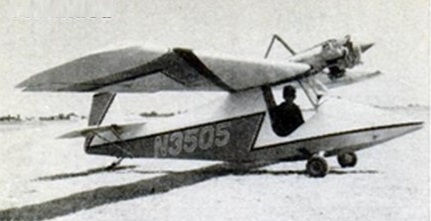
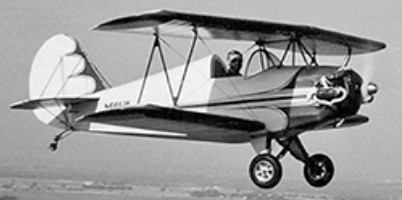
Ed Fisher first designed the Zippy Sport, which was officially introduced 1983 as a participant in the Dupont/Western Flyer design contest, and was marketed through Fishercraft. It is not the design prototype, but rather, the “proof of plans” aircraft. This “Sport Plane” was identified as an ARV, (Air Recreational Vehicle). At that time, designer, Ed Fisher flew the Zippy with a Cuyuna 430 dual carb engine, and a Winters 2:1 planetary gearbox. Top speed was about 110 mph Flying behind a 30-hp 430 RR Cuyuna, has a top speed of 115 mph. Designer Ed Fisher specializes in fast planes, many of them racers. Zippy Sport was de¬signed as a lightweight, folding-wing, trailerable, low-power aircraft with a ULF of +4.4 -3.1 G’s. Airfoil is the NAQR 4412 curve, with good stall characteristics and cruise. Wing is built up of ¾” by 61/2” solid spruce main spar and a 2” by 1” rear spar, ribs of sawn plywood or aluminum, leading edge aluminum sheet. Landing gear is of ½” by 5 ½ ,” aluminum spring tapering to 2” at the axle end. Go-Kart wheels and brakes are used. Ailerons and elevator are actuated by conven¬tional push/pull tubes, linked to a central joystick, Rudder is worked by rudder bar connected with 3/32” cables.
Over the next couple of years a full VW 1200 driving from the heavy end was fitted. Through, much of 1986, the aircraft was VW powered, while “debugging” flights took place. Green Sky Adventures had been interested in the Zippy’s development from the early stages. By 1986, the Rotax Service Center was in serious need of a test platform with a broad speed range to explore the effects of variable loads on small engines in general, and Rotax 2-strokes, in particular. A deal was struck with Ed Fisher, and by late fall of that year, Green Sky Adventures were flying a Rotax 503 powered Zippy Sport, enjoying it’s handling and speeds to 120 mph. Green Sky Adventures bought the “proof of plans” prototype Zippy Sport from Ed in 1986. The Zippy was flown to Oshkosh from NE Ohio in 1987. That year, the design prototype, N81ZS was trailered to Oshkosh by Ed, and the two aircraft were parked together on the homebuilt flightline. Through 1987 and some of 1988, hours were accumulated, and the aircraft was particularly useful for oil test runs, and propeller performance evaluations. During this period, another deal was struck with Ed, and the Zippy Sport design rights were acquired by Green Sky Adventures, selling a plans set at US$135. A stub axle failure in 1988 resulted in some substantial damage, taking the aircraft off line till early 1991, when it was relicensed with a new 43 HP Rotax 508 two cylinder 4-stroke engine. In subsequent years, Zippy Sport N83ZS has flown with 4 other Rotax engines, and countless propellers. It has been back to Oshkosh several times. The HKS 700-E is the 9 th engine for the test bed. The Zippy continues to function in it’s roll as test bed with the addition of the Green Sky Adventures, Inc HACman mixture control for the HKS 700-E and Rotax 912 series 4 strokes.
Engine 30-hp Cuyuna 430 MR Reduction unit Ultralight Technology 2:1 planetary drive Prop 54/36 Gross Wt: 610 lb Empty Wt. 340 lb Fuel capacity 5.5 USG. Wingspan 26 ft Length 17 ft l0 in Top 115 mph. Cruise 95 mph. Stall 35 mph Climb rate 750 fpm Takeoff run 360 ft Landing roll 650 ft
Engine: Rotax 503, 52 hp. HP range: 30-60. Height: 5 ft. Length: 17.83 ft. Wing span: 26.33 ft. Wing area: 100 sq.ft. Fuel cap: 11 USG. Weight empty: 421 lbs. Gross: 680 lbs. Speed max: 120 mph. Cruise: 100 mph. Range: 300 sm. Stall: 40 mph. ROC: 700 fpm. Take-off dist: 350 ft. Landing dist: 55 ft. Service ceiling: 15,000 ft. Seats: 1. Landing gear: tail wheel.
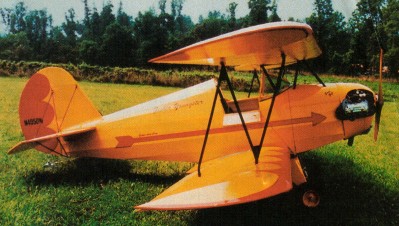
The Youngster “V” was designed, based on the Bücker Bü 133 Jungmeister, with all wood construction and short 350 build time. The cockpit accommodates up to 6’4″ pilots. This airplane offers a four-cycle VW engine and a 2315 airfoil with stainless wires and a bubble canopy. Enjoy an open cockpit on warm summer days and a fully enclosed cockpit for the winter. First flown in 1994, the V stands for VW and Rotax power is optional. It was designed to be affordable, but with the high quality you’ve come to know of Fisher Flying Products. The Youngster is gentle on the ground, but allows you to play with it in the air. The Youngster employs all wood construction using a Warner truss frame with 1/8″ birch ply skins in the fuselage. Stringers are placed along the fuselage sides and top turtledeck to form the fabric shaped fuselage. 1997 Youngster V kit price: US$3700. The Rotax powered kit sold for US$3400. Plans were US$200. By 2004, ten had been sold. 2009 Youngster V kit price: US$8750
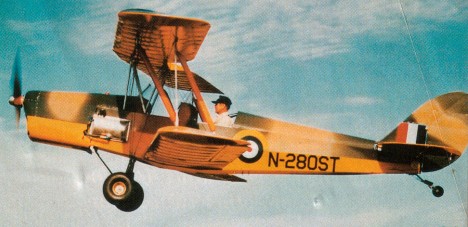
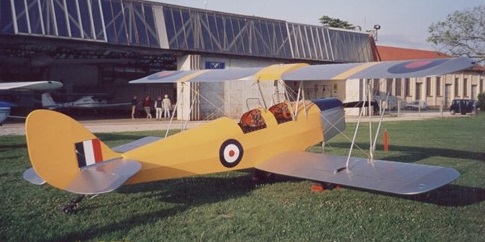
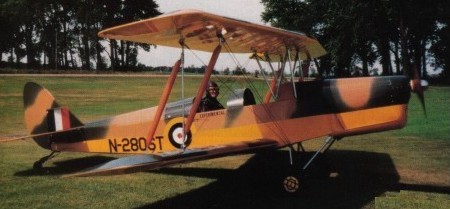
Steve Turner & Steve Lamberg developed the R-80 Tiger Moth as an 80% scale de Havilland Tiger Moth. Introduced and first flown in 1994, the original prototype fuselage was made of wood and powered with a Norton rotary engine. In 2000 the Tiger Moth was introduced with a 4140 steel tube fuselage. The kit cost approximately US$5000 more than the wood version and included a prewelded fuselage, vertical fin, rudder, stabiliser, and elevator. No welding is required by the builder. In 1997 the basic kit cost US$9300 with the quick build kit US$10,600. The Rotac 582, 618 or Subaru engines were options. Issues with the fuel consumption and cooling led to a change in 2000 to a LOM M132, 120 hp engine. LOM provided a wood propeller that matched that engine. At that time the engine cost US$12,000 and the propeller US$1800. The R-80 Tiger Moth is recommended for both first-time and experienced builders and only basic tools are needed in construction. Realistic estimates put construction time at 700 hours. The wood R-80 is straight-forward and strong. Aircraft grade epoxy adhesives are used throughout.
Initially, the airframe was designed by an aeronautical engineer. A design engineer was then brought in to assist during the actual construction and modification stage. The airframe was then tested, by an independent firm that specializes in structural analysis, to a limit of six positive and three negative g’s. At one point in this test, over 6,000 pounds of sandbags were on the R-80’s airframe-and it didn’t break. By 2001 the standard airframe kit cost US$16,500, and quick build airframe kit cost US$18,500. 2009 kit price: US$15,500
 All Aero