WAR F4U Corsair

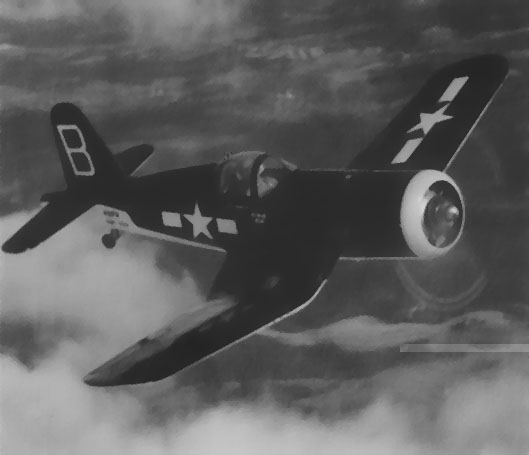
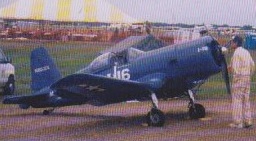
The half-scale Corsair is built around a plywood box core and covered with styrofoam and fiberglass. Plans have been produced for this and two other ½-scale World War II replicas by War Aircraft Replicas. All use the same common wooden fuselage box and wing spar construction in order to duplicate the various fighter aircraft. Polyurethane foam is shaped and covered with high-strength fiberglass cloth and laminating epoxy resin to form a rigid, yet light structure. Landing gears are of air/oil oleo type, with either electrical or manual retract and have a built-in emergency release. Engines vary from 65 hp to 125 hp, which accounts for variations in performance. Authentic three and four bladed props are available.
Features fully retractable landing gear, sliding canopy, and detachable wings.

Wing twist 2 degree
Engine: Continental O-200, Lycoming 0-290-D, HCI 7 cylinder Radial
Prop: 60″dia 3 or 4 blade ground adjustable
Wingspan: 20’0″
Wing area: 70 sq.ft
Length: 16 ft
Tread: 7 ft
Empty Weight: 600-620 lbs
Max Gross Weight: 900-920 lbs
Fuel capaci¬ty 15 USG
Wing Loading: 12lbs/sq ft
Cruise: 135 MPH @3.2 GPH
Max level speed: 165 MPH
Stall Speed: 55 MPH
Approach & Pattern Speed: 70-75 MPH
Take off Run: 800-1000 ft
Rate of Climb: 700 ft/min.
Endurance: 3-4 Hrs: 400 miles
Structural capability Aerobatic ( +/- 6 g’s)
Landing roll 1200 ft
Seats: 1
Cockpit width: 24 in
LSA: yes

Engine: Continental O-200, 100 hp
Wing span: 6.1 m
MAUW: 544 kg
Empty weight: 417 kg
Fuel capacity: 53 lt
Max speed: 273 kph
Cruise speed: 217 kph
Minimum speed: 88 kph
Climb rate: 7 m/s
Seats: 1
Plan price (1998): $245

N246S
Wing span: 20’0″
Length: 16’0″
Useful load: 279 lb
Max speed: 170 mph
Cruise speed: 140 mph
Stall: 90 mph
Range: 400 mi
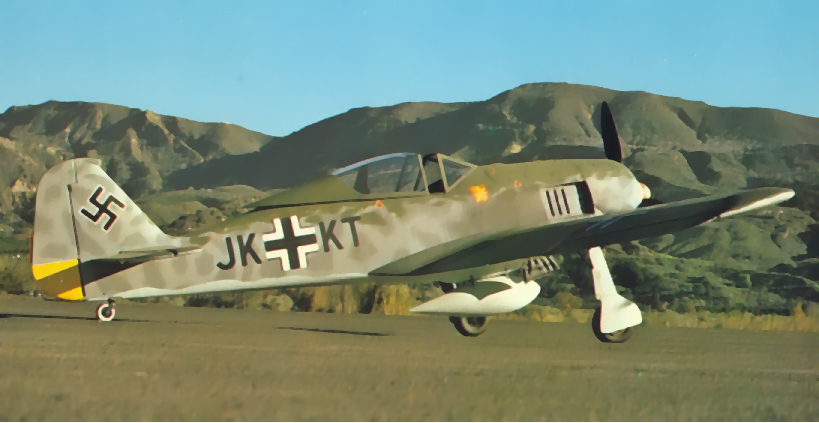
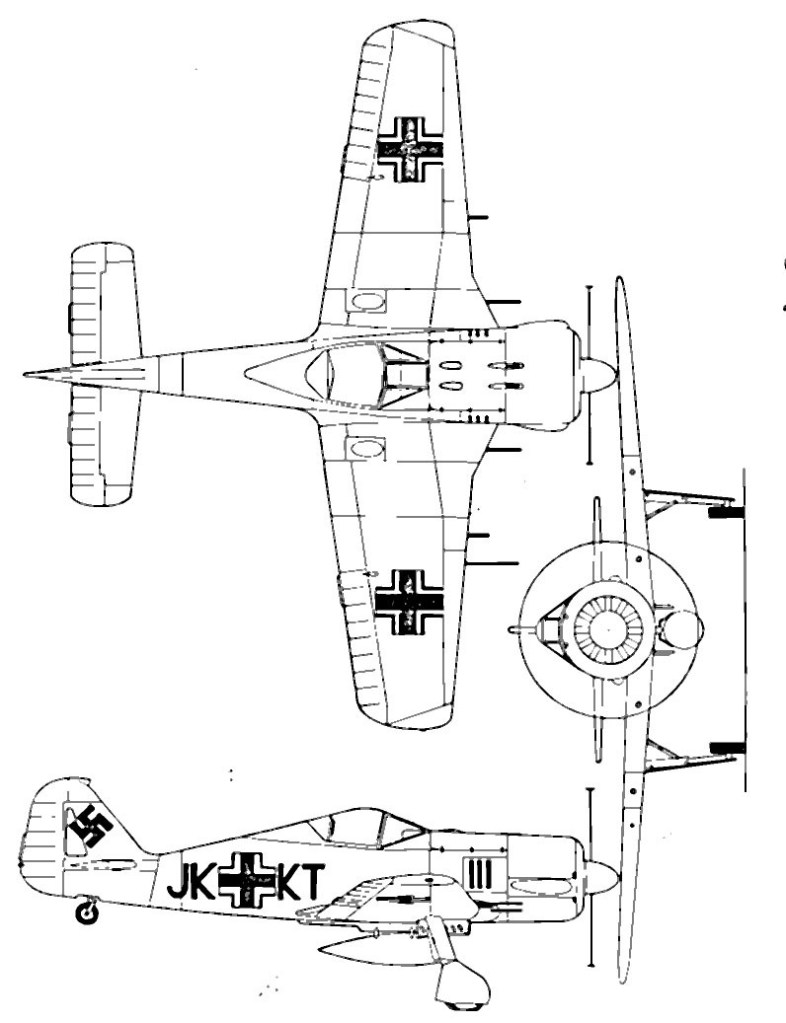
WAR Focke-Wulf 190

Construction is by War Aircraft Replicas, whose aim is to build scaled down versions of fighters for use as sport aircraft, instead of aerobatic sport aircraft which look like fighters.
WAR Aircraft Replicas is a company formed to market kits and plans for 1/2-scale World War II aircraft replicas. The Focke-Wulf 190 was singled out to be the first prototype, and development started in 1973. The first flight was made on 21 August 1974 with a 70hp VW engine. Other versions to be certified are the F4U Corsair and the P-47 Thunderbolt. All use the same common wooden fuselage box and wing spar construction. In order to duplicate the various fighter aircraft, polyurethane foam is shaped and covered with high-strength laminating fabric and epoxy resin to form a rigid, yet lightweight structure. Landing gear are electrically-retractable tailwheel type with an emergency system. Power is supplied by a 0-200 Continental turning a three-blade, fixed-pitch prop.
Plans 2005: US$245
Features fully retractable landing gear, sliding canopy, and detachable wings.

WAR Focke-Wulf 190 Article

Gallery

Engine: Continental O-200, Lycoming 0-290-D, HCI 7 cylinder Radial
Prop: 60″dia 3 or 4 blade ground adjustable
Wingspan: 20’0″
Wing area: 70 sq.ft
Wing section root: 23015 54 in
Wing section mid: 23014 46 in
Wing section tip: 23012 31 in
2 degree twist
Length: 16’7″
Tread: 6 ft 8 in
Empty Weight: 600-620 lbs
Max Gross Weight: 900-920 lbs
Fuel capacity 15 USG
Wing Loading: 12lbs/sq ft
Cruise: 135 MPH @3.2 GPH
Vne: 195 mph
Max level speed: 165 MPH
Stall Speed: 55 MPH
Approach & Pattern Speed: 70-75 MPH
Take off Run: 800-1000 ft
Rate of Climb: 700 ft/min.
Endurance: 3-4 Hrs: 400 miles
Structural capability Aerobatic (+/- 6 g’s)
Landing roll 1200 ft
Seats: 1
LSA: yes

War Aircraft Replicas (WAR)

The principle of the half-scale design was generated WAR Aircraft Replicas, Santa Paula, California, in 1973. The concept involves the use of a common-design wood fuselage box and spar structure. The desired contours to duplicate a particular aircraft are obtained by carving polyurethane foam that is covered with fabric and epoxy resin to form a structure stressed for + or -6g. By changing fuselage contours, using different engine cowlings and wingtips, and by shape changes to tail surfaces, a number of different aircraft could be copied.
The company fell into financial difficulties in the late 1980s following the death of its president, Peter Nieber, in the prototype P-51.
In 1996 the concept was revived by Carl E. Boenig of Tampa, Florida, when he formed WAR Aircraft Replicas of Florida to market some of the original plans.

1998-2008: War Aircraft Replicas
P.O.Box 79007
Tampa, FL 33619

Walker Skylark

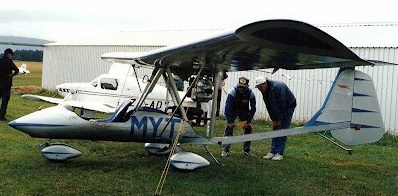
Bruce Walker of Tauranga, New Zealand, designed and built this homegrown microlight which used some components from a Quicksilver that Bruce had previously owned. The wing is a high lift Australian Tyro kitset wing of 32 foot span, and the pusher engine is a Rotax 447 which gives a cruise of around 70 mph.

Bruce Walker Custom Skylark ZK-MYT (c/n TY 6520) was first registered by Bruce on 1 December 2000. Bruce says it has done around 200 hours and flies really well. Bruce keeps it in a hangar on a topdressing strip near Te Puke.

ZK-MYT was for sale.

Wainfan FMX-4 Facetmobile

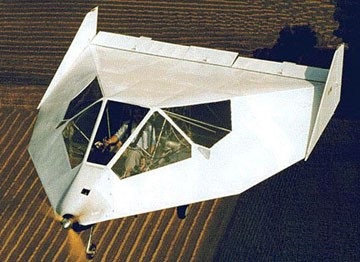
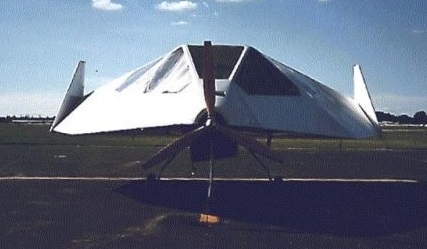
An “experimental lifting-body sportplane,” creation of Barnaby and Lynne Wainfan, and Rick Dean, took 2.5 years to develop and build. First flown on 22 April 1993, after 130 hours flight time, registered N117WD, it was damaged in a forced landing after the 2-stroke 46 horsepower engine malfunctioned at 500 agl. The plane landed at 28 mph and Barnaby walked away.

It was in reconstruction in 1999 with a Jabiru 4-cylinder replacement engine.

Engine: Rotax 503DC, 50hp
Wing span: 15’0″
Length: 19’6″
Useful load: 250 lb
Max speed: 110 mph
Cruise speed: 90 mph
Stall: 25-30 mph
Range: 200-250 mi
Ceiling: 11,000′
Empty wt: 370 lb
Seats: 1

Wag-Aero Wag-a-Bond / Traveller

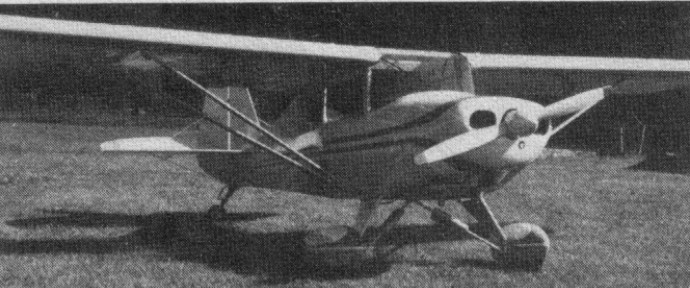
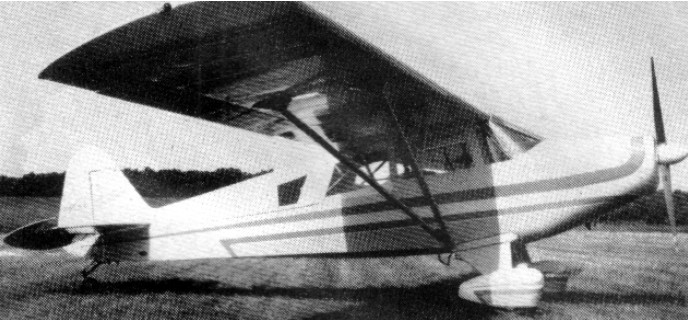
The Wag-A-Bond can be built in either of two versions — the Classic or the Traveler. The Classic is a replica of the Piper PA-15 Vagabond, and the Traveler is a modified and up¬dated version of the Vagabond with port and starboard doors, overhead skylight window, extended sleeping deck, extended bag¬gage area and provisions for engines up to 115 hp. The wings are strut-braced, high-wing, all-wood structures covered with fabric. The spar and ribs are spruce with mahogany plywood gussets. The ailerons are fabric-covered aluminum. The fuselage is welded steel tube.
The Wag-A-Bond Builder’s kits includes drawings for both options, with many parts preformed and many assemblies pre-welded. The Builder kits feature predrilled spars and precut nose ribs in the wing kit. This same detailing follows through to all of the other kits with items such as the tail group, including elevators, and stabilizers and the rudder and vertical fin finish welded. The landing gear is available completely finished, ready to attach to the fuselage structure.
When Dick Wagner developed his Cuby, Wagabond and 2+2 kits, all were fitted with J-3 rudders. Reason: Dick had purchased all the J-3 inventory left at Piper’s old Ponca City, OK plant, which included a barn full of J-3 elevators, stabilizers, gear legs and rudders.

Engine: Lycoming O-235, 115 hp
Wing span: 8.93 m
Wing area: 13.57 sq.m
MAUW: 658 kg
Empty weight: 329 kg
Fuel capacity: 98 lt
Max speed: 217 kph
Cruise speed: 169 kph
Minimum speed: 88 kph
Climb rate: 3 m/s
Seats: 2
Fuel consumption: 25 lt/hr
Plan price (1998): $65

Classic
Engine from 65 hp to 100 hp
Top speed 105 mph
Cruising speed 95 mph
Stalling speed 45 mph
Rate of climb 625 fpm
Gross Weight 1250 lb
Empty weight 700 lb
Wing Span 29 ft 3.5 in
Wing area 147.5 sq. ft
Length overall 18 ft 8.5 in
Height overall 6.0 ft
Baggage capacity 40 lb
Fuel capacity 12 Usgal
Seats: 2
LSA: yes

Traveler
Engine Lycoming 108 hp
Top speed 122 mph
Cruising speed 115 mph
Stalling speed 45 mph
Rate of climb 850 fpm
Gross weight 1450 lb
Empty weight 800 lb
Wing Span 29.3 ft
Wing area 147.5 sq. ft
Length overall 18.7 ft
Height overall 6.0 ft
Baggage capacity 60 lb
Fual capacity 26 USgal
LSA: yes

Traveler
Engine: Lycoming O-235, 115 hp
Speed max: 136 mph
Cruise: 124 mph
Range: 620 sm
ROC: 850 fpm
Take-off dist: 390 ft
Landing dist: 760 ft
Service ceiling: 14,000 ft
Fuel cap: 26 USG
Weight empty: 725 lbs
Gross: 1450 lbs
Height: 6 ft
Length: 18.7 ft
Wing span: 29.3 ft
Wing area: 147.5 sq.ft
Seats: 2
Landing gear: tail wheel
Cockpit width: 40 in
LSA: yes

Wing span: 35’9″
Length: 23’5″
Useful load: 1120 lb
Max speed: 129 mph
Cruise speed: 124 mph
Stall: 38 mph
Range: 670 mi
Seats: 4

Wag-Aero Sportsman 2+2

The Sportsman 2 + 2 is a replica of the PA-14 family Cruiser. This is a four-place aircraft designed for the recreational pilot. It has extended wings and such features as extra baggage area and additional fuel. Utilizes large tires for off-airport operation. Accepts engines from 125 to 200 hp
When Dick Wagner developed his Cuby, Wagabond and 2+2 kits, all were fitted with J-3 rudders. Reason: Dick had purchased all the J-3 inventory left at Piper’s old Ponca City, OK plant, which included a barn full of J-3 elevators, stabilizers, gear legs and rudders.

Engine: Lycoming O-320, 150 hp
HP range: 125-200
Height: 6.75 ft
Length: 23.36 ft
Wing span: 35.9 ft
Weight empty: 1080 lb
Gross: 2200 lb
Fuel cap: 39 USG
Speed max: 129 mph
Cruise: 124 mph
Range: 670 sm
ROC: 800 fpm
Take-off dist: 230 ft
Landing dist: 340 ft
Service ceiling: 14,800 ft
Seats: 4
Landing gear: tail wheel
Cockpit width: 39 in

Wag-Aero CUBy / Sport Trainer / Acro Trainer

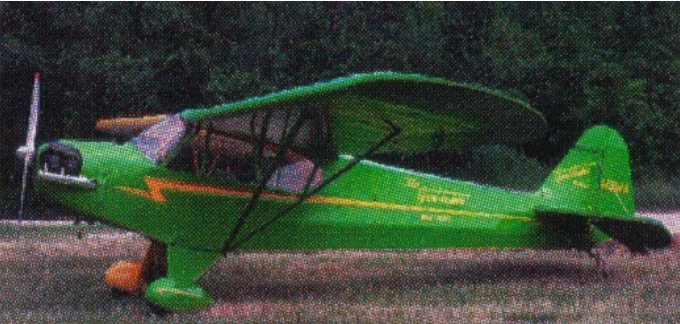
The CUBy is a replica of the Piper J-3 Cub with numerous design improvements – Higher gross with more useful load, increased cruise speed, and utilizing Continental engines from 65 thru 100 hp. It was designed by Dick Wagner, president of Wag-Aero of Lyons, Wisconsin. There is very little difference between the CUBy and the original J-3, except for a crank-operated elevator trim tab instead of the jackscrew adjustment that moved the stabilizer plane. When Dick Wagner developed his Cuby, Wagabond and 2+2 kits, all were fitted with J-3 rudders. Reason: Dick had purchased all the J-3 inventory left at Piper’s old Ponca City, OK plant, which included a barn full of J-3 elevators, stabilizers, gear legs and rudders.

First flown on 12 May 1975.

Wag-Aero CUBy Article

The CUBy can be made in four different versions: Standard CUBy, Super CUBy (a replica of the PA-18 allowing for larger engine). CUBy Observer (replica of the L-4), and the Acro Trainer (which is a special shortened-wing version for aerobatics).

Later marketed as the Wag-Aero Sport Trainer.
The Quick Build Kit will produce a complete aircraft less the engine, propeller, and finish paint. Fits the Light Sport Aircraft category and will only take a Builder 700-1000 hours to complete with a fully welded fuselage.

Engine: Continental, 85 hp
HP range: 65-150
Length: 22.3 ft
Wing span: 35.2 ft
Weight empty: 720 lb
Gross: 1400 lb
Fuel cap: 12 USG
Speed max: 102 mph
Cruise: 94 mph
Range: 270 sm
ROC: 220 fpm
Take-off dist: 375 ft
Landing dist: 420 ft
Service ceiling: 12,000 ft
Seats: 2
Landing gear: tail wheel

Sport Trainer
Cruise: 85 mph
Stall: 38 mph
Range: 310 sm
Rate of climb: 450 fpm
Takeoff dist: 375 ft
Landing dist: 420 ft
Engine: Continental C-85, 85 hp
HP range: 68-85
Fuel capacity: 12 USG
Empty weight: 720 lb
Gross weight: 1220 lb
Length: 22.3 ft
Wing span: 35.2 ft
Seats: 2 tandem
Cockpit width: 24 in
Landing gear: tailwheel
LSA: yes

Engine: 150 hp
Wing span: 35’3″
Length: 22’3″
Useful load: 680 lb
Cruise speed: 94 mph
Stall: 39 mph