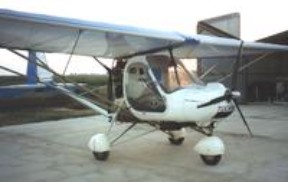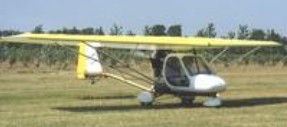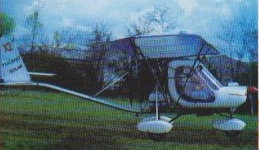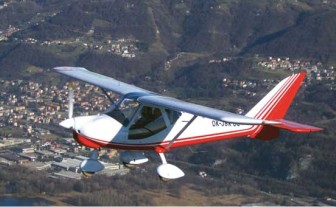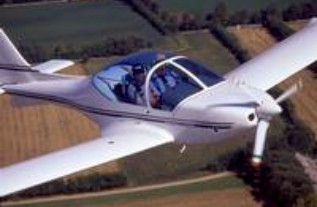
Fly Synthesis Texan

Texan RG

The Texan is a two seat ultra-light plane. As a true three-axis low wing aircraft, it has been designed to get maximum performance when compared to the more traditional aircraft designs. With its high aerodynamic efficiency the Texan is a master at short take-off and landing runs, rapid climbs and fast cruises with modest fuel consumptions. A unique feature of the Texan design is the elevated level of flight comfort for the pilot and passenger alike. With excellent views, extra cabin space and the very low noise level inside the cockpit, occupants can now enjoy comforts usually found only in commercial aircraft.
Texan 600 LSA is a two seats, three-axis, low wing, designed to obtain very good performance, maximum comfort, excellent views, very low noise level inside the cabin, elevated standard of quality and construction compared to the traditional designs. It has been designed for the new Light Sport Aircraft category. With its high aerodynamic efficiency the Texan is a master at short take-off and landing runs, rapid climbs and fast cruises with modest fuel consumptions. To strengthen the high value of this project, the aircraft is also very easy to fly, with perfect control even at low speed. Our engineers have designed the Texan to give the owner a durable and low maintenance plane for the life of the aircraft. When it comes to crash safety the Texan has a re-enforced structure ensuring the strongest possible fuselage. The windshield also has a roll over protection bar further increasing occupant safety.
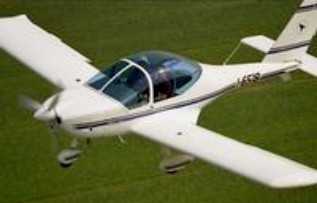
Texan Top Class

The wing is a rectangular type with laminar profile and separate flaps that work independently to the ailerons. Both flaps and ailerons are integrated into the profile of the wing. This configuration allows a wide range of low resistance control due to the wake of the airflow permitted by the use of both features. Each semi-wing is constructed using high tech composite materials. In fact the internal wing structure is made with carbon fiber resin and honeycomb sheets with the advantages being reliability, structural strength and lightness. Ailerons and flaps are fully composite type. The linkages and their relative hinges are fixed directly to the composite structure. Each aileron is hinged on a support fixed to the wing and the movement is directly braked and balanced by counterweights that also prevent flutter phenomena. Each wing is connected to the fuselage through particular anchorage points and the spars are linked with specially designed bolts. The wing is a “wet” type, with fuel tank integrated in the wing shells and with a capacity of 50 lt. of fuel each.
The fuselage is integrally constructed in carbon fibers and honeycomb. Five ribs further strengthen the self-supporting structure guarantee the rigidity of the fuselage system. The tail boom is made in carbon fibers materials and it is an extension of the same structure of the fuselage. The front zone of the fuselage is delimited by a firewall made of steel and strong enough to accommodate the engine mounts and associated bolts. The cabin is closed by folding Plexiglas canopy. The Plexiglas thermoformed windshield has been fixed to the cell through screws and allows for very good visibility outside; it has been redesigned with a more aerodynamic shape. The fuselage support the landing gear system and it’s special strengthened absorb vibrations, shocks and bumps that may be experienced during rough take off and landing. The two seats are made with composite matrix structure, fastened directly to the fuselage frame through screws. Each seat is adjustable and upholstered in a soft fabric material or optionally available in alcantara®. Both safety seat belts are securely fastened directly to the structure of the fuselage through bolts.
The empennages are constructed entirely in composite materials to guarantee lightness and structural rigidity. The fin is an integral part of the tail boom and is opportunely fixed to the rudder section. Rudder movement is achieved via two metal hinges especially designed and fixed directly to the composite structure. The elevator is a complete extension of the whole surface type and is frontally attached to the stabiliser through an oscillating support that is rigidly connected to the tail boom. The elevator includes a trim on pitch axis that is directly adjustable from the cockpit (optional electric control servo) and that eliminates the need for an anti-tab function. To avoid flutter the elevator have been provided with balancing counterweights. A special lower fin is fitted in the lower part of fuselage boom. The landing gear system is a fixed tricycle type with pivoting forward gear. The main gear is composed by two legs of rectangular section made of aluminium alloy type 2024 T3 and fixed to the fusolage by two bolts . An additional metal structure connects each leg to the longitudinal rib of the fusolage. The front gear is pivoting type, free to rotate during take off , landing and ground manouvres and is composed by a beam of aluminium alloy type 2024 T3 which acts as a spring. The two wheels of the main gear are made by aluminium alloy of the separable split-rim type. Each wheel comes with sealed bearings and tires with air chamber. The brakes are the disk type with hydraulic command positioned in the pedals and acting on main gear wheels. The steering front wheel is achieved by the rudder pedals. The wheel is made by nylon separable split-rim type, with sealed bearings and tire with air chamber. To reduce drag, wheels and legs are covered with fiberglass fairings. The aircraft is governable around three axes by the ailerons, the elevators and the rudder. The cloche, through rigid aluminium push-pull rods, controls the ailerons and elevators. Ailerons is designed to guarantee the differential command using hinges with spherical terminal that synchronises the whole command mechanism, ensuring a low friction and precise movement. Stainless steel cables connected to the pedals control the rudder. The elevator is provided with an automatic anti-servo tab that can be controlled by the trim on the pitch axis. The flaps are situated in the nearest part of the wing root. These are operated through an electric servo actuator and it is also provided with an indicator, positioned on the instrument panel that shows the angle of deflection measured in degrees.
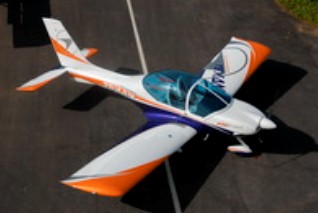
Texan 600

Equipped with the powerful and appreciated Rotax 912 ULS, four cylinders, four stroke, reduction geared propeller with mixed air/water cooling system.
TEXAN LSA is supplied in a basic configuration with the followings flight and engine instruments:
Airspeed indicator
Turn coordination
Altimeter
Rate of climb indicator
Magnetic compass
RPM indicator
Flap position indicator
Two fuel level indicator
Two low fuel level warning lamps
Generator warning lamp
Oil pressure indicator
Oil temperature indicator
Fuel pressure indicator
Cylinders Head Temperature
Hour-meter
Exhaust Gas Temperature
Carburetor air temperature indicator.
2009 Price: 67500 EURO

The factory produced two versions of the Texan Top Class. The Texan Top Class 600 LSA and Texan 550 LSA. The 550 being the MTOW.
The 600C comes with a castoring nosewheel and toe brakes.

Gallery

Texan – 1998
Engine: Rotax 912, 80 hp
Wing span: 9.4 m
Wing area: 12.8 sq.m
MAUW: 450 kg
Empty weight: 250 kg
Fuel capacity: 48 lt
Max speed: 260 kph
Cruise speed: 200 kph
Minimum speed: 65 kph
Climb rate: 4 m/s
Fuel consumption: 13 lt/hr
Seats: 2

TEXAN RG
Stall: 33 kt / 39 mph / 62 kmh
Cruise: 127 kt / 146 mph / 235 kmh
VNE: 151 kt / 174 mph / 280 kmh
Empty Weight: 282 kg / 622 lbs
MTOW Weight: 450 kg / 992 lbs
Climb Ratio: 1400 ft/min / 7,5 m/s
Glide Ratio: 15
Landing distance (50ft obstacle): 460 ft / 140 m

TEXAN TOP CLASS
Stall: 35 kt / 40 mph / 64 kmh
Cruise: 121 kt / 140 mph / 225 kmh
VNE: 135 kt / 155 mph / 250 kmh
Empty Weight: 275 kg / 606 lbs
MTOW Weight: 450 kg / 992 lbs
Climb Ratio: 1400 ft/min / 7 m/s
Glide Ratio: 14
Landing distance (50ft obstacle): 460 ft / 140 m

TEXAN 600
Stall: 38 kt / 43 mph / 70 kmh
Cruise: 113 kt / 130 mph / 210 kmh
VNE: 135 kt / 155 mph / 250 kmh
Empty Weight: 320 kg / 705 lbs
MTOW Weight: 600 kg / 1323 lbs
Climb Ratio: 1050 ft/min / 5 m/s
Glide Ratio: 14
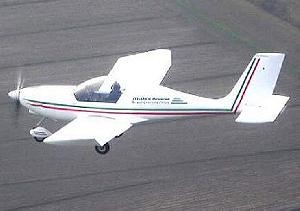
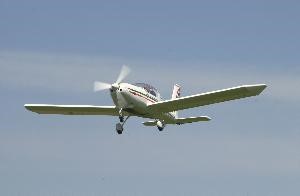
Fly Synthesis Revenge / Baylor Revenge

The Revenge was designed to be a low-cost aircraft for flight training and sport flying. Powered by the Rotax 912, the Revenge is responsive, economical and easy to fly. With a very low approach speed it has good short-field characteristics and it is easy to land. In Italy the aircraft is classified as an ultralight. In collaboration with the university of Baylor, an alcohol-powered version of the 912 has been tested successfully.

Engine: Rotax 912, 80 hp
Wing span: 9 m
Wing area: 12 m²
MTOW: 450 kg
Empty weight: 280 kg
Fuel capacity: 35 litre
Maximum speed (Vmax): 230 km/h
Cruise speed (Vc): 210 km/h
Stall speed (Vs0): 58 km/h
Number of seats: 2
Fuel consumption: 12 l/h
Class: FAI-ML

Flylab Tucano Delta 3 VTW

Twin Engine Ultralight, with tractor and pusher engines. The Tucano Delta3 VTW is directly derived from the twin-engined Tucano Delta3 TW, to which the same concepts that have led to the Tucano V have been coupled: cleaner aerodynamics, new cabin, new mudguards.

Tucano Delta3 VTW
Stall: 30 kt / 34 mph / 55 kmh
Cruise: 78 kt / 90 mph / 145 kmh
VNE: 92 kt / 106 mph / 170 kmh
Climb Ratio: 1600 ft/min / 8 m/s
Take-off distance (50ft obstacle): 200 ft / 60 m
Landing distance (50ft obstacle): 300 ft / 90 m

Flylab Tucano

The Tucano is for sure the most sold and flown ultralight aircraft in Italy. Strong and reliable, it is suitable for beginners as much as for expert pilots, being also the most used ultralight in flight schools.

Tucano
Stall: 28 kt / 32 mph / 52 kmh
Cruise: 54 kt / 62 mph / 100 kmh
VNE: 81 kt / 93 mph / 150 kmh
Empty Weight: 220 kg / 485 lbs
MTOW Weight: 450 kg / 992 lbs
Climb Ratio: 800 ft/min / 4,5 m/s
Take-off distance (50ft obstacle): 230 ft / 70 m
Landing distance (50ft obstacle): 230 ft / 70 m

Engine: Rotax, 64 hp
Wing span: 10.17 m
Wing area: 16.97 sq.m
MAUW: 450 kg
Empty weight: 230 kg
Fuel capacity: 76 lt
Max speed: 150 kph
Cruise speed: 100 kph
Minimum speed: 52 kph
Climb rate: 4.5 m/s
Fuel consumption: 13 lt/hr
Certification: Vz
Seats: 2
Price (1998): 24 900 000 L

Flyitalia MD3 Rider

Flyitalia MD-3 has all-metal semi-monocoque airframe, primary glued and riveted from aluminum alloy sheets by blind rivets. This design enables longer life and easy maintenance without great skills.
Rider is the first own design of Flyitalia s.r.l., but not the first one from MD-3 creators.
Fuselage cockpit cage is welded from steel tubes. Its basic structure has firewall, engine mounting hinges and front wheel bracket in the front, doors and main gear hinges on its sides and instrument panel frame and seats brackets in the middle. Rear fuselage is riveted from aluminum alloy sheets with integral fin and tail hinges in the rear. Side canopy doors hinged on the front enable great view and easy access.
Composite engine cowling and rear part of the canopy fairing create natural aerodynamic shape without usual square corners. All metal wings with simple aerodynamically shaped strut and efficient MS(1)-0313 airfoil with-beam pressed ribs and integral fuel tanks 72 or 100 liters. Ailerons and large flaps with 15deg and 42deg deflection are hinged on rear help-beam. Large aerodynamically shaped wingtips increase wing efficiency.
Classic-type all-metal tail has symmetrical NACA 12% profile. Elevator has electrically controlled trim-tab as a standard.
Full dual control with classic joysticks and pedals for both pilots. Flap lever, trim lever and throttle are placed on the central column.
Elevator and ailerons are controlled by rods, rudder is controlled by wires in plastic tubes. Flaps are controlled by electric actuator placed in the cockpit ceiling.
Wings can be (optional) quickly folded to the tail and horizontal tail surfaces can be dismounted for transportation or storage.
Instrument panel with central engine instruments and drivers panel, full cockpit upholstery with adjustable seats.
Tricycle type landing gear, with steerable 13×4″ nose wheel, composite legs of main undercarriage and front wheel leg and fork welded from steel tubes.
14×4″ main wheels have hydraulic disc brakes, controlled by lever on the central column.
Standard version uses pushing throttle and choke, there is prepared twin throttle version and level throttle version with peculiar styling.
From first time of development the chosen interior can be our “trade mark” = sport car like, comfortable, ergonomical, safety.
Air diffuser from automobile industry, standard middle communication panel for radio, GPS map and FLYdat.
Negative swept wing brings greater outside view, to enjoy cross-country flying.
Base price 2008: US$99,995

Engine: Rotax 912 ULS, 100hp
Wing span: 8.50 m
Wing area: 9.50 sq.m
Length: 5.70 m
Height: 2.30 m
Gross weight: 1267.2 lb / 480 kg
Empty weight, std: 654 lb / 277 kg
MTOW: 450 kg
Useful load, std: 612 lb
Payload, full std. fuel (lbs.): 456
Useable fuel: 25 Usgals / 70 lt
Vne: 270 kph
Top speed: 240 kph
Cruise 75% pwr: 210 kph
Max cruise speed: 113 kt
Stall clean: 82 kph
Stall flaps: 62 kph
Best rate of climb, SL: 1200 fpm / 7m/sec
Max range: 1000 km
Takeoff distance: 396 ft
Landing distance: 578 ft
Max load factor: +4/-2G

Flying Microlight Javelin

The Javelin features a dacron covered, single surface, strut braced high wing. Like its predecessor, the Mustang, the Javelin pilot sits below the mainplane in an openframe cockpit. The rugged tail dragger undercarriage features steel spring main gears and tailwheel which assists with those flights off unprepared strips. The machine can be assembled and broken down for trailering or storage in about 10 minutes. The airframe is coated in baked enamel for a very fine finish.

Engine: Rotax 277.
Prop: 127cm.
Wingspan: 8.5m
Wingarea: 12.8sqm.
Length: 5m.
Weight: 91 kgs.
Fuel capacity: 9 ltr.
Cruise speed: 50 kts.
Stall: l7 kts.

Flying Machines FM250 Vampire / Mystique

FM250 Vampire

The Flying Machines FM250 Vampire is a Czech ultralight and light-sport aircraft, designed and produced by Flying Machines s.r.o. of Rasošky, introduced at the Sport Aircraft Show held in Sebring, Florida in 2007.

A two seat all composite, high performance ultralight designed to fit inside European ultralights regulations and US light-sport aircraft rules with an empty weight of 250kg.

It features a cantilever low-wing, a two-seats-in-side-by-side configuration enclosed cockpit under a bubble canopy that hinges forward, fixed tricycle landing gear and a single engine in tractor configuration. The aircraft is made from composite materials and features a wet wing.

Its wing has flaps and standard engines available are the 80 hp (60 kW) Rotax 912UL or the 100 hp (75 kW) Rotax 912ULS. Full dual controls are provided, with the exception of wheel brakes, which are left seat only.

The FM 250 Mystique is S-LSA version of FM250 with a bigger wing area and all structure is redesigned for a 600 kg max take off weight. The Mystique was designed and is produced by Flying Machines s.r.o.

The aircraft is powered by Rotax 912 series engines and is custom built and is delivered to customers fully assembled and ready to fly. The airplane can be fitted with safety BRS system.

The FM250 Vampire II improved model was introduced in 2011.

FM-250 Vampire II

In production in 2011, the price was €60,000 assembled.

FM250 Vampire
Stall: 35 kt / 40 mph / 65 kmh
Cruise: 103 kt / 118 mph / 190 kmh
VNE: 146 kt / 168 mph / 270 kmh
Empty Weight: 250 kg / 551 lbs
MTOW Weight: 472 kg / 1041 lbs
Climb Ratio: 1400 ft/min / 7 m/s
Glide Ratio: 15,4

FM250 Vampire II
Engine: 1 × Rotax 912ULS, 75 kW (101 hp)
Wingspan: 7.8 m (25 ft 7 in)
Wing area: 10.05 m2 (108.2 sq ft)
Length: 6.32 m (20 ft 9 in)
Height: 2.18 m (7 ft 2 in)
Empty weight: 266 kg (586 lb)
Gross weight: 472.5 kg (1,042 lb)
Fuel capacity: 100 litres (22 imp gal; 26 US gal)
Wing loading: 47.01 kg/m2 (9.63 lb/sq ft)
Maximum speed: 250 km/h (160 mph, 130 kn)
Cruise speed: 220 km/h (140 mph, 120 kn)
Stall speed: 65 km/h (40 mph, 35 kn) flaps down
Never exceed speed: 270 km/h (170 mph, 150 kn)
Range: 1,200 km (750 mi, 650 nmi)
Rate of climb: 7 m/s (1,400 ft/min)
Crew: one
Capacity: one passenger

FM 250LSA Mystique
Stall: 37 kt / 43 mph / 69 kmh
Cruise: 108 kt / 124 mph / 200 kmh
VNE: 131 kt / 151 mph / 243 kmh
Empty Weight: 278 kg / 613 lbs
MTOW Weight: 600 kg / 1323 lbs
Climb Ratio: 1200 ft/min / 6 m/s
Glide Ratio: 15:1
Take-off distance (50ft obstacle): 600 ft / 183 m
Landing distance (50ft obstacle): 600 ft / 183 m