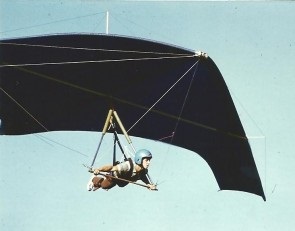
Fulmar was one of the first manufacturers in Europe to motorise a hang glider, their Fulmar I, of 183 sq.ft (17.0 sq.m) area, using a Soarmaster American supplied engine, as the Fulmar 1B.
Fulmar first saw the light of day in 1978 and was one of the first manufacturers in Europe to motorise a hang glider, their Fulmar I, of 183 sq.ft (17.0 sq.m) area, using a Soarmaster American supplied engine. The company was incorpo¬rated into SPRL in July 1981, at which time Fulmar Ultralight Diffusion not only made single seater and two seater trikes using Robin 244, 333 and 432cc engines under wings of their own design and manufacture, but also built Weedhoppers on behalf of the European dealer Media Systems. 50 machines were built in this way. 1983: Fulmar Ultralight Diffusion, rue des Palais 285A, B 1000 Bruxelles, Belgium; tel (02) 216.79.30. Designer: Pierangelo Mezzapesa.
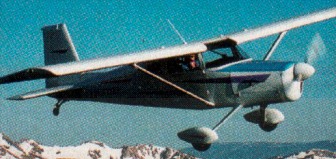
A metal monocoque aircraft kit with 2 seats side by side. The MD-11 can accommodate engines up to 200hp. Built with 2024 T-3 aluminium. First flown in 1993. The standard kit price in 1996 was US$19,500.
Engine: Franklin, 120 hp. HP range: 100-180. Height: 6 ft. Length: 24.5 ft. Wing span: 29.5 ft. Wing area: 155.9 sq.ft. Weight empty: 925 lbs. Gross: 1800 lbs. Speed max: 180 mph. Cruise: 125 mph. Range: 875 sm. Stall: 40 mph. ROC: 1000 fpm. Take-off dist: 500 ft. Landing dist: 400 ft. Service ceiling: 16,000 ft. Seats: 2. Landing gear: tail wheel. Cabin width: 43 in
Engine: Walter Lom, 140 hp HP range: 100-200 Fuel capacity: 43 USG Height: 6.5 ft Length: 27.5 ft Wing span: 29.5 ft Wing area: 177 sq.ft Empty weight: 1150 lb Gross weight: 2000 lb Top speed: 200 mph Cruise: 150 mph Stall: 35 mph Range: 700 sm Rate of climb: 1000 fpm Takeoff dist: 500 ft Landing dist: 400 ft Service ceiling: 16,000 ft Seats: 2 Landing gear: tail Cabin width: 43 in
Engine: Lycoming HP range: 150-180 Height: 6.5 ft Length: 27.5 ft Wing span: 29.5 ft Wing area: 177 sq.ft Fuel capacity: 43 USG Empty weight: 1150 lb Gross weight: 2000 lb Top speed: 200 mph Cruise: 150 mph Stall: 35 mph Range: 700 sm Rate of climb: 1000 fpm Takeoff dist: 500 ft Landing dist: 400 ft Service ceiling: 16,000 ft Seats: 2 Landing gear: tail Cabin width: 43 in
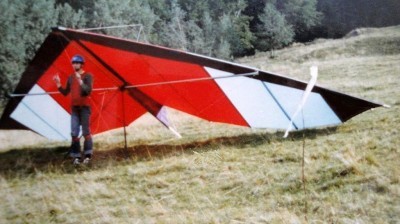
The Free Flight K1 ZK-JFW was originally a “K 1” hang-glider but has been converted to a Trike powered by a Rotax 447 with a Bing carburettor and a three-blade adjustable propeller. It also has a ballistic parachute mounted above the wing for emergency use. Its first flight was at Murawai Beach, New Zealand, by Karl Hoffman.
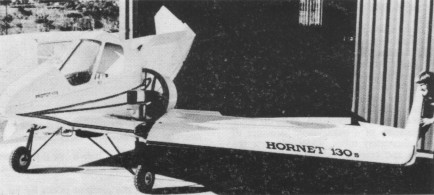
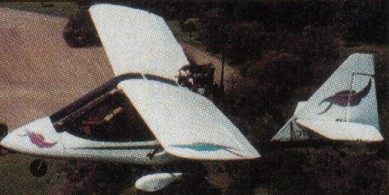
Single-seat single-engined low-wing monoplane with conventional three-axis control. Wing has swept back leading and trailing edges, and tapering chord; no tail. Pitch/roll control by stabilator; yaw control by tip rudders; control inputs through stick for pitch/roll and pedals for yaw. Cantilever wing; 100% double-surface. Undercarriage has three wheels in tall-dragger formation; rubber suspension on main wheels. Composite construction fuselage, totally enclosed. Engine mounted above wing driving pusher propeller. The David Betteridge designed Hornet (which should not be confused with the British manufacturer of the same name) is one of the most innovative designs to come from Australia, especially considering that the aircraft was originally conceived in 1977. At that time Free Flight was a hang-glider producer, and it was David’s involvement which got the Hornet project started. Construction of what was originally intended to be a rigid-wing powered hang-glider began in early 1978 and the first non-flying prototype was exhibited at the Schofields Airshow in Sydney that year, finally taking to the air on 8 March 1979 in the hands of Colin Scott. From that prototype the Hornet 130S evolved – a tail-less composite-construction machine with a tapered swept-back wing and ailerons which can be used together to act as elevators, in a similar fashion to the stabilators of a Mitchell Wing B10. Like the latter, yaw control is by tip rudders. As an aid to portability, the wings fold upward and rearward, giving a package for transport which is only 15.1 ft long x 7.5 ft wide (4.6 x 2.3 m). Wing structure consists of a 4.5 inch (114mm) diameter aluminium alloy spar tube reinforced with riveted flanges over the inboard section. Bonded and riveted to this tube are moulded glass-fibre ribs, supporting a C-section alclad rear spar. The leading edge is a U-section glass-fibre moulding with a spruce stiffener. Wing covering is glass-fibre sheet. The fuselage is predominantly glass-fibre too, moulded around paper-honeycomb bulkheads. Early versions of the 130S used a Lock Laird 0-500-2 four-stroke opposed twin giving 36 hp, but later the company switched to a fuel-injected version of the Koenig three cylinder radial, coupled to a direct-drive three-blade ducted fan.
Engine: Konig SC430 engine. Max power 30hp at 4500rpm. Propeller: three blade. No reduction. Power per unit area 0.23hp/sq.ft, 2.5 hp/sq.m. Empty weight 2291b, 104kg. Max take-off weight 397 1b, 180kg. Payload 168 1b, 76 kg. Max wing loading 3.08 1b/sq.ft, 15.0 kg/sq.m. Max power loading 13.2 1b/hp, 6.0 kg/hp. Load factors +6.6, -3.3 design; +8.0, ultimate. Length overall 9.8ft, 3.0m. Height overall 5.6ft, 1.70m. Wing span 25.9ft, 7.90m. Mean chord 5.0ft, 1.52m. Dihedral 2 deg. Sweepback 18 deg. Total wing area 129 sq.ft, 12.0sq.m. Wing aspect ratio 5.2/1. Max level speed 127mph, 204kph. Cruising speed 98mph, 158 kph. Stalling speed 35 mph, 56 kph. Max climb rate at sea level 790 ft/min, 4.0 m/s. Best glide ratio with power off 16/1. Take-off distance 200ft, 60m. Landing distance 350 ft, 105 m.
 All Aero