1985: Geonic Aero Ind. Pty Ltd. 10 Geonic St, Woodridge, Qld 4114, Australia.
UL builder
1985: Geonic Aero Ind. Pty Ltd. 10 Geonic St, Woodridge, Qld 4114, Australia.
UL builder
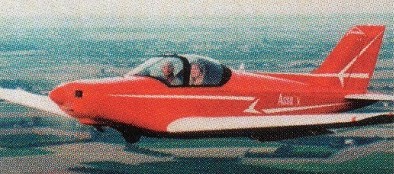
Top speed: 140 mph
Cruise: 125 mph
Stall: 47 mph
Range: 425 sm
Rate of climb: 940 fpm
Takeoff dist: 425 ft
Landing dist: 330 ft
Service ceiling: 12,000 ft
Engine: Limbach 2000, 80 hp
HP range: 75-115
Fuel capacity: 13 USG
Empty weight: 617 lb
Gross weight: 1058 lb
Height: 7 ft
Length: 20 ft
Wing span: 27.3 ft
Wing area: 120sq.ft
Seats: 2
Landing gear: nose or tail
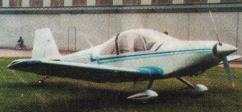
Equipped with folding wings.
Top speed: 175 mph
Cruise: 150 mph
Stall: 52 mph
Range: 750 sm
Rate of climb: 900 fpm
Takeoff dist: 600 ft
Landing dist: 600 ft
Service ceiling: 13,000 ft
Engine: Lycoming O-235, 108 hp
HP range: 85-125
Fuel capacity: 30 USG
Empty weight: 1035 lb
Gross weight: 1600 lb
Height: 9 ft
Length: 23 ft
Wing span: 25 ft
Wing area: 108 sq.ft
Seats: 2
Landing gear: nose or tail
1996: 118 Notre-Dame, Le Gardeur, Quebec J5Z 3C3, Canada.
LSA builder
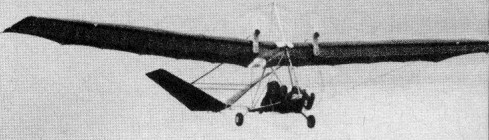
The Gemini Hummingbird 103 and Hummingbird Super 103 are single seat twin engined high wing mono¬plane with conventional three axis control. Wing has unswept leading edge, swept forward trailing edge and tapering chord; V tail. Pitch/yaw control by elevon; roll control by ailerons; control inputs through stick for pitch/roll and pedals for yaw. Wing braced from below by struts; wing profile; double surface. Undercarriage has three wheels in tricycle formation; no suspension on nosewheel and steel spring suspension on main wheels. Push right go right nosewheel steering connected to yaw control. Optional brake on nosewheel; optional brakes on main wheels. Aluminium tube framework, without pod (Hummingbird 103), totally enclosed (Hummingbird Super 103). Engines mounted at wing height driving tractor propellers. Two tractor Solo 210 engines, direct drive (two 20-hp Solos, 3:1 reduction unit, tuned exhaust optional). The Super 103 is the same basic configuration as the Standard 103 but POWERPLANT: Two Solo 210s, 3:1 reduction unit, tuned exhaust.
Gemini International Hummingbird Article
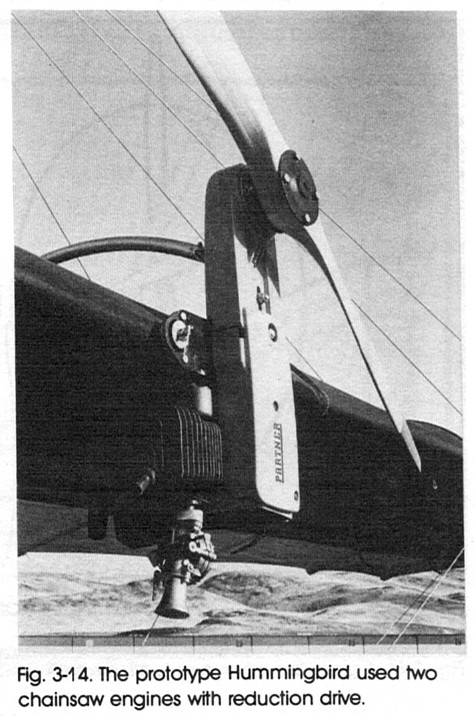
First year built: 1979. The 103 marks a change in marketing policy for the company, as it is the first kit built machine offered by the firm, taking two days to build. A wide range of options is available on the 103, including wheel spats and a fabric covering for the fuselage, with Lexan windows to make a fully enclosed cockpit. Thus modified, the aircraft is known as the Hummingbird Super 103 and costs $6185, as against $5495 for the Hummingbird 103, in 1982.
Other notable options are floats, amphibious floats into which the wheels retract, disc or drum brakes on the main wheels, a nosewheel brake, heavy duty 16 inch (41 cm) wheels and a ‘Super Wing’ high performance wing. Reduction drive is optional.
Units delivered by June 1981 48.
The Hummingbird Prospector had the wing braced from above by kingpost and cables, from below by cables. Aluminium tube framework, without pod (total enclosure optional). The Hummingbird Prospector was the flagship of the Gemini range in that it came complete and test flown from the factory, unlike the Hummingbird 103 and Hummingbird Super 103. It was an older design, easily distinguished from the 103s by its retention of kingpost and cable bracing. The Prospector was sold with two Solo 335 engines. However, there were plenty of Prospectors around with Limbach 275 cc engines. Latest power units for the Hummingbird Prospector were reduction drive Solos.
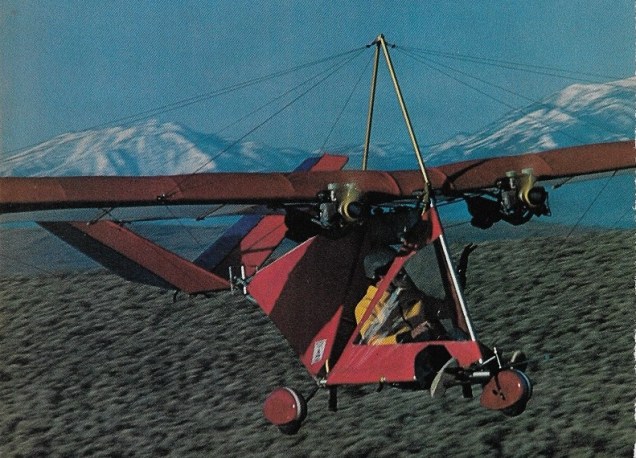
The Tractorplane is a utility ultralight version of Prospector. The Sport Hummingbird is a mono-wing with upright V-tail. Mixed three-axis controls make use of true ailerons for roll control and a separate elevator on the V-tail for pitch control. Construction is aluminum-tubing frame with the wings and tail surfaces covered with presewn 3.8-ounce Dacron. The engines are mounted in tractor position on the leading edge of each wing, and operated separately. Reduction drive turns each two-blade wooden Gemini propeller. Fuel tank is polypropylene. LANDING GEAR: Solid tricycle with steerable nosewheel. Wheels measure 16 inches.
Hummingbird
3-axis conventional (rudder, aileron, elevator).
Gross weight 415 lb.
Empty weight 163 lb (can be modified to 155).
Max pilot weight 230 lbs.
First year built 1979.
Hummingbird Standard 103
Engines: 2 x Solo 335, 20 hp at 7200 rpm.
Propeller diameter and pitch 52 x 27 inch, 1.32 x 0.69 m.
V belt reduction, ratio 3.0/1.
Max static thrust 340 lb, 154 kg.
Power per unit area 0.24 hp/sq.ft, 2.6 hp/sq.m.
Fuel capacity 4.4 US gal, 3.7 Imp gal, 16.6 litre.
Length overall 21.0 ft, 6.40 m.
Height overall 5.0ft, 1.52m.
Wing span 36.0ft, 10.97m.
Chord at root 5.0ft, 1.52m.
Chord at tip 3.9ft, 1.16m.
Dihedral 4 deg.
Sweepback 0 deg
Tailplane span 5.0ft, 1.52m.
Height of in¬clined fixed surface 5.0 ft, 1.52 m.
Total wing area 163 sq.ft, 15.1sq.m.
Total aileron area 18.0sq.ft, 1.67sq.m.
Inclined fixed area 18.0sq.ft, 1.67 sq.m.
Total elevon area 14.0 sq.ft, 1.30 sq.m.
Wing aspect ratio 7.9/1.
Wheel track 6.0ft, 1.82m.
Wheelbase 5.0ft, 1.52m.
Nosewheel diameter overall 6 inch, 15cm.
Main wheels diameter overall 6 inch, 15cm.
Optional floats: length 8.0ft, 2.43m.
Optional skis: length x width 6.0 ft x 3.5 inch, 1.82 x 0.08 m.
Empty weight 240 lb, 109 kg.
Max take off weight 560 lb, 254 kg.
Payload 320 lb, 145
Max wing loading 3.43 lb/sq.ft, 16.7 kg/sq.m.
Max power loading 14.0 lb/hp, 6.3kg/hp.
Load factors +4.5, 3.5 design; +5.0, 4.0 ulti¬mate.
Max level speed 62 mph, 100 kph.
Never exceed speed 70 mph, 113 kph.
Max cruising speed 57 mph, 92 kph.
Economic cruising speed 45 mph, 72 kph.
Stalling speed 22 mph, 35 kph.
Max climb rate at sea level 941 ft/min, 4.8 m/s.
Min sink rate 207 ft/min at 30 mph, 1.0 m/s at 48 kph.
Best glide ratio with power off 11/1 at 42mph, 67 kph.
Take off distance 100 ft, 30 m.
Land¬ing distance 120ft, 38m.
Service ceiling 27,000ft, 8235m.
Range at average cruising speed 100 mile, 160km.
Hummingbird Super 103
Engines: 2 x Solo 335, 20 hp at 7200 rpm.
Propeller diameter and pitch 52 x 27 inch, 1.32 x 0.69 m.
V belt reduction, ratio 3.0/1.
Max static thrust 340 lb, 154 kg.
Power per unit area 0.24 hp/sq.ft, 2.6 hp/sq.m.
Fuel capacity 4.4 US gal, 3.7 Imp gal, 16.6 litre.
Length overall 21.0 ft, 6.40 m.
Height overall 5.0ft, 1.52m.
Wing span 36.0ft, 10.97m.
Chord at root 5.0ft, 1.52m.
Chord at tip 3.9ft, 1.16m.
Dihedral 4 degs.
Sweepback 0 deg.
Tailplane span 5.0ft, 1.52m.
Height of in¬clined fixed surface 5.0 ft, 1.52 m.
Total wing area 163 sq.ft, 15.1sq.m.
Total aileron area 18.0sq.ft, 1.67sq.m.
Inclined fixed area 18.0sq.ft, 1.67 sq.m.
Total elevon area 14.0 sq.ft, 1.30 sq.m.
Wing aspect ratio 7.9/1.
Wheel track 6.0ft, 1.82m.
Wheelbase 5.0ft, 1.52m.
Nosewheel diameter overall 6 inch, 15cm.
Main wheels diameter overall 6 inch, 15cm.
Optional floats: length 8.0ft, 2.43m.
Optional skis: length x width 6.0 ft x 3.5 inch, 1.82 x 0.08 m.
Empty weight 240 lb, 109 kg.
Max take off weight 560 lb, 254 kg.
Payload 320 lb, 145
Max wing loading 3.43 lb/sq.ft, 16.7 kg/sq.m.
Max power loading 14.0 lb/hp, 6.3kg/hp.
Load factors +4.5, 3.5 design; +5.0, 4.0 ulti¬mate.
Max level speed 62 mph, 100 kph.
Never exceed speed 70 mph, 113 kph.
Max cruising speed 57 mph, 92 kph.
Economic cruising speed 45 mph, 72 kph.
Stalling speed 22 mph, 35 kph.
Max climb rate at sea level 941 ft/min, 4.8 m/s.
Min sink rate 207 ft/min at 30 mph, 1.0 m/s at 48 kph.
Best glide ratio with power off 11/1 at 42mph, 67 kph.
Take off distance 100 ft, 30 m.
Land¬ing distance 120ft, 38m.
Service ceiling 27,000ft, 8235m.
Range at average cruising speed 100 mile, 160km.
Hummingbird Prospector
Engines: Twin Solo 210 cc , 12.5 hp, 3:1 reduction unit, tuned exhaust.
Undercarriage: Standard tricycle, steerable nosewheel.
Wingspan 34 ft.
Wing area 153 sq.ft.
Aspect ratio 7.5:1.
Length 22 ft.
Empty weight: 240 lbs.
Payload 400 lbs.
Gross weight 640 lbs.
Wing loading 4.18 lbs/sq.ft.
L/D 10:1.
Cruise speed 33 mph.
Stall speed 21 mph.
Vmax 63 mph.
Takeoff/landing roll 75 ft.
Climb rate 600 fpm.
Fuel capacity 4.5 USG.
Engines: 2 x Yamaha KT1005, 30 hp, 3.0 reduction
Undercarriage: Tricycle 10-inch mains and steerable nosewheel.
Wingspan, 30 ft.
Wing area, 153 sq.ft.
Empty weight, 198 lbs.
Wing loading, 2.37 lbs/sq.ft.
Fuel capacity, 3.5 USG.
Hummingbird Tractorplane
Engines: Two Solo 210s, 3:1 reduction unit, tuned exhaust.
Undercarriage: Standard tricycle, steerable nose-wheel
Wingspan 34 ft.
Wing area 153 sq.ft.
Aspect ratio 7.5:1.
Length 22 ft.
Empty weight: 163 lbs. (can be modified to 155).
Max pilot wt: 230 lbs.
Payload 420 lbs.
Wing loading 4.18 lbs/sq.ft.
L/D 10:1.
Sport Hummingbird
Engine: Twin Gemini/Partner K-1200 100cc, 7 hp
Static thrust, 51 lbs each.
Wingspan, 34 ft.
Wing area: 186 sq.ft.
Aspect ratio, 7.5:1.
Empty weight, 138 lbs.
Usable payload (include fuel), 200 lbs.
Wing loading, 1.07 lbs/sq.ft.
L/D power-off glide ratio, 11:1.
Cruise speed (85% power), 30 mph.
Stall speed, 15 mph.
Approach speed, 25 mph.
Flair speed, 20 mph.
Liftoff speed, 17 mph.
Takeoff roll distance, 150 ft.
Rate of climb, 250 fpm.
Fuel capacity, 1.75 USG.
Range at cruise, 50 sm.
1982: Gemini International Inc, 1080 Linda Way #21 Sparks, Nevada 89431, USA.
1983: 75 Bank St., Sparks, NV 89431, USA.
Ultralight / LSA builder
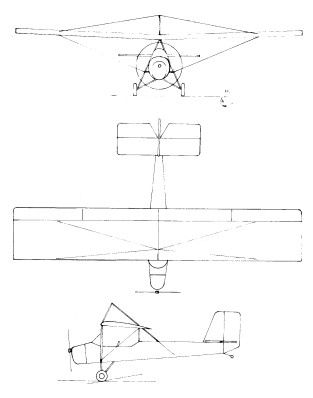
Tandem two seat single engined high wing monoplane with conventional three axis control. Wing has unswept leading and trailing edges, and constant chord; cruciform tail. Pitch control by elevator on tail; yaw control by fin mounted rudder; roll control by half-span ailerons; control inputs through stick for pitch/roll and pedals for yaw. Wing braced from above by kingpost and cables, from below by cables; wing profile Gardan (high lift airfoil); double surface. Undercarriage has three wheels in tail dragger formation; steel-spring suspension on tailwheel and rubber suspension on main wheels. Push right go -right tailwheel steering connected to yaw control. Optional brakes on main wheels. Aluminium tube framework, with optional pod. Engine mounted below wing driving tractor propeller. All aluminium airframe with Dacron covering.
For his first ULM, Yves Gardan opted for an all metal construction covered in Dacron in order to make industrial manufacture easier. With a high lift airfoil which he has designed himself, the wing of his GY 120 is also fitted with flaps covering most of the span, which are separate from the ailerons and have three positions: 10, 20 and 30 degree depression. It is worth noting that the load sheet for this aircraft complies to the FAR23 Utility category applicable to aircraft of less than 3.70 tonne (4.08 US ton, 3.64 Imp ton) according to international law.
Design work started in June 1982 and the building of the prototype in October of the same year, its first flight being programmed for the 15 May 1983. The motor on the prototype is a Hirth 270R 03E of 40hp, but the aircraft is designed to receive any engine usable as a tractor and developing 35 60 hp. Options include a fuselage fairing, complete dual control equipment, differential brakes on the main wheels, floats and skis specifically designed for the GY 120, an instrument panel and load carrying pods (agricultural or military).
Engine: Hirth 270R 03E, 40 hp at 7000 rpm.
Propeller diameter: 55 in (1.40m).
Toothed belt reduction, ratio 2.71-1.
Power per unit area 0.21 hp/sq.ft, 2.3 hp/sq.m.
Fuel capacity 7.9 US gal, 6.6 Imp gal, 30.0 litre in main tank; 7.9 US gal, 6.6 Imp gal, 30.0 litre in reserve.
Length overall 19.0 ft, 5.80 m.
Height overall 8.211, 2.50m.
Wing span 32.9ft, 10.00m.
Constant chord 5.9ft, 1.75m.
Dihedral 2 deg.
Sweepback 0 deg.
Tailplane span 9.2ft, 2.80m.
Fin height 4.3ft, 1.30m.
Total wing area 189 sq.ft, 17.5sq.m.
Total aileron area 20.5 sq,ft, 1.90sq.m.
Fin area 7.5 sq.ft, 0.70sq.m.
Rudder area: 7.0 sq.ft, 0.65sq.m.
Tailplane area: 15.3 sq.ft, 1.42sq.m.
Total elevator area: 14.0 sq.ft, 1.30sq.m.
Wing aspect ratio 5.711.
Wheel track 5.9 ft,1.80 m.
Wheelbase 14.9 ft, 4.50 m.
Tailwheel diameter overall 5 inch, 13 cm.
Main wheels diameter overall 16 inch, 40 cm.
Empty weight 320 lb, 145 kg.
Max take off weight 751 lb, 340 kg.
Payload 431 lb, 195 kg .
Max wing loading 3.97 lb/sq.ft, 19.4 kg/sq.m.
Max power loading 18.77 lb/hp, 8.503kg/hp.
Load factors design; +6.6, 3.3 ultimate.
Max level speed 75 mph, 120 kph.
Never exceed speed 87 mph, 140kph.
Max cruising speed 68mph, 110 kph.
Economic cruising speed 47mph, 75kph.
Stalling speed 24 mph, 38 kph.
Max climb rate at sea level 500 ft/min, 2.5 m/s.
Min sink rate 370 ft/min at 40 mph, 1.8 m/s at 65 kph.
Best glide ratio with power off 10/1 at 40mph, 65 kph.
Take off distance 130 ft, 40 m.
Land¬ing distance 115ft, 35m.
Service ceiling 8200ft, 2500m.
Range at average cruising speed 240 mile, 400 km.
A tandem two seat single engined flex wing aircraft with weight shift control. Rogallo wing with keel pocket. Pilot suspended below wing in trike unit, using bar to control pitch and yaw/roll by altering relative positions of trike unit and wing. Wing braced from above by kingpost and cables, from below by cables; floating cross tube construction with 85% double surface not enclosing cross tube; pre¬formed ribs. Undercarriage has three wheels in tricycle formation; no suspension on any wheels. Push right go left nosewheel steering independent from yaw control. Optional brake on nosewheel. Aluminium tube trike unit, without pod. Engine mounted below wing driving pusher propeller.
This two seater trike unit was originally called the Tiger and is available with two different wings: the Bold wing, in production since 1981, and the more recent Jumbo wing. In April 1983, the complete assembly was renamed Jumbo. Our data refers to the later version.
The wing is foldable into a package 16.4 x 1. 3 x 1. 0 ft (5. 00 x 0. 40 x 0. 30 m) and the trike unit folds down to 6. 1 x 2.3 x 2.3 ft (2. 10 x 0. 70 x 0.70 m).
Jumbo
Length overall 13.2 ft, 4.00 m.
Height overall 9.1 ft, 3.00m.
Wing span 34.5ft, 10.50m.
Nose angle 130 deg.
Total wing area 205 sq.ft, 19.0 sq.m.
Wing aspect ratio 5.8/1.
Wheelbase 5.1 ft, 1.80 m.
Nosewheel diameter overall 12 inch, 30 cm.
Main wheels diameter overall 16 inch, 40 cm.
Engine: Hirth 2701R.
Max power 43hp at 6750rpm.
Propeller diameter and pitch 59 x 28 inch, 1.50 x 0.70 m.
Toothed belt reduction, ratio 2.6/1.
Max static thrust 265 lb, 120 kg.
Power per unit area 0.21 hp/sq.ft, 2.3hp/sq.m.
Fuel capacity 4.0 US gal, 3.3 Imp gal, 15.0 litre in main tank; 7.9 US gal, 6.6 Imp gal, 30.0 litre in reserve.
Empty weight 287 lb, 130kg.
Max take off weight 707 lb, 320kg.
Payload 420 lb, 190 kg.
Max wing loading 3.45 lb/sq.ft, 16.8kg/sq.m.
Max power loading 16.4 lb/hp, 7.4 kg/hp.
Max level speed 50 mph, 80 kph.
Never exceed speed 62 mph, 100 kph.
Max cruising speed 44 mph, 70 kph.
Economic cruising speed 40mph, 65kph.
Stalling speed 22 mph, 35 kph.
Max climb rate at sea level 500 ft/min, 2.5 m/s.
Min sink rate 344ft/min, 1.75m/s.
Take off distance 82ft, 25m.
Landing distance 66 ft, 20 m.
Service ceiling 6560 ft, 2000 m.
Range at average cruising speed 62 mile, 100km.

Single seat single engined flex wing aircraft with weight shift control. Rogallo wing with keel pocket. Pilot suspended below wing in trike unit, using bar to control pitch and yaw/roll by altering relative positions of trike unit and wing. Wing braced from above by kingpost and cables, from below by cables; floating cross tube construction with 50% double surface enclosing cross tube; pre-formed ribs. Undercarriage has three wheels in tricycle formation; no suspension on any wheels. Push right go left nosewheel steering independent from yaw control. Optional brake on nosewheel. Aluminium tube trike unit, without pod. Engine mounted below wing driving pusher propeller.
The single seater Trident trike, which incorporates a Rival 183 ft’ (17.0 m2) sail, is the basic model of the Fulmar range. The Trident entry in the London to Paris in September 1982 was one of the most noticeable, not because of the quality of the pilots and the performance of the aircraft, though these were above reproach, but because the sponsor of the Fulmar team, Dior, had decorated the left wing of the Trident with ‘Jules’ logo in large letters. This has earned this single seater the ‘Macho Jules’ nickname throughout most of Europe. The aircraft is offered ready built with a Hirth F 263R engine without reduction drive. This trike is also available with the same engine but fitted with a 2.611 reduction drive.
Length overall 12.6 ft, 3.80 m.
Height overall 9.2ft, 2.80m.
Wing span 34.5ft, 10.50m.
Nose angle 130 deg.
Total wing area 183 sq.ft 17.0 sq.m.
Wing aspect ratio 6.5/1.
Wheel track 5.1 ft, 1.80 m.
Wheelbase 5.5 ft, 1.66 m.
Nose¬wheel diameter overall 12 inch, 30 cm.
Main wheels diameter overall 12 inch, 30 cm.
Engine: Hirth 293 cc engine.
Max power 23 hp at 3800 rpm.
Propeller diameter and pitch 59 x 22 inch, 1.50 x 0.55 m.
V belt reduction, ratio 2.6/1.
Max static thrust 155 lb, 70 kg.
Power per unit area 0.13 hp/sq.ft, 1.4hp/sq.m,
Fuel capacity 2.6 US gal, 2.2 Imp gal, 10.0 litre in main tank; 4.0 US gal, 3.3 Imp gal, 15.0 litre in reserve.
Empty weight 243 lb, 110kg.
Max take off weight 464 lb, 210kg.
Payload 221 lb, 100 kg..
Max wing loading 2.53 lb/sq.ft, 12.4 kg/sq.m.
Max power loading 20.2 lb/hp, 9.1kg/hp.
Max level speed 44 mph, 70 kph.
Never exceed speed 50 mph, 80 kph.
Max cruising speed 37 mph, 60 kph.
Economic cruising speed 32mph, 52kph.
Stalling speed 22 mph, 35 kph.
Max climb rate at sea level 400 ft/min, 2.0 m/sec.
Min sink rate 344 ft/min at 30 mph, 1.7 m/s at 48 kph.
Take¬off distance 100 ft, 30 m.
Landing distance 65 ft, 20 m.
Service ceiling 6560 ft, 2000 m.
Range at average cruising speed 50 mile, 80km.
Single seat single engined high wing mono¬plane with two axis control. Wing has unswept leading and trailing edges, and constant chord; cruciform tail. Pitch control by eleva¬tor on tail; yaw control by fin mounted rudder; control inputs through stick for pitch/yaw/roll. Wing braced from below by struts; single surface. Undercarriage has three wheels in tricycle formation; no suspension on any wheels. Push right go left nosewheel steering indepen¬dent from yaw control. Optional brake on nosewheel. Aluminium tube framework, without pod. Engine mounted below wing driving pusher propeller.
The MP 16 Heron was designed by Pierangelo Mez¬zapesa, the driving force behind Fulmar. The prototype made its first flight on the 1 February 1983, and became available from April 1983 with two engine options: Sachs 330cc (see per¬formance characteristics below) or Hirth F 263R of 383 cc, which develops at 3900 rpm, an equivalent power (23 hp) to the Sachs. Despite the solidity of its tubular structure, the MP 16 Heron is foldable for transport on a road trailer, its space requirement then being 16.5 x 5.9 x 5.9 ft (5 x 1.74 x 1.75 m). A side by¬side two seater version is at the design stage.
Length overall 16.5 ft, 5.00 m.
Height overall 6.7ft, 2.00m.
Wing span 32.1ft, 10.0m.
Constant chord 4.7ft, 1.40m.
Dihedral 5 deg.
Sweepback 0 deg.
Tailplane span 8.2 ft, 2.50 m.
Total wing area 151 sq.ft, 14.0 sq.m.
Fin area 5.4 sq.ft, 0.50 sq.m.
Rudder area 14.0 sq.ft, 1.30 sq.m.
Tailplane area 13.5 sq.ft, 1.25 sq.m.
Total elevator area 9.2 sq.ft, 0.85 sq.m.
Wing aspect ratio 7.1/1.
Wheel track 5.9ft, 1.75m.
Nosewheel dia¬meter overall 12 inch, 30cm.
Main wheels diameter overall 16 inch, 40cm.
Engine: Sachs SA 340 engine.
Max power 22hp at 5250rpm.
Propeller diameter and pitch 41 x 18 inch, 1.05 x 0.46 m.
No reduction.
Max static thrust 155 lb, 70 kg.
Power per unit area 0.15hp/sq.ft, 1.6hp/sq.m.
Fuel capacity 2.6 US gal, 2.2 Imp gal, 10.0 litre in main tank; 5.3 US ga1, 4.4 Imp gal, 20.0 litre in reserve.
Empty weight 1991b, 90kg.
Max take off weight 419 lb, 190kg.
Payload 220 lb, 100kg.
Max wing loading 2.78 lb/sq.ft, 13.6 kg/sq.m.
Max power loading 19.1 lb/hp, 8.63 kg/hp.
Load factors design; +6.0, 3.0 ultimate.
Max level speed 44 mph, 70 kph.
Never exceed speed 50 mph, 80kph.
Max cruising speed 37mph, 60kph.
Economic cruising speed 34mph, 55kph.
Stalling speed 20 mph, 32 kph.
Max climb rate at sea level 300 ft/min, 1.5 m/s.
Min sink rate 400 ft/min at 31 mph, 2.0 m/s at 50 kph.
Best glide ratio with power off 7/1 at 34 mph, 55kph.
Take off distance 115 ft, 35 m.
Land¬ing distance 66 ft, 20 m.
Service ceiling 6560 ft, 2000 m.
Range at average cruising speed 50 mile, 80km.
 All Aero