Harper Aircraft

Jack Harper soloed at the age of 14 in a J-3 Cub. Later he graduated from Embry-Riddle Aeronautical University in 1989 with a Bachelor of Science degree in Aviation Technology. An A&P mechanic, he’s an instrument-rated pilot holding a Commercial Multi-Engine FAA certificate. He’s logged more than 4,500 hours of flight time by 2005.

Jack had a builder’s background before he started to manufacture the Lil’ Breezy kits. In the 1970s he and his father built a Bede BD-5. Since that project, Jack has built a Hatz Biplane and a Skybolt Biplane plus a Wittman Tailwind and an RV-8. Not content simply to build kits, he also restored a J-3 Cub, an Aeronca Champ and a Starduster Too Biplane.

All that work generated a desire to design an airplane from scratch. He first designed on paper, with drawings of shapes that interested him. He decided to bring some of the drawings to life and built the first Lil’ Breezy model and started improving on it after many hours of flying prototypes. The first planes were single-seaters and used a rear-mounted engine. Later, he went to a front engine and then back to what he calls “the superior rear-mounted engine.”

With the success of a Part 103 the first planes were true ultralights, but with the passing of the FAA Sport Pilot and Light-Sport Aircraft rule, it opened up a whole new set of possibilities. The later Lil’ Breezy “B” model had two seats, convertible to a single-seater (with great performance) if desired.
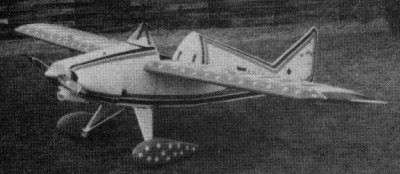
Harmon Mr America

Harmon chose the long-established combination of a welded steel-tube fuselage and tail surfaces, with wood spar and rib wings. In addition, the wing may be easily removed for storage and towing. The entire aircraft can be built with hand tools except for the use of a welding rig. Mr. America’s powerplant is a nearly stock 1600-cc Volkswagen engine bored to 1650. The engine develops an honest 60 hp, to pro¬duce what is said to be rapid acceleration on takeoff to around 800 fpm at 90 mph during initial climb.

Gross Wt. 630 lb
Empty Wt. 430 lb
Fuel capacity 9 USG
Wingspan 19’8”
Length 15’2”
Engine 60 to 70-hp Volkswagen.
Top speed 125 mph
Cruise 110 mph.
Stall 48 mph.
Climb rate 800 ft
Ceiling 12,000 ft
Takeoff run 200 ft
Landing roll 300 ft
Range 400 miles

Harmon Der Donnerschlag

The translation of this open-cockpit sport plane’s name is “The Thunderclap” It was the airframe of this plane which was used as the foundation for “Mr. America.” Both share similar wings, fuselage, tail unit and landing gear. The wings are a wire-braced, shoulder type with two simple beam spars. As with the Mr. America, seating is for one, behind a modified Volkswagen engine turning a two-blade wooden prop.

Gross Wt. 600 lb
Empty Wt. 350 lb
Fuel capacity 10 USG
Wingspan 19’6”
Length 14’6”
Engine 73-hp Volkswagen
Top speed 120 mph
Cruise speed 110 mph.
Stall speed 55 mph
Climb rate 800 fpm
Ceiling 10,000 ft
Takeoff run 130 ft
Landing roll 250 ft
Range 500 mile

Guerpond Autoplan

The Guerpond Autoplan is an all-wood tandem microlight aimed at the amateur constructor. The large tailplane allows a large CoG range. Engines of up to 64 hp can be used.

Engine: Rotax 462, 52 hp
Wing span: 8.60 m
Wing area: 17.50 sq.m
MAUW: 420 kg
Empty weight: 230 kg
Fuel capacity: 50 lt
Max speed: 150 kph
Cruise speed: 130 kph
Minimum speed: 50 kph
Climb rate: 4 m/s
Seats: 2
Fuel consumption: 15 lt/hr