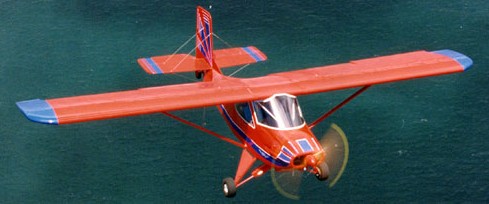
The Hughes Group of companies has been producing the Australian LightWing, range of 2 and 4 seat light aircraft for the Australian and world aviation market. With one hundred and seventy-five aircraft produced since 1984.
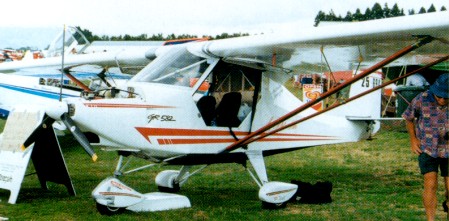
The development of this two-seat aircraft began back in 1984 by Howard Hughes En¬gineering Pty Ltd with production underway in 1985 from Ballina in NSW. Flaps, brakes and instrumentation are fitted. Both VW and Rotax powered versions were available. The 582 designation informs us that it is fitted with a Rotax 582, two-stroke engine and the -T tells us that it has a tricycle undercarriage. The tailwheel version (the GR-912) and the nose-wheel version, the ALW SPORT 2000 are 2 seat high wing monoplane. Construction consists of a riveted alloy wing partly covered with aircraft fabric (part alloy) combined with a welded light weight steel fuselage also part composite, part fabric covered. The welded steel fuselage provides a high degree of protection in the event of an accident while the slow stall speed (35 kts) reduces momentum adding to safety. Economical Cruise Speed is 75 kts for both aircraft and a maximum cruise speed is 85 kts. Range is a little over 3 hours with 2 wing mounted fuel tanks of 30 l each.
The Hughes Group of companies has been producing the Australian LightWing, range of 2 and 4 seat light aircraft for the Australian and world aviation market. With one hundred and seventy-five aircraft produced since 1984.
Australia Markets completed examples or kits of the Australian Light Wing PR tandem two-seat cabin monoplane and Australian Light Wing GR-912 side-by-side two-seat cabin monoplane LSA.
1998: Southern Cross Drive PO Box 89 Ballina NSW 2478 Australia
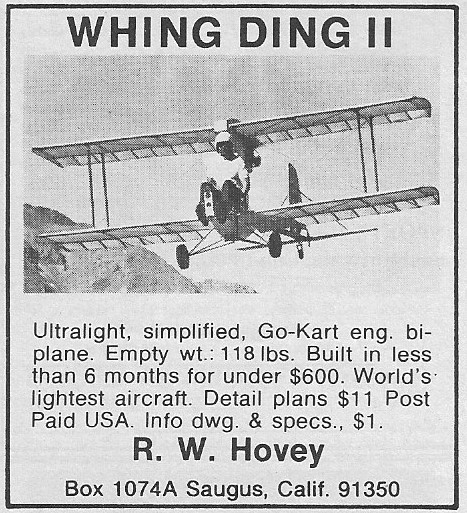
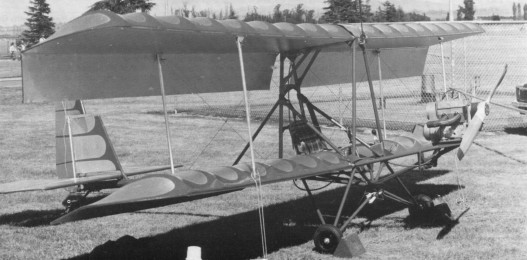
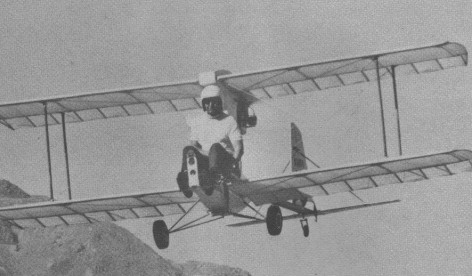
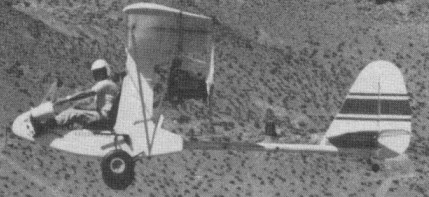
Single seat single engined biplane with conventional three axis control. Wings have un¬swept leading and trailing edges, and constant chord, conventional tail. Pitch control by elevator on tail; yaw control by fin mounted rudder; roll control by full span ailerons on each wing; control inputs through stick for pitch/roll and bar for yaw. Wing braced by struts, and transverse X cables; wing profile Hovey 10; double surface. Tail surfaces of plywood-reinforced foam core. Undercarriage has three wheels in tail dragger formation. Fiberglass-covered laminated fir suspension on main wheels. Push right go right tailwheel steering connected to yaw control. Mahogany plywood closed-box fuselage, without pod, 3” aluminum tube tail boom foam filled for stiffness. Fuselage accommodates seat, rudder bar, standard controls and wing spar sockets. Engine mounted between wings driving pusher propeller. Bob Hovey started to design the Whing Ding in October 1970 and at the same time he started to build the prototype. The result was that it accomplished its first flight in February 1971, only five months later.
Bob’s objective was to design a single seater which was easy to build in minimum time, offering the qualities of a STOL aircraft (short take off and landing), and quickly demountable to fit on to its specially designed road trailer. This 15-hp, 300-pound gross-weight biplane is the ultimate in lightness and simplicity. The tail surfaces are constructed from ½-inch thick Styrofoam art-board faced with high strength kraft paper on both sides, with the critical areas reinforced with 1/8-inch plywood gussets. The tail boom is a 3-inch aluminum pipe filled with foam to resist buckling. The fuselage is basically a 6-inch wide box of plywood filled with foam that serves as an engine mount and a mast support for the wings. The prop is belt-driven from a 15-hp McCulloch two-cycle go-kart engine. The wings have two spars and are fabric covered. The prototype established a record for light aircraft, with an empty weight of less than 121 lb (55 kg), but its designer had to abandon the original design of the tail structure which was made from polyurethane foam covered in kraft paper. The wing section is an in house design, the Hovey 10, and the two wings are of equal span, staggered by 4O and having 1 O of dihedral. Their structure is a twin spar design in wood, using tubular metal ribs and with a polyurethane foam leading edge, the covering being fabric. The fuselage has a pine frame with mahogany plywood cladding and is filled with polyurethane foam. The pilot sits in front in the open air and leans back on a pylon which joins the two wings and also carries engine. The wings on each side are joined by two straight struts and rigged with two flying and landing wires in an X configuration on each half wing. Construction of the Ding requires around 400 hr.
Dec 73 – Feb 74
Engine: McCulloch MC-¬101AA, 12.5 hp at 8000 rpm. Propeller diameter 48 inch, 1.22m. No reduction. Power per unit area 0.13 hp/sq.ft, 1.4 hp/sq.m. Fuel capacity 0.5 US gal, 0.4 Imp gal, 2.0 litre. Length overall 13.0 ft, 3.96 m. Height overall 5.33ft, 1.62m. Wing span 17.0ft, 5.18m. Dihedral 1 deg. Sweepback 0 deg. Total wing area 98 sq.ft, 9.1sq.m. Wing aspect ratio 2.9/1. Empty weight 122 lb, 55kg. Max take off weight 310 lb, 140kg. Payload 188 lb, 85kg. Max wing loading 3.16 lb/sq.ft, 15.4kg/sq.m. Max power loading 24.8 lb/hp, 11.2kg/hp. Max level speed 50mph, 80kph. Never exceed speed 60mph, 97 kph. Max cruising speed 40 mph, 64 kph. Stalling speed 26 mph, 42 kph. Max climb rate at sea level 100ft/min, 0.5m/s. Take off distance 250 ft, 75 m. Landing distance 150 ft, 45 m. Service ceiling 4000 ft, 1220 m. Range at average cruising speed 20 mile, 32 km.
Hp range: 8-15 Length: 13 ft Wingspan: 17 ft Wingarea: 98 sq.ft Empty weight: 122 lb Gross weight; 310 lb Fuel capacity: 1 USG Top speed: 45 mph Cruise: 35 mph Stall: 28 mph Range: 28 nm ROC: 200 fpm TO dist: 250 ft Landing dist: 100 ft Service ceiling: 2000 ft Seats: 1 Landing gear: tailwheel
Engine: McCulloch, 12 hp Hp range: 8-15 Length: 13 ft Wingspan: 17 ft Wingarea: 98 sq.ft Empty weight: 123 lb Gross weight: 310 lb Fuel capacity: 3 USG Cruise: 35 mph Stall: 24 mph ROC: 200 fpm TO dist: 250 ft Landing dist: 100 ft Seats: 1 Landing gear: tailwheel LSA: yes
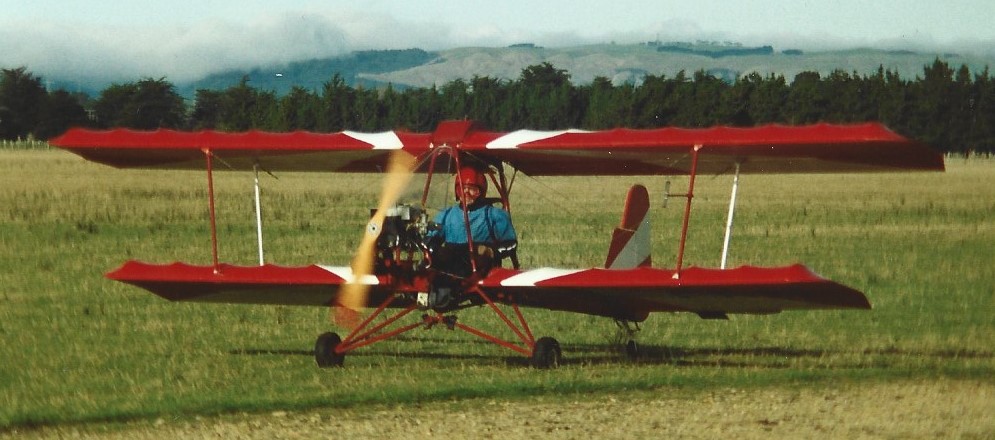
Single seat single engined biplane with conventional three axis control. Wing has unswept leading and trailing edges, and constant chord; conventional tall. Pitch control by elevator on tail; yaw control by fin mounted rudder; roll control by full span ailerons on upper wing; control inputs through stick for pitch/roll and pedals for yaw. Wing braced by struts and transverse X cables; wing profile; double surface. Undercarriage has three wheels in tail dragger formation. Push right go right tailwheel steering connected to yaw control. Aluminium tube framework, without pod. Engine mounted between wings driving tractor propeller. Tubing from 6061T6 aluminium; galvanised steel rigging; Dacron wing covering.
This three axis machine is a biplane which was revealed to the public at the EAA convention for amateur constructors, Oshkosh, in August 1982, where it was hailed as a modernised version of the Whing Ding II with a simpler structure and more power. The adoption of an aluminium tubular structure allowed Aircraft Specialties to offer the Delta Bird in plan form, as with the other two aircraft, but also as a kit requiring around 200 h for assembly. In place of the pusher common to the Beta Bird and the Whing Ding II, the motor is mounted as a tractor on a triangular framework at the front of the main framework. The exhaust pipe passes under this triangular section and finishes by the junction of the two triangular frameworks which support the main wheels, an arrangement designed to allow all terrain use. The machine retains conventional controls with ailerons on the trailing edges of the two top wings, a rudder hinging from the fin and the elevators from the horizontal stabiliser; they are all of generous proportions.
Engine: Cuyuna 430R, 30 hp at 5500 rpm. Propeller diameter and pitch 54 x 27 inch, 1.37 x 0.69 m. Belt reduction, ratio 2.0/1. Power per unit area 0.20 hp/sq.ft, 2.1 hp/sq.m. Fuel capacity 3.5 US gal, 2.9 Imp gal, 13.2 litre. Length overall 15.0 ft, 4.57 m. Height overall 6.0ft, 1.83m. Wing span 24.0ft, 7.31m. Constant chord 3.5 ft, 1.07 m. Sweepback 0 deg. Tailplane span 8.0 ft, 2.44 m. Fin height 3.7 ft, 1.13 m. Total wing area 152 sq.ft, 14.1 sq.m. Fin area 9.0 sq.ft, 0.84sq.m . Tailplane area 20.0 sq.ft, 1.86 sq.m. Wing aspect ratio 6.9/1. Wheel track 6.3ft, 1.92 m. Main wheels diameter overall 15 inch, 39 cm. Empty weight 218 lb, 99kg. Max take off weight 450 lb, 204kg. Payload 232 lb, 105 kg. Max wing loading 2.96 lb/sq.ft, 14.5 kg/sq.m. Max power loading 15.0 lb/hp, 6.8kg/hp. Load factors +3.5, 3.5 design; +5.3, 5.3 ulti¬mate. Max level speed 60mph, 97kph. Never exceed speed 60mph, 97kph. Max cruising speed 45mph, 72kph. Stalling speed 26 mph, 42 kph. Max climb rate at sea level 400 ft/min, 2.0 m/s. Best glide ratio with power off 6/1. Take off distance 250 ft, 75 m. Landing distance 250 ft, 75 m. Range at average cruising speed 50 mile, 80km.
The Beta Bird, designed in 1977 but not flown until April 1979 at Mojave, California, is a high wing monoplane version of the Whing Ding II, with which it shares a common fuselage. Like the biplane, the conventional tailplane is carried on a tubular boom and there is a tailwheel undercarriage. Wing profile Hovey BB 14. Brakes on main wheels. Engine mounted below wing. The Beta Bird was initially known as the Bushwacker. Flight handling characteristics are very good, with an extremely docile stall. Rugged reliability was proven in off-airport operations in high desert country. Single-place, single-engine, strut-braced monoplane followup to Whing Ding II biplane, using drooperons. Stick-and-rudder 3-axis controls. Nose cowl and instrument panel included. Landing gear: Two mains with large 600×6 wheels & tires (from Cessna 150) for rough-field operation, using individually operated hydraulic toe brakes. Tail-wheel non-swiveling, steered with rudder cable linkage. Powerplant: Converted VW engine, pusher mounted, direct drive to 54×24 prop. It is powered by a 1,385-cc converted VW engine and offers the homebuilder simplified methods of construction. The wings fold for transport or storage. The fuselage pod is plywood and spruce construction with a stiffened aluminum tail boom to support the tail. The wings are spruce in a two-spar configuration, and the ribs are single-piece aluminum tubes. The tail group is fabricated from aluminum tubing, pop-riveted together with gussets and covered with Dacron. Only 250 feet are needed for takeoff and landing, and the 7 1/2-gallon fuel tank is good for 180 miles.
Engine: Volkswagen 1385cc, 45 hp. Power per unit area 0.52 hp/sq.ft, 5.6 hp/sq.m. Length overall 16.5 ft, 5.02 m. Height overall 6.0ft, 1.83m. Wing span 25.5ft, 7.77m. Sweepback 0 deg. Total wing area 87 sq.ft, 8.1 sq.m. Wing aspect ratio. 7.3/1. Empty weight 405 lb, 184kg. Max take off weight 650 lb, 295kg. Payload 245 lb, 111kg. Max wing loading 7.47 lb/sq.ft, 36.4kg/sq.m. Max power loading 14.4 lb/hp, 6.6kg/hp. Max level speed 85 mph, 137 kph. Never exceed speed 95 mph, 153kph. Cruising speed 70mph, 113kph. Stalling speed 40 mph, 64 kph. Max climb rate at sea level 400ft/min, 2.0m/s. Take off distance 250 ft, 75 m. Range at average cruis¬ing speed 130 mile, 209 km.
Engine: VW 1800cc hp Range: 50-85 Length: 16.5 ft Wingspan: 26 ft Wing area; 110 sq.ft Empty weight; 405 lb Gross weight: 650 lb Fuel cap: 7.5 USG Cruise: 80 mph Stall: 45 mph Rate of climb: 750 fpm Takeoff dist: 250 ft Landing dist: 150 ft Seats: 1 Landing gear: tailwheel LSA: yes
Single seat wood and fabric ultralight sailplane to FAR 103 specs. Cantilever midwing, monocoque fuselage, conventional 3-axis controls with spoilers. 1930’s looks and technology for that vintage feel. Construction time 1000+ hours, cost $1500 US. Plans not available, sized and built for designer.
 All Aero