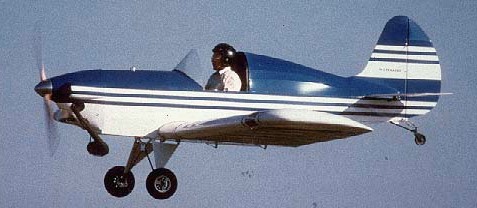
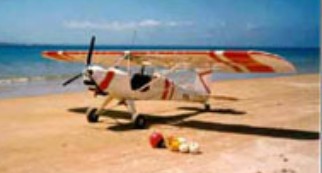
The H-3 Pegasus is a low-wing, open cockpit monoplane by noted lightweight sportplane designer Bert Howland. It features a lightweight fuselage, based on TIG-welded, square aluminum tubing that weighs only 18 pounds. The internal construction of the wings features a cantilevered design that eliminates struts and cables. Powerplant range is 28 hp to 55 hp. The prototype H-3 first flew in 1988 and won the “The Most Innovative Unltralight” award at Sun ‘N Fun 1989. The design was also designated “Best Commercial Ultralight’ at the 1990 event. The H-3 is not an ultralight vehicle as defined in FAR Part 103. Gross weight of the Pegasus is between 500 and 595 lbs. Pegasus plans cost $250 in 2009 and were available from Classic Aero Enterprises.
Speed max: 60 mph. Cruise: 55 mph. Stall: 27 mph. ROC: 600 fpm. Take-off dist: 200 ft. Landing dist: 250 ft. Service ceiling: 8,000 ft. Engine: Hirth F263, 31 hp. HP range: 28-65. Fuel cap: 5 USG. Weight empty: 252 lbs. Gross: 555 lbs. Height: 4.75 ft. Length15 ft. Wing span: 25 ft. Wing area: 110 sq.ft. Seats: 1. Landing gear: tail wheel.
Classic Aero H-3 Engine: Hirth 2703, 55 hp Wing span: 7.6 m Wing area: 10 sq.m MAUW: 226 kg Empty weight: 114 kg Fuel capacity: 45 lt Max speed: 100 kph Cruise speed: 88 kph Minimum speed: 43 kph Climb rate: 3 m/s Fuel consumption: 12 lt/hr Seats: 1 Plan price (1998): US$250
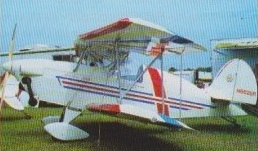
The H-2 Honey Bee is a lightweight aerobatic biplane first flown in 1986. With the H-2, designer Bert Howland introduced the technique of TIG-welding the fuselage from square 6061-T6 aluminum tubing, yielding a strong and rugged fuselage frame that weighs only 24 pounds. The airfoil on the 4 equal span wings is 6-1/2” thick and features 7 aluminum-capped foam ribs per panel with a D-cell leading edge spar and a C-section rear spar. Design load factor is +8g to -6g. The prototype and early versions used engines in the 40-46 horsepower range, but the designer later moved up to an engine of 65 horsepower as standard. The plans provide a two or four aileron option for those who wish a more responsive roll rate. When that option is selected, together with an engine in the 85 horsepower range or better (such as the Hirth F-30), and with an inverted fuel system, the H-2A is suitable for use in competition aerobatics up to the International Aerobatic Club’s “intermediate level.” In 1992, an H-2A Honey Bee was named “Best” in the combined Ultralight/Lightplane category during the EAA East Coast Fly-In at Wilmington, Delaware. The aircraft has been powered with engines from 40 to 95 hp. Homebuilder plans cost $250 in 2009 and consist of 40 engineering drawings and designer construction notes.
Classic Aero H-2A Honey Bee
Speed max: 68-80 mph. Cruise: 55-68 mph. Stall: 25-35 mph. ROC: 400-850 fpm. Take-off dist: 125-200 ft. Landing dist: 150-275 ft. Service ceiling: 8,000 ft. Engine: Hirth 2705, 65 hp. HP range: 40-95 Prop: 60-69in. Fuel cap: 7.5-12 USG. Weight empty: 335-496 lbs. Gross: 550-725 lbs. Length: 15.75 ft. Wing span: 19 ft. Wing area: 140 sq.ft. Seats: 1. Landing gear: tail wheel. Design load at 550 lbs: +8,-6g.
Classic Aero H-2A Honey Bee Engine: Hirth 2706, 65 hp Wing span: 5.8 m Wing area: 13 sq.m Empty weight: 150 kg MAUW: 270 kg Fuel capacity: 40 lt Max speed: 130 kph Cruise speed: 108 kph Minimum speed: 48 kph Climb rate: 6 m/s Fuel consumption: 12 lt/hr Seats: 1 Plan price (1998): US$250
1996: 27518 County Rd. 561, Tavares, FL 32778, USA.
LSA builder
Howland Aero Design was liquidated in 1995, after the death of Burt Howland. Classic Aero Enterprises handled the Howland’s designs since the liquidation in 1995.
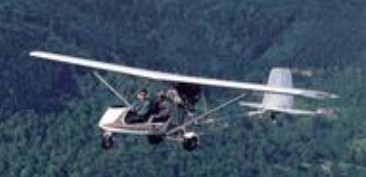
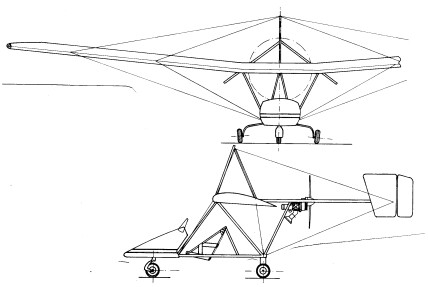
Single seat single engined high wing mono¬plane with conventional three axis control. Wing has unswept leading and trailing edges, and constant chord; inverted V tall. Pitch/yaw control by elevon; roll control by ailerons; control inputs through stick for pitch/roll and pedals for yaw. Wing braced from above by kingpost and cables, from below by cables; wing profile; double surface. Undercarriage has three wheels in tricycle formation; suspension on all wheels. Push right go right nosewheel steering connected to yaw control. Brakes on main wheels. Aluminium ¬tube framework, with pod. Engine mounted at wing height driving pusher propeller. Flown for the first time publically at the Aero 83 salon at Friedrich¬shafen, the prototype Milan from Howatherm UL Systeme made its first flight in March 1983. The prototype is fitted with a KFM 107 twin cylinder engine mounted level with the wing and driving a pusher propeller between the two booms carrying the tail¬plane, which is stiffened by cables. By 1983 two prototypes had been built and the first production run of 10 machines was being laid down. This machine will be fitted as standard with drum brakes on the main wheels.
Length overall 18.0 ft, 5.50 m. Height overall 8.5ft, 2.60m. Wing span 34.4ft, 10.50m. Constant chord 3.9 ft, 1.20m. Dihedral 4 deg. Sweepback 0 deg. Tailplane span 8.2 ft, 2.50 m. Total wing area 136 sq.ft, 12.6 sq.m. Total aileron or spoiler area 25.8 sq.ft, 2.40sq.m. Tailplane area 32.3 sq.ft, 3.00 sq.m. Wing aspect ratio 8.8/1. Wheel track 4.9ft, 1.50m. Nosewheel dia¬meter overall 10 inch, 26cm. Main wheels diameter overall 12 inch, 30cm. Engine: KFM 107, 25 hp at 6300 rpm. Propeller diameter and pitch 54 x 20 inch, 1.37 x 0.51 m. V belt reduction, ratio 2.1/1. Max static thrust 143 lb, 65 kg. Power per unit area 0.18 hp/sq.ft, 2.0hp/sq.m Fuel capacity 5.3 US gal, 4.4 Imp gal, 20.0 litre. Empty weight 214 lb, 97kg. Max take off weight 442 lb, 200 kg. Payload 228 lb, 103 kg . Max wing loading 3.25 lb/sq.ft, 15.9 kg/sq.m. Max power loading 17.7 lb/hp, 8.0kg/hp. Load factors; +6.0, 3.0 ultimate. Max level speed 62 mph, 100 kph. Never exceed speed 68 mph, 110 kph. Max cruising speed 56 mph, 90 kph. Economic cruising speed 37 mph, 60 kph. Stalling speed 27 mph, 43 kph. Max climb rate at sea level 400 ft/min, 2.0 m/s. Best glide ratio with power off 13/1. Take off distance 100 ft, 30 m. Landing distance 100 ft, 30 m.
The large square plan wing section provides a very low pitching moment. There is very little need to use the trim in either the SP2000 or 4000. When flaps are set, the increase or decrease in power has very little effect on the pitching which makes the aircraft very easy to fly. Wing cord is 1.5m thickness 20 cm maximum at about 1/3 cord. With a wingspan of only twenty-eight feet, (28′) the square plan wings have an inbuilt anti-stall feature that keeps the wing tips flying right up to the stall. On landing, the large flaps are effective; the aircraft can slow right down and the effect of crosswinds is much less pronounced. Although they’re comparatively short, the wings on the SP2000 provide excellent stability in the air and on the ground. The tyres are fifteen inch (15”) Air Tracs with disk brakes, and can handle rough or bush strips with ease. The nose wheel casters. The LSA ‘Speed’ was available in various configurations, from the lightweight RAA registerable SP-2000S (Nosewheel or tailwheel) to the four seat SP-4000 (Nosewheel only). Fitted with side control sticks, hydraulic toe operated disk brakes, elevator trim, and multi position electric flaps.
Australian LightWing SPEED SP-2000-S Engine: Rotax 912-s or Rotax 914 Wingspan: 28 ft Wing cord: 1.5m Wing thickness: 20 cm maximum at about 1/3 cord. Wing Area: 12.62 sqm Fuel Capacity: 120 lt Useable fuel: 112 lt Cruise 115 kts VNE 145 kts Stall Speed full flap: 45 kts Range max: 600 nm Takeoff distance to 50 ft MTOW: 600m Seats: 2 Undercarriage: Nosewheel or Tailwheel Structural testing: +- 5 G Wheels: 6″ x 6″ tyres 15″ Rear baggage area: 1m x .8m x .8m
The PR-Breeze is a single seat version of the PR-582, available as a kit only. From Spinner to tail wheel, every component has been designed with safety, economy and high speed construction in mind. The welded steel pilot protection cage has made The Australian LightWing the safest in it’s class. The cabin layout provides excellent all-round visibility. The PR Breeze is an open aircraft, for the pilot that likes the feel of the wind in his or her hair. it can be built as a one or two seater with a build time of less than 300 hours. The aircraft has no rear fuselage covering. The wing construction features a unique and massive 4″ diameter high tensile aluminum tubular main spar, fiberglass ribs slide on to self align.
This system enables the wing kit to be framed up in a day. The Rotax 912 is the optional power plant, adding extra reliability and fuel economy.
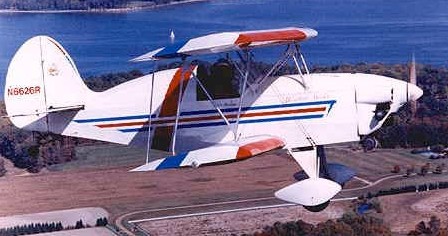
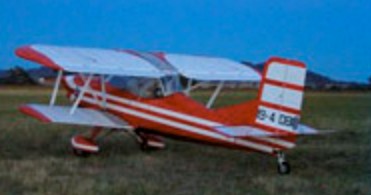
Designed and manufactured by Australian LightWing as a kit aircraft, the first PR-Bipe was test flown on Sat 10 July 2004. The aircraft was completed by Eddie Sieve in Sydney’s Northern suburbs, the aircraft was flown at Cessnock NSW. The Bipe is a pleasure to fly with ultra responsive controls and is ideally suited to positive G aerobatics the second seat can carry up to an 85 kg passenger or baggage. The aircraft shown above is powered by the Jabiru 4 Cyl 4 stroke engine. The PR-Bipe is a derivative of the PR-582, this superb aircraft can be fitted with either the Rotax 582, the 912 or the 912-s. The ALW Bipe Wing span is reduced to 6m. The aircraft can be built with a fully enclosed cockpit seating two. An open configuration Bipe can be made to order. The aircraft is available as a kit or a quick build kit and is suitable for either AUF or Experimental registration where aerobatics are approved by the manufacturer.

 All Aero