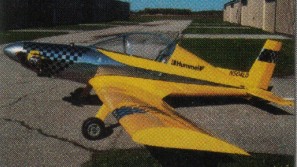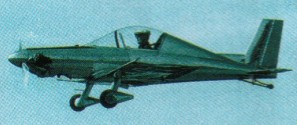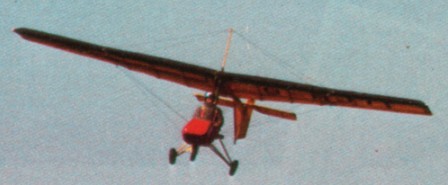
Huntair Pathfinder II

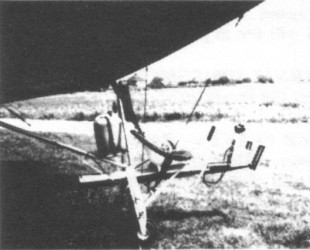
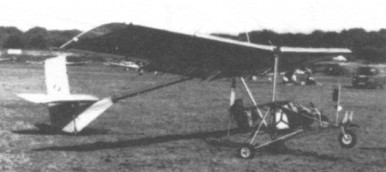
Single seat single engined high wing monoplane with conventional three axis control. Wing has unswept leading edge, swept forward trailing edge and tapering chord cruciform tail. Pitch control by elevator on tail; yaw control by fully flying rudder with additional fin; roll control by half span ailerons; control inputs through stick for pitch/roll and pedals for yaw. Wing braced from above by kingpost and cables, from below by cables; wing profile, modified 23012; 100% double surface. Undercarriage has three wheels in tricycle formation with additional tailwheel; no suspension on nosewheel and steel spring suspension on main wheels. Push right go right nosewheel steering connected to yaw control. No brakes. Aluminium tube framework, with optional pod. Engine mounted below wing driving pusher propeller. Aluminium tubing to British HT3OTF specification. Polyester sailcloth.
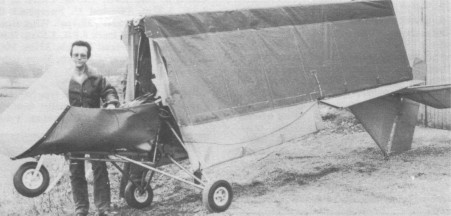
The Pathfinder II is similar in concept to the Pathfinder I and is a logical development of the previous design. Visually the most obvious difference is the large diameter single upright, which replaces the two uprights originally used, but there are many other changes too. A fully double surface wing is used, with curved underside, lower camber (3%), 12% aerofoil, shorter span and slightly lower area, changes which make the aircraft less affected by turbulence and, as a bonus, faster.
To improve handling, rigid ailerons are used, constructed similarly to the tail surfaces of the Pathfinder I The rudder has been made smaller and the fin area larger. Although the 330 engine is unchanged internally, the mounting system has been changed to reduce vibration and the fan-cooling dispensed with, saving weight and increasing power. Other improvements are the inclusion of a carburettor heat facility and a more durable design of drive shaft.
The combined effect of these changes is an aircraft which is faster, lighter and more compact than its predecessor. Although the pod remains optional, it is a standard fitment.
Steve Hunt designed the wings of the Pathfinder II to fold in four minutes, allowing the aircraft to be stored in a small space without being totally dismantled.

Engine: Robin EC34, 35 hp at 6500 rpm.
Propeller diameter 54 inch, 1.37 m.
V-belt reduction, ratio 2.4/1.
Max static thrust 210 lb, 95 kg.
Power per unit area 0.24 hp/sq.ft, 2.6 hp/sq.m.
Fuel capacity 5.4 US gal, 4.5 Imp gal, 20.4 litre.
Length overall 21.0 ft, 6.40 m.
Height overall 8.5ft, 2.59m.
Wing span 29.0ft, 8.84m.
Chord at root 5.3ft, 16.3m.
Chord at tip 4.5ft, 1.37m.
Dihedral 1 deg
Sweepback 0 deg
Total wing area 146 sq.ft, 13.6 sq.m
Wing aspect ratio 5.8/1.
Wheel track 4.4ft, 1.34m.
Nose¬wheel diameter overall 13 inch, 33 cm.
Main wheels diameter overall 13 inch, 33 cm.
Optional floats, dimensions: 12 ft, 3.66 m long.
Optional skis, dimensions 3.8 ft, 1.16 m long.
Empty weight 260 lb, 118kg.
Max take off weight 540 lb, 245kg.
Payload 280 lb, 127 kg.
Max wing loading 3.70 lb/sq.ft, 18.0 kg/sq.m.
Max power loading 15.41b/hp, 7.0kg/hp.
Load factors: +6.0, 4.0 ultimate.
Max level speed 80 mph, 129 kph.
Never exceed speed 90 mph, 145 kph.
Max cruising speed 75 mph, 121 kph.
Economic cruising speed 60 mph, 97 kph.
Stalling speed 26 mph, 42 kph.
Max climb rate at sea level 500 ft/min, 2.5 m/s.
Take off distance 300 ft, 90 m.
Landing distance 300 ft, 90 m.
Service ceiling 12,000 ft, 3660 m.
Range at average cruising speed 180 mile, 290 km.
Huntair Pathfinder I

Single seat single engined high wing monoplane with conventional three axis control. Wing has unswept leading edge, swept forward trailing edge and tapering chord cruciform tail. Pitch control by elevator on tail; yaw control by fully flying rudder with additional fin; roll control by half span ailerons; control inputs through stick for pitch/roll and pedals for yaw. Wing braced from above by kingpost and cables, from below by cables; wing profile 80% double surface. Undercarriage has three wheels in tricycle formation with additional tailwheel; no suspension on nosewheel and steel spring suspension on main wheels. Push right go right nosewheel steering connected to yaw control. No brakes. Aluminium tube framework, with optional pod. Engine mounted below wing driving pusher propeller. Aluminium tubing to British HT3OTF specification. Polyester sailcloth.

At the end of 1981, the Pathfinder appeared, and as the first ‘fully conventional’ British designed three axis microlight in quantity production, it found a ready market.

By the time production ended in early 1983, some 70 aircraft had been built and the Pathfinder had gained a reputation for durability and good performance, qualities which were underlined by its performance in the 1982 London Paris, in which nine started and nine finished, seven of them in the first ten. In addition, a Pathfinder piloted by Gerry Breen was joint winner of the speed award.

The Pathfinder was normally sold with a 330 cc Robin EC34PM engine, but a number were built with a 440 cc Robin EC44. The 440 version was not intended as a high performance option (though it was indeed faster) but was designed to provide good take off and climb characteristics for pilots whose weight was close to the Pathfinder’s 220 lb (100 kg) payload.

Both versions of the Pathfinder were replaced by the Pathfinder II in early 1983, and as a result the earlier aircraft is now called Pathfinder I.

Pathfinder I 330
Engine: Robin EC34PM, 28hp, at 6500rpm.
Propeller diameter and pitch 54x30inch, 1.37×0.76m.
V belt reduction, ratio 2.3/1.
Max static thrust 200 lb, 91 kg.
Power per unit area 0.19 hp/sq.ft, 2.0 hp/sq.m.
Fuel capacity 5.4 US gal, 4.5 Imp gal, 20.4 litre.
Length overall 23.0 ft, 7.01 m.
Height overall 10.0ft, 3.05m.
Wing span 32.0ft, 9.75m.
Chord at root 5.0ft, 1.52m.
Chord at tip 4.3ft, 1.31m.
Dihedral 2 deg.
Sweepback 0 deg.
Total wing area 148 sq.ft, 13.7 sq.m.
Wing aspect ratio 6.9/1.
Wheel track 4.5 ft, 1.37 m.
Nosewheel diameter overall 13 inch, 33cm.
Main wheels diameter overall 13 inch, 33 cm.
Optional floats, dimensions: 12 ft, 3.66 m long.
Optional skis, dimensions 3.8 ft, 1.16 m long.
Empty weight 293 lb, 133 kg.
Max take off weight 513 lb, 233 kg.
Payload 220 lb, 100 kg.
Max wing loading 3.47 lb/sq.ft, 17.0 kg/q.m.
Max power loading 18.3 lb/hp, 8.3 kg/hp.
Load factors: +5.5, 4.0 ultimate.
Max level speed 55 mph, 88 kph.
Never exceed speed 70mph, 113kph.
Max cruising speed 55 mph, 88 kph.
Economic cruising speed 50 mph, 80 kph.
Stalling speed 25 mph, 40 kph.
Max climb rate at sea level 400ft/min, 2.0m/s.
Take off distance 300 ft, 90 m.
Landing distance 150 ft, 45 m.
Service ceiling 12,000 ft, 3660 m.
Range at average cruising speed 125 mile, 201 km.

Pathfinder I 440
Engine: Robin EC44, 40hp, at 6500rpm.
Propeller diameter and pitch 54x36inch, 1.37×0.91m.
V belt reduction, ratio 2.3/1.
Max static thrust 275 lb, 125 kg.
Power per unit area 0.27 hp/sq.ft, 2.9 hp/sq.m.
Fuel capacity 5.4 US gal, 4.5 Imp gal, 20.4 litre.
Length overall 23.0 ft, 7.01 m.
Height overall 10.0ft, 3.05m.
Wing span 32.0ft, 9.75m.
Chord at root 5.0ft, 1.52m.
Chord at tip 4.3ft, 1.31m.
Dihedral 2 deg.
Sweepback 0 deg.
Total wing area 148 sq.ft, 13.7 sq.m.
Wing aspect ratio 6.9/1.
Wheel track 4.5 ft, 1.37 m.
Nosewheel diameter overall 13 inch, 33cm.
Main wheels diameter overall 13 inch, 33 cm.
Optional floats, dimensions: 12 ft, 3.66 m long.
Optional skis, dimensions 3.8 ft, 1.16 m long.
Empty weight 305 lb, 138 kg.
Max take off weight 525 lb, 238 kg.
Payload 220 lb, 100 kg.
Max wing loading 3.55 lb/sq.ft, 17.4 kg/sq.m.
Max power loading 13.1 lb/hp, 6.0 kg/hp.
Load factors: +5.5, 4.0 ultimate.
Max level speed 70 mph, 113 kph.
Never exceed speed 70mph, 113kph.
Max cruising speed 70 mph, 113 kph.
Economic cruising speed 60 mph, 97 kph.
Stalling speed 25 mph, 40 kph.
Max climb rate at sea level 800 fpm, 2.0m/s.
Take off distance 150 ft, 45 m.
Landing distance 150 ft, 45 m.
Service ceiling 12,000 ft, 3660 m.
Range at average cruising speed 60 mile, 97 km.

Huntair

Steve Hunt, the founder and director of Huntair. In 1980 he left Hiway to form Huntair, intent on producing his own three ¬axis microlight.
1983: Huntair, Truleigh Sands, Truleigh Manor Farm, Edburton, near Henrield, West Sussex BN5 9LLGreat Britain.

Hummer TX

Single seat single engined high wing mono¬plane with conventional three axis control. Wing has unswept leading and trailing edges, and constant chord; V tail. Pitch/yaw control by elevon; roll control by 13% span spoilerons; controls inputs through stick for pitch/ roll and pedals for yaw. Wing braced from above by struts and cables, from below by cables; wing profile Clark Y; 100% double-surface. Undercarriage has three wheels in tail dragger formation; steel spring suspension all wheels. Push right go right tailwheel steering connected to yaw control. Optional brakes on main wheels. Aluminium tube framework, with optional pod. Engine mounted below wing driving pusher propeller. Aluminium to 6061T grade.
Hummer Sales basic func¬tion was to assemble and sell the Maxair Sports Hummer in Britain. However, recognising the interest in conventional three axis control in the UK, the company developed its own version of the aircraft, fitted with stick operated spoilerons. Pedals operated the elevons individually, as well as the steerable tailwheel, while the fore and aft movement of the stick operated both elevons together.
The Hummer TX, as this conventional three axis control machine is known, should not be confused with the American three axis version of the Hummer, which has its spoilers operated by the rudder pedals.
Introduced in mid 1982, the Hummer TX uses a Robin engine, like most UK built Hummers. In 330 cc guise (the basic model was 250 cc) the TX was regarded as a competitor to the Huntair Pathfinder, but in fact it was never seriously marketed. In April 1983 Hummer Sales decided to abandon aircraft manufacture altogether.
Five TXs were built three with 250 cc engines, one with a 330 and one without engine.

Total spoileron area 2.3 sq.ft, 0.22 sq.m.
Engine: Robin EC25PS or EC34PM.

Hummel H5

In September 2009 the plans were available and cost US$350.00. The welded parts, bulkheads, ribs and misc. other parts were available for scratch builders and kits were being developed. The H5 is basically a slightly modified Ultracruiser Plus. The major difference is the style of the canopy, turtle deck and dorsal fin area. It is now like the Hummelbird. We also wanted to get away from the name Ultracruiser Plus because of the confusion it caused since we had a plane called the Ultracruiser. People thought the Plus was an Ultracruiser with some option added as opposed to a completely different airplane.
Optional wing tanks allow 21 USgallons of fuel.

Horse power range: 60 to 85
Airfoil: Harry Ribblett GA30-618
Wing span: 22.5 feet (optionally 25 feet)
Wing area: 100 sq. ft. – 22.5 ft. wing.
Wing loading: 8.5 lbs./sq. ft.
Fuselage length: 17 ft.
Empty weight: 457 lbs.
Gross weight: 850 lbs.
G-load: 3.8 plus/minus
VNE: 150 mph
Cruise speed @ 75% power: 120 mph
Stall: 46 mph
Take of distance: 300 feet.
Landing roll: 600 feet.
Fuel capacity: 9 – 21 USG

Hummel CA-2

Designed by Frank Griffith. CAD plans were available for US$125.

Top speed: 63 mph
Cruise: 50 mph
Stall: 26 mph
Range: 125 nm
Rate of climb: 600 fpm
Takeoff dist: 150 ft
Landing dist: 250 ft
Service ceiling: 10,000 ft
Engine: Rotax 277, 40 hp
Fuel capacity: 5 USG
Empty weight: 250 lb
Gross weight: 520 lb
Length: 16.5 ft
Wing span: 26 ft
Wing area: 117 sq.ft
Seats: 1
Landing gear: tailwheel

Hummel UltraCruiser

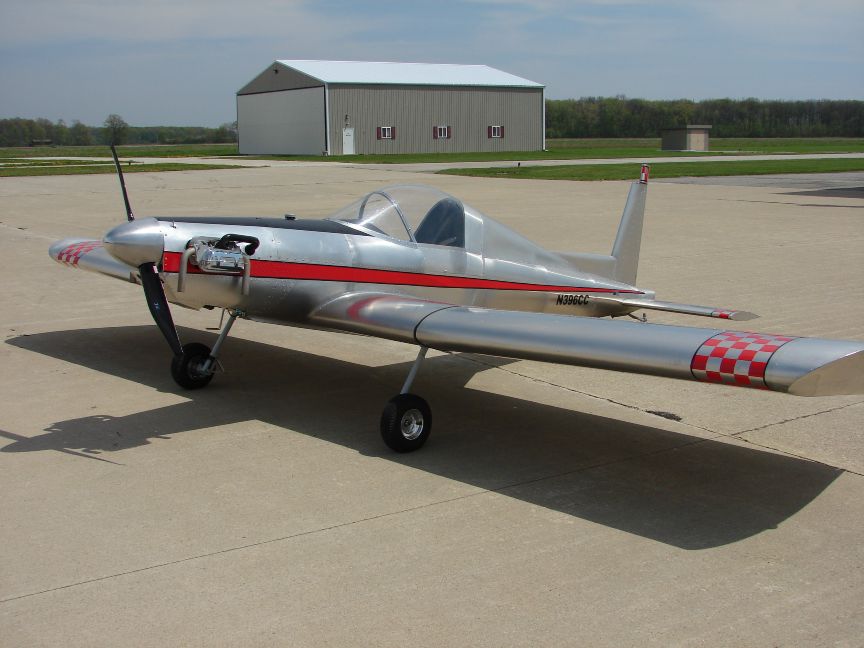
The UltraCruiser is an LSA legal all metal ultralight with economical, reliable, four stroke power and cruise of 60 mph. Canopy and heater for year round flying, and the canopy can be removed quickly. Detachable wings for easy storage. Full size parts shown on the plans. A wide 6.5 ft. landing gear track is standard for improved ground handling.

Ultra Cruiser
Cruise: 85 mph
Stall: 28 mph
VNE: 83 kt / 95 mph / 153 kmh
Range: 290 sm
Rate of climb: 1000 fpm / 5 m/s
Engine: ½ VW, 37 hp
HP range: 28-45
Fuel capacity: 5 USG
Empty Weight: 115 kg / 254 lbs
MTOW Weight: 227 kg / 500 lbs
Length: 16 ft
Wing span: 25 ft
Wing area: 112 sq.ft
Cockpit width: 24 in
Takeoff dist: 150 ft
Landing dist: 250 ft
Take-off distance (50ft obstacle): 300 ft / 91 m
Landing distance (50ft obstacle): 250 ft / 76 m
Seats: 1
Landing gear: tailwheel

Ultra Cruiser Plus
Cruise: 100 mph
Stall: 36 mph
Range: 350 sm
Rate of climb: 900 fpm
Takeoff dist: 250 ft
Landing dist: 500 ft
Engine: VW 1835cc, 60 hp
HP range: 50-80
Fuel capacity: 10 USG
Empty weight: 420 lb
Gross weight: 750 lb
Length: 17 ft
Wing span: 25 ft
Wing area: 112 sq.ft
Seats: 1
Cockpit width: 26 in
Landing gear: nose or tail

Hummel Bird

Hummel Bird began as a modified Watson Windwagon, but the designer/builder, Morry Hummel, of Bryan, Ohio, highly modified it and called it Hummel Bird, using the Revmaster R-800 rather than the half-VW. The LSA airframe has been modified and strengthened, tail area increased, and a locking tailwheel added for better ground control. A high L/D Schreder #3 airfoil and flaps also were used.

Excellent single place aircraft. Features all aluminum construction. Fast and inexpensive to build, many were flying.

Engine: Revmaster R-800.
Gross weight 520 lbs.
Empty weight 275 lbs.
Wingspan 18 ft
Length 13 ft 4 in
Vmax 115 mph.
Cruise speed 105 mph.
Stall 45 mph.
Climb rate 700 fpm.
Takeoff run 350 ft
Range 420 sm.

Engine: half VW, 37 hp
HP range: 30-40.
Span: 18 ft
Length: 13 ft 4 in
Height: 4 ft.
Wing area: 63 sq.ft.
Gross: 550 lbs.
Empty Weight: 270 lb
Useful Load: 250 lb
Fuel cap: 7 USG.
Speed max: 135 mph.
Cruise: 105 mph
Stall: 45 mph
Rate Of Climb: 800 fpm
Range: 250 sm.
Service ceiling: 13,000 ft.
Take-off dist: 300 ft.
Landing dist: 600 ft.
Landing gear: nose or tail wheel.
Cockpit width; 22 in
Seats: 1