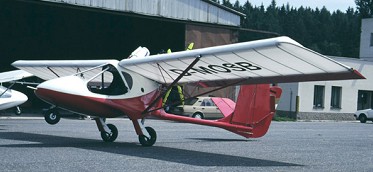
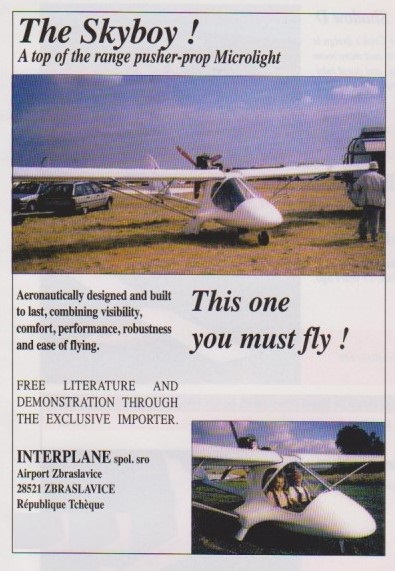
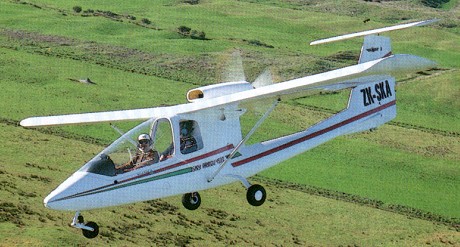
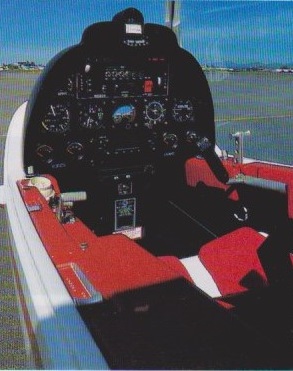
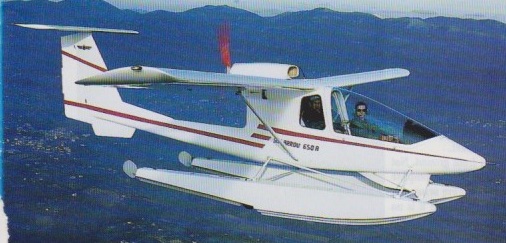
A two place, side by side ultralight has a composite fuselage, an automobie like instrument panel and faired undercarriage. Power is with a Rorax 503, with a Rotax 582 optional, in pusher configuration at the back of the cockpit area and behind the trailing edge of the wing. The tail is on a tubular tailboom with conventional three axis controls. A high wing-aluminium & composite microlight, the Skyboy has a fully enclosable composite cabin with dual controls. The Skyboy comes preassembled by Czech firm LET. The agent in France was Junkers Profly. The price in France, 1997, ex France, including engine and propeller was approximately US$22,400. The “Skyboy” was renamed the S1 Cobra.
1998
The Skyboy was offered with two different wing profiles. One for low speed manoeuvrability and one for fast cruise.
Engine: Rotax 503 Wing span: 34.5 ft Length: 20.8 ft Empty weight: 447 lb MTOW: 990 lb Stall: 35 kt / 40 mph / 64 kmh Cruise: 83 kt / 95 mph / 153 kmh VNE: 111 kt / 128 mph / 206 kmh Climb Ratio: 1050 ft/min / 5 m/s Take-off distance (50ft obstacle): 330 ft / 101 m Landing distance (50ft obstacle): 380 ft / 116 m
Engine: Rotax 582, 64 hp Wing span: 10.5 m Wing area: 15.2 sq.m MAUW: 450 kg Empty weight: 210 kg Fuel capacity: 42 lt Max speed: 150 kph Cruise speed: 120 kph Minimum speed: 54 kph Climb rate: 5.5 m/s Seats: 2 Fuel consumption: 15 lt/hr Price (1998): 32 000 DM
The International Ultralight Banchee (also called the Banshee) is an American ultralight aircraft designed by Brian Jensen, Gil Kinzie and Nick Nichols and produced by International Ultralight Aviation. The aircraft was supplied as a kit for amateur construction. Unit cost was US$5,495 ready to fly in 1982.
The aircraft closely resembles the Pterodactyl Ptraveler, and, like the Pterodactyl, was designed to comply with the US FAR 103 Ultralight Vehicles rules, including the category’s maximum empty weight of 254 lb (115 kg). The Banchee has a standard empty weight of 251 lb (114 kg). It features a cable-braced high-wing, single-seat, open cockpit, without pod, single pusher engine configuration, and is equipped with tricycle landing gear. Steel spring suspension on nose¬wheel and glass fibre suspension on main wheels. Push right go left nosewheel steering independent from yaw control. No brakes.
The aircraft is made from bolted-together aluminum tubing, with the double surface wing covered with Dacron sailcloth. Its 34 ft (10.4 m) span wing is cable-braced from an inverted “V” kingpost, has 4° of dihedral and 15° of leading edge sweepback, unswept trailing edge. The wing has a tapering chord, no tailplane, and canard wing. The three-axis control system is unconventional, with pitch controlled by an all-flying canard, yaw by wingtip rudders and roll by spoilerons, all actuated by a single side-stick, the aircraft lacking rudder pedals. The cockpit is an open sling seat without a windshield. The tricycle landing gear features suspension on all wheels. The Cuyuna 430R engine is mounted below wing behind the pilot and can produce 35 hp (26 kW) at 6250 rpm.
A ballistic parachute was available as an option, as was an electric starter; the company claimed that the Banchee could be rigged in 35 minutes.
Conceived by Brian Jen¬sen and Gill Kinzie, the Banchee was shown publicly for the first time at Sun ‘n’ Fun in March 1983 at Lakeland, Florida. Just before this exhibi¬tion, it took part in the Greater Arizona Ultralight Air Race, where two of the five Banchees entered finished 3rd and 4th in Class E, which was considered to be a convincing first public appearance.
On 21 May 1983 during a demonstration flight at St. George, Utah a Banchee suffered a cable swaging failure at an altitude of 50 to 60 ft (15 to 18 m) that resulted in one fatality. The US National Transportation Safety Board cited the probable causes as improper maintenance and quality assurance on the part of the manufacturer. The company went out of business shortly after the accident.
Banchee Engine Cuyuna ULII 02 engine. Max power 35 hp / 26 kW at 6250 rpm. Propeller: 2-bladed wooden Propeller diameter and pitch 54 x 27 inch, 1.37×0.69m. V belt reduction, ratio 2.0/1. Max static thrust 230 lb, 104kg. Power per unit area 0.18 hp/sq.ft, 2.0 hp/sq.m. Fuel capacity 5.0 US gal, 4.2 Imp gal, 18.9 litre. Length overall: 12.0 ft, 3.65 m. Height overall: 9.0 ft, 2.74m. Wing span: 34.0 ft, 10.36m. Chord at root 6.0 ft, 1.82m. Chord at tip 4.0 ft, 1.22m. Dihedral 4 deg Sweepback 15 deg Canard span 10.0ft, 3.04m. Canard chord 2.0 ft, 0.61 m. Total wing area 190 sq.ft, 17.7sq.m. Main wing area 170 sq.ft, 15.8sq.m. Canard area 20 sq.ft, 1.9 sq.m. Total aileron or spoiler area 3.0 sq.ft, 0.28sq.m. Rudder area 14.0 sq.ft, 1.30sq.m. Main wing aspect ratio 6.8/1. Nosewheel diameter overall 16 inch, 41 cm. Main wheels diameter overall 16 inch, 41 cm. Floats, dimensions 13 x 1.10 ft, 3.96 x 0.56 m. Skis, dimensions 3 x 0.6ft, 0.91 x 0.15m. Empty weight: 251 lb / 114 kg Gross weight: 600 lb / 272 kg Fuel capacity: 5 U.S. gallons / 19 lt / 4.2 imp gal Payload 280 lb, 158 Max wing loading 3.15 lb/sq.ft, 15.4kg/sq.m. Max power loading 17.1 lb/hp, 7.8kg/hp. Load factors; +6.0, 3.0 ultimate. Maximum level speed: 55 mph / 89 km/h / 48 kt Never exceed speed: 65 mph / 56 kt / 105 km/h Max Cruise speed: 50 mph / 43 kt / 80 km/h Economic cruising speed: 35 mph, 56 kph. Stalling speed: 24 mph / 21 kt / 39 km/h Max climb rate at sea level 1000 ft/min, 5.1 m/s. Min sink rate 350 ft/min at 30 mph, 1.7 m/s at 48 kph. Best glide ratio with power off 12/1 at 38 mph, 61 kph. Take off distance 75 ft, 23 m. Landing distance 50ft, 15 m. Service ceiling 14,500ft, 4422 m. Range at average cruising speed 120 mile, 193 km / 104 nmi Crew: one
1982: International Ultralite Aviation Inc, 2294 Hindenburg Lane, Provo, Utah 84601, USA. 1983: 1393 East Point Drive, Sandy, UT 84092, USA. On 21 May 1983 during a demonstration flight at St. George, Utah a Banchee suffered a cable swaging failure at an altitude of 50 to 60 ft (15 to 18 m) that resulted in one fatality. The US National Transportation Safety Board cited the probable causes as improper maintenance and quality assurance on the part of the manufacturer. The company went out of business shortly after the accident.
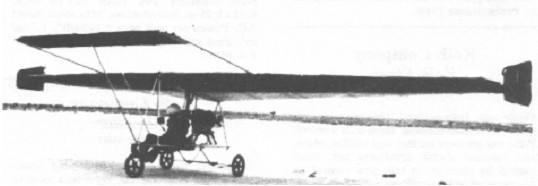
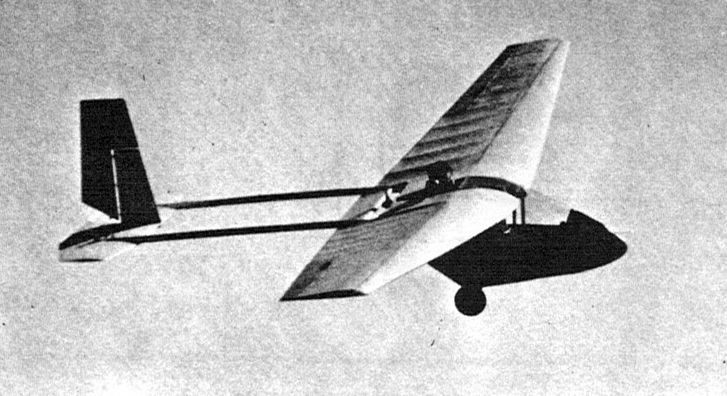
The Wanderer was a single seat single engined high wing monoplane with conventional three axis control. Wing has swept back leading edge, swept forward trailing edge and tapering chord; conventional tail. Pitch control by elevator on tail; yaw control by fin mounted rudder; roll control by half span ailerons; control inputs through stick for pitch/roll and pedals for yaw. Cantilever wing; wing profile; double surface. Undercarriage has three wheels in tail dragger formation; suspension on tailwheel; suspension on main wheels. Tailwheel steering. No brakes. Steel tube fuselage, totally enclosed. Engine mounted above wing driving pusher propeller.
The Wanderer is a soaring machine and appeared in 1982. The test pilot, George Worthington, had a miraculous escape when a wing broke during a spin of the prototype of the Wanderer in August 1982. On the 10 September 1982 he was killed in the second prototype after a similar break in the wing. The aircraft may not go into series production.
Engine Yamaha KT 100S, 15hp at 10,000rpm. Power per unit area 0.11hp/sq.ft, 1.21 hp/sq.m. Fuel capacity 5.0 US gal, 4.2 Imp gal, 18.9 litre. Length overall 17.0 ft, 5.18 m. Height overall 3.6ft, 1.08m. Wing span 35.6ft, 10.82m. Total wing area 133 sq.ft, 12.4sq.m. Wing aspect ratio 9.5/1. Empty weight 190 lb, 86kg. Max take off weight 480 lb, 218kg. Payload 270 lb, 132kg. Max wing loading 3.6 lb/sq.ft, 17.6 kg/sq.m. Max power loading 32.0 lb/hp, 14.5 kg/hp. Load factors; +4.6, 4.6 ultimate. Max level speed 75 mph, 121 kph. Max cruising speed 60 mph, 97kph. Stalling speed 25mph, 40kph. Max climb rate at sea level 300 ft/min, 1.5 m/s. Best glide ratio with power off 17/1 at 40 mph, 64 kph. Take off distance 200 ft, 60 m. Land¬ing distance 300 ft, 90 m. Range at average cruising speed 240 mile, 386 km.
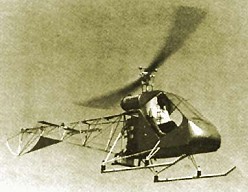
The commercial rights to the Helicom H-1 Commuter Junior were sold to Southern Pacific Aircraft Co and then to International Helicopter Inc of Mayville, New York, with the machine being refined along the way as the Commuter II – a two-place, 125 hp Franklin engined helicopter. First built in 1970. The creator of that design, Harold “Pop” Emigh, went on to develop the popular 2-seaters—the Commuter-IIA and -IIB.
The Commuter IIA main rotor and tail rotor are both gear driven, and it is powered by the proven 150-hp Lycoming aircraft engine with a dual ignition. Such complicated parts as the main rotor transmission, tail rotor gear box, rotor blades, etc., are assembled at the factory. The airframe is of Chrome-Moly steel tubing. With engine off it descends at a rate of only 1200 to 1400 fpm. Commuter IIA price in 1982: $12,000 (Excludes engine). Plans available for $75. Aircraft kit with engine costs $18,000. Units delivered to June 1982: 89.
Vortech offered the large, thick manual containing the building plans for the classic Commuter-II. The airframe, control system, main- and tail-drive system, engine mounting, cabin construction, etc. are all detailed. Bear in mind that the control head was sold as an assembled, tested component and the drawings for this unit are somewhat general.
Commuter II Engine: Franklin, 125 hp
Commuter IIA Engine: Lycoming 150 hp Rotor Diameter: 25 ft Length: 22 ft Height: 8 ft Width: 5.7 ft Empty Weight: 700 lbs Gross Weight: 1,300 lbs Useful Payload: 600 lbs Maximum Speed: 100 mph Cruise Speed: 70 mph Rate of Climb: 900 fpm Range: 225 miles Service Ceiling: 11,000 ft
Commuter IIA Gross weight: 1,375 lbs. Empty weight: 800 lbs. Useful load: 575 lbs. Fuel capacity 22 USG. Rotor span 25 ft. Length 29 ft. Engine 150-hp Lycom¬ing. Top speed 100 mph. Cruise 90 mph. Climb rate 1071 fpm. Ceiling 13,000 ft. Range 225 sm.
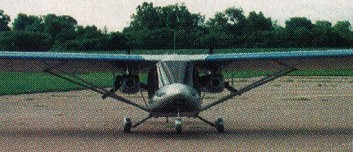
First flown in 1996. The kit price for this twin pusher, including engines but not props or instruments, was US$23,500. An auxilary 20 US Gallon fuel tank was optional.
Engine: 2 x Rotax 503, 53 hp Top speed: 100 mph Cruise: 90 mph Stall: 40 mph Rate of climb: 1200 fpm Takeoff dist: 350 ft Landing dist: 150 ft Fuel capacity: 20 USG Empty weight: 650 lb Gross weight: 1400 lb Height: 6.9 ft Length: 19.4 ft Wing span: 31.5 ft Wing area: 155 sq.ft Seats: 2 Landing gear: nose wheel
The Sky Arrow is based on the earlier, remotely piloted drones, the Rondine. The development of the proven airframe (with certification originally funded by the Italian government) into a series of sporting sircraft was undertaken, producing the Sky Arrow. Guiseppe Archangeli made the first flight of the Sky Arrow from Ponzano, near Rome, on 13 July 1992. On that flight the prototype was fitted with the original metal wings, and it required only a 2 degree change in the tailplane incidence and minor mods to the controls. To meet the civilian market demands and regulations, the Sky Arrow has been modified from the original concept, with the initial design studies being wind tunnel tested at the University. The original metal wings have been substituted with an all composite version. The Sky Arrow 450T is a single-engine aircraft with vertically staggered tandem seats and dual controls. The instrument panel is located ahead of the front seat, and all the instruments are arranged to allow visibility from the rear seat, which is elevated somewhat in relation to the front seat. However, wing flaps, dual electronic switches and cabin heat can only be operated from the front seat. Operable from both seats are the brakes, trim, mixture control and carburettor air control.
The high wings are braced and rectangular in shape, and are made of a carbon-fibre sandwich with kevlar reinforcement, while the struts are constructed of alu¬minium and steel. The Sky Arrow 450 T wings are the as as the P92. The fuselage and empennage are made from carbon-fibre and kevlar. Landing gear is a fixed tricycle-type constructed of multilayered carbon-fibre and rubber shock absorbers for the nose gear. Load factor limits at a planned maximum all up weight of 450kg are +3.8G/-1.9G, with an ultimate strength of +7.6G/-3.8G before breakage occurs. The aeroplane is powered by an 80 hp four-stroke Rotax 912 engine, coupled by means of a reduction gear¬box with a ratio of 1:227 driving a two-bladed propeller. The airframe is fully manufactured with composite materials (kevlar and carbon sandwich). The high-wing tandem configuration provides excellent visibility of over 300degrees. The Sky Arrow is fitted with either a Rotax 912 or 914 engine. The aircraft is offered to homebuilder enthusiasts as a kit which meets the FAA 49/51 percent rule. The Sky Arrow kit is composed of 10 subkits which can be bought separately and incrementally.
The Sky Arrow 450 and 650 are the same aircraft available as certified and ultralight versions. Easily converted to wheels, floats or amphibian, the 650TC is certified to JAR/VLA standard. Both the 450T ULM and 650T kit are built to that standard.
In 2014, the Sky Arrow 600 was manufactured by Italian maker Magnaghi. Base price 2014: $87,000 (Sky Arrow); $100,000 (loaded with SkyView 10-inch EFIS for limited time).
 All Aero