After the KAPPA 77 a.s. was declared bankruptcy on 16 February 2005, the company Jihlavan airplanes, s.r.o. was founded on 2 March 2005 with the main objective – to proceed in the production of the ultralight aircraft KP 2U SOVA. On 1 April 2005, the Jihlavan airplanes, s.r.o. became the holder of the manufacture rights, intellectual properties, etc. of the KP-2U. Over 160 airplanes of the Kappa KP-2U versions were built. After Jihlavan took over the production of the aircraft it was renamed as the Rapid KP-2U.
LSA/UL
JH Aircraft Corsair
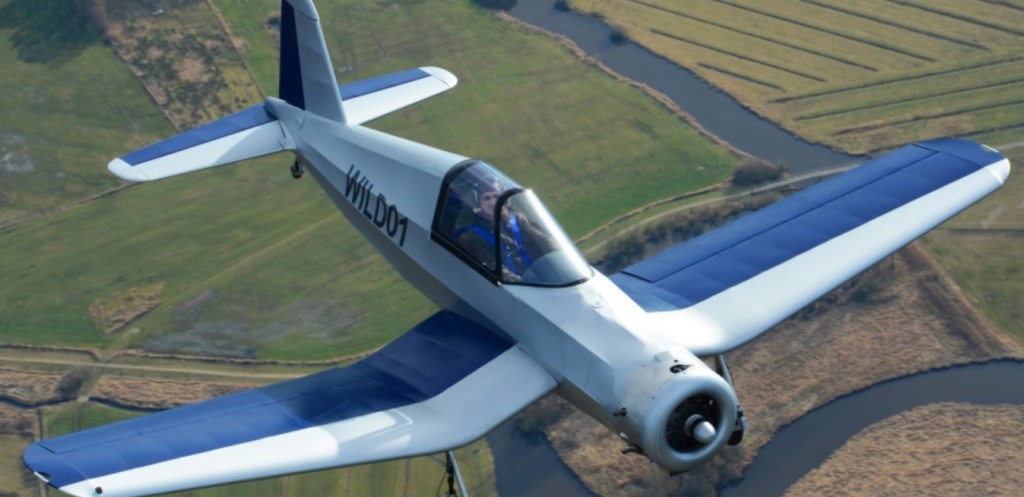
The Corsair relies on latest lightweight construction technology to combine flight performance, agility and energy efficiency. The whole primary structure is made of aerospace grade carbon fiber. Carbon fiber spaceframe technology is applied on the fuselage to achieve the greatest possible strength at the lowest possible weight.
The Carbon structure has a proven strength of +9 and -6g. Furthermore the complete cockpit area is constructed as a Kevlar reinforced safety cell.
The Corsair follows the German LTF-L regulation. As well it covers many other national regulations, e.g the British SSDR, the Italian, French, Czech, Polish and even the US American FAR part 103 regulation. For the later the empty weight, MTOW and speeds are slightly reduced.
The Verner Scarlett 3 V – a 4-stroke, 3-cylinder radial engine designed as a light aircraft engine and produces 42 bhp at 2500 rpm. The high engine torque allows the use of a rather big and efficient propeller. There are two standard options: either a ground adjustable 3-blade 1,60 m carbon prop which can produce – depending on the blade pitch – up to 100 kg of static thrust. Or the 1,75 m Helix 2- or 3-blade props which both even deliver more than 100 kg thrust.
The first version of the Corsair features a classic tailwheel configuration. The fixed main landing gears are located at the wings and due to the wing shape are rather short and quite aerodynamic. The cantilevered main wheel attachment together with hydraulic springs and dampers is great for grass strips and the occasional less than perfect landing.
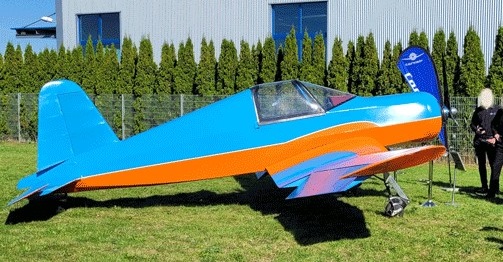
The tail gear is connected with the rudder by means of a GFRP spring and allows good ground handling. Even the tail wheel is on a cantilever and has an elastomeric spring and damper.
Provisions for a retractable landing gear have been considered in the wing design and if we see sufficient customer demand a retractable version could become available in the future. Nevertheless it has to be stated, that the retractable version does not promise to be any faster – the additional weight and the resulting drag will consume the aerodynamic benefit.
Engine: Verner Scarlett 3 VW, 31 kW (42 BHP) at 2.500 RPM
Wing span: 24,6 ft
Wing area: 108 sq ft
Length: 20,7 ft
Empty weight: 265 lbs (FAR part 3 254 lbs)
Payload: 287 lbs (FAR part 3 254 lbs)
Loading: +6g / -4g
Wings folded width: 9,0 ft
Maximum speed: 55 knots / 102 km/h (EU 55 km/h)
Cruise: 54 knots / 100 km/h (EU 160 km/h)
Stall: 24 knots / 44 km/h (EU 210 km/h)
Best climb: 1000 ft/min / 5 m/s
JDT
Production of the TEAM Inc Mini-MAX and Hi-MAX lines moved to the JDT facility at the Nappanee, Indiana Airport (Hangar M). JDT do not own the rights to any other Ison designs.
JCC Aviation J.300
Offered as a kit to construct the J.300 two-seat cabin microlight.
JCC Aviation
France
Offered a kit to construct the J.300 two-seat cabin microlight.
Javelin Aircraft Corp
Plans were available to construct Wichawk biplane, first flown 1971 and offering side-by-side seating plus optional third seat. Also offers plans for V6 STOL, a four-seat high-wing cabin monoplane which uses Piper PA-22 Tri-Pacer components.
1995: Municipal Airport, Augusta, KS 67010, USA.
Jarzab Klos
Single seat single engined parasol winged air¬craft with conventional three axis control. Wing has unswept leading and trailing edges, and constant chord; V tail. Pitch/yaw control by elevon; roll control by ailerons; wing profile Clark Y; double surface. Undercarriage has three wheels in tail dragger formation. Aluminium tube/wood fuselage, partially en¬closed. Engine mounted at wing height driving tractor propeller.
Began in 1974, it was not until July 1977 that the aircraft, a joint venture between Kazimierz Jarzab, S Kustron and S Wojton, made its first flight. It is a parasol winged tail dragger constructed largely from wood and aluminium alloy. The pilot sits under the wing, in an open cockpit but protected by a windscreen, and the two blade pusher propeller is mounted at the trailing edge of the wing. A tubular empen¬nage supports the V tail, which has in addition two fins, shaped like an isosceles triangle with rounded corners.
Length overall 13.8 ft, 4.20 m.
Height overall 3.6ft, 1.10m.
Wing span 23.0ft, 7.0m.
Constant chord 2.8ft, 0.86m.
Sweepback 0 degs
Total wing area 65 sq.ft, 6.0 sq.m.
Wing aspect ratio 8.2/1.
Engine: MZ 250, 16 hp.
Power per unit area 0.25 hp/sq.ft, 2.7 hp/sq.m.
Fuel capacity 5.3 US gal, 4.4 Imp gal, 20.0 litre.
Empty weight 209 lb, 95kg.
Max take off weight 419 lb, 190kg.
Payload 209 lb, 95 kg.
Max wing loading 6.45 lb/sq.ft, 31.7 kg/sq.m.
Max power loading 26.2 lb/hp, 11.9kg/hp.
Cruising speed 68mph, 110kph.
Max climb rate at sea level 400ft/min, 2.0mls.
Take off distance 660ft, 200m.
Range at average cruising speed 622 mile, 1000km.
Jarzab, Kazimierz
1983: Kazimierz Jarzab, 38 400 Krosno, ul Staszica 11/22, Poland.
LSA builder
JAI JAI-40
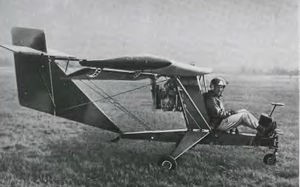
In 1986 at SKB JAI a light aircraft named JAI-40 (Russian: ХАИ-40) and nicknamed “VOK” was developed. Originally this device was obtained as a student work directed by G. Jmyz from the previous JAI-21. The aircraft was safe, light in handling and excellent speed and economy characteristics.
The JAI-40 was designed as a mixed construction single-seater high-wing monoplane. The wing, braced by inverted V posts, was constructed of wood with some use of composite materials and featured control surfaces along the entire length of the trailing edge.
The bar-type fuselage was constructed of metal tubes and sheets.
The glue unit was conceived on the basis of a fabric-coated duralumin tube structure. The horizontal planes were located high above the empennage and were braced to the structure by cables. The rudder featured a large area.
The landing gear was designed in a tricycle configuration. The front wheel was of the steerable type and was located directly at the bow of the device. The pilot sat in a seat on the basic structure of the fuselage. To avoid impacts during landing at large approach angles, a skid was installed under the rear of the fuselage.
The drive configuration difficulties were offset by installing a 35 hp RMZ-640 geared motor. This engine was installed directly on the vertical pylon for fixing the wings, moving a propeller with two wooden blades 1.38 meters in diameter. The selection of the engine and the use of a wing with 8.2 aspect ratio allowed the model to fly easily and have an excellent take-off step. Later and in order to improve performance, a 42 hp Vulcan engine designed by VP Manuilenko would be installed, moving a propeller of 1.51 meters in diameter.
Its further development was reinforced and in 1988 it reached first place in its class in the light aircraft competition held in Túshino. With a takeoff weight of 305 kg and a 42 hp engine this little machine was capable of reaching 105 km / h.
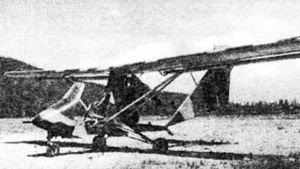
The JAI-40 successfully participated in the SLA-87 light aircraft competition.
JAI-40
Engine: 1 x Vulcan 42 hp
Wingspan: 8.50 m
Length: 4.75 m
Wing area: 9.60 m²
Tailplane wingspan: 5 m
Vertical fin area: 1.64 m²
Rudder area: 0.90 m²
Queue area: 1.40 m²
Elevators area: 0.86 m²
Wing aspect ratio: 8.7
Wing Profile: GA  -1
-1
Wheel spacing: 2.05m
Empty weight: 172 kg
Gross weight: 262 kg
Maximum takeoff weight: 305 kg
Wing loading: 2.44 lb / sq.ft
Power load: 7.48 kg / hp
Fuel capacity: 10 liters
Maximum speed: 105 km / h
Cruising speed: 95 km / h
Stall speed: 55 km / h
Ascent speed: 128 m / min
Practical range: 90 km
Accommodation: 1
JAI JAI-37 Mikhail Yefimov
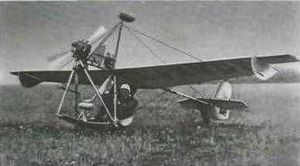
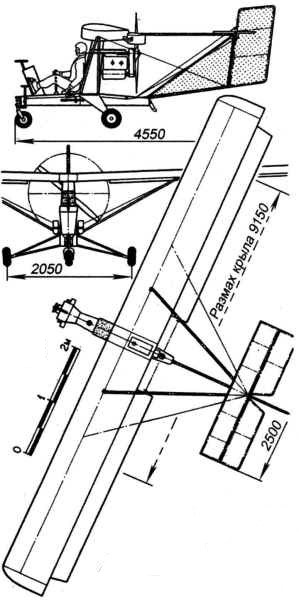
JAI-37 “Mikhail Yefimov” (Russian: ХАИ-37 “Михаил Ефимов”) was an ultralight aircraft developed at the AKA of the JAI.
Structurally, the JAI-37 was conceived as a high-wing braced monoplane of mixed construction. The ailerons were located at the wing tips. These ailerons appeared as increases to the wingspan.
A modified “Vijr-30” naval engine with air cooling was used as the power plant for this implementation and with a takeoff power of about 28 hp.
The JAI-37, named Mikhail Yefimov, was built in 1982 by a group of JAI students from a project developed by V. Dombrov, who also directed the construction. In this process, V. Kozhushnov, S. Kurinni, R. Sielix, M. Boiko and I. Tkach stood out.
First flying in 1980, as a glider, and August 1981 powered, tests were not good due to the lack of effectiveness of the wingtip ailerons.
Based on JAI-37, the improved JAI-37M model was developed with modified wings and tail and more standard placement of the ailerons. Later another model would be built, known as JAI-37M2.
The JAI-37M participated in the First SLA-85 Light Aviation Competition, but in this competition it did not fly.
 All Aero