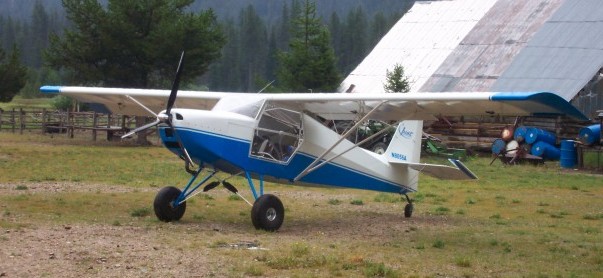
Just Aircraft Highlander

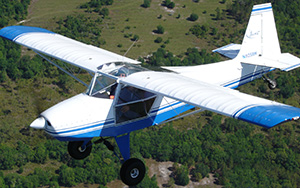
Introduced at Arlington and Oshkosh 2004, Highlander is an upgraded version of the Escapade. Just Aircraft’s new bush plane qualifications are enhanced by a larger balanced elevator and rudder, a larger trim tab, extended (and beefed up) gear legs with larger wheels and brakes, gull wing doors (can be opened in flight), an 8″ tail wheel and VG’s. And, a new three foot longer wing.
The Highlander has the same features as the Escapade, but with all the upgrades to make it a better backcountry aircraft. The Highlander is manufactured with all high quality aircraft materials. It is also manufactured with attach points for floats, lots of cabin area and extra large cargo area.
The Escapade and Highlander share considerable structural elements including the chrome-moly fuselage frame, wing airfoil construction, and engine compartment.
Using the same basic fuselage for both planes means they both have a huge luggage capacity that extends to the tail. The planes can handle a 6’7”+ frame and 300lb+ people. With sliding seats and 44” of elbow room.
Highlander LSA 2010 Kit Price: US$22,250
Both planes can be flown with the doors off or the doors and windows open, although a heater can be installed for frigid conditions.
The planes are available as complete ready to assemble kits which take about 600 – 700 hours to complete. Or you may choose various stages of assembly based upon your time demands and pocket book. Some choose to have the factory finish the wings and cover the fuselage which cuts the build time in half. There is also the option of “Build Assist” where for a monthly fee the owner may assemble the plane in the factory with company experts on hand for assistance. Those desiring a complete build ready to fly option will find this also available.
This would be SLSA certified if desired.
An extended-gear option for the Highlander provides heavy-duty axles to support bush tires: those legs raise the fuselage and widen the track by about 4 inches.
The Highlander is the bush plane model of the Escapade with longer wings, taller-heavier gear, tundra tires and larger tail feathers with balanced elevator and rudder.
The Escapade and Highlander can be installed with any power plants in the weight range of the Rotax 503 up to the Rotax 914 or Jabiru 2200 up to the Jabiru 3300.

Engine: Rotax 912 100 hp
Height: 7’10”
Length: 19′
Cabin Width: 44 in
Wing Span: 31′ 6″
Wing Area: 120.75 sq.ft
Empty Weight: 620 lbs
Gross Weight: 1320
Useable Load: 700
Fuel Capacity: 18 USgal
Flight Load Factor: +4 -2 G
Vne (never exceed speed): 130 mph
Cruise speed @ 75% power: 105 mph
Vso (full flap) at Gross Weight: 23 mph
Vs (clean) at Gross Weight: 27 mph
Take off Distance Ground Roll: 300 ft
Landing Distance Ground Roll: 250 ft

Highlander LSA
Engine: Rotax 912S, 100 hp
Wingspan: 31′ 6″
Length: 19 ft
Wing area: 116.25 sq.ft
Empty weight: 620 lb
MTOW: 1320 lb
Useful load: 700 lbs
Cruise 75%: 105 mph
Stall: 25 mph
Range: 520 sm
ROC: 1500 fpm
Takeoff dist: 100 ft
Landing distance; 75 ft
Seats: 2
Cockpit width: 44 in

Engine: Rotax 912S, 100 hp
Wing Span: 31’6”
Wing area: 120.75 sq.ft.
Mean Cord: 45”
Length: 19’
Height: 7’10”
Length Folded: 20’8”
Width Folded: 7’ 11.5”
Number of Seats: 2
Number of Doors: 2
Landing Gear: 8” Tail Wheel
Gear Width: 76”
Fuel Capacity: 18 or 26 USGallons (24 useable)
VNE: 130 mph
Cruise: 110 mph
Stall With Flaps 40 deg: 27 mph
Stall Clean: 32 mph
Take off Roll: 300 ft
Take off Distance to 50 ft: 800 ft
Ground Roll: 300 ft
Landing Distance from 50 ft: 1000 ft
Climb Rate: 880 fpm
Gross weight: 1320 Lbs
Empty weight: 615 Lbs
Useful Load: 705 Lbs
Load Limit Factors: +4 g’s –2 g’s
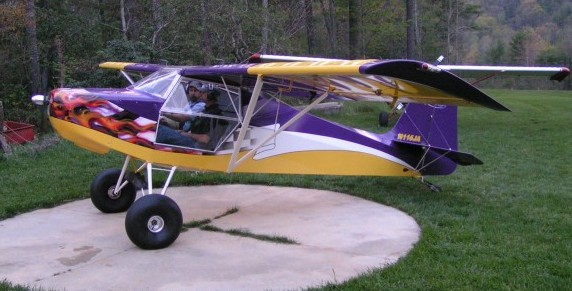
Just Aircraft Escapade

The Escapade has been developed to meet the demand for a two place side-by-side dual control (individual stick controls) aircraft that can be used for training as well as recreation.
The Fuselage, tail and landing gear are manufactured from 4130 Chrome-moly steel.
The original Escapade earned the United Kingdom’s BCAR (British Civil Aviation Requirement) Section S structural – and flight – test standards.

The wings fold in under 2 minutes with no disconnecting of any controls or control surfaces. The Escapade can be configured with tail-wheel or tri-cycle landing gear with the ability to swap from one to the other in about 1 hour.

The Escapade has been through UK Section S static testing certification requirements and flight-testing certification requirements. The Escapade can be installed with any power plants in the weight range of the Jabiru 2200 or Rotax 912/914. Jabiru Pacific can provide from the firewall forward.

The Escapade and Highlander share considerable structural elements including the chrome-moly fuselage frame, wing airfoil construction, and engine compartment.
Using the same basic fuselage for both planes means they both have a huge luggage capacity that extends to the tail. The planes can handle a 6’7”+ frame and 300lb+ people. With sliding seats and 44” of elbow room.
Both planes can be flown with the doors off or the doors and windows open, although a heater can be installed for frigid conditions.
The planes are available as complete ready to assemble kits which take about 600 – 700 hours to complete. Or you may choose various stages of assembly based upon your time demands and pocket book. Some choose to have the factory finish the wings and cover the fuselage which cuts the build time in half. There is also the option of “Build Assist” where for a monthly fee the owner may assemble the plane in the factory with company experts on hand for assistance. Those desiring a complete build ready to fly option will find this also available.
This would be SLSA certified if desired.
Escapade LSA 2010 Kit Price: US$20,250
The Escapade and Highlander can be installed with any power plants in the weight range of the Rotax 503 up to the Rotax 914 or Jabiru 2200 up to the Jabiru 3300.

Variation:
Lanitz Escapade Two

Engine: Rotax 912, 80 hp
Height: 7’2”
Length: 19′
Cabin Width: 44 in
Wing Span: 28′ 6″
Wing Area: 108 sq.ft
Empty Weight: 615 lbs
Gross Weight: 1320
Useable Load: 705
Flight Load Factor: +4 -2 G
Vne (never exceed speed): 130 mph
Cruise speed @ 75% power: 110 mph
Vso (full flap) at Gross Weight: 27 mph
Vs (clean) at Gross Weight: 32 mph
Climb Rate (sea level @ gross): 880 ft/min
Take off Distance Ground Roll: 300 ft
Landing Distance Ground Roll: 300 ft
Fuel Capacity: 18 USgal

Escapade LSA
Engine: Jabiru 2200 85 hp
Wingspan: 28′ 6″
Empty weight: 620 lb
MTOW: 1320 lb
Useful load: 700 lb
Cruise 75%: 110 mph
2010 Kit Price: US$20,250

Engine: Rotax 912S, 100 hp
Wing Span: 28’6”
Wingarea: 108 sq.ft.
Mean Cord: 45”
Length: 19’
Height: 7’2”
Length Folded: 19’2”
Width Folded: 7’ 11.5”
Number of Seats: 2
Number of Doors: 2
Landing Gear: Tricycle or Tail Wheel
Gear Width: 72”
Fuel Capacity: 18 or 26 USGallons (24 useable)
VNE: 130 mph
Cruise: 110 mph
Stall With Flaps 40 deg: 27 mph
Stall Clean: 32 mph
Take off Roll: 300 ft
Take off Distance to 50 ft: 800 ft
Ground Roll: 300 ft
Landing Distance from 50 ft: 1000 ft
Climb Rate: 880 fpm
Gross weight: 1320 lbs
Empty weight: 615 lbs
Useful Load: 705 lbs
Load Limit Factors: +4 g’s –2 g’s
Just Aircraft

Caldwell, Idaho, USA.
Just Aircraft was founded in 2002 when aircraft designer Troy Woodland left his position at Flying K Enterprises, manufacturer of the Sky Raider kit. Troy wanted to design a plane of his own. He met Gary Schmitt at an air show and Gary wanted a plane with many of the features of the new Escapade.With Gary’s backing they collaberated on a design.
The Escapade has a huge luggage compartment, a more roomy cabin , and a simplified wing-folding mechanism that avoids the need to remove control linkages.

Soon after the Escapade came the Highlander, a more rugged plane that was the bush airplane they wanted. The Highlander Debuted at Arlington in 2004, and by 2010 dominated Just’s sales by three-to-one aircraft sold .

In 2004 the company relocated to Walhalla, South Carolina, into a state of the art production facility with its own runway. This was a time of serious growth for Just Aircraft, when materials buying and costs analysis became implemented, when marketing, accounting, and all other true “front office” needs of the growing company were founded.

Over 170 kits had been shipped worldwide: including England, France, Spain, New Zealand, Canada and Equador. Sales are running about 50/50 domestic and export.

In addition to selling kits, Just Aircraft offers customers a build assist program, where they can construct their plane in the factory, or the Company will build 100% of the plane in accordance to the customers specifications.

Jurkštas RJ-2

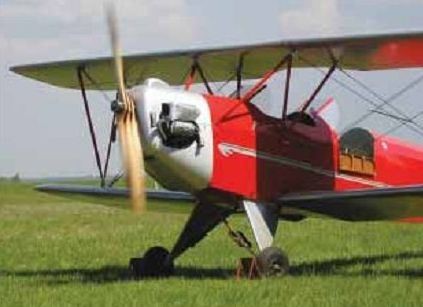
In 1998 Jurkštas started the construction of the plane named JR biplane – 2, although it more often fellow aviators called it “Biukeriu” because the similarity to the German aircraft. Jurkštas does not deny the similarity, but argues that the design that the detailed drawings, were followed by five years was work.

The JR-2 is an ultra-light wooden structure biplane. The front part of the fuselage is covered with oilcloth, and the rear with canvas. The front by the engine hss duralumin coated tin. There is a technical requirement that this place is not flammable. The bonnet is formed of glass material.

Wooden structure has two wings spars. The front part of the first spar coated oilcloth. Next frame covered with canvas wings. The upper wings are connected on duraliminio pipes. The lower wings attach to the trunk connectors with 2.5 mm thick stainless steel plates. The wings are tensioned with 5.6 mm diameter steel guys.

The stabilizer and fin also has two spars. Their profile is NACA 0009. Until the first spar they are oilcloth covered, the rest is canvas. The rudder is coated with canvas. Wheels 350X135 came from a L-13 Blanik glider.

The wood was gathered in one of Silutes sawmills by R.Jurkštas. Jurkštas said that it was created by looking at a Piper Cub.

An air-cooled VW 1600 engine turns a constant pitch 1.52 m diameter propellor, which is made of laminated wood. The pitch is 0.92 m . The engine is 65 hp, maximum shaft speed of 4600 rev / min. The engine cost 250 litas.

The fuel tank is installed in the front of the fuselage. Its capacity of 23 liters. It is attached with duralumin screw bands.

The Lithuanian biplane was completed in 2003, and the first flight was on June 23, 2004, piloted by R.Jurkštas. After the first tests, it was decided that the aircraft would better suit a larger diameter and pitch propeller. That improved its flight characteristics. R.Jurkštas flew more than 60 hours.

Jurkštas, Ramunas

Ramūnas Jurkštas

After graduating from high school in Klaipeda Baltic went to study in the aviation school in Kaluga in Russia, flew L-29, MiG-15, MiG-17. While still a student in 1977 R.Jurkštas began to glide at Klaipeda Aeroclub.
The first teachers were the club fliers A. Dust, E. Ramon V. Tamošiūnas, J.Aleknavičius.

Ramunas Jurkštas became Silute Aero Club instructor pilot.

Jurca, Marcel

France
Developed a very extensive range of light aircraft, available for home construction from plans. These include MJ.2 Tempete single-seat wood/fabric aerobatic monoplane (first flown 1956), MJ.5 Sirocco tandem two-seat aerobatic monoplane (first flown 1962), MJ.8 as 75 percent scale replica of Fw 190 fighter, MJ.9 as 75 percent scale replica of Bf 109 fighter, MJ.10 Spitfire as 75 percent scale wooden replica of Supermarine fighter, MJ.12 as 75 percent scale replica of P-40 fighter, MJ.53 Autan side-by-side two-seater (first flown 1991), MJ.77 Gnatsum as 75 percent scale wooden replica of P-51 Mustang fighter, and a range of full-size replicas of Second World War fighters, including MJ.80/Fw-190, MJ.90/Bf- 109 and MJ.100/Spitfire.

1998:
2, allée des bordes
F-94430 Cheneviére
France

Marcel Jurca died in October 2001, aged 81.

Junqua-Diffusion Ibis RJ.03

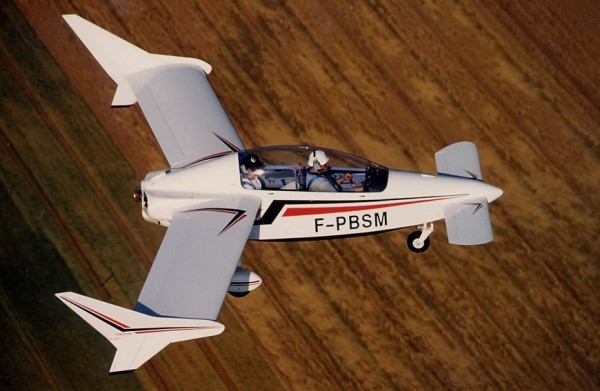
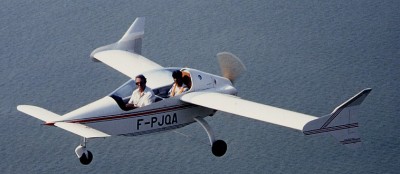
Developed from the RJ.02 Volucelle, the RJ.03 Ibis tandem two-seat canard monoplane, first flown 1991, was offered in plans form for home construction.
In March 1992 the Ibis received its French certification at Pau airport in France.
Totally enclosed in wood (spruce, douglas fir), it requires no fabric coverings.
By utilizing a combination of “Styrodur” (polystyrene) with identically-matching plywood ribs and depression-bonding of surface-coatings, its surface finish matchs that of synthetic-fibre aircraft.

Fitted with “flaperons” on the wings, its approach speed is identical to that of classic aircraft bearing the same load per sq.m. With little nosing-up during approach, rearward and forward visibility is excellent. Due to the use of a nonlaminar surface on the canard, flights are not affected by rain.

The fuel consumption is only 13 l/h at 200 km cruising speed or 10 l/h at 180 km. The rate of climb is 700 fpmat max. take-off weight with only 60 hp.

The IBIS is designed to be used with different types of engines (VW-1830cc, VW-1915cc, French JPX-475T, Australian JABIRU 2200cc, Limbach-2000 EC) and can be fitted with certain types of rotary engines (MID-WEST).
The structure comprises 7 frames, 4 longerons and diagonal struts. It is covered with plywood and requires no padding. The fuselage is assembled on the model plane principle, upside down on a table, and after construction of the different frames. The 150 pages handbook, included in the instruction document pack, will give you all the necessary explanations as regards: construction, adjustments and test flight techniques.

The canard wing is rectangular, with no twisting or dihedral angle. It has round tips which are bevelled on the underside. The trailing edge is fitted with a built-in slotted flap, which runs along the whole length of the wing. The canard structure consists of a “box-form spar” the same thickness as the profile and which joins 8 identical plywood former-ribs. The whole structure is filled with “Styrodur” foam, and covered with thin plywood which is glued by suction using the same technique as that employed in the construction of certain model planes.
The wing spar is a “box-form” construction and consists of two caps braced together by means of plywood strips on each side. It is in one single piece, at an angle to the airframe. Width and height are constant along whole thickness of the profile. There is no dihedral angle or twisting. All wing ribs are identical, and are in plywood. They are made in a single operation using a metal template and a joiner’s spindle moulding machine. This can be done very quickly. The wing is filled with blocks of “styrodur” foam hollowed out to allow passage of flight control linkages and is covered with thin plywood glued by suction. This method represents a saving of circa 40% on the production time required for standard wood and fabric wing construction. The wing can be dismantled only for major overhaul.
Each stabilizer consists of two half-stabilizers made of main plywood longerons and 5 plywood ribs. Thc stabilizers are completely filled with “styrodur”, and covered with glued plywood. The rudders are incorporated in the profile of the stabilizers.
The cabin is heated. Internal luggage stowage is behind the passenger’s head. The one-piece canopy, opens laterally.
The front undercarriage is mounted on a steering wheel, and is connected to the rudder dual controls; it is not retractable. It is made of steel tubes and fitted with a wheel mounted on a rocker, rubber shock absorbers with brakes on the rear-weels. The main undercarriage is made of glued laminated plywood, for weight, easy assembling and low cost. It is highly efficient even on grass runways.
The dual flight control system is the “rigid linkage” type with ball, bell-crank levers and rod connecting joints. The steering and rudder controls are the only system making use of cables. Flight control of the plane is performed through: flaperons (flaps/ailerons) running the whole length of the main wing span, elevator on the canard wing, rudders on stabilizers. The IBIS is flown in a totally classic way.
Fuel tanks are in epoxy resin and are incorporated in the leading edge of the wing. They have a capacity of 60 litres; they are equipped with a feed-tank and have a single refuelling point on the wing or on the luggage hold. The tanks are fitted with an electric fuel gauge and with a single pipe leading from the lower part of the feed-tank. There is no manual system for transferring fuel.
The IBIS plane has been designed for use with VW (Volkswagen) engines in the 60 to 80 HP range, i.e. engines of at least 1830 CC or any more powerful VW engine. Any four stroke four cylinder engine, without reducing gear, weighing 75 kg or less, in good working order (and roughly equivalent to the VW or up to 20 kg lighter) presently in use or coming on line, can be mounted on the IBIS.
It is also possible to use the French engine “JPX 4T 75A” 80 HP, the German “LIMBACH 2000 EC” 68 HP or Australian “JABIRU 2200” 80 HP. All of these engines are without a reduction gearbox.
A two-stroke engine is not recommended as its specific consumption is much greater than that of the four-stroke engines. Some rotary engines can also be considered as alternative solutions. The 65 HP Continental engine is too heavy.
Plans (set of 12 drawings and a 160 pages contruction handbook) of the IBIS aircraft are available in French and English version.
Estimated construction time is put at 2200 hours.
The IBIS RJ03 is classified in a “light aircraft category”. It cannot be modified as “ultra-light”.

Engine: VW
Wing span: 6.3 m
MAUW: 470 kg
Empty weight: 260 kg
Fuel capacity: 60 lt
Max speed: 250 kph
Cruise speed: 203 kph
Minimum speed: 95 kph
Climb rate: 3.5 m/s
Seats: 2
Plan price (1998): 3000 F

Engine: VW, 60 hp.
HP range: 60-80.
Wing span: 6.30 m / 20.66 ft
Length: 4.90 m / 16 ft.
Height: 5.6 ft.
Wing area: 52 sq.ft.
Vertical stabilizer height: 1.76 m / 5.6 ft
Fuselage width: 0.64 m / 26 in
Cabin height: 1.04 m / 3.15 ft
Cabin width at pilot elbow: 0.64 m / 26 in.
Max. take-off weight: 470 kg / 1034 lbs
Weight empty: 260 kg / 572 lbs.
Fuel capacity: 60 lt / 16.2 US.G
Payload (full fuel): 170 kg / 374 lbs
Front pilot weight limits: 65-95 kg / 143-209 lb
Vmo / Vne: 161 mph / 260 km/h / 140kts
Normal cruise 65%: 200 km/h / 108 kt / 124 mph
Long range cruise: 180 km/h / 97 kt / 112 mph
Max. range: 900 km (485 nms) + VFR reserves – 559 sm
Approach speed: 120 km/h / 65 kts / 74 mph
Stall speed: 95 km/h / 52 kts / 59 mph
ROC: 650 fpm.
Vz: 3.5 m/s
Takeoff distance: 1050 ft
Landing distance: 1500 ft
G-loading: +4.5 and -3.0
Seats: 2 tandem.
Landing gear: nose wheel.

Engine: VW 1835 cc
Wing span: 6.30 m / 20.66 ft
Length: 4.90 m / 16 ft.
Height: 5.6 ft.
Wing area: 52 sq.ft.
Vertical stabilizer height: 1.76 m / 5.6 ft
Fuselage width: 0.64 m / 26 in
Cabin height: 1.04 m / 3.15 ft
Cabin width at pilot elbow: 0.64 m / 26 in.
Climb rate: 700 fpm at M.T.O. weight.
Fuel capacity: 60 lt / 16.2 US.G

Junqua-Diffusion RJ.02 Volucelle

In 1987, Roger Junqua and his son Jean-Claude presented a small, all-wood two seater canard at the International Amateurs Builders air show in Brienne-le-Chateau in France.
The “VOLUCELLE”, as it was called, with its futurist lines, after testing, turned out to be an excellent airplane. However, it remained a prototype which was used as a research and test-bed airplane for the development of the “IBIS”.

Junqua-Diffusion Internationale

1995-8: S.C.A.M., 69 Rue Garibaldi, 94100 St Maur, France.

Roger Junqua

Roger Junqua, an ex French Air Force airplane mechanic, had always been very interested in amateur airplane construction. He has worked on the ” Dewoitine 500″ and the “Spitfire” as well as taking part in the design and construction of M. Gatards “Poussin” and “Pigeon” designs. All represents more than 50 years experience.
Airline pilot Jean-Claude Junqua has flown on most airplane types, from DC4 to Learjet, from Boeing to Piper or Falcon and Convair and had a total of 15,000 hours. He was the test pilot for the “VOLUCELLE” and “IBIS” and prepared the plans for the latter airplane.