Offered as a completely finished, unassembled kit. A high-wing monoplane with conventional tail group and three-axis stick-and-rudder controls. Steerable nosewheel. Strut-braced, built-up rigid wings, Dacron cover-ing. Fuel tank built into pilot seat. POWERPLANT: Yamaha 15 hp, 2:1 reduction drive, 48-inch prop. LANDING GEAR: Spring tube.
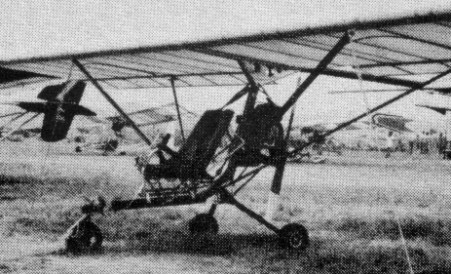
A single seat single engined high wing monoplane with hybrid control circa 1983. Wing has unswept leading and trailing edges, and constant chord. Yaw control by rudder. Control inputs through weight shift for pitch/yaw/roll. The Chtyvnoplat appears from the very sketchy information available to be a Russian equivalent of the Quicksilver E. It differs from the Eipper-formance machine in that the pilot lays prone, but the control system is similar, being primarily weight shift but assisted by a rudder. The high rectangular wing has a large dihedral and a single boom supports the tail, the whole structure being supported in flight by a web of cables of considerable density. The claimed glide ratio is 15 17/1.
Length overall 17.1ft, 5.20m. Wing span 31.5 ft, 9.60 m. Constant chord 4.8 ft, 1.46 m. Total wing area 151 sq.ft, 14.0 sq.m. Wing aspect ratio 6.5/1.
The Kawasaki 440, also called the T/A 440, is a Japanese twin-cylinder, in-line, two-stroke engine that was designed for snowmobiles and produced by Kawasaki Heavy Industries until the early 1980s.
The engine was widely adapted for other purposes, including ultralight aircraft and Formula 500 automobile racing. Kawasaki did not condone or support the use of the engine in aircraft and it was largely supplanted in this role by the similar purpose-designed Rotax 377 aircraft engine.
The engine has two cylinders in an in-line configuration. The single ignition system uses a coil and points. Fuel is metered by a Mikuni 34 mm slide-type carburetor. Starting is by a recoil starter system with electric start as an option.
In its aircraft applications the 440 uses an aftermarket reduction drive system to reduce the maximum 5000 rpm to a speed more manageable for propeller use.
Specifications Type: twin-cylinder, two-stroke engine Displacement: 436 cc (26.61 cu inches) Dry weight: 49 lb (22 kg) Valvetrain: piston ported Fuel system: Mikuni 34 mm slide-type carburetor Oil system: premixed oil and fuel Cooling system: air cooled Reduction gear: aftermarket reduction drive for aircraft use Power output: 38 hp (28 kW) at 5000 rpm
In 1994 the development of the all-metal UL aircraft KP-2U SOVA was started. Three prototypes were built: two for the test flights and one for the strength tests. The first test flight of the SOVA was done in May 1996. In September 1997 the aircraft obtained the type certificate by the UL-2 regulations from the Air Amateur Association of the Czech republic. In June 1977, KAPPA77 a.s. was founded and the KP-2U entered serial production. After the KAPPA 77 a.s. was declared bankruptcy on 16 February 2005, the company Jihlavan airplanes, s.r.o. was founded on 2 March 2005 with the main objective – to proceed in the production of the ultralight aircraft KP 2U SOVA. On 1 April 2005, the Jihlavan airplanes, s.r.o. became the holder of the manufacture rights, intellectual properties, etc. of the KP-2U. Over 160 airplanes of the Kappa KP-2U versions were built. After Jihlavan took over the production of the aircraft it was renamed as the Rapid KP-2U.
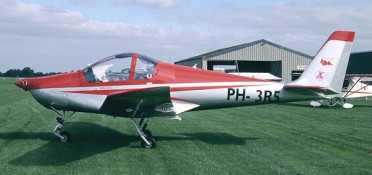
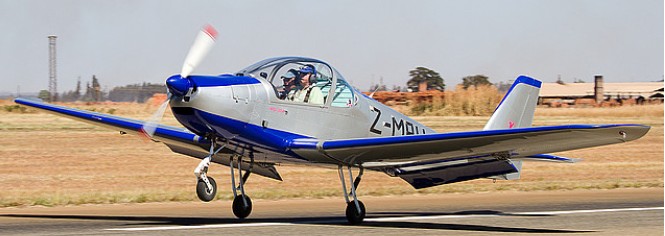
The Kappa KP-2UR Sova is a side-by-side two-seat low-wing ultralight aeroplane, featuring variable-pitch three blade composite prop, retractable trailing link tricycle undercarriage and fowler flaps. The all-metal aircraft is delivered in airworthy condition, with electro-retractable landing gear with hydraulic brakes, mechanically controlled Fowler flaps, removable wings with winglets, dual control and an elevator with electro-controlled trim tab. Both fabric-covered seats are adjustable, with four-point safety belts. 2009 Price: 49000 EURO
KP 2U
The KP 2V SOVA structure is entirely riveted dural tube. The side by side two seater is equipped with retractable undercarriage and Fowler flaps with a GAW 1 profile.
Kappa Ltd was established in 1991 in the Czech Republic. Produces the KP-2U Sova two-seat low-wing lightplane, first flown May 1996. 1998: Brtnica 21 CZ-586001 Jihlava Czech Republic
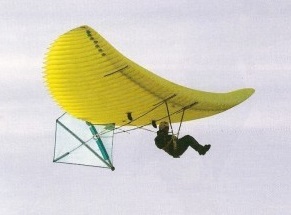
The Kalbermatten Woopy is a Swiss high-wing, single-place, hang glider that was designed by Laurent de Kalbermatten of Villars-sur-Glâne, Switzerland. The price was about 15’000CHF and ready to fly about 10 minute.
The Woopy fuselage is made from aluminum tubing, with a conventional tail, a seated pilot position and weight shift controls. The wing is inflatable and based on the same concept as an air mattress, kept inflated by two small battery-powered fans. Launch and landing is carried out on foot.
Much of the development was undertaken using scale flying models to speed construction and reduce pilot risk. Two models were developed, the Woopy Fly and the Woopy Jump, plus a powered version of the Woopy Fly. The Woopy Fly aircraft was developed in Siberia and can be assembled in 15 minutes, the wing is inflated by two small electric fans underneath the wing, and it is powered by small 20 hp engine.
Variants:
Woopy Fly Initial model Wingspan: 9.7 m (31.8 ft) Aspect ratio: 4.58:1 Wing area: 20.5 sq.m (221 sq ft) Empty weight: 17 kg (37 lb) Glide ratio: 9:1
Powered Woopy Fly Engine: HE R120 120 cc two-stroke, 20 hp Propeller: 70 cm (28 in) Empty weight: 123 lbs (56 kg) MTOW: 240 lbs (109 kg) Cruise speed: 32 kts / 37 mph / 59 kph Stall speed: 23 kts / 26 mph / 43 kph VNE: 40 kts / 46 mph / 74 kph Take-off distance: 197 ft (60 m) Landing distance: 164 ft (50 m) Fuel consumption: 1 GPH (3.8 LPH)
Woopy Jump More portable development model Empty weight: 7 kg (15 lb) Folded length: 160 cm (63 in)
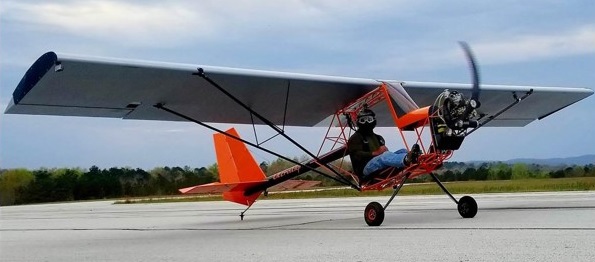
Troy Woodland designed the Just 103 to conform to the FAA Part 103 requirements for ultralight aircraft, including a maximum weight of 254 pounds, a single seat, and a top speed of 63 mph. The new ultralight logged 1.5 hours before heading to the Sun ‘n Fun International Fly-In and Expo. Other than a narrow windscreen, the pilot is very much out in the open air, “which was typical with a lot of earlier Part 103 designs”.
A Polini Thor 250 engine from Italy supplies 37 horsepower at 7,500 rpm, and retails for less than $4,000. Woodland also expected to mount a Rotax 582, which would push the aircraft beyond the ultralight limits and require registration as a light sport or experimental light sport aircraft.
The company was to sell the Just 103 as a kit or ready-to-fly from the factory in Walhalla, South Carolina.
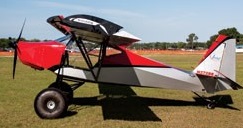
The Just Aircraft SuperSTOL is a classic doped fabric/chrome moly steel frame taildragger with automatically deploying full-span two-segment leading-edge slats, 15-25-40-degree barn door flaps, Rotax 912 power and hydraulic shock-absorbing main gear struts.
The SuperSTOL is based on the Just Highlander. The base price (kit) for the SuperSTOL in 2012 was $36,650 (before engine and avionics), with S-LSA certification underway.

 All Aero