1985: Ron Lang, Lot 7 Whiteside Rd., Officer, Vic., 3089. Australia.
UL builder
1985: Ron Lang, Lot 7 Whiteside Rd., Officer, Vic., 3089. Australia.
UL builder

Founded in 1974 by brothers Gérard Thevenot and Jean-Marc Thevenot, the company was formed to produce versions of the American Seagull hang glider. Their glider was named La Mouette, after which the company was named. In 1979 they produced the La Mouette Atlas which remained in production through 2012 and of which there are over 8000 examples flying.
In 1986 the company started building paramotors and in 1995 introduced the “topless” hang glider, deleting the kingpost and upper flying wires.
1998: 1 rue la Petite Fin, F-21121 Fontaine les Dijon, FRANCE
In 2010-11 the company developed an electric aircraft, the Samson.
The company also built a rigid wing hang glider, the Tsunami and a powered parachute, the Skydancer under the brand Helite. Helite went on to be a company that specializes in air bag designs.
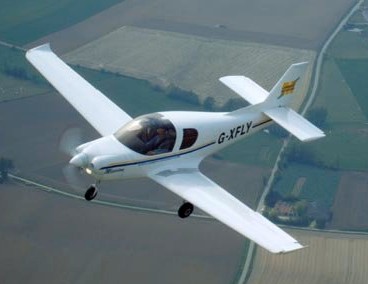
The Mission M212 is a single engine light aircraft of conventional configuration. It has an unswept straight-tapered low wing. The fuselage provides side-by-side seating and has sufficient room to accommodate four adults. In the initial design stages, significant attention was paid to visibility, comfort and ergonomics. The single piece forward hinging canopy provides excellent visibility in level flight as well as in turns. In addition, the clean arrangement ensures a good and water proof seal and keeps aerodynamic noise low. Both the seats and rudder pedals are adjustable. Elevator and aileron control is by sticks. The aircraft is standard equipped with full dual controls.
Control surfaces are conventional with single slotted flaps and an all-moving horizontal tail. The main landing gear consists of a cantilever leaf spring and the steerable nosewheel is of the telescopic oleo-pneumatic type. The airframe is all composite. Construction is mainly of glass fibre and epoxy. Carbon reinforcements are used in spars and longerons where additional stiffness is required.
The development of the Mission M212 started in mid 1992 with a thorough study, which investigated the impact of a light aircraft’s engine on the efficiency of the aircraft as a whole, and which evaluated the potential use of several engines as alternative to the traditional engines.
The project moved to the Cranfield Institute of Technology (now Cranfield University) in October 1992 where the design was started after an extensive market analysis. The specification of the M212-series are mainly based on the results of this market research.
In April 1993 the conceptual design of the Mission was started. A full scale mock-up of the fuselage was built in July 1993 to check for cockpit size, accessibility, visibility and ergonomics. In September 1993 a 1/14 wind tunnel model was built and extensive wind tunnel testing was done during the following months. The conceptual design was completed in January 1994 and the preliminary design in May 1994. Although the Mission was initially not intended for the competition, in the same month, the conceptual design was declared a joint winner in the first stage of the Light Aircraft Design Competition organised by the Royal Aeronautical Society.
The structural design of the Mission was completed by July 1995, after which final drawings were produced. The complete design file of the M212-100, (at that time) the two-seater version, was submitted for the second stage of the Design Competition, and reached a first place.
The construction of tooling was started in January 1996. Fuselage, wing and tailplane plugs were built, of which a set of female moulds were taken. Next, development was concentrated on the wings. All tooling to produce and assemble the components for the wing structure was built.
Concurrently a structural testing programme was set up. Composite materials testing was started early in 1997. Initially work focused on the development and testing of time-saving, reliable and durable manufacturing and assembly methods. Alongside the test work, manufacturing parameters, processes, component lay-up and assembly procedures, quality standards and a quality control system were worked out. In contrast to most proof-of-concept prototypes, the Mission prototype is not a ‘hand carved’ example. Instead all components are produced from production tooling and assembled in the jigs that will be used for series production. In December 1998 a milestone in the development of the Mission was achieved when an assembled wing structure was loaded to the design ultimate load (8.55 g) at 900 kg (2 000 lb), the MAUW (max. all up weight) of the M212-100.
With the prototype wings and control surfaces completed by mid 1999, the work on the fuselage structure was tackled. Again, for all composite parts, moulds were made and an assembly jig for the fuselage was built. The jig ensures correct alignment of the components during assembly. As of July 2001, all structural subassemblies (i.e. wings, fuselage, empennage and control surfaces) were ready for rigging. A jig for matching the wings to the fuselage with the proper incidence and dihedral was built.
While the work on the structure was taking place, the development of the aircraft systems steadily progressed and detail drawings were produced. Subsequently, components for controls and fuel system were manufactured and the subassemblies were ready for installation.
In January 2002, the structural work was finished. With the fuselage standing on the main landing gear, the wings and control surfaces had been rigged and the control systems had been installed. This milestone was celebrated with a roll-out of the Mission M212 prototype on February 8th.
In late February 2002, the firewall forward section was tackled. The engine mount was built. A plug for the cowlings was built, of which female moulds were taken which in turn allowed the cowlings to be made. The prototype was moved to another facility by the end of May for painting. The aircraft was displayed for the first time at the PFA Rally at Cranfield on 21-23 June 2002.
In September and October 2002, structural testing was carried out on the prototype fuselage. Testing was in accordance with FAR-23/JAR-23 airworthiness standards. Stiffness of the structure proved to be very high. Behaviour was entirely to the expectations with no sign of cracks, buckling or wrinkling.
Subsequently the engine was bolted to the engine mount and all accessories onthe engine were installed and connected. Nosewheel steering was also installed. Various improvements were worked out such a redesigned control system for the elevator trim, which meets FAR-23/JAR-23 requirements.
Between December 2002 and June 2003, significant progress was made with installation and completion of various systems and equipment such as cabin heating/ventilation, electrical system, instruments, adjustable front seats and interior. The main landing gear was redesigned to increase its stiffness and raise the maximum landing weight.
Prototype G-XFLY was on display all day on the Grote Markt (Grand Place) in Kortrijk on 25 June, where it attracted lots of attention of public and press. After returning from the PFA Rally 2003, the aircraft moved to Hangar 63 at Kortrijk-Wevelgem airfield for ground testing and preparations for flight testing. With the aircraft now permanantly assembled, further testing was carried out on control systems. Full ground vibration tests were run in February 2004. The aircraft was inspected several times and subsequent improvements or modifications were designed and integrated. The final version of the design work, the test reports and the JAR-23 compliance list was submitted to PFA Engineering, where a massive effort was undertaken to review drawings and double check all the stressing.
On 23 June, the Mission M212 prototype G-XFLY was given a final inspection. That evening, the inspector, Finbar Colson, signed off all paperwork and declared the aircraft fit for flight. All documents were sent to the PFA headquarters, together with the application for a Permit to Test.
The aircraft was trailered to Cranfield where it was prepared for its maiden flight. The Permit to Test came on 7 July, but bad weather prevented us to fly the aircraft before the PFA Rally two days later.
The first flight was made on Tuesday 13 July 2004 with Roger Bailey, test pilot at Cranfield University, at the controls. The flight lasted 40 minutes and the aircraft behaved very much as expected.
During the following months, the Mission M212 prototype was flown from Cranfield for flight testing. Flight testing was concluded in april 2005 with PFA type approval.
Aircraft performance varies with type of propeller fitted. Engines may be limited to 2500 rpm for optimum noise reduction.
Mission M212
Engine: DeltaHawk DH200A4 XP-360, 147 kW (200 HP) at 2700 rpm
Fuel type: Jet Fuel, Diesel
Wing span: 9.80 m (32 ft 2 in)
Wing area: 12.00 sq.m (129 sq.ft)
Aspect ratio: 7.7
Length: 7.40 m (24 ft 3 in)
Height: 2.90 m (9 ft 6 in)
Tailplane span: 3.20 m (10 ft 6 in)
Wheeltrack: 2.80 m (9 ft 2 in)
Baggage capacity: 200 lt (7 cu ft) approx.
Cabin width: 1.12 m (44 in)
Cabin height: 1.25 m (49 in)
Fuel capacity (std): 160 lt (42 us gal)
Fuel capacity (opt): up to 280 lt (72 us gal)
Never exceed speed: 183 kt (338km/h)
Limit load factors: 3.8/-1.9
Empty weight: 735 kg (1620 lb)
Max. all up weight: 1150 kg (2535 lb)
Max. level speed at S/L: 144 kt (268 km/h)
Max. S/L rate of climb: 1020 ft/min (5.1 m/s)
75% cruise at 8000 ft: 141 kt (261 km/h)
60% cruise at 8000 ft: 130 kt (241 km/h)
Range at 75% (std fuel): 655 nm (1215 km)
Range at 60% (std fuel): 760 nm (1410 km)
Range at 60% (opt. fuel): 1360 nm (2520 km)
Fuel flow at 75%: 32 l/h (8.5 us gal/h)
Fuel flow at 60%: 26 l/h (6.8 us gal/h)
Stall speed, full flaps: 53 kts (98 km/h)
T-O ground roll: 250 m (820 ft)
Mission M212
Engine: Lycoming O-360, 133 kW (180 HP) at 2700 rpm
Fuel type: Avgas 100LL, Unleaded mogas
Wing span: 9.80 m (32 ft 2 in)
Wing area: 12.00 sq.m (129 sq.ft)
Aspect ratio: 7.7
Length: 7.40 m (24 ft 3 in)
Height: 2.90 m (9 ft 6 in)
Tailplane span: 3.20 m (10 ft 6 in)
Wheeltrack: 2.80 m (9 ft 2 in)
Baggage capacity: 200 lt (7 cu ft) approx.
Cabin width: 1.12 m (44 in)
Cabin height: 1.25 m (49 in)
Fuel capacity (std): 160 lt (42 us gal)
Fuel capacity (opt): up to 280 lt (72 us gal)
Never exceed speed: 183 kt (338km/h)
Limit load factors: 3.8/-1.9
Empty weight: 722 kg (1590 lb)
Max. all up weight: 1150 kg (2535 lb)
Max. level speed at S/L: 140 kt (260 km/h)
Max. S/L rate of climb: 900 ft/min (4.5 m/s)
75% cruise at 8000 ft: 137 kt (254 km/h)
60% cruise at 8000 ft: 126 kt (232 km/h)
Range at 75% (std fuel): 480 nm (890 km)
Range at 60% (std fuel): 550 nm (1020 km)
Range at 60% (opt. fuel): 1000 nm (1850 km)
Fuel flow at 75%: 42 l/h (11.0 us gal/h)
Fuel flow at 60%: 34 l/h (8.9 us gal/h)
Stall speed, full flaps: 53 kts (98 km/h)
T-O ground roll: 280 m (920 ft)
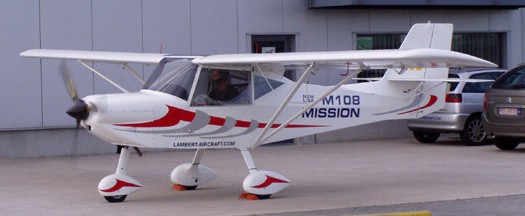
The Mission M108 Light Sport Aircraft is a two seater single engine light sport aircraft. It has an unswept untapered high wing. The fuselage provides comfortable side-by-side seating. Two upwards hinging doors provide access to the cabin. The large transparent areas of the cabin provide excellent visibility in level flight as well as in turns. Both seats are individually adjustable. Elevator and aileron control is by sticks. The aircraft is standard equipped with full dual controls.
The fuselage is a welded space frame, which is fabric covered. High strength steel tubing is used throughout. The wings are of aluminium construction and also fabric covered.
Control surfaces are conventional with single slotted flaps, pushrod operated elevator and cable operated rudder and ailerons. The main landing gear consists of composite cantilever leaf springs. The Mission M108 is available as either a tailwheel or a nosewheel version.
The front mounted ULPower UL260i engine produces 85 HP at 2850 rpm and drives a three blade ground adjustable propeller. The four stroke four cylinder engine is air cooled and features FADEC (Full Authority Digital Engine Control).
With a large choice of options, instruments and avionics, your Mission M108 can be customised to meet your personal preferences.
Depending on the applicable national regulations, the Mission M108 is available as a kit built aircraft or as a ready to fly factory built aircraft.
Mission M108
Engine: ULPower UL260I, 62 kW (85 HP) at 2850 rpm
Wing span: 9.32 m (30 ft 6 in)
Wing area: 11.8 sq.m (127 sq.ft)
Aspect ratio: 7.4
Length: 6.10 m (20 ft)
Height TD: 2.15 m (7 ft 1 in)
Height NW: 1.95 m (6 ft 6 in)
Width wings folded: 2.60 m (8 ft 7 in)
Wheeltrack: 1.75 m (5 ft 10 in)
Max. all up weight: 1320 lbs (600 kg))
Empty weight: 680-700 lbs (310-320 kg)
Fuel capacity: 78 lt standard
Fuel capacity: 110 lt long range
Baggage capacity: 40 kg (90 lbs)
Never exceed speed: 112 kt (210 km/h )
Max. level speed at S/L: 100 kt (185 km/h)
Max. S/L rate of climb: 850 ft/min (4.25 m/s)
Cruise speed: 80-85 kt (150-160 km/h)
Fuel consumption: 12-15 litres/h
Range (20 min res.): 460 nm (850 km)
Stall speed, full flaps: 39 kts (72 km/h)
T-O ground roll: 80-110 m
Max. crosswind TD: 12 kt
Max. crosswind NW: 16 kt
Limit load factors: +3.8/-1.9
Tailplane span: 2.40 m (8 ft 0 in)
Cabin width: 1.08 m (43 in)
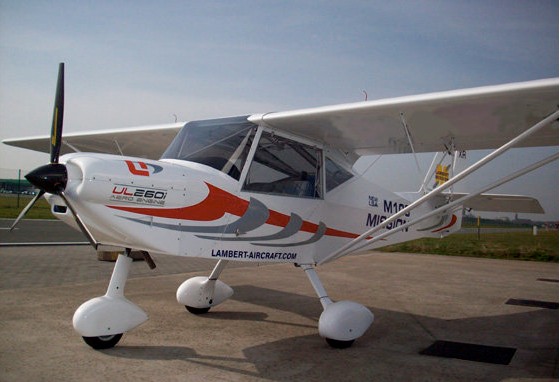
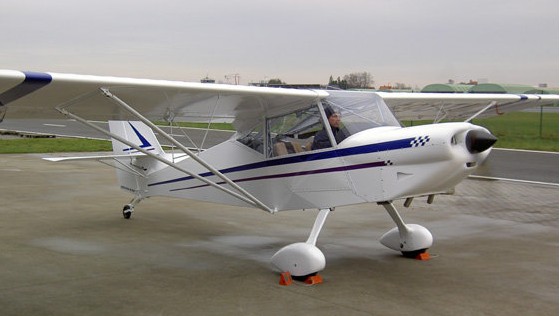
The Mission M106 is a single engine aircraft conventional configuration certified in ULM category in Belgium and France. It has an unswept untapered high wing. The fuselage provides comfortable side-by-side seating. Two upwards hinging doors provide access to the cabin. The large transparent areas of the cabin provide excellent visibility in level flight as well as in turns. Both the seats and rudder pedals are adjustable. Elevator and aileron control is by sticks. The aircraft is standard equipped with full dual controls.
The Mission M106 is available as a factory built Microlight (ULM/UL) category aircraft with tailwheel or nosewheel. It is standard fitted with a UL260i engine and glass cockpit. 2009 Price: 36900 EURO
The fuselage is a welded space frame, which is fabric covered. High strength steel tubing is used throughout. The wings are of aluminium construction and also fabric covered.
Control surfaces are conventional with single slotted flaps, pushrod operated elevator and cable operated rudder and ailerons. The main landing gear consists of composite cantilever leaf springs. The Mission M106 is available as either a tailwheel or a nosewheel version.
The front mounted ULPower UL260i engine produces 82 HP at 2800 rpm and drives a three blade ground adjustable propeller. The four stroke four cylinder engine is air cooled and features FADEC (Full Authority Digital Engine Control).
A ‘glass cockpit’ is standard in the Mission M106. All flight instruments are integrated in the EFIS. Engine instruments are displayed on the EMS. We offer a choice of two instrument panel layouts with displays of different sizes. Optionally, these avionics can be complemented with navigation and communication equipment, such as a GPS with moving map, VHF radio and ATC transponder.
Engine: UL260I, 60 kW (82 hp) at 2800 rpm
Wing span: 9.32 m (30 ft 6 in)
Wing area: 11.8 sq.m (127 sq.ft)
Aspect ratio: 7.4
Length: 6.10 m (20 ft)
Height TD: 2.15 m (7 ft 1 in)
Height NW: 1.95 m (6 ft 6 in)
Width wings folded: 2.60 m (8 ft 7 in)
Empty weight: 260 kg / 573 lb approx.
Max. all up weight: 450 kg / 472.5 kg
Fuel capacity: 78 litres
Baggage capacity: 40 kg (90 lbs)
Max. level speed at S/L: 100 kt (185 km/h)
Never exceed speed: 112 kt (210 km/h )
Cruise speed: 80-85 kt (150-160 km/h)
Fuel consumption: 11-14 litres/h
Range (20 min res.): 380 nm (700 km)
Stall speed, full flaps: 35 kts (65 km/h / 40 mph)
Max. crosswind TD: 12 kt
Max. crosswind NW: 16 kt
Max. S/L rate of climb: 1000 ft/min (5 m/s)
Glide Ratio: 9
T-O ground roll: 80-110 m
Take-off distance (50ft obstacle): 920 ft / 280 m
Landing distance (50ft obstacle): 980 ft / 300 m
Cabin width: 1.08 m (43 in)
Tailplane span: 2.40 m (8 ft 0in)
Wheeltrack: 1.75 m (5 ft 10 in)
Limit load factors: +4.0/-2.0
Lambert Aircraft Engineering manufactures a range of light aircraft, marketed under the name Mission. Mission aircraft are developed to modern standards and intended for general aviation. The aircraft are primarily intended for flight training and recreational flying.
2011: Lambert Aircraft Engineering bvba
Hangar 59, Wevelgem Airfield
B-8560 Wevelgem
BELGIUM

A US designed two seat aircraft built in Australia by Lake Macquarie Aviation. The aircraft, powered by either a Rotax 532, 582 two stroke or 912 four stroke (79hp). Specifications include a useful load of 225 kg, a gross weight of 429 kg, a cruise of 90 knots, a 1000 fpm ROC and a take off distance a 100 ft.
1991: Lake Macquarie Aviation, PO Box 200, Broadmeadow, NSW, Australia.
LSA builder
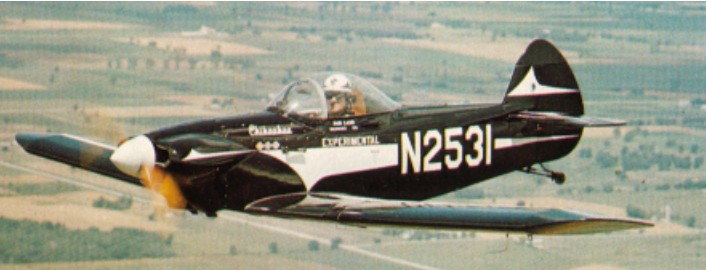
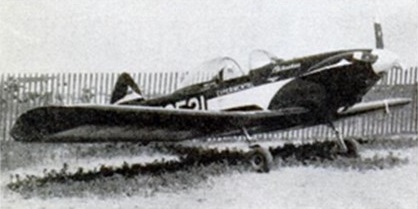
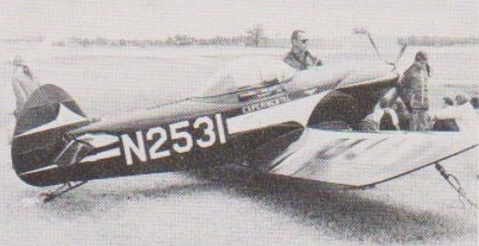
Built by Robert Ladd in 1967, the Taylor Chihuahua single place, enclosed low wing monoplane, was developed from the British John Taylor monoplane. One was built, N2531, was first flown in September 1967.
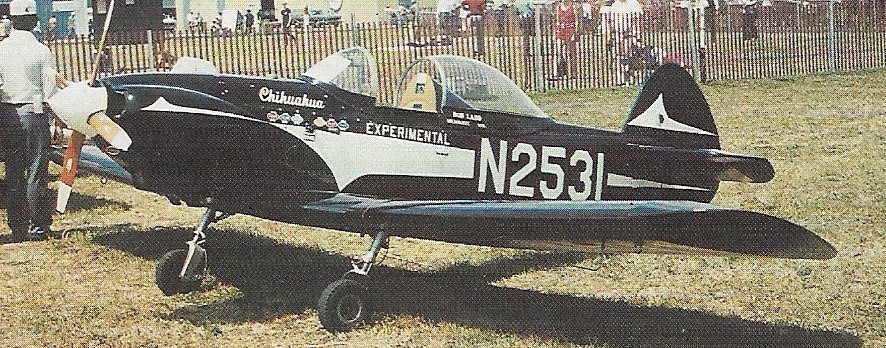
Engine: 53hp VW
Wingspan: 21’0″
Length: 15’6″
Cruise speed: 118 mph
Stall: 60 mph
Range: 250 mi
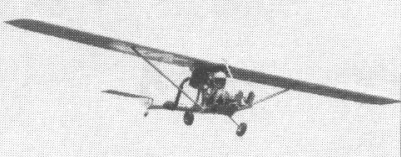
The Hitchiker is the third ultralight design from Robert Labahn and it is designed for cross-country and short field operations. With a rigid wooden wing sporting full span flaperons having both positive and negative selling, the light weight Hitchiker easily fits the bill. The pilot’s seating is reclining, glider like, to present the smallest possible frontal area. A streamlined pod will be fitted in the colder months for pilot protection.
Engine: Rotax 277 geared drive.
Prop: 127 cm x 96cm pitch.
Wing span: 8.05 m.
Weight: 100 kgs.
Fuel capacity: 27 ltr.
Econ cruise speed: 43 kts.
Stall: 23 kts.
Construction time: Ready to fly.
 All Aero