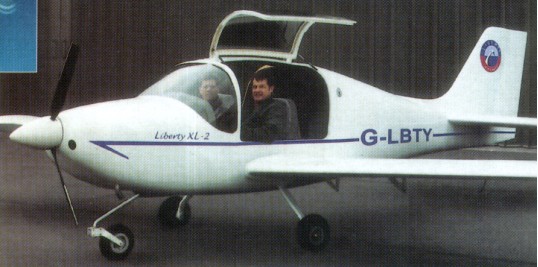
The Liberty XL-2 two-seat touring airplane. The XL-2 was designed by the same team that created the Europa kitplane. The tri-gear Liberty features a composite fuselage and bonded aluminum wing. Fuel is carried in a fuselage tank behind the cockpit. Liberty will certify the XL-2 in the normal category with ap-proval for night and IFR flight.
The XL2 is constructed using the same Toray composites used for the Boeing 787, providing both light weight and exceptional durability and performance. Our fuselage weighs only 70 pounds, but is stronger than a comparable aluminum fuselage, contributing to the exceptional performance and fuel efficiency of the XL2.
The XL2 has three major components – the fuselage, a rolling chasis, and the wings, that come together to efficiently manufacture a high technology aircraft. The wings of the aircraft are removable in about 10 minutes by a licensed mechanic, enabling multiple aircraft to be stored in a small hangar footprint for flight schools in the event of severe weather.
The wing can be folded by one person in about a minute, allowing the airplane to be trailercd to and from the airport and to he stored in a one-car garage. That wing, however, will not be on the first XL-2s, because of cerfi¬fication delays such a feature might cre¬ate. The Liberty XL2 first flew on April 2, 2001.
Scaled Technology Works of Mon¬trose, Colorado, was to do much of the manufacturing and assembly of the air¬plane.
Using a carbon fiber fuselage, advanced FADEC equipped engine to optimize performance, and advanced avionics, the Liberty XL-2 was awarded FAA Part 23 IFR type certification on February 19, 2004
This two-seater was the first aircraft to be certified with FADEC, or Full Authority Digital Engine Control. A single lever combines throttle and mixture allowing a computer to control ignition and fuel injection, as well as other vital engine parameters. The aircraft owes much of its design history to the Europa kit plane, though the metal winged, all-composite fuselage XL2 has evolved considerably.
In 2007, Liberty signed a contract with Anyang Angel Aero in Beijing, Peoples Republic of China to produce 600 Liberty XL-2 aircraft under license.
On February 27th, 2008, the 100th Liberty XL-2 was delivered.
In April 2008, the Vanguard Edition XL-2 was introduced, with increased gross weight, a 420 lb. useful load with full fuel, and toe, rather than finger brakes. All aircraft after serial #120 will be Vanguard Edition aircraft.
The undercarriage is fixed tricycle with a spring steel nose gear with castoring wheel. The spring aluminum main gear has differential brakes
Liberty XL2
Engine: Rotax 912S, 100 hp.
Fuel cap: 20 USG.
Cruise: 120 kts.
Range: 500 sm.
Liberty XL2
Seats 2
Gross wt. 1,653 lb
Empty wt. 1,065 lb
Fuel capacity 29.5 USG
Engine 125-hp Continental IOF 240-B (FADEC)
Top Cruise 132 kts
Stall 43 kts
Initial climb rate 682 fpm
Range 500 nm
Takeoff roll 822 ft
Landing roll 841 ft
2006 Liberty XL-2
Base price 2009: $159,900
Engine: Continental IOF-240, 125 hp
TBO: 2000 hr
Fuel type: 100/100LL
Propeller: 2-blade, FP Sensenich
Landing gear: Tri./Fixed
Max ramp weight: 1653 lb
Gross weight: 1653 lb
Landing weight: 1653 lb
Empty weight, std: 1065 lb
Useful load, std: 588 lb
Payload, full std. fuel: 420 lb
Useful fuel, std: 28 USgal
Wingspan: 28 ft. 9 in
Overall length: 20 ft. 4 in
Height: 7 ft. 5 in
Wing area: 112 sq. ft
Wing loading: 14.8 lbs./sq. ft
Power loading: 13.3 lbs./hp
Seating capacity: 2
Cabin doors: 2
Cabin width: 48 in
Cabin height: 46 in
Wheel track: 70.3 in
Wheel base: 57.2 in
Baggage capacity: 100 lb
Cruise speed 75% power: 132 kt
Cruise speed 60% power: 120 kt
Max range 75% power: 450 nm
Max range 55% power: 500 nm
Fuel consumption 75% power: 6.0 USgph
Fuel consumption 60% power: 5.3 USgph
Stall speed (flaps up): 50 kt
Stall speed (flaps down): 43 kt
Best rate of climb (SL): 682 fpm
Service ceiling (ft.): 14,000
Takeoff ground roll: 750 ft
Takeoff over 50-ft. obstacle: 1250 ft
Landing ground roll: 750 ft
Vanguard
Engine: Teledyne Continental IOF-240-B: 125 hp at 2,800 RPM
Propeller: 2-Blade MT Propeller 69″ / 1.75 m diameter, Fixed Pitch
Overall Height (max) : 7′ 5″ / 2.26 m
Overall Length : 20′ 3.8″ / 6.19 m
Wing Span (overall): 29 ‘ / 8.76 m
Area: 112 ft / 10.41 sq.m
Aspect Ratio: 7:1
Cabin Height (max): 34″ / 0.86 m
Cabin Length (firewall to aft baggage area): 91.9″ / 2.33 m
Cabin Width: 48″ / 1.22 m
Fuel: AvGas 100LL / 100
Fuel Capacity: 29.5 US Gal / 111 L
Total usable fuel: 28 US Gal / 106 L
Baggage Allowance : 100 lbs / 45 Kg
Standard Empty Weight : 1165 lbs / 529 Kg
Max. T/O Weight: 1750 lbs / 794 Kg
Useful Load : 588 lbs / 265 Kg
Landing Weight: 1750 lbs / 794 Kg
Full Fuel Payload: 417 lbs / 189 Kg
Ground roll: 1472 ft / 448 m
Total distance over 50 ft obstacle: 2,564 ft / 781 m
Landing Ground roll: 708 ft / 215 m
Total distance over 50 ft obstacle: 1,453 ft / 442 m
Rate of Climb, Sea Level: 669 ft/min
Best Rate of Climb: 76 kts / 87 mph / 141 kph
Best Angle of Climb: 69 kts / 79 mph / 127 kph
Maximum Operating Maneuvering Speed: 103 kts / 119 mph / 191 kph
Maximum Flap Extended Speed: 86 kts / 99 mph / 59 kph
Maximum Takeoff Flap Extended Speed: 90 kts / 104 mph / 167 kph
Maximum Structural Cruising Speed: 122kts / 140 mph / 226 kph
Never Exceed Speed: 157 kts / 180 mph / 291 kph
Stall Speed, IAS Flaps up / Vs / Clean: 50 kts / 58 mph / 93 kph
Stall Speed, IAS Flaps down / Vso / Dirty: 44 kts / 51 mph / 81 kph
Cruise Range (30 min Res – 65% Power): 505 nm / 935 km
Maximum Range (55% Power): 588 nm / 1,089 km
Max Cruise at Sea Level: 125 kts / 144 mph / 152 kph
Economy Cruise – 55% Power: 105 kts / 121 mph / 194 kph
Economy Cruise – 55% Power: 5.1 hrs
Economy Cruise – 55% Power Range: 535 nm / 990 km
Cruise – 65% power: 113 kts / 130 mph / 222 kph
Cruise – 65% power: 4.4 hrs
Cruise – 65% power Range: 497 nm / 920 km
Cruise – 75% power: 120 kts / 138 mph / 240 kph
Cruise – 75% power: 3.7 hrs
Cruise – 75% power Range: 444 nm / 822 km
Fuel consumption @ 55% Power: 4.7 US gph / 18.9 lph
Fuel consumption @ 65% Power: 5.5 US gph / 20.8 lph
Fuel consumption @ 75% Power: 6.5 US gph / 23.5 lph
Power Loading: 14.00 lb/hp
Service Ceiling : 12,500 ft / 3,350 m
Max. Demo Crosswind: 15 kts / 17 mph / 28 kph
Wing Loading: 15.63 lb/sq.ft
2009 Liberty XL-2 Vanguard Edition
Base/Used Price: 2009 $188,000 (includes standard IFR with Garmin 430 and SL 40)
Price with Aspen Evolution Pro PFD and Garmin 530 upgrade: 2009 $212,000
Engine: 4-cylinder TCM IOF-240-B with FADEC
Horsepower: 125 hp@2800 rpm
Fuel type: 100/100LL
Propeller type/diameter: 2-blade, fixed-pitch, 69-inch MT propeller wood/composite core
Landing gear type: Tri./Fixed
Max ramp weight: 1750 lb
Max takeoff weight: 1750 lb
Landing weight: 1750 lb
Empty weight, std: 1165 lb
Useful load, std: 588 lb
Usable fuel, std: 28 USgal
Payload, full std. fuel: 420 lb
Wingspan (ft): 29
Overall length: 20 ft. 3.8 in.
Overall Height: 7 ft. 5 in
Wing area: 112 sq. ft
Wing loading: 15.63 lbs./sq. ft
Seating capacity: 2
Cabin width: 48 in
Baggage capacity: 100 lb
Cruise speed 75% power: 120 kt/138 mph
Cruise speed 65% power: 113 kt/130 mph
Cruise speed 55% power: 105 kt/121 mph
Fuel consumption 75% power: 6.5 USgph
Fuel consumption 65% power: 5.5 USgph
Fuel consumption 55% power: 4.7 USgph
Max range 75% power: 444 nm
Max range 65% power: 497 nm
Max range 55% power: 535 nm
Vso: 44 kt
Best rate of climb, SL: 669 fpm
Service ceiling: 12,500 ft
Takeoff ground roll: 1472 ft
Landing ground roll: 708 ft
Max demo crosswind: 15kt

 All Aero