1997: 1121 Lewis Ave, Sarasota, FL 34237, USA.
2009: Windex AB, Lucernavägen 9, 593 50 Västervik, Sweden
LSA motor-glider builder
1997: 1121 Lewis Ave, Sarasota, FL 34237, USA.
2009: Windex AB, Lucernavägen 9, 593 50 Västervik, Sweden
LSA motor-glider builder
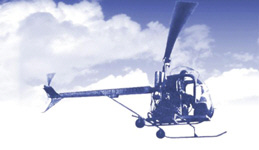
The Aeros is a Single Seat homebuilt helicopter. The plans manual offers pages of highly detailed construction prints, photos and assembly instructions to guide the builder.
This single-seat helicopter can be built in a well-equipped home shop. It features a bolt-together main frame and a standard helicopter control system: full collective with a twist-grip throttle, full cyclic and foot-operated tailrotor pedals. For low-cost and reliability, the drive train utiliizes a converted VW car engine and a primary belt drive that leads to a geared transmission with VW gears. The belt-driven tailrotor is high-mounted to minimize the rolling moment caused by tailrotor thrust. A number of weight-saving features have gone into the design Aeros, including a simple, but attractive monocoque tailboom. The Aeros is licensed as an Experimental Aircraft.
The Guidebook covers, with clear, illustrated explanations, how helicopters work, the various considerations that go into their design, main and tailrotor aerodynamics, control-system operation, and a glossary of terms. Then, fully illustrated with photos and detailed specifications, is a presentation of what is currently available to the helicopter hobbyist in the form of kits and plans. A comprehensive list includes sources of engines, metals, AN hardware, cables, controls, rotorblades, instruments, and the regulations you need to know.
The Aeros is capable of vertical take-offs and landings; hovering; forward, backward and sideward flight. In the event of engine failure, the Aeros can autorotate to a safe landing.
Length: 18 ft.
Height: 7 ft.
Width: 5 ft.
Main rotor dia: 22 ft.
Main rotor chord: 8 in.
Main rotor rpm: 450
Disc loading: 2.5 lb/sq ft
Tail rotor dia.: 40 in.
Tail rotor chord: 3.5 in.
Tail rotor rpm: 3200
Empty weight: 544 lbs.
Useful load: 356 lbs.
Speed (max): 85 mph
Range (max): 65 miles
Engine: Volkswagen
Horsepower: 95+
Power loading: 9 lbs/hp
Fuel capacity: 12 gal.
Fuel consumption: 4 gph
Altitude (max): 12000 ft
1998: 1208 H East Walnut St, Santa Ana, CA 92701, USA
Wills Wing
500 W. Blueridge
Orange CA 92865
USA
Hang glider builder
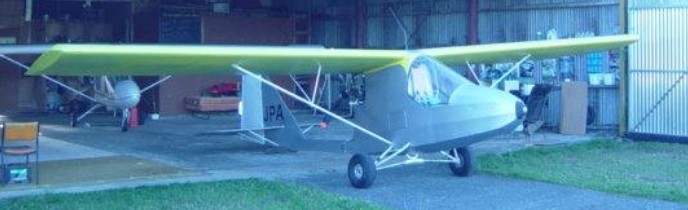
As the designation infers, the Williams Mk.4 is the fourth aircraft from the hands of the late Geoff Williams, a well-known Otago identity who did not like to conform to the rules. It was finished about 1990, first flew in 1991 and had logged over 160 illegally flown hours prior to its sale to Bob Gibson in June 2002. This aircraft was legally registered as ZK-JPA on 25 February 2003.
Geoff Williams never flew again after the third aeroplane, but resolved to build a fourth aircraft. This is the aircraft Bob Gibson bought. This plane was not difficult to fly he did have a few minor landing faults.
Geoff’s ambition was to fly his aeroplane around Fiordland coastline, landing at somewhere like Jackson’s Bay for refuelling and to this end he built a heated cabin and fuel capacity of over 100 litres and a locker where he could hold an additional 10- or 15-litre can. Sadly this was never to be realised as Geoff became ill March 2002 and died on 10 May 2002. It was Geoff’s wish that his plane be kept flying, and Bob seemed to be the person most interested.
Wingspan: 30 ft
Engine: Rotax 447
Prop: 3-blade Warp Drive
Cruise: 60 kts
Stall: 22 kts
Seats: 1
ROC: 500 fpm
Fuel burn: 12 lt/hr
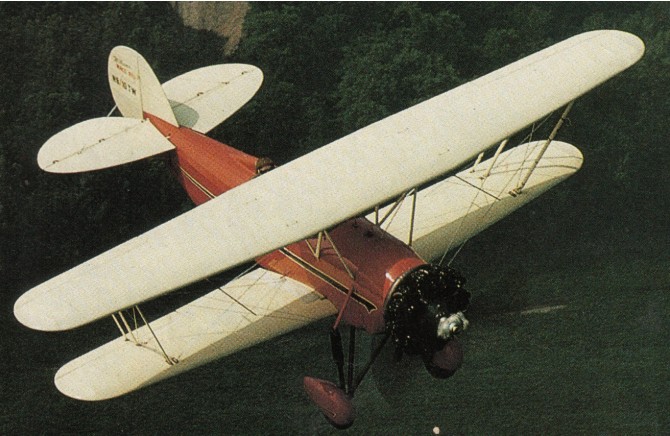
An 80% scaled replica version of the Waco ATO. Construction began in May 1983.
The four wing panels are identical but required 48 ribs built during 1983. Each panel contains 12 truss type spruce ribs, and the 6 foot centre section has nine constant chord ribs. The wings retain the original M-6 profile. The chord of the centre section ribs is 4 ft 1.5 in, and outboard ribs 2 ft 10.5 in. The spars are solid planks, the forward being 5 x 11/8 in and the rear spar 4 x 1 inch. The four ailerons each have six ribs and are equal span and chord. The wings are braced with dual straight 4130 steel outboard struts and N centre section struts, and streamlined stainless steel wires. The fuselage and tail components are welded 4130 with wood formers and stringers in the fuselage and wood fairings at the fin and stabiliser roots.
The tail spans 8 ft 10 in and rudder stands 3 ft 3 in. Rudder and aileron are cable controlled and the elevator through torque tubes. The main undercarriage is a welded outrigger type with Cleveland brakes, and a 5 ft 2 in tread. A Scott 3200 tailwheel holds an 8 inch tyre.
The first flight was in August 1987. Total cost: approx US$15,000.
Engine: Warner Super Scarab, 165-175 hp
Prop: Aeromatic 85 in
Seats: 2
Empty wt: 1085 lb
Loaded wt: 1630 lb
Wingspan: upper 24 ft lower 22 ft
Length: 18 ft
Height: 7 ft 2 in
Fuel cap: 31 USG
ROC 2500 fpm @ 70 mph
Cruise 65%: 105 mph
Stall: 55 mph
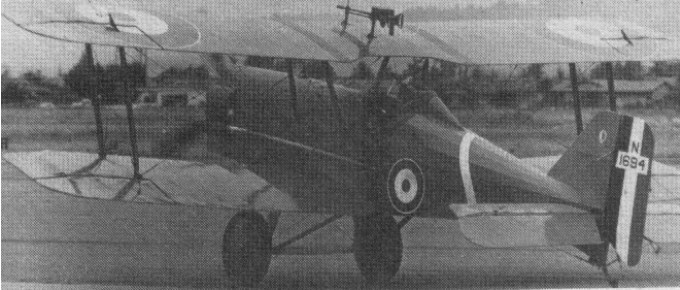
This little single-seat biplane is a 4/5 scale model of the famous British S.E.5A fighter of World War I. Designed by William Wienberg of Kan¬sas City, Missouri, it is constructed of wood and fabric. The wing structure consists of conventional wooden spars and ribs with center-section bracing struts and fabric covering. The fuselage is an all-wood box structure covered with plywood. The tail assembly is a wire-braced steel tube structure also covered with Ceconite fabric. Accom¬modations include a single-seat cockpit and a small baggage com¬partment behind the headrest.
Gross Wt. 1100 lb
Empty Wt. 900 lb
Fuel capacity 24 USG
Wingspan 22 ft
Length 18 ft
Top speed 95 mph
Cruise 85 mph
Stall 50 mph
Climb rate 600 fpm
Takeoff run 200 ft
Range 250 sm
A single-seat monoplane with enclosed cockpit.
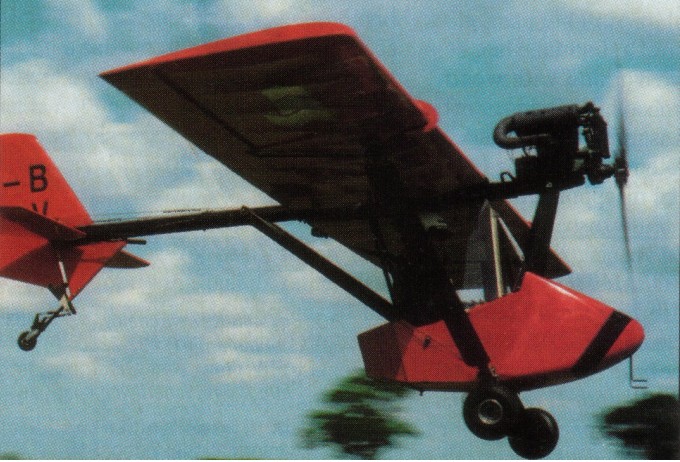
The MW-7 is a scratch-built only, single seat, aerobatic microlight. Designed in 1986, the wing area was too small for the UK ultralight category. Construction is tube and fabric. The wings can be folded. Designed to meet British section PPL-A requirements in accordance with ARB paper 98 aerobatic requirements.
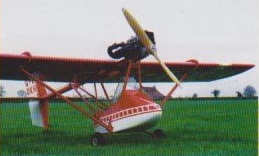
By 1998 ten examples had flown.
Plans were being sold be the Vintage Ultralight Association.
Engine: Rotax 503, 52 hp
HP range: 52-65
Length: 15 ft
Wing span: 22 ft
Wing area: 88 sq.ft
Empty weight: 320 lb
Gross weight: 600 lb
Fuel capacity: 5-10 USG
Vne: 110 mph
Cruise: 55 mph
Stall: 35 mph
Rate of climb: 800 fpm
Takeoff dist: 150 ft
Landing dist: 125 ft
Service ceiling: 15,000 ft
Seats: 1
Landing gear: tailwheel
LSA: yes
Engine: Rotax 503, 50 hp
Wing span: 6.70 m
Wing area: 8.20 sq.m
MAUW: 273 kg
Empty weight: 145 kg
Max speed: 185 kph
Cruise speed: 120 kph
Minimum speed: 65 kph
Climb rate: 5.1 m/s
Seats: 1
Plan price (1998): £60
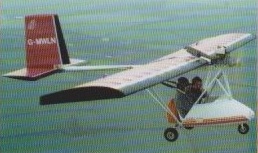
A two-seat version of the MW5, the MW6T Merlin seats two in tandem, and the MW6S Fatboy Flyer seats two side by side. Both are tube and fabric.
Engine: Rotax 503, 50 hp
Wing span: 9.98 m
Wing area: 15.24 sq.m
MAUW: 390 kg
Empty weight: 190 kg
Max speed: 148 kph
Cruise speed: 102 kph
Minimum speed: 56 kph
Climb rate: 2.5 m/s
Seats: 2
Certification: PFA
Plan price (1998): £65

A single-seat monoplane ultralight, kits were available but by 1998 plans only were sold.
Engine: Rotax 447, 42 hp
Wing span: 8.54 m
Wing area: 11.2 sq.m
MAUW: 285 kg
Empty weight: 145 kg
Max speed: 148 kph
Cruise speed: 102 kph
Minimum speed: 56 kph
Climb rate: 3.0 m/s
Seats: 1
Certification: PFA
Plan price (1998): £65
 All Aero