Aer Lualdi L.59

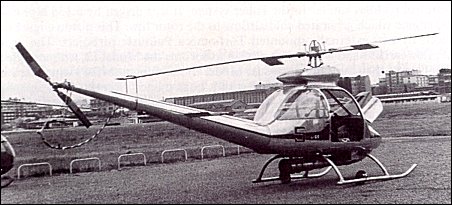
The L.57 flight testing has proved so satisfactory that it forms the basis for the fully-developed L.59, with more powerful engine and metal rotor blades. The L-59 had more extensive cockpit transparencies and a 260hp Continental IO-470-D engine. A four-seat light general-purpose helicopter with a two-blade main rotor of metal construction, built by Parsons and of the type fitted to the Hiller UH-12C helicopter. Cyclic pitch control is of Hiller “Rotor-Matic” type with Lualdi gyro-stabilizer. The L.59 has a two-blade reinforced plastic tail rotor. The all-metal fuselage has four seats in two pairs, with dual controls for the front pair, and car-type door on each side. The undercarriage was of two tubular metal skids with upturned forward ends and wheels for ground handling (stored under the boom, forward of the tail rotor).

The nose mounted engine exhausted through a central exhaust under the fuselage, between the skids. Fuel was in a pair of tanks mounted side-by-side above the cabin on each side of the rotor pylon on pylons. Provision was made for the addition of a rescue hoist and carriage of two litters.

Two L.59 prototypes were constructed by Macchi at Varese with technical assistance from Sud Aviation. A test flight programme was flown from 1960 and the commercial type certificate was issued in August 1961 but the programme was terminated as more capable helicopters had become available.
The first prototype (I-GOGO – later MM576) was bought by the Italian army’s air corps for evaluation as an observation platform and was later transferred to a museum.

L-59
Engine: Continental IO-470-D, 260 hp
Main rotor dia: 34 ft 9.5 in / 10.6m
Fuselage length: 29 ft 9.5 in / 9.08 m
Height: 9 ft 10 in / 3m
Main rotor disc area: 949.92 sq.ft / 88.25 sq.m
Tail rotor dia: 1.70m
Payload: 380kg
Empty weight: 1631 lb / 740 kg
MTOW: 2646 lb / 1200 kg
Max speed: 99 mph / 160 kph
Cruise speed: 86 mph / 139 kph
Initial ROC: 820 fpm / 250 m/min
Absolute ceiling: 19,355 ft / 5900 m
HIGE: 9515 ft / 2900 m
HOGE: 5575 ft / 1700 m
Endurance: 3 hr 30 min
Fuel capacity: 110kg
Seats: 4
Skid track: 2.40m.
Aer Lualdi L.55

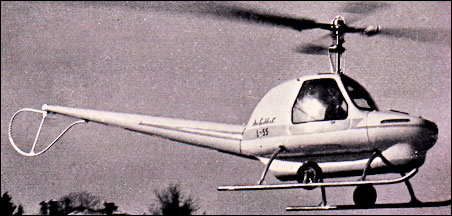
Aer Lualdi were appointed agents and licencees for Hiller in Italy, and the rotor system pioneered with the ES 53 became a feature of each of their subsequent designs. The first of these was the all-metal L.55, which introduced a fully-streamlined fuselage with stressed-skin tailboom and was powered by a 180hp Lycoming engine mounted in the nose and driving a rotor pylon which was carried in a housing in the centre of the cabin.
Experience with the L.55 prototype led to construction of an improved model, designated the L.57.

Engine: Lycoming O-360, 180 hp
Seats: 2

Lualdi-Tassotti ES 53

Aer Lualdi flew its first experimental helicopter, designated the ES 53, at Campoformido in September 1953, powered by an 85hp Continental engine. The ES 53 incorporated the “Rotor-Matic” rotor system designed by Hiller Aircraft Corp. supplemented by a Lualdi gyroscopic system which was claimed to ensure smoother flight and easier handling qualities.
Subsequently, Lualdi were appointed agents and licencees for Hiller in Italy, and the rotor system pioneered with the ES 53 has been a feature of each of their subsequent designs. The first of these was the L.55.

Engine: Continental, 85 hp
Rotors: 2 x 2-blade co-axial
Rotor diameter: 24 ft
Cruising speed: 75 mph
Seats: 1

Aer Lualdi & C S.p.A.

Aer Lualdi & C S.p.A was founded in 1953 for the design, development and production of Italian helicopters designed by Carlo Lualdi but based on the Rotor-Matic type of main rotor patented in the USA by Hiller Aircraft Corp. Aer Lualdi soon became the licensee for this rotor system. The first Italian helicopter to fly with this type of rotor was the Lualdi-Tassotti ES 53.
Aer Lualdi ceased trading during 1963-4.

Aeris Naviter AN-2

A two seater, piston engine helicopter with a fully articulated coaxial rotor system. First introduced on 1/1/2011, the price (2012) was US$130000.

Engine: Lycoming IO 233 LSA, 115 hp
Rotor Diameter: 22.9 ft
Number of rotor blades: 4
Number of tail rotor blades: 0
Length: 17.3 ft
Height: 11.3 ft
Fuselage width: 2.6 ft
Gross Weight: 1320 lb
Empty Weight: 860 lb
Useful Load : 460 lb
Max. Range: 466 mi
Cruise Speed: 93 mph
Maximum Speed: 105 mph
Service Ceiling: 15000 ft
Seats: 2

AEG Helicopter

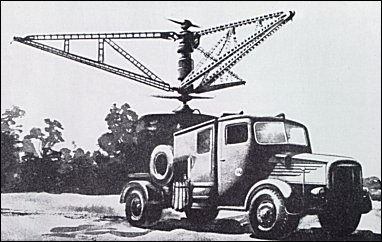
The A.E.G. helicopter designed by R. Schmidt was attached to the ground by a system of three tethering cables which helped to stabilise. R. Schmidt worked from about 1933 and this work was finalised in 1940 in the shape of a tethered electric helicopter for use as an aerial observation or support post for the army.
The helicopter had two two-blade rotors mounted co-axially, one being attached to the shaft and one to the shell of an electric motor. Three fixed arms were attached above the upper rotor, and these arms not only supported the cabin below but served as the cable attachment points for tethering. In the event of engine failure, the observer escaped by using a parachute blown into the air by a powder charge.
The three tethering cables were also used to feed power to the motor from a ground source via the control panel located in the launching and transporting truck. It was driven by electric motors of 50, later 100 and 200 horsepower and had a lift ranging from 450 to 1250 kilograms. Despite successful trials, the AEG helicopter does not appear to have been adopted for military use.

Engine: 1 x 200hp electric motor
Rotor diameter: 7.92m
Weight fully loaded: 1225kg
Ceiling: 1000m
Seats: 1

Adams-Wilson Model 101 Hobbycopter / Model 102 Hobbycopter / XH-1 Hobbycopter

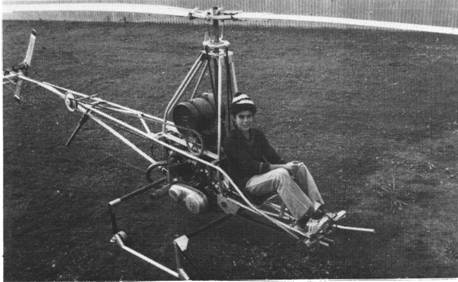
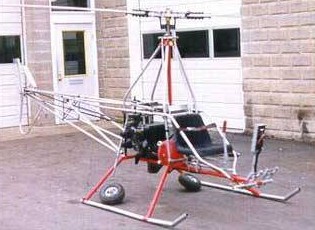
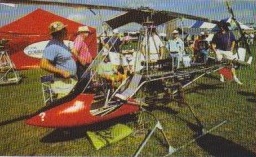
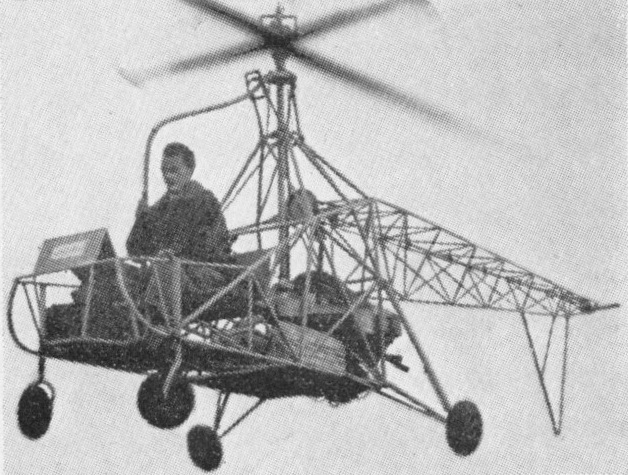
This company was formed by Mr. T.G.Adams and Mr. Paul Wilson to market plans the single-seat helicopter named the HobbyCopter, of which they have built a prototype, N23P, with a 34 hp engine.
The company also supplies kits of parts for the Hobby-Copter sold as a kit to amateurs as the Model 101 Hobbycopter, offered in kit (US$900) or plan (US$35) The subsequent Model 102 had a strengthened structure, 50hp Triumph engine and fibreglass cockpit shell.
First flown in November 1958, this single seat fully fledged helicopter was powered by a motor cycle engine, rubber mounted and fitting into the frame with no modifications – including starting procedures.
Powered by a 40-46hp Triumph 650cc motorcycle engine, the engine, as in its original mount, is kick-started. Fuel is in a single tank above engine with a capacity of 11.4 litres. Oil capacity is 3.8 litres.
When the run-up is complete and ready for takeoff, the pilot engages gear through the motorcycle gearbox — the power being transmitted through a one-way drive to the main rotors and by a vee-belt to the tail rotor.
An open air machine, the helicopter utilises skids and features a 22 foot laminated spruce wooden main rotor of NACA 0012 aerofoil section (chord 0.20m) and a formed aluminium two ¬bladed tail rotor.
Cyclic and collective pitch are controlled by a swash-plate.
The rotor drive involves engine-to-gearbox by chain; gearbox-to-main rotor by direct shaft; gearbox-to-tail rotor by belt. The main rotor rpm in flight is 360, and tail rotor rpm in flight 1,800.
The fuselage is all aluminium tube structure, bolted together, with tubular skids, with retractable ground-handling wheels. A single fiberglass bucket seat is ahead of the rotor drive shaft.
The plans are all to aircraft specifications and the structure is bolted together. The main lift bearing is designed to take six tons.

XH-1 HobbyCopter
Engine: 850cc Norton
Main rotor dia: 22 ft / 6.55m
Tail rotor dia: 0.94 m
Fuselage length: 4.27 m
Width: 1.52m
Height: 1.83m
Empty wt: 335 lb
MAUW: 600 lb / 252kg
Weight empty, equipped: 161kg
Max speed: 72 mph / 96km/h
Max cruise: 72km/h
Econ cruising speed: 64km/h
Service ceiling: 2440m
Max range: 193km
Fuel burn: 1.5 USG/hr
Seats: 1

AB Helicopters A/W 95

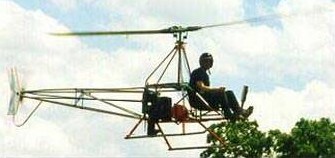
A single-seat open-frame helicopter, Doug Schwochert’s adaptation of the Adams-Wilson design included a re-designed main and tailrotor-swash plate and main frame. Plans include over 100 pages of CAD drawings and photos. The rotor blades are from A-B Helicopter, and are all aluminum extruded spar with full length aluminum skins bonded and riveted.
The A/W 95 features of true helicopter vertical take-off & landing, and forward, backward, sideward & hover flight, with standard helicopter-type control system.

Improvements on the original Adams-Wilson design include a higher power-to-weight engine, improved, more durable swash plate and tail rotor system and updated airframe design. Now powered by a Rotax 503, the drive of the rear rotor has been redesigned and the rotor head reinforced to take extruded dural blades.

Now powered by a Rotax 503, the drive of the rear rotor has been redesigned and the rotor head reinforced to take extruded dural blades.

Engine: Rotax 503, 52 hp
Rotor span: 5.94 m
Blade area: 0.178 sq.m
MAUW: 222 kg
Empty weight: 120 kg
Cruise speed: 97 kph
Minimum speed: 0 kph
Fuel consumption: 15 lt/hr
Seats: 1
Plan price (1998): $79

Engines: 52 hp Rotax 503 or larger (2-cycle only)
HP range: 50-75
Engine rpm: 6200-6500
Rotor Diameter: 19 ft 5 in / 5.94m
Rotor blade chord: 7 in / 17.78cm
Airfoil: .0012
Main rotor rpm: 435-450
Tail rotor diameter: 3 ft 4 in / 102 cm
Tail rotor rpm: 2800
Min Speed: Hover
Cruise: 55-60 mph
Top Speed: 65 mph
Empty Weight: 272 lb / 123 kgs
Useful Load: 225 lbs / 102 kg
Gross Weight: 497 lb / 222 kg
Width: 5 ft 9 in / 175 cm
Height: 6 ft 5 in / 196 cm
Length: 15 ft / 4.57m
Fuel capacity: 5 USG
Endurance: 1 hr
Ceiling: 10,500 ft