Aerospace General Corporation of Odessa, Texas produced series of strap-on and sit-on single-seat helicopters under the Mini-Copter name.
Helicopters
Aeronautical Products A-3
The NX1272 Model 3 of 1944 fuselage was of fabric-covered welded steel tubing, and resembled that of a light aircraft with the engine located in the forward section and placed horizontally forward of the cabin.
Power from the engine, cooled by a fan mounted directly above it, was transmitted by pulleys and vee belts to a horizontal main drive shaft, then through a bevel gear drive to the main rotor shaft which passed between the pilot’s and the passenger’s seats.
Mounted on the vertical rotor drive shaft was the main gearbox for the tail shaft operating the two-bladed anti-torque rotor, with a diameter of 1.71 metres, the pitch of which was controlled by rudder pedals. This rotor’s maximum rotational speed was 1200 r.p.m.
The three blades of the main rotor were made with tapered tubular spars and also connected to the root spars by a double-action hydraulic shock absorber.
Cyclic pitch control was obtained by a hanging stick while on the engine throttle support was the collective pitch control.
The A-3 was tested in 1945.
A-3
Engine: 1 x Franklin 6AC-298, 165hp
Number of Seats: 2
Rotor Diameter: 9.14m
Weight Fully Loaded: 544kg
Tail rotor diameter: 1.71 m
Tail rotor speed: 1200 rpm
Aeronautical Products A-1

Two undergraduate engineers of the University of Michigan, Corwin Denny and Karl Schakel, with the Aeronautical Products Corporation of Detroit, Michigan, have designed and built a helicopter. Both of the designers left the corporation, but work progressed on the helicopter they initiated. First flown April 1944, during preparations for a trial flight, was damaged, and was rebuilt.
The Denny and Schakel helicopter is a single, main-rotor machine with an auxiliary tail rotor for torque correction. The main rotor is 9m in diameter and is powered by a ninety-horsepower engine. The gross weight is reported to be approximately 540kg. It has a fixed tricycle landing gear.
Built of welded-steel tubular construction, this helicopter is a single-seater with enclosed cabin. The pilot sits behind the engine, which is mounted in the nose. A long shaft extends under the pilot’s seat and is geared to the vertical shaft of the rotor.
It was not put into production.
Aeronautical Products Inc
Formed in Detroit, Michigan, in 1935 to manufacture aircraft engine parts, and in 1942 began development of a cheap helicopter, first flown April 1944. An improved type (A-3) was tested 1945. Both had nose-mounted engines.
In 1947 Aeronautical Products merged with the McQuay Company.
Aeronautica Lndustrial sa / AISA
Aeronáutica Industrial S.A. was established in Madrid in 1923, engaged on aircraft manufacture, repair, and maintenance. In 1927 built some of earliest Cierva Autogiros, a type originated in Spain. H.M.1 and 5 trainers and H.M.9 glider tug built 1943; H.M.3 seaplane and H.M.7 cabin monoplane 1947; took over Aircraft Department of Iberavia SA (including helicopter designs); flew I-11 1953; built AVD-12 high-wing all-metal monoplane to designs of Emile Dewoitine mid- 1950s. Tandem-seat trainer I-115 went into production for Spanish Air Force at same period, also I-11B tourer/trainer. Repair work has embraced several modern types of helicopter, while fixed-wing production continued with Italian-designed Siai-Marchetti four-seater. Rotarywing work continued with AISA Autogyro GN, having jump take-off capability.
The company was bought by CASA in 1995, but continued to operate under its own name.
Aerodyne Systems Engineering Ltd
Bought assets of Texas Helicopter Corporation in 1985 and continued development of Wasp as single-seat agricultural and utility helicopter based on Bell Model 47 and known as ML74 Wasp, plus M79 Hornet (certification 1985) as tandem two-seat and turbine-engined armed helicopter based on former Texas Helicopter Jet Wasp II.
Aero Design & Development Hummingbird
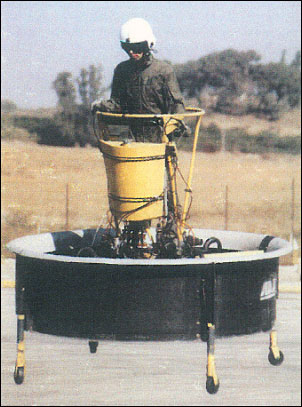
Launched as private venture, reviving concept explored by US Hiller VZ-1 in the 1950s but incorporating new features. The first (tethered) hovering flight was made on 28 August 1997; and the first free (untethered) flight (4X-BEB) 4 October 1998. Availability in kit form was originally planned for 2000.
A naturally stable VTOL platform which can be flown by persons with limited piloting experience. The Hummingbird has full engine redundancy, and can continue flying safely throughout full flight envelope after a single engine failure (initial hovering flights used approximately half of total available power). Air duct has outwards-curved lip on upper surface and diameter to length ratio of approximately 2.75:1.
Vertical speed (rise/descent) is controlled by pilot increasing or reducing rotor rpm via a twist-grip throttle with the left hand. Lateral (sideways) and longitudinal (fore/aft) motion is achieved simply by the pilot tilting his body slightly in desired direction. Maximum allowable speed is attained when pilot’s body reaches limit imposed by circular railing at waist height. The ‘Nose’ of vehicle can be turned by a small lever at pilot’s right hand.
The engines are mounted on four sides of a square gearbox which also serves as pedestal supporting the occupant. Rotors extend from the lower end of gearbox. The engines and propellers are off-the-shelf ultralight components and the circular outer duct is of graphite/epoxy construction.
Four non-retractable, free-castoring single wheels, each with shock-absorbing oleo that can withstand vertical impacts of up to 3.7m/s serve as landing gear.
Four 16.4kW Hirth F33-15A single-cylinder piston engines, each with dual ignition, own carburettor and own fuel line are coupled through torsional dampers and one-way clutches. These drive, via an AD & D gearbox equipped with a chip detector, two three-blade contrarotating propellers/rotors which are synchronised to obtain practically zero yawing moment at all throttle settings.
The Hummingbird accomodates a pilot only, standing inside tubular metal frame.
AD & D Hummingbird
Engines: 4 x Hirth F33-15A, 16.4kW
Diameter: 2.2m
Height overall: 1.9m
Empty weight: 145kg
Max T-O weight: 260kg
never-exceed speed: 74km/h
Hovering ceiling, IGE: 2440m
Hovering ceiling, OGE: 1525m
Range, standard fuel: 31km
Endurance, standard fuel: 30min
Standard fuel capacity: 19 litre
Aerocopter ZA-6 San’ka / AK1
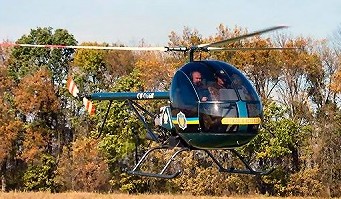
The Ukraine State Border Committee sought a light helicopter for border patrol from a Ukrainian-based company and selected Aerokopter. Founded on 14 December 1999 by I.V.Polituchy, A.N.Zapishny and A.I.Polituchy, the Politava-based Aerokopter design team began with Aviampex of Kiev to co-develop and manufacture the AK1-3. This coopertion ended within months and as of 3 May 2000 Aerokopter worked independently. One month later the chief designer, Zapishniy Alexander Nikolayevich was killed in a motor hang glider accident and the team carried on under Slava Sherbak. Much of the experimental research was done in co-operation with the Kharkov National Aeronautical University. The whole helicopter was designed using CAD.
Two-stage development of ZA-6: initially involving one of the latter (registered GL-0478, shown at Manufacturing & Security Exhibition, Kiev, September 2002), designated AK-1-5 (five-blade main rotor). At the same event, the uncompleted AK-1-3 prototype was shown with the definitive three blade rotor, starboard side tail rotor and twin vertical fins mounted on horizontal tail surfaces.
The first AK1-5 Sanka helicopter was flown on October 12, 2001. This helicopter was used for many ground and factory tests so that constructional elements could be improved and engineering processes for units and parts could be worked through. Production of this model was stopped. This had a five blade rotor and was tested with different Subaru engines including the 3.0 lt flat six, the 2.0 lt turbo and 2.5 lt had normally aspirated power plants.
The second AK1-3 was flown in July 2003. Aerokopter AK1-3 is a light helicopter, which can be used for a range of practical purposes. The design makes it comply with the FAR 27 Regulations, and with the requirements of JAR 27 and international noise abatement requirements.
The AK1-3 helicopter conforms to international airworthiness regulations (FAR, Pt.27) for normal category rotorcraft and international noise abatement regulations. The AK1-3 is certified under the State Administration of Ukraine for Aviation Safety Oversight and bears the Type Certificate Number TII 0008.
A conventional, two seat pod-and-boom helicopter, with five-blade main rotor and two-blade tail rotor mounted on the left side. The structure is of metal and composites and all flying flying controls are manual. The landing gear is of Twin skids.
The AK1-3 is designed with a skid landing gear, a tubular chassis, composite cabin, and empty weighs 390kg, making it possible to transport it on a small car trailer. The two seat cabin has a shoulder height width of 1200mm (Elbow height – 1353mm). Instrumentation is for daytime VFR only.
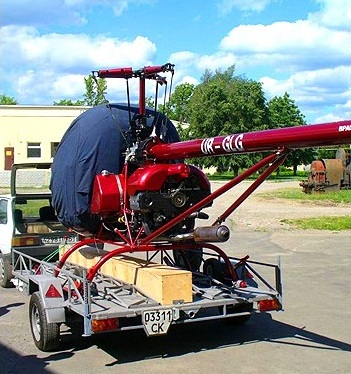
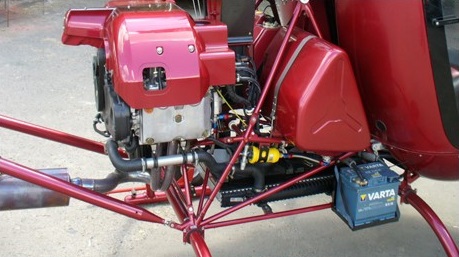
The three rotor blades are made of composite material with non-linear construction. Powered by a Subaru EJ-25, with belt drive reduction, the minimum fuel is 95 octane. The composite floor with its lower triangulated aluminium sub-frame are the main structural elements. The floor is made of a 16mm plywood with machined out pockets filled with foam inserts, with a skin of composites on both sides. The lower Duralumin frame is riveted together CNC machined elements which are atached to the rest of the airframe.
The seat frames are made from titanium tubing, have a riveted aluminium sheet base, with leather covered cushion. Each seat has a four point harness. The upper body of the cabin is made of coposite material with four separate tinted polycarbonate windscreens bonded into place.
The lower composite belly-panel is screwed in to allow access to control linkages, wiring loom, and “Red-Top” racing battery. The doors can be removed, limiting the Vne to 150 kph / 80 kt at sea level. The single electronic ignition system is totally waterproof.
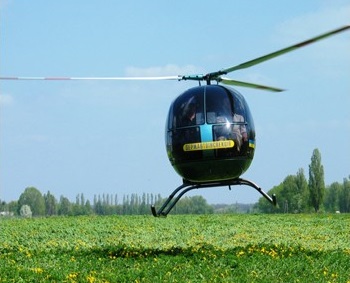
In the AK1-3 with the rotors turning at 595 rpm (105.5% – top of the green band), the engine turns at 5600 rpm so full power is available for takeoff and landing. Bottom of green ban equals 5000 rpm and sea level flight cruise with governor set to middle of green (100%) equates to 5300 rpm. The engine redline is 6200 rpm. Engine power transmission uses primary engine speed reduction via pulleys and V-belts, driving a secondary main rotor gearbox on one side and shaft drive to the tail rotor gearbox on the other. To disengage the rotors for startup, the six untensioned V-belts are used as a clutch. The rotor head uses a laminated torsion bar system with sixteen Y-shaped steel plates. The three main blades operate from 465-600 rpm.
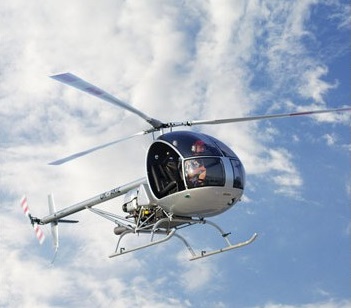
The composite main rotor blades have a non-linear -9.5 degree twist and a variable profile NACA 63012 / 63015. Each finished blade weighs approximately 7.5 kg. The tail rotor blades are also made of composite material and Rohacell foam with a leading edge wear strip. Both the main and tail rotor blades have no time life and are only replaced “on condition”.
The collective and cyclic control inputs are transmitted to the rotor system via duralumin tube control rods and levers.
The designed MAUW is 650 kg.
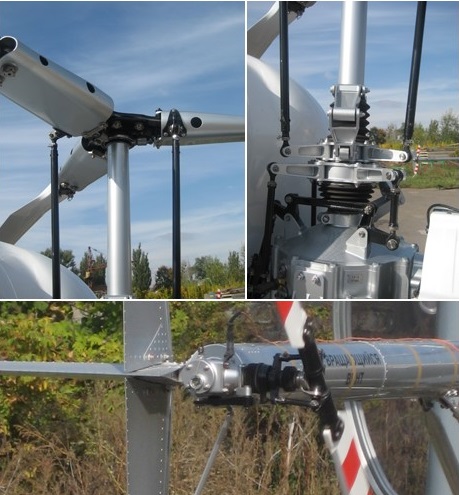
The tail boom is made up of four rolled aluminium sheet sections.
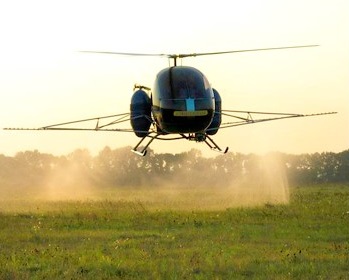
The AK1-3CX helicopter is a further development of the basic model and is designed for aerial spraying of crops with chemicals using 1-40 liters per hectare. The helicopter’s general dimensions and construction are similar to those of the basic model. The helicopter is equipped with a unit of quick-detachable equipment for spraying liquid chemicals, including the ULV technique. The unit of equipment consists of two tanks (140 liters each), which are mounted on either side of the cockpit, spray booms with struts, a rotary pump, connection hoses, and a control unit. The whole unit weighs 34kg.
ZA-6
Main rotor diameter: 6.0m
Tail rotor diameter: 1.24m
Max take-off weight: 750kg
Empty weight: 400kg
Max level speed: 190km/h
Max cruising speed: 140km/h
Econ cruising speed: 90km/h
Service ceiling: 2100m
Range with max fuel: 500km
AK1-3
Engine: Subaru EJ22, 119kW
Main rotor diameter: 6.84m
Length with rotor: 8.09m
Height: 2.22m
Max take-off weight: 650kg
Empty weight: 380kg
Max speed: 186km/h
Cruising speed SL: 160km/h
Static ceiling OGE: 1800m
Dynamic ceiling: 3000m
Normal range: 450km
Climb Rate: 2000 ft/min / 10 m/s
Fuel capacity: 80 lt
Price 2009: US$150000
Aerocopter / Aerokopter
Aerokopter was established on 14 December 1999 by I.V. Polituchy, A.N. Zapishny, and A.I. Polituchy, associated with Aviaimpex, to develop light rotorcraft. After conducting marketing research, it was decided to create a light two-seat helicopter with a piston engine and an airborne weight of 650-700kg. On 3 May 2000, Aerokopter became the separate Aviaimpex design bureau, also active in Ukraine.
Aerocentre NC.2001 Abeille
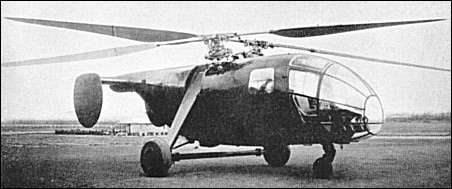
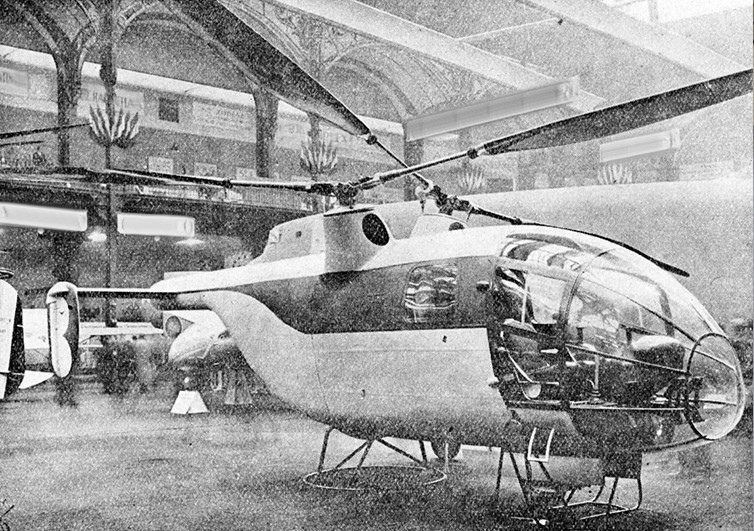
The Helicopter Division of SNCAC was established by Rene Dorand and designed and built three prototypes of the NC.2001 “Abeille” helicopter, the second of which was flown on 28 June 1949, following ground destruction of the first machine. It had twin inter-meshing two-blade rotors, an all-metal fuselage with an extensively glazed nose and accommodation for five people. The undercarriage was a fixed tricycle type and it had a tailplane with twin fins. The NC.2001 was powered by a 450hp Renault 12S00 piston engine. The project was discontinued on the dissolution of SNCAC in 1949 with only one flight having been made.
NC.2001
Engine: 1 x Renault, 335kW
Rotor diameter: 15.0m
Length: 9.7m
Max take-off weight: 2550kg
Max speed: 159km/h
Ceiling: 4880m
 All Aero