The American Helicopter Society issued a a prize of $10,000 for the Igor I Sikorsky Human Powered Helicopter Competition in 1980. By May 2009 the prize was $250,000. The requirement was to lift off to a height of 3m/9.8ft and hover over a 10sq.m/107.6 sq.ft ‘box’ for one minute using only human power. More than 20 teams tried and failed.
The AeroVelo team 9the name derived from ‘aerodynamic’ and Velo, French for bicycle) was led by pilot and chief engineer Dr. Todd Reichert and co-chief engineer Cameron Robertson, and made up of students at the University of Toronto.
The Atlas four rotors each span nearly 21.3m/70 ft. The airframe is of very light carbonfibre tubes and polymer weighing only 52kg/115lb, with a highly modified bicycle frame pedalled by the pilot.
The Atlas received many incremental improvements during 18 months and on 13 June 2013 Altas flew for 64.11 seconds, reached a peak altitude of 3.3m/10.8ft, and drifted off-centre a maximum of 9.8m/32.2ft.
The American Helicopter Society declared the Toronto, Canada-based AeroVelo Atlas team the winners.
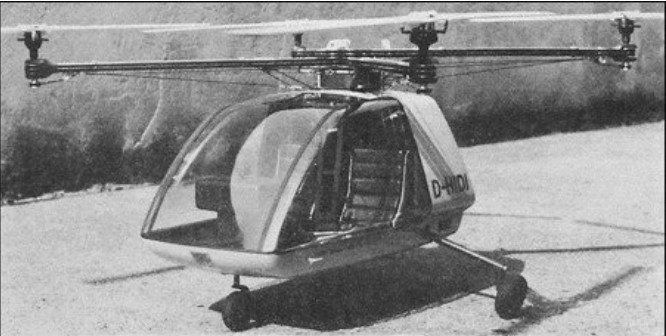
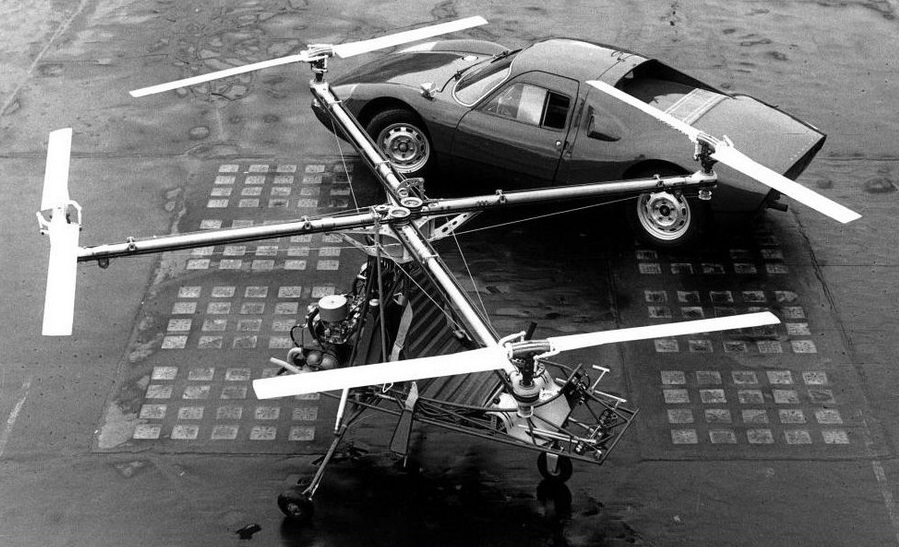
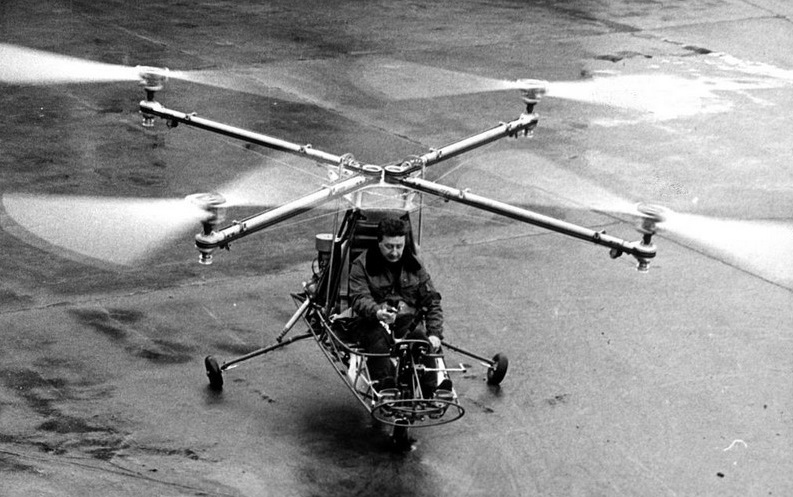
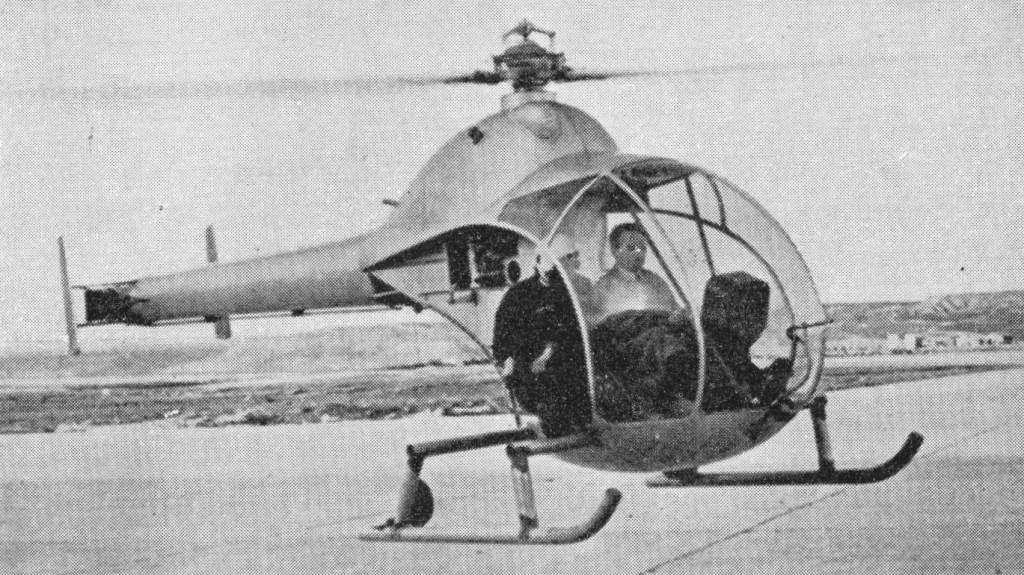
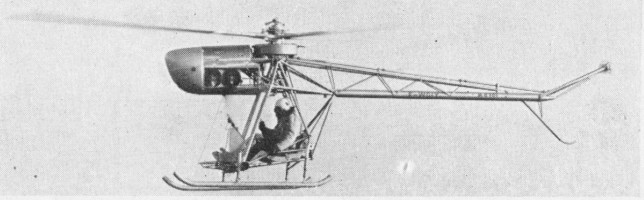
Following successful testing of the single-seat WGM 21 prototypes, Aerotochnik developed a side-by-side two-seat version, the 1975 WGM 22, with an extensively-glazed and fully-enclosed cabin.
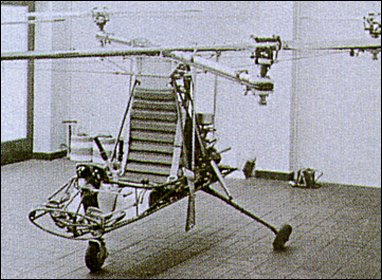
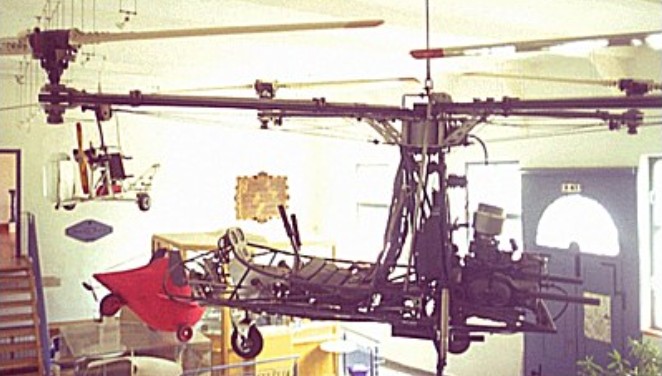
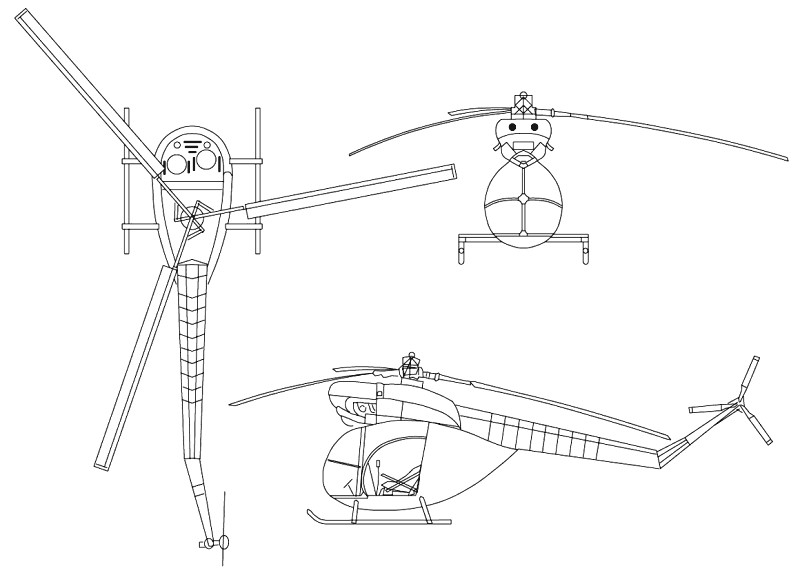
The configuration of the WGM 21 and WGM 22 differs essentially from other and more familiar forms of helicopter in having four two-blade rotors, each mounted at the extremity of one of a pair of diametrically-opposed rotor support arms on top of the main rotor column. This configuration allows the entire output of the engine to be transmitted directly to the main rotors, and eliminates the need for tail control surfaces or a tail rotor. The support arms can be folded enabling the helicopter to be stored in a small area.
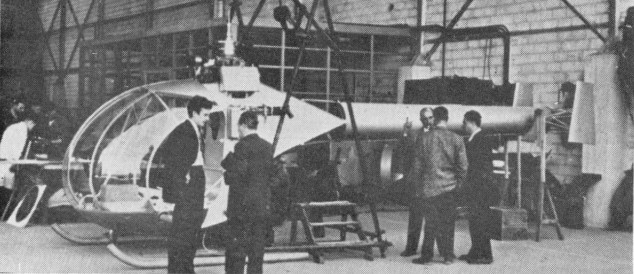
It was estimated that the WGM 22, shown in mockup form in the accompanying photograph, should have a max speed of about 200km/h and a range of 800km.
In early 1960s Aerotechnik began development of cheap, easy-to-fly helicopter, a prototype of which was completed in 1968. Other single-seat models followed, but development of WGM.22 two-seater ended mid-1970s.
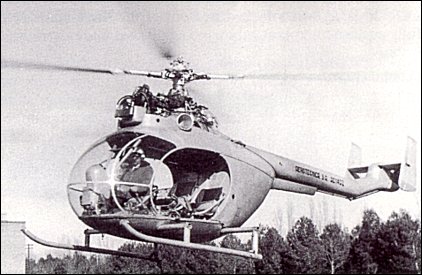
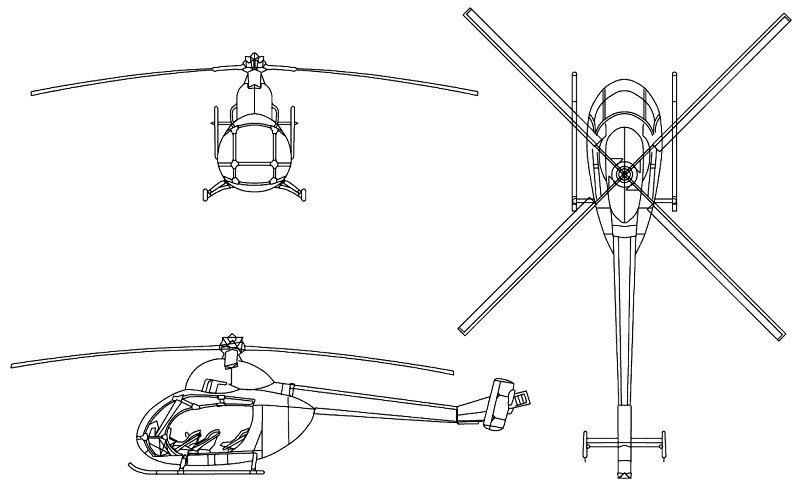
An improved version of the AC-13 was designed, known as the AC-14. A larger version of the AC-13, powered by a Turbomeca Artouste II shaft turbine and with accommodation for five. The prototype AC.14 used part of the structure of one of the AC.13s but had a lengthened cabin section with a rear seating area and a larger 400shp Turbomeca Artouste IIB turboshaft engine. The engine is mounted above the cabin, which is extensively sound-proofed. Residual thrust is used to increase forward speed, and anti-torque control by gas deflection in helicopter flight and by vertical rudders in gyrodyne flight (high speed cruising). The single, four-blade rotor has double-articulated blades with an area each 0.84sq.m, and total disc area of 72.35sq.m. The landing gear of of skid type with a 2.0m track. The enclosed cabin seats a pilot at the front and four passengers in two side-by-side pairs behind. Entrance doors are on each side of cabin. An initial series of six was completed in Madrid by ENHASA and the first flew on July 16, 1957. Having provided funds for the Aerotecnica helicopter project, the Spanish Government ordered ten examples. These were delivered to the Spanish Air Force, with the designation EC-XZ-4, where they served for a relatively short period before being retired.
Aerotecnica AC-14 Engine: 1 x Turbomeca Artouste IIB shaft-turbine, 400hp. Oil capacity: 9.4 lt Main rotor diameter: 9.60m Overall length: 11.22m Fuselage length: 8.25m Height: 3.10m Weight empty: 700kg Weight loaded: 1300kg Max speed: 180km/h Cruising speed: 150km/h Best rate of climb SL: 300m/min HIGE: 2700m Service ceiling: 6350m Range: 260km Fuel capacity: 74 lt ag version Fuel capacity: 244 lt passenger version.
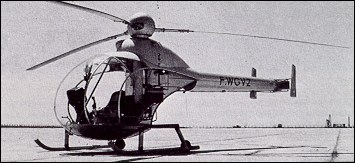
Jean Cantinieau had been working on a three-seat turbine-powered helicopter, the designs for which he had sold to Societe Nationale de Constructions Aeronautiques du Nord (S.N.C.A.N.). Very similiar to the AC.12, SNCAN built two prototypes as the Nord N.1750 Norelfe with a large bubble canopy and a Turbomeca Artouste I turbine mounted above and behind the cockpit.
The three-blade rotor was positioned directly above the engine and had a rotorhead enclosed in a large spherical fairing. The tail rotor was replaced by a ducted exhaust gas controlled by the pilot through pedals.
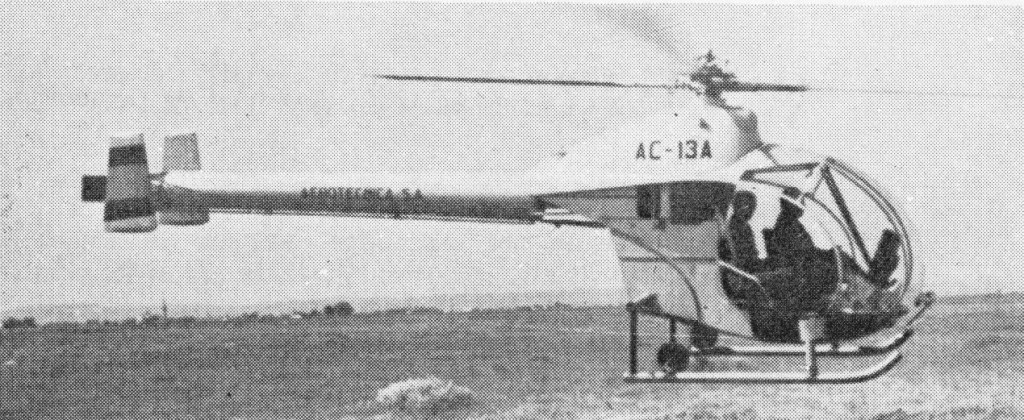
The first Noreife prototype, F-WGVZ, was flown on 28 December 1954 but SNCAN sold both the aircraft and the rights to Aerotecnica who designated them AC.13A. After further testing in Spain, Aerotecnica moved to a larger five-seat version known as the AC.14.
The two prototypes were acquired by the Spanish Government.
From the Matra-Cantinieau MC-101 / AC-11 Aerotecnica developed the AC-12 and AC-13, the former powered by a 150hp Lycoming O-320 engine and the latter by a Turbomeca Artouste I gas turbine.
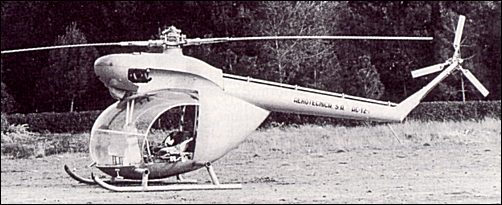
A twin seat single-rotor helicopter, the AC-12 has a full all-metal monocoque fuselage with a large overhead ‘spine’ encompassing the boom and engine mounted above the cabin. Three-blade rotor with double-articulated blades. Each blade has a solid machined duralumin spar which forms the leading-edge, duralumin ribs and trailing-edge. Space between ribs is filled with a plastic foamed resin compound named Klogecell, with a final overall covering of Fiberglas. Floating hub, with cyclic and collective-pitch changes made through a “spider.” Rotor blade area each 0.71sq.m. Rotor disc area 57sq.m. Three-blade anti-torque rotor of similar construction to main rotor. Anti-torque rotor blade area 0.0927sq.m. Anti-torque rotor disc area 2.26sq.m.
The main rotor is driven direct from the engine gear-box (7.28 : 1 ratio) and clutch through a universal joint. The anti-torque rotor is driven through a gear-box (1.4 : 1 ratio) and cardan shaft.
Enclosed cabin seating two side-by-side with dual controls. Entrance door on each side of cabin. Landing gear is skid type. Track of skids 2.0m
Two prototypes were built with Spanish Government funding in Madrid by AISA, with a transmission and reduction gear designed on motor-car principles and built by the ENHASA airscrew company. One 168hp Lycoming O-360-B2A fan-cooled engine mounted above the cabin with direct drive through the gear-box to the main rotor. Fuel tank under seats with capacity of 60 litres. Oil capacity 9 litres. The first of these flew on July 20, 1956.
A production order for 12 was received from the Spanish Government with a military designation of XZ-1 where they served for a relatively short period before being retired.
Cantinieau moved on to a two-seater, the MC.101, which retained the general layout of the C.100 but with a much cleaned-up structure and a 105hp Hirth engine. Two examples of the MC.101 were built by Matra (F-WGIX and F-WGIY), the first of which was flown by Gerard Henry at Buc on 11 November 1952. It was shortly after this that Cantinieau gained the interest of the Marquis del Merito, a Spanish industrialist, who had established Aerotecnica SA as an aerial photography and crop spraying business based at Cuatro Vientos near Madrid. Aerotecnica S.A. began building helicopters by hiring French engineer Jean Cantinieau and acquiring the Matra-Cantinieau MC-101 light helicopter built by the French Societe Matra in 1952. This helicopter was given the designation AC-11 (Aerotecnica-Cantinieau-11). It became evident that the aircraft was underpowered in Madrid’s hot and high conditions and a 150hp Lycoming was installed – in which form it became the Model AC.12. From the AC-11 have been developed the AC-12 and AC-13.
Engine: 105 h.p. Hirth Rotor diameter: 26 ft. 4 in Rotors: 3-blade main; 3-blade tail Fuselage length: 22 ft Loaded weight: 1760 lb. Ceiling; 9,840 ft. Typical range: 250 miles at 96 m.p.h. with ful1 load. Seats: 2
Marquis del Merito, a Spanish industrialist, established Aerotecnica SA as an aerial photography and crop spraying business based at Cuatro Vientos near Madrid. Aerotechnica sa began to develop and build helicopters of French (Jean Cantinieau) design, and also was licensed for Matra-Cantinieau production. Two prototypes of AC-12 built in Madrid by mid-1950s (first one flown July 1956) and a few delivered to Spanish Air Force. Type was unorthodox in layout and featured transmission and reduction gear on automobile principles. AC-14 development flew July 1957, but Aerotecnica organization dissolved in 1962. Aerotecnica also started construction of a prototype of the much larger AC.21 which was a 12/14 passenger machine with twin Turbomeca Turmo III turbines and a massive ducted-air tailboom. A turbine version of the AC.12 was planned and they also started working on the AC.15 development of the AC.14 with a 260hp Lycoming O-435-V engine. In 1962 the Spanish Government withdrew further financial support and Aerotecnica went into liquidation. Following the collapse of Aerotecnica, Jean Cantinieau returned to France where he joined Matra.
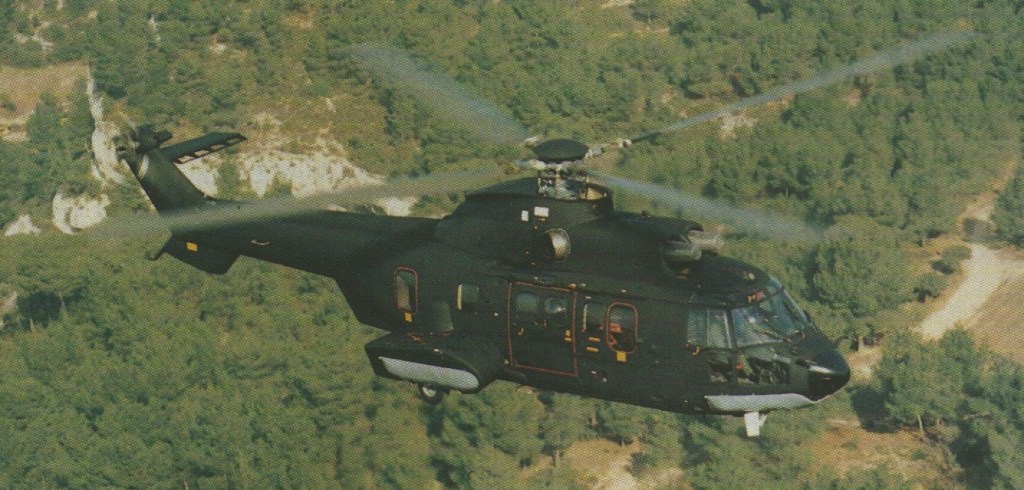
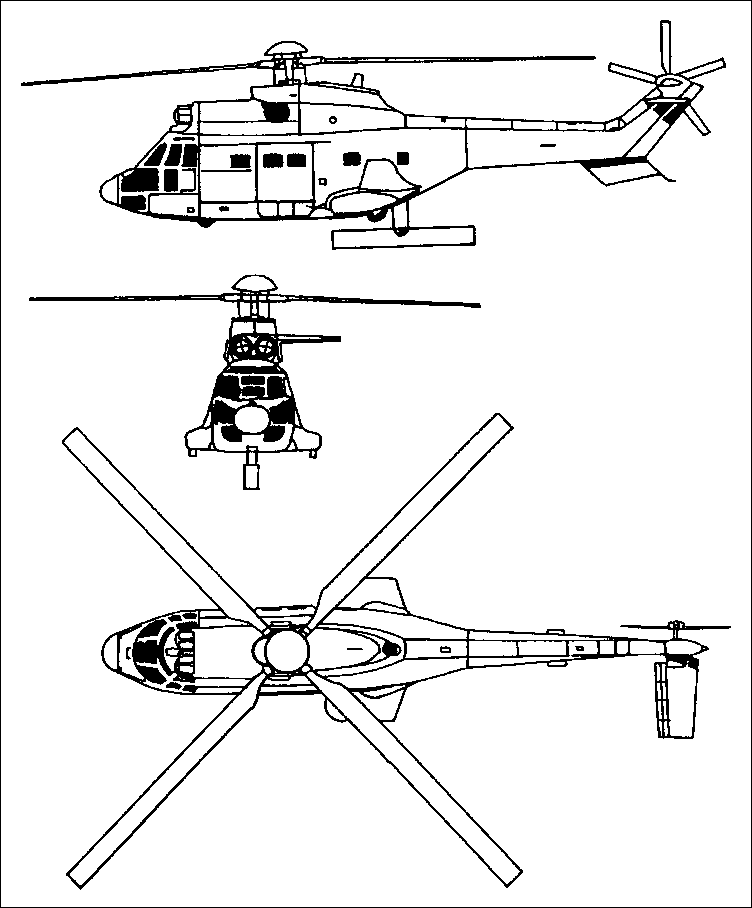
Beginning in 1990, Super Pumas were separated in their civilian and militarized forms by the latter taking on the production designation of AS 532 “Cougar” (civilian models still retained their AS 332 designations). The Cougar family now consists of the AS 532MC Mk I (note the “Mk I” mark designation was retroactively applied to previous Super Puma forms) as a Search & Rescue (SAR) platform, the AS 532SC Mk I as a short-fuselage anti-submarine variant, the AS 532U2 Mk II as an unarmed base model, the AS 532A2 Mk II as another Search & Rescue form, the AS 532L2 Mk II featuring a lengthened fuselage for extra seating and extended main rotor blades, and the simplified AS 532 “Cougar 100” with fixed landing gear. Militarized Super Puma/Cougar aircraft can display a broad range of armaments including 7.62mm general purpose cabin-door machine guns (on pintle mountings), 7.62mm gun pods, rocket pods, anti-ship missiles and various makes of air-to-surface missiles.
The AS 532U2 Cougar Mk.2 incorporated new main and tail rotors, a lengthened rear fuselage and four-tube EFIS cockpit display and digital autopilot. Powered by two 1,877 shp (1400 kW) Turbomeca Makila turboshafts, the standard military AS 532M1 can carry 25 troops while the civil AS 332L1 seats up to 24 passengers.
AS 532 Cougar
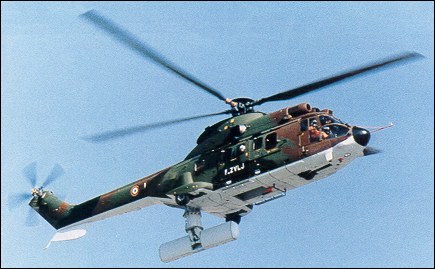
Versions include the AS.532SC, navalised; AS.532UC, tactical transport; AS.532AC, armed with pod mounted cannon; AS.532UL, tactical transport; and AS.532AL, armed with pod mounted cannon or side firing cannon. The Horizon system, Helicoptere d’Observation Radar et d’Investigation sur Zone, includes a Cougar AS 532 UL twin-engine helicopter with radar and electronic countermeasures and a ground station. The helicopter surveillance system was originally developed to counter any possible threat by tank fleets of the Warsaw Pact countries. The French Ministry of Defence awarded a development contract to Eurocopter in 1992 initially for two then four AS 532 UL Horizon systems. The first flight of the Horizon Cougar helicopter with the full radar system took place in late 1992. The first AS 532 Horizon was delivered to the French Army in July 1996. The Swiss Air Force, ordered 27. The unarmed AS 532 UL is equipped with a long range multi-mode retractable pulse Doppler radar with a rotating antenna carried beneath the fuselage. The radar range is 200km with the helicopter operating at an altitude of 4000m and a cruise speed of 180 km per hour. The radar scans a ground area of 20,000 sq.km over a depth of 200km in 10 seconds and the data is transmitted to a ground station. For moving targets the radar provides a speed resolution of the target of 2 m/second. The cockpit is night vision goggle compatible and a weather radar is fitted. The navigation equipment includes a Decca navigator and flight log with an SFIM model 155 autopilot, inertial navigation and global positioning system. The engine is fitted with jet efflux diluters and the crew are armour protected. The helicopter is equipped with anti-icing systems. The AS 532 UL Cougar helicopter is equipped with two Turbomeca Makila 1A1 turboshaft engines with the air intakes protected from debris with a grille. Centrisep multipurpose air intakes are provided for operations in high dust/particulate or desert conditions. Six flexible self-sealing fuel tanks have a capacity of 2,020 litres.
AS.532SC Cougar Engine: 2 x Turbomeca Makila 1A1 Instant pwr: 1400 kW MTOW: 9000 kg Payload: 4500 kg Max speed: 135 kts Max range: 800 km HIGE: 9156 ft HOGE: 5413 ft Crew: 2 Pax: 2
AS.532U2 Cougar Mk.2 Engines: 2 x Turbomeca Makila 1A2 turboshaft, 1,845shp Instant pwr: 1570 kW Length: 51.02ft (15.55m) Width: 60.01ft (18.29m) Height: 16.11ft (4.91m) Empty Weight: 10,902lbs (4,945kg) Maximum Take-Off Weight: 21,493lbs (9,749kg) Maximum Speed: 170mph (273kmh; 147kts) Maximum Range: 494miles (795km) Rate-of-Climb: 1,260ft/min (384m/min) Service Ceiling: 13,448ft (4,099m) HIGE: 8525 ft HOGE: 4921 ft Accommodation: 3 + 19 Hardpoints: 2
AS.532UC/AC Cougar Engine: 2 x Turbomeca Makila 1A1 Instant pwr: 1400 kW MTOW: 9350 kg Payload: 4670 kg Max speed: 140 kts Max range: 845 km HIGE: 9196 ft HOGE: 5413 ft Crew: 2 Pax: 21
AS.532UL/AL Cougar Engine: 2 x Turbomeca Makila 1A1 Instant pwr: 1400 kW MTOW: 9350 kg Payload: 4500 kg Max speed: 140 kts Max range: 1245 km HIGE: 9196 ft HOGE: 5415 ft Crew: 2 Pax: 25
AS.532 Cougar AEW Main rotor diameter: 15.60 m Fuselage length: 15.53 m Height: 4.92m MTOW: 9000 kg Cruising speed: 262km/h HOGE: 2300 m Range: 910 km Crew: 4-5

 All Aero