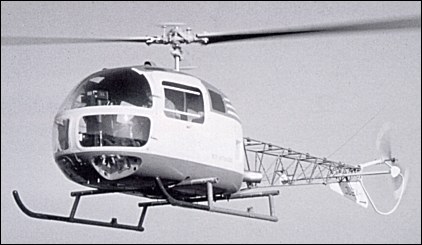
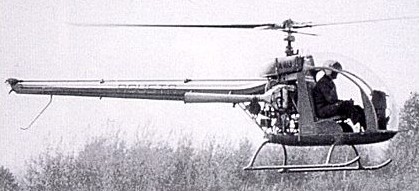
The A.115 was a developed version of the Bell 47J-3. Featuring an open rear fuselage structure and powered by a 480shp Turbomeca Astazou II turboshaft, one prototype, I-AGUC, was built.
The first mass-produced helicopter designed by Agusta, the A 109 Hirundo (Swallow), was originally intended to be powered by a single 740hp Turbomeca Astazou XII turboshaft but was redesigned in 1967 for two Allison 250-C14 engines.
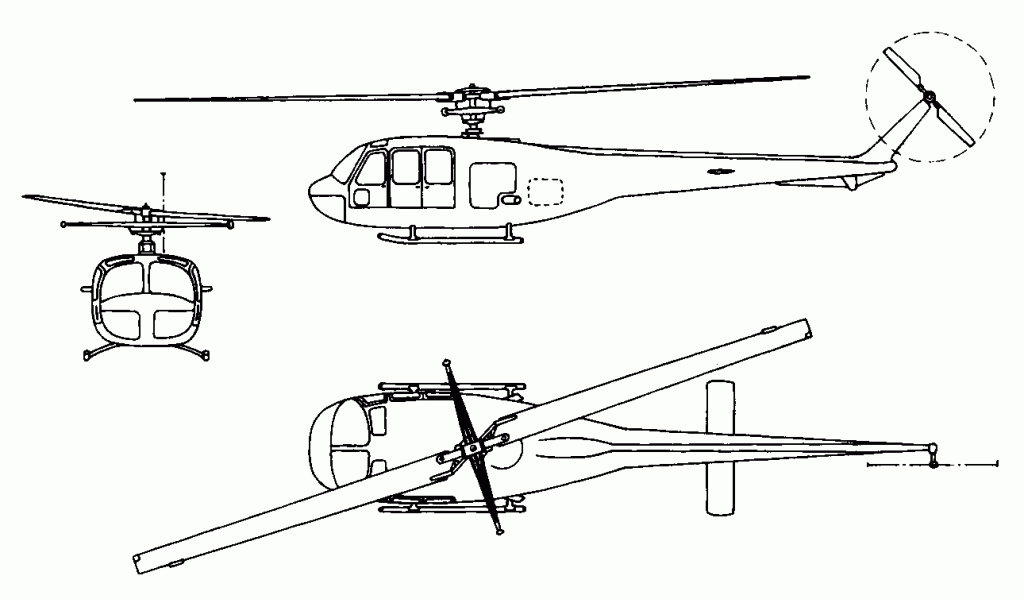
Feasibility studies for a medium-capacity helicopter – the A.109 – began in 1969. Wind tunnel tests, lasting almost a year, enabled the characteristics of the new helicopter to be greatly refined. Once the basic project had been drawn up, final design work of parts and equipment began in spring 1970, and in the summer, detailed construction work was started. The aircraft was assembled in spring 1971 and the prototype (NC7101) made its first flight on 4 August 1971 from the Cascina Costa plant. It was piloted by Ottorino Lancia, accompanied by Paolo Bellavita, who had developed the aircraft together with Bruno Lovera. Owing to a minor accident, testing was resumed some time later, in 1972, using the second prototype, as well as a special static test rig for the dynamic components. In 1973 a third prototype in military configuration was developed, together with a fourth model for civil use and an airframe for static tests. The A.109 has a four-blade articulated rotor, especially designed for fast flight. The rotor blades are honeycomb structure with a light alloy skin and extensive structural bonding. The fuselage is a metal honeycomb with light alloy panels. The cabin can have various internal layouts, with pilot and crew seated side-by-side, two bench seats for two-three people, and a baggage compartment. Behind the cabin is the rear fuselage section, which carries the landing gear units and fuel tanks. The fuel is distributed by electric pumps from two tanks with a total capacity of 550 litres. The two turbine engines are mounted side-by-side but are fully independent. The five prototypes of the A.109 were certified on 30 May 1975. American approval followed two days later on 1 June. Production had already begun with five aircraft for evaluation by the Italian Army. Atlantic Aviation, then the American distributors of the Agusta 109, took out an option on 100 aircraft for the civil market at the same time. The first A 109 pre-production aircraft was not completed until April 1975. Delivery of production machines, designated A 109A, started in 1976. The Agusta 109A has been certi¬ficated for single pilot IFR; 20 January 1977 (Italy); 22 December 1977 (USA). A specialised military utility model, the A 109B, was proposed, but in 1969 this was abandoned in favour of the eight-seat A 109C civil version certificated in early 1989. The A.109C (civil) version had the same four-blade rotor but a completely new fuselage, with cleaner lines and a retractable undercarriage. The hi-tech maritime A 109A ECM (electronic countermeasures) variant has a radar display, direction finder, electromagnetic emission analyser and jamming equipment. Agusta introduced the general purpose Model A.109A Mk.II derivative, which has been modified to improve engine-out performance at high altitudes, and in hot climates. This features an uprated transmission, two 400 shp (276 kW) Allison 250-C20B turboshafts and seating for seven passengers. First delivered in 1981, nearly 200 had been built by 1989, following on from the 150 or so of the original model. From 1985 the Mk II has been available in a ‘wide-body’ configuration with bulged fuselage sides for greater comfort.
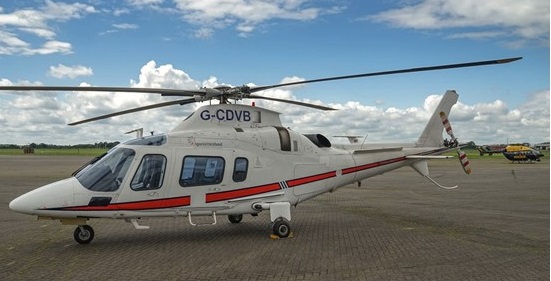
A.109 II ZK-HXI
Belgium has ordered 46 Mk II-Plus versions for Army use. Several military versions of the A.109A Mk.II are offered for armed scout, light-attack, command and control, utility, ESM/ECM, and naval roles. The A.109 MAX is a wide-body medevac variant of the A109 Mk II. The naval variant may be configured for ASW/ASV with a long-range search radar, as well as for SAR, utility, and medevac. It may also be employed, with suitable systems installed, for over-the-horizon guidance of ship-launched Otomat missiles. The Mirach version of the A.109A carries two Mirach 100 battlefield surveillance RPVs, while other reconnaissance/surveillance models can carry Flir equipment.
Developed for multirole hot-and-high missions, particularly in the Middle East and Africa, the A.109K is powered by two 539kW Turbomeca Arriel 1K turboshafts each rated at 575kW for 2.5 minutes, 550kW for take-off (30 minutes) and 471kW maximum continuous power, has a length¬ened nose for additional avionics, and a taller fixed tricycle landing gear. A new composite main rotor hub is resistant to abrasion by sand and dust. The A.109K flew in April 1983, and is primarily intended for two-crew combat missions armed with TOW anti-tank missiles and gun pods. The first flight of the production representative second aircraft took place in March 1984. Main transmission uprated to 671kW for take-off and maximum continuous twin-engined operation; single-engine rating is 477kW for 2.5 minutes and 418kW maximum continuous. Main rotor rpm 384, tail rotor 2,085. Standard usable fuel capacity 750 litres, with optional 150 litre auxiliary tank for EMS operations, or 200 litre auxiliary tank in the A109KM. Self-sealing fuel tanks optional. Independent fuel and oil system for each engine.
The Italian Army’s advanced observation helicopter, the A.109EOA, is similar in configuration to the A.109K but is powered by twin uprated Allison 250-C20R engines giving better performance than the standard -C20Bs of the A.109A.
Both the A 109 EOA and A 109K feature fixed undercarriage and a lengthened nose. PZL in Poland were making all the fuselages for the Agusta A109, AW119 and AW139, before shipping them to Brindisi, Italy, for customour fit-out. PZL also manufactured the A109 and A139 tail booms. Total of all versions delivered by 1 January 1999 was 621, of which 513 civil and 108 military. The Power has two Allison 250-C20R/1 turboshafts, each rated at 335kW for 5 minutes for T-O and 283kW maximum continuous; flat rated at 258kW for twin- engine operation; engines mounted side by side in upper rear fuselage and separated from passenger cabin and from each other by firewalls. Transmission ratings 589kW for take-off and 567kW for maximum continuous twin-engined operation, with maximum contingency rating of 607kW for 6 seconds. Rating for single-engined operation is 336kW for take-off (5 minutes limit). Two bladder fuel tanks in lower rear fuselage, combined capacity 560 litres, of which 550 litres are usable. Refuelling point in each side of fuselage, near top of each tank. Oil capacity 7.7 litres for each engine and 12 litres for transmission. Provision for internal auxiliary tank containing up to 150 litres of fuel.
Two of Argentina’s four A 109As were captured during the 1982 Falklands War and were used by the British.
Variants:
A.109 Hirundo Eight-seat executive helicopter with streamlined fuselage incorporating vertical fin and tailplane, 4-blade main rotor, retractable tricycle u/c, 2345kg TOGW and powered by two 420shp Allison 250-C20B turboshafts. Prot. NC7101 FF 4 Aug. 1971.
A.109A A.109 with additional ventral fin, structural strengthening and 2585kg TOGW. Initial production model, powered by twin 313kW Allison 250-C20B turboshaft engines. Replaced by A 109C Mk II from September 1981.
A.109A Mk.II Single-pilot IFR certificated version of A.109A with two 450shp Allison 250 C20R/1 engines, increase in transmission rating; new tail rotor driveshaft with two-point suspension; increased tail rotor blade life and reliability through use of Nomex core material and improved bonding techniques; new self- damping engine mounts; new integral-design oil coolers and blowers; redesigned tailboom; higher-pressure hydraulic system; improved avionics and instrument layout; additional access panels; and removable floor in baggage compartment. A utility version with less sophisticated interior and instrumentation was also available from 1983.
A 109A Mk II Plus Special law enforcement model.
A.109A TOW Military A.109A with externally mounted Hughes TOW missile tubes and nose-mounted ranging module.
A. 109BA Anti-tank version for Belgian Army.
A 109C Certificated in USA by Agusta Aerospace Corporation in early 1989; approved for single-pilot IFR operation; transmission uprated from 552kW to 589kW; ‘wide-body’ cabin; new composites main rotor blades; Wortmann aerofoil on tail rotor; strengthened landing gear; maximum T-O weight raised to 2,720kg, affording 109kg increase in payload. Other civil/public service roles include law enforcement and coastal patrol with 360° radar. Military version A.109CM.
A 109CM Military version of civil A 109C powered by two 335.6kW Allison 250-C20R/1; can have sliding doors and fixed landing gear; ventral fin removed; first customer Belgian Army (Agusta designation 109BA) with 18 scout versions and 28 anti-tank versions designated 109HO and 109HA respectively by customer; ordered 1988; first delivery, from offset supplier Sabca, February 1992; first 109BA with equipped weight reduced to originally specified 1,944kg delivered 25 November 1992; maximum T-O weight increased to 2,850kg; this was 11th of 46 109BAs; composites sliding doors, relocated batteries and custom Collins/Alcatel Bell avionics; scouts have roof-mounted Saab Helios stabilised observation sight; anti-tank system has roof-mounted Saab/ESCO HeliTOW 2 sight and TOW-2A missiles on lateral pylons; firing trials completed in Sardinia late 1992. Last Belgian aircraft delivered 4 February 1994.
A.109D Experimental A.109K-2 with retractable u/c, new rotor head with titanium hub and Allison 250-C22 turboshaft.
A.109 EOA Military A.109A for Italian Army with sliding doors, fixed u/c, external ordnance points and two 450shp Allison 250 C20R/1 turboshafts. 24 (16 EOA-1 and eight EOA-2) delivered in 1988 as Elicottero d’Osservazione Avanzata to Aviazione dell’Esercito; fitted with sliding doors, roof-mounted SFIM M334-25 daytime sight with CILAS laser ranger, variety of armament options, fixed landing gear, crashworthy fuel tanks and ECM. Maximum flight weight with slung load 2,850kg.
A.109E Power A.109D with fixed u/c, wider cabin, redesigned instrument panel and controls, modified tailfin and two 732shp Pratt & Whitney PW206C turboshafts. Prototype registered I-EPWR.
A 109 G di F Special version for coastal patrol, equipped with an integrated Mission Equipment Package (MEP) including various communication and navigation systems, 360° search radar RDR-1500, and searchlight, FLIR, and weapon systems such as pintle-mounted MG-3 machine gun.
A. 109K Military version of A.109A with revised nose profile, redesigned engine compartment and uprated transmission, external stores hardpoints, optional fixed u/c, composite main-rotor head with elastomeric bearings and composite blades with hard surface coating; new tail rotor of Wortman blade section; longer nose-to-house additional avionics and 722shp Turbomeca Arriel 1K turboshafts for enhanced hot & high operations. Also known as A.109KM and A.109KN (Naval version).
A.109K2 Civil hot and high rescue version with special avionics, fixed u/c, new fuel tanks. Tail skid replacing ventral fin, 771shp Arriel 1K1 engines, rescue hoist etc. Prototype registered HB-XWA.
A 109K2 Law Enforcement Dedicated police version; optional equipment includes 907kg cargo hook, 204kg capacity variable speed rescue hoist with 50m of cable, rappelling kit, wire-strike protection, SX-16 searchlight, MA3 retractable light, external loudspeakers, emergency floats, GPS, FM tactical communications, weather radar, LLTV and FLIR.
A.109KM Military version of A.109K2 with external braced hardpoints, fixed landing gear and sliding side doors.
A 109KN Shipboard version with equivalent roles to A 109KM, including anti-ship, over-the-horizon surveillance and targeting and vertical replenishment.
A 109 LUH Light utility version for the South African Air Force (SAAF) with Turbomeca Arrius 2K2 engines; production and final assembly by Denel. Orders placed for 30 aircraft, plus 10 options.
A.109 MAX Medevac version certificated in USA by Agusta Aerospace Corporation early 1989 with large upward-opening bulged doors and fairings give 3.96cu.m cabin volume and allow for two stretchers across main cabin and three sitting attendants/patients
Agusta 109 Engines: 2 x Allison 250 C20B, 420 shp TBO: 1,500 hrs Main rotor dia: 36 ft. 1 in Length: 36 ft. 7 in Height: 9 ft. 6 in Disc loading: 5.3 lb/sq.ft Empty wt: 3,224 lb Useful load: 2,176 lb Payload with full fuel: 1,233 lb Gross weight: 5,400 lb Power loading: 6.4 lb/hp Fuel cap: 146 USG/986 lb Baggage capacity: 330 lb Baggage area: 18.4 cu.ft ROC: 1,620 fpm SE ROC: 300fpm Service ceiling: 15,000 ft SE service ceiling: 2,625 ft VNE: 167 kt Max cruise: 150 kt Economy cruise: 129 kt Range @ max cruise (45 min res): 193 nm Range @ economy cruise (45 min res): 238 nm Duration @ max cruise (no res, std tanks): 2.2 hr HIGE: 9,800 ft HOGE: 6,700 ft Seats: 8
A.109A Engine: 2 x Allison 250-C14, 370shp
A.109B Engine: 2 x Allison 250-C14, 370shp
A.109A Mk.II Engine: 2 x Allison 250-C20B, 420 shp / 298kW TBO: 3500 hr Main rotor: 36.1 ft No. Blades: 4 Fuselage length: 10.7 m Crew: 2 Pax: 6 Seats: 8 Length: 45.2 ft Height: 11 ft Max ramp weight: 5730 lb Max takeoff weight: 5730 lb Standard empty weight: 3640 lb Max useful load: 2090 lb Max landing weight: 5730 lb Max sling load: 2000 lb Disc loading: 5.6 lb/sq.ft Power loading: 6.8 lb/hp Max usable fuel: 978 lb Max rate of climb: 1620 fpm Service ceiling: 15,000 ft Hover in ground effect: 9800 ft Hover out of ground effect: 6700 ft Max speed: 147 kt ROC: 515 m/min Normal cruise @ 3000 ft: 142 kt Fuel flow @ normal cruise: 355 pph Endurance @ normal cruise: 2.6 hr Fuel cap: 560 lt
A109-Mk.II Plus Engines: 2 x Allison 250-C20B Cruise: 150 kt Fuel cap: 191 USG Range incl res: 440 nm Max endurance: 4:35 hr Useful load 1 hr fuel: 1168 kg.
A.109C Hirondo Engines 2 x Allison 250-C20R/1 Rotor dia. 11.0 m Max T/O weight 2,720 kg Max payload 907 kg Max useful load 1,110 kg Max cruise 150 kt Max range 780 km HIGE 11,398 ft HOGE 8,000 ft Service ceiling 15,000 ft Seats: 8
A.109E Power Engines: 2 x P&W PW-206C / Turbomeca Arrius 2K1, 631 shp Weight empty: 1590 kg / 3,505 lb Internal load: 2850 kg External load: 3000 kg Max take off weight: 6284.3 lb / 2850.0 kg Rotor Diameter: 36.089 ft / 11 m Length: 13.04 m Height: 11.483 ft / 3.5 m Maximum Rate of Climb: 9.8 m/s Service ceiling: 13301 ft / 4054 m Cruising altitude: 4987 ft / 1520 m Max. speed: 168 kt / 311 km/h Cruising speed: 162 kt / 300 km/h Range: 948 km Endurance: 4 h
A.109 EOA Engine: 2 x Allison 250-C20R
A.109K/KM Engine: 2 x Turbomeca Arriel 1K1, 722 shp (538 kW) Rotor dia: 11.0 m Max T/O weight: 2,850 kg Max payload: 1,197 kg Max speed: 142 kt Max range: 580 km HIGE: 18,600 ft HOGE: 15,190 ft Crew: 1 Passengers: 7
A.109K2 Engine: 2 x Turbomeca Arriel 1K1, 550 kW Rotor dia: 11 m MTOW: 2720 kg Useful load: 1100 kg Max speed: 152 kt Max cruise: 145 k Max range (max payload): 543 km HIGE: 18,602 ft HOGE: 15,190 ft Service ceiling: 20,000 ft Crew: 1 Pax: 7
A.109KN Engine: 2 x Turbomeca Arriel 1K1, 575 kW MTOW: 2850 kg Max speed: 142 kt Max range: 543 km HIGE: 18,600 ft HOGE: 15,1900 ft Crew: 2
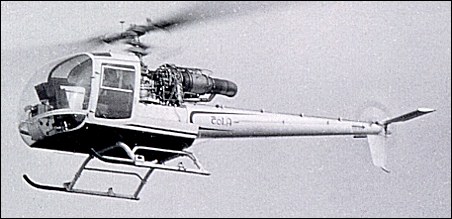
Flown in prototype form early in November 1965, the Agusta A.106 is a small lightweight armed helicopter designed initially in an antisubmarine role. The single-seater had a Turbomeca-Agusta TAA-230 turbine behind the cockpit, and the 2-blade main rotor, and the tail section including the 2-blade tail rotor, can be folded for stowage on board ship. With a standard skid landing gear, an auxiliary fuel tank may be carried externally. Systems included an autostabilizing device, an acoustic submarine detector and armament of two Mk.44 torpedoes. The Ferranti company developed an electronic three-axis stability augmentation system for the A 106, providing a stable firing platform and damping out external disturbances. The Italian Navy ordered two prototypes and five production aircraft, but construction of the production aircraft was suspended in 1973.
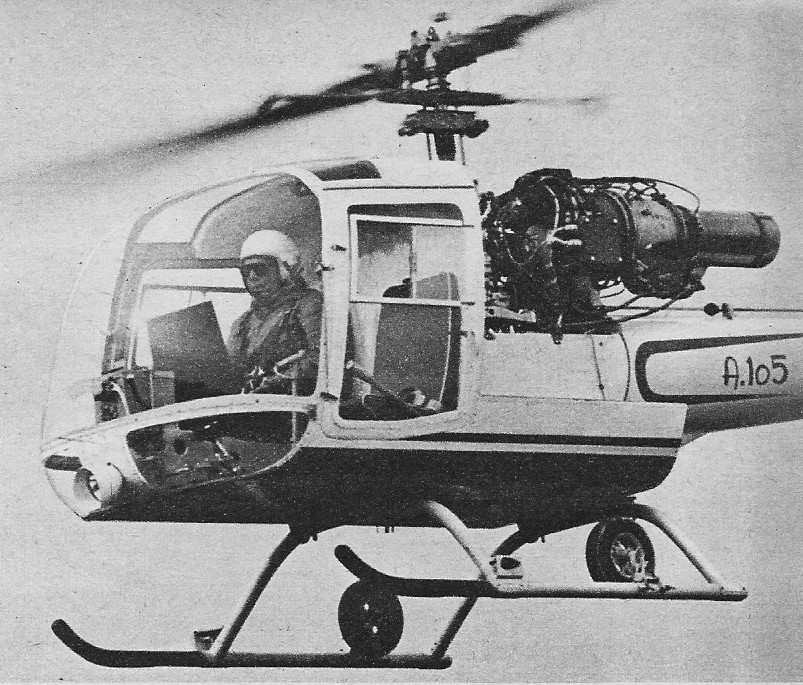
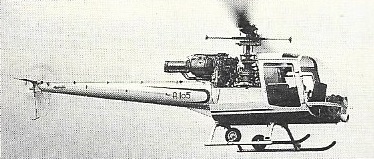
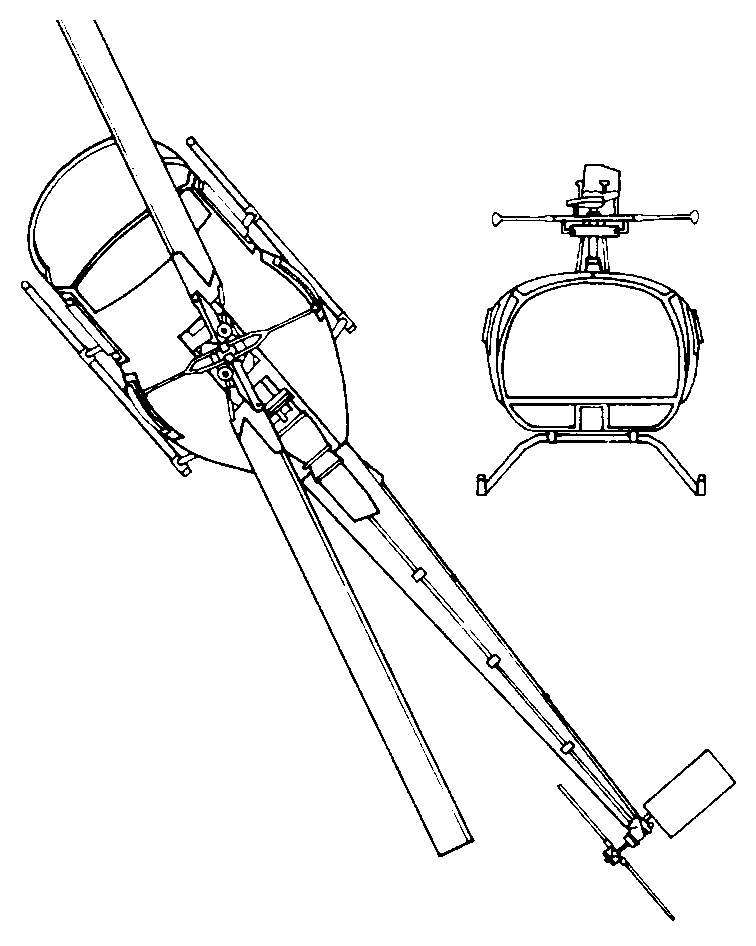
The A.105 small helicopter was designed from the start to simplify the manufacturing process and was powered by a Turbomeca-Agusta TA-230 turbine engine developing 350shp. The design also incorporated an Agusta-designed transmission.
First flown in April 1964 the A.105 was built in two models – the A.105 two-seater and the A.105B four-seat variant. Cruising speed was around 210kph with a range of 320km. The four-seat variant, the A.105B, was displayed at the 1965 Paris Air Show. It had the same mechanical and structural parts as the two-seater, but a bigger cabin. Both helicopters never progressed beyond the prototype stage.
The all-metal two-seat A.104 developed from the A.103 was produced by the Cascina Costa works. With a single stabilised rotor, skid udercarriage and powered by one 140hp Agusta MV-A120 piston engine, the first of two prototype, I-AGUM, first flew in December 1960. One A.104BT was built; an A.104 with a 270shp Agusta A.270 turboshaft engine.
The single-seat A.103 and two-seat A.104 were produced by the Cascina Costa works with a 120hp Agusta 1MV-GA70 piston powerplant. A light single-seat single rotor ‘pod & boom’ helicopter, one prototype first flew in October 1959.
Agusta had gained experience from licenced building of the Agusta/Bell-47. Agusta designed a new fuselage around the Bell-47 that increased its capacity to eight passengers. The first prototype flew on 3 February 1959 and was seen in military colours at the 1959 Paris Airshow. Designed to fill the growing civilian helicopter market, the A.102 sold to several Italian commercial companies, powered by a Pratt & Whitney R-1340 piston engine developing 600hp, mounted in the aft cabin, had a range of 400km and a cruising speed of 160kph. The name Agusta-Bell was applied because Agusta used in this aircraft a Bell two-blade main rotor system complete with stabilising bar below and at right angles to the rotor blades. In other respects it was of conventional pod and boom configuration, the tail pylon mounting a two-blade anti-torque rotor. Tubular skid landing gear was provided. The forward cabin was furnished to accommodate a pilot and 7/9 passengers. Up to 880kg of freight could be carried internally in an all-cargo role. An electric hoist was also available optionally for use in SAR operations. The Elivie company, which was already running flights with AB-47J helicopters between Naples and the islands, took delivery of a couple of A.102s in spring 1961, to operate a regular service between the center of Turin and Milan airports. The availability of new turbine-powered helicopters, however, soon rendered the A.102 obsolete.
AB-102 Engine: 1 x Pratt & Whitney R-1340-S1H4 radial, 600 hp / 447kW Main rotor diameter: 14.5m Length: 17.92m Height: 3.23m Take-off weight: 3025kg Empty weight: 1810kg Max speed: 177km/h Cruising speed: 160km/h Service ceiling: 3900m Range: 400km Crew: 1 Passengers: 7-9
The company was founded by Count Giovanni Agusta in 1923, who flew his first airplane in 1907 and several more were built before the First World War. The firm was revived in 1923, specialising in light aircraft. The MV Agusta motorcycle manufacturer began as an offshoot of the Agusta aviation company at the end of the Second World War as a means to save the jobs of employees of the Agusta firm.
In 1952 Agusta was granted a license to build Bell Model 47 helicopters, the first Agusta-built example flying in May 1954, and over 1,200 were built before production ended in mid-1970s. The company also produced Bell Iroquois models as Agusta-Bell 204B and 205, 212 and 206 JetRanger helicopters. In 1967, under Sikorsky license, production of SH-3D helicopters began, and in 1974 production of HH-3F (S-61R); production of final HH-3F Combat SAR version lasted into mid-1990s. Together with Elicotteri Meridionali, SIAI-Marchetti, and other Italian companies, Agusta became involved in production of the Boeing Vertol CH-47C Chinook. Other license-built helicopters include AB-412EP/Griffon/Maritime Patrol versions of the Bell 412EP and Griffon, AMD-500E version of the McDonnell Douglas MD 500E, and Agusta-Boeing 520N NOTAR helicopter.
The company also had ambitions to design and build its own helicopters. The Agusta A.101 and the Agusta A.106 can be considered the best of its earlier attempts. Others included the AB.102, A.103, A.104, and A.115. Agusta-designed helicopters include the twin-turboshaft A109 civil/military multipurpose type (flown August 1971), A 119 Koala single-turboshaft wide-body helicopter (first flown February 1995), and A129 Mangusta tandem two-seat attack helicopter (first flown September 1983) and its more-powerful International variant with five-blade main rotor as standard (first flown January 1995).
It also produced a small line of aero engines such as the GA.70 and GA.140.
Developed in the 1970s, the Agusta A109 has undoubtedly been the company’s biggest success. The A109 is a commercial and military twin turbine helicopter, of which the latest variants are still in production, hundreds having already been sold.
Agusta acquired 30% of SIAI-Marchetti in 1970, increased its stake to about 60% by 1973 and reached complete ownership in 1983.
In 1983 the Agusta A129 Mangusta anti-tank helicopter partook in its first official flight engagement. It was the first attack helicopter to be designed and produced in Western Europe. However, this helicopter has been a limited commercial success so far, seeing service with the Italian Army, and only now has a modernized variant being developed for the Turkish Army.
The 1980s saw the start of several collaborative projects for Agusta. In 1981 Agusta and Westland of Britain started the EH101 medium-lift naval helicopter project in order to satisfy the requirements of the Royal Navy and the Italian Navy. In 1985 the company started a collaborative programme with the aeronautic industries of Eurocopter Deutschland; Eurocopter, and Fokker in order to develop and produce the NHI NH90, a 9-ton twin engine multi-role medium helicopter in order to satisfy the requirements of their respective countries’ armed forces.
1990s projects include the Agusta A109 Power, an improved version of the A109 (1994) and the Agusta A119 Koala (1997), a single-engine design based on the A109.
Agusta became involved in a notorious Belgian bribery scandal when it was revealed that the company had paid the two Belgian socialist parties who were then (1988/1989) in the government to assist the company in getting the contract for attack helicopters for the Belgian army.
1995: 520 Via Giovanni Agusta, Cascina Costa di Samarate, Varese I-21017, Italy.
In 1998 Agusta formed a joint venture with Bell Helicopter Textron called the Bell/Agusta Aerospace Company. Its aim was to develop the Bell/Agusta AB139 helicopter and the Bell/Agusta BA609 tiltrotor aircraft. Bell later withdrew from the AB139 project, which is now known as the AgustaWestland AW139.
In July 2000 Finmeccanica and GKN plc agreed to merge their respective helicopter subsidiaries (Agusta and GKN-Westland Helicopters), forming AgustaWestland.
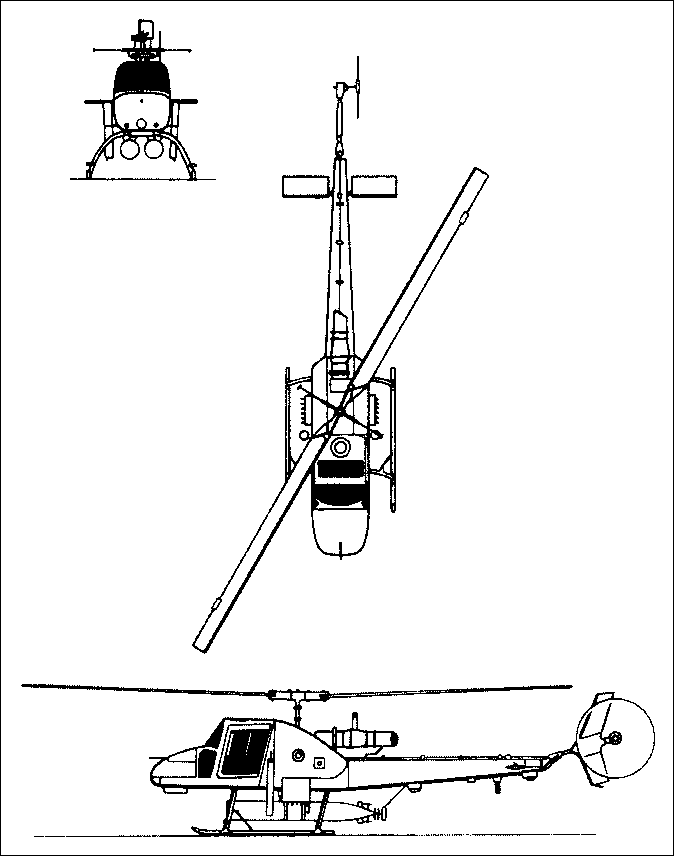
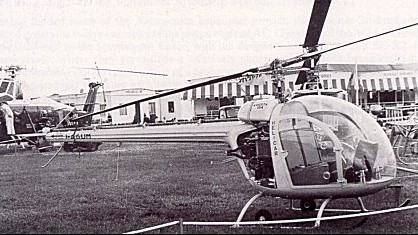
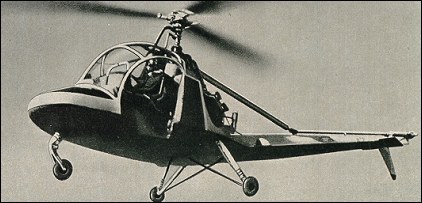
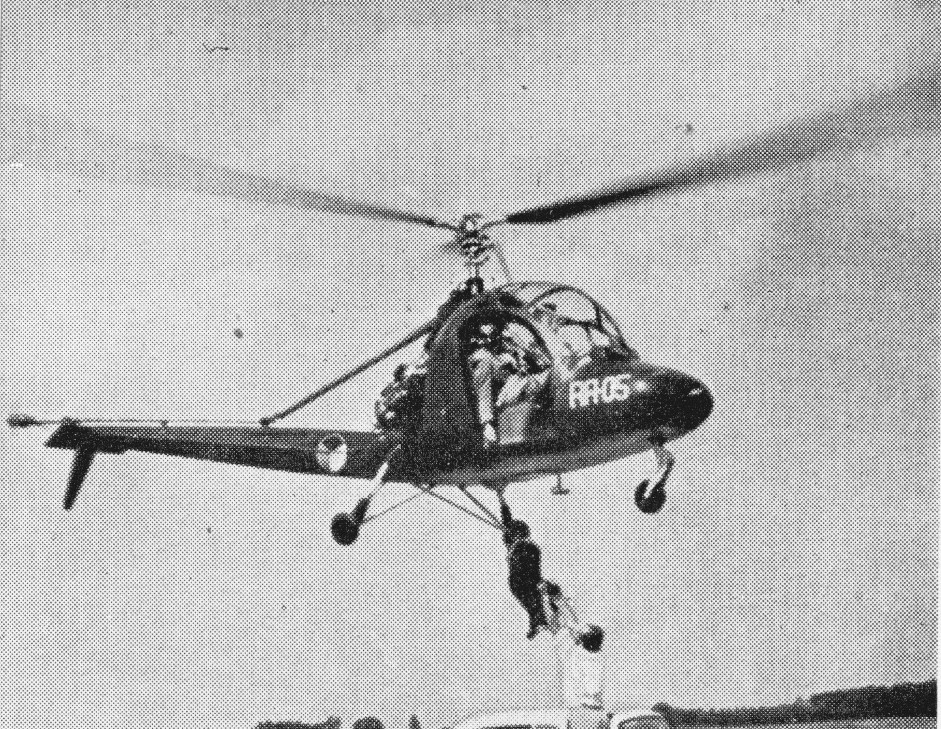
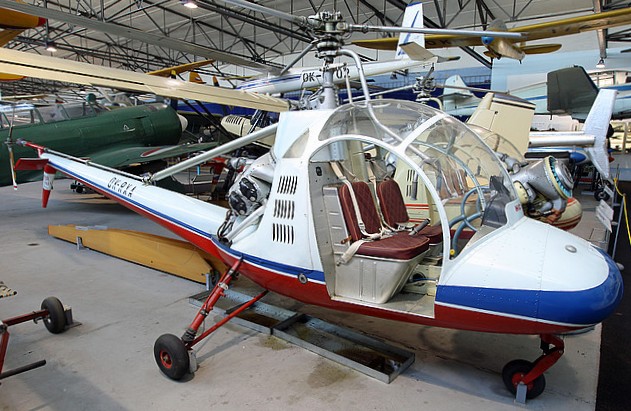
The XE-II was developed into the prototype HC-2, HC-3, and HC-102 Heli-Baby two-seat general-purpose helicopter. With an all-metal fuselage/boom, fixed tricycle undercarriage and 80hp Praga DH engine driving a three-blade rotor, the prototype HC-2 flew on 3 March 1954, and an order for 200 HC-2 helicopters was announced while still flying in prototype form. It is not clear how many examples were finally delivered, but the HC-2 of 1958 served with the Czech Air Force for some years.
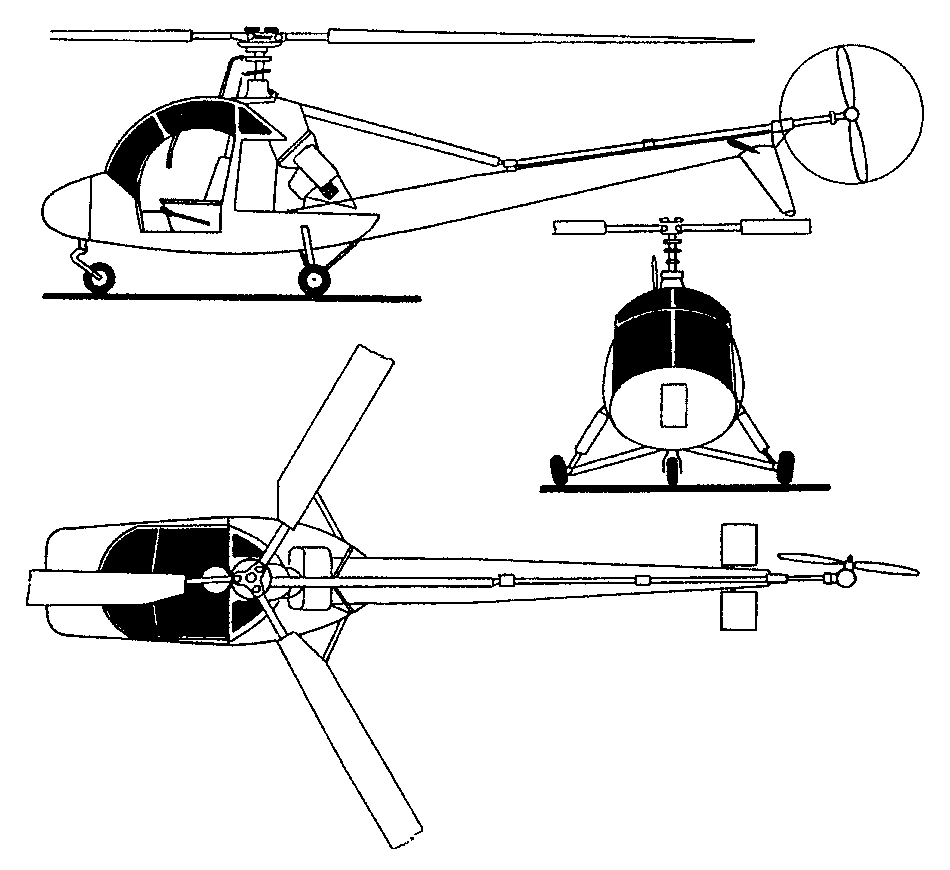
The HC-2 prototype is a two-seat light general-purpose helicopter, with a three-blade main rotor and two-blade anti-torque tail rotor. The main rotor blades are of wooden construction with a steel insert in leading-edge for mass balance and plywood covering armoured with fiberglass of NACA 23015 aerofoil section. The blades are fully articulated in flapping and drag planes with a single adjustable friction damper for all three drag hinges. The blades are mounted on tubular steel spars incorporating tension-torsion bars with cyclic pitch change actuated by control stick. The collective pitch lever is synchronised with engine throttle. Override settings of throttle are by means of twist-grip on pitch control lever. The individually-flapping tail rotor blades of laminated wood with fiberglass covering have the pitch controlled by rudder pedals. Additional horizontal tail surfaces are used during transition from vertical to horizontal flight. The fuselage is an all-metal semi-monocoque structure, with a non-stressed cabin enclosure. The landing gear is a fixed tricycle type, with castoring nose-wheel capable of swivelling through 360°, and oleo-pneumatic shock-absorbers on all three 260x85mm wheels. A tail-skid is fitted to avoid damage to rotor.
HC-2
Powered by an 83hp Praga DH four-cylinder horizontally-opposed fan-cooled engine mounted aft of the rotor pylon, with the crankshaft centre-line inclined at 45°. Drive from engine is taken through a centrifugal clutch to the main gearbox with a free-wheel in the main gearbox for autorotation. The tail rotor is driven off the main gearbox through a universal joint and shafting. The engine / main rotor r.p.m. ratio is approximately 10 : 1, and engine / tail rotor r.p.m. ratio approximately 3 : 2. Normal fuel capacity is 40 litres.
Seating is side-by-side for two in a cabin with Plexiglas canopy. Controlled by dual overhead cyclic control sticks and collective pitch levers on the left side of each seat. Starboard controls quickly removable. No doors.
HC.3
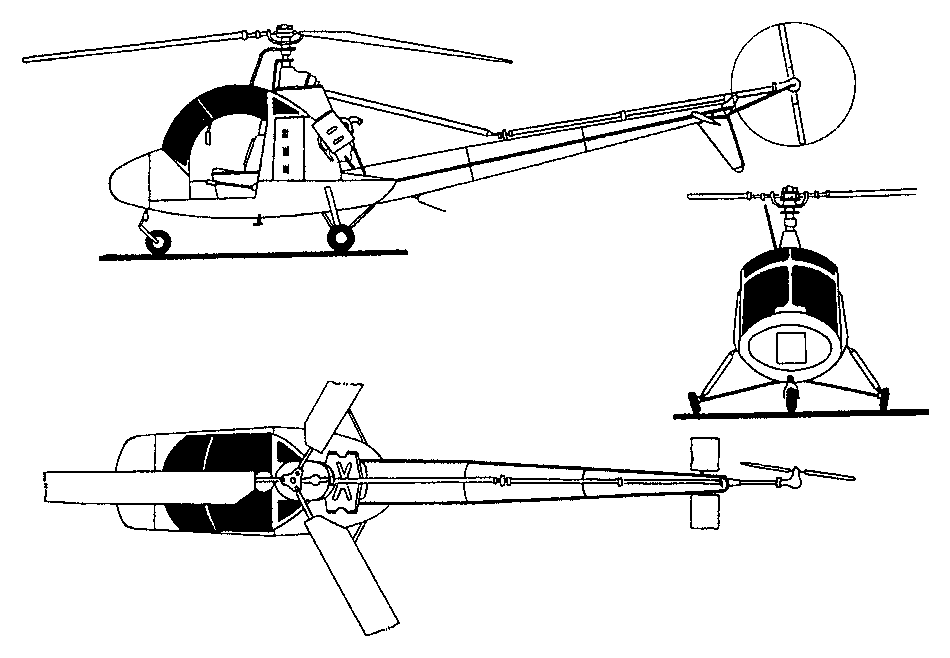
The HC.3 was an enlarged four-seater based on the HC-2 but with a four-leg undercarriage, englarged cabin section and an M-108H engine mounted above and behind the cabin. Three prototypes were tested (OK-15 to OK-17) but the type did not reach production.
HC.102
HC-2 Engine: 1 x Praga DH, 80 hp / 60kW Main rotor diameter: 8.8m Length: 10.50m Height: 2.3m Take-off weight: 580kg Empty weight: 370kg Max speed: 126km/h Cruising speed: 100km/h Ceiling: 3030m Range: 150km
Aero Vodochody Ltd After World War 2 the Czech aviation industry was nationalised under central control although the Aero 140 was sold under the Aero name.
Aero Vodochody Narodni Podnik was established on July 1, 1953, perpetuating the old Czech name Aero. Achieved technical distinction and international success during 1963-1974, when the major product (for several countries) was the Delfin jet trainer (first flown April 1959; more than 3,000 built). This was succeeded in production in late 1972 by the L-39 Albatros jet trainer and light attack aircraft (first flown November 1968), following its selection as standard jet trainer of all Warsaw Pact countries except Poland; the L-39 as part of training system, comprising also special simulator, ejection training simulator and mobile automatic test equipment. Aero Vodochody received the Red Banner award of the Ministry of Engineering and UVOS seven times. Renamed Aero Vodochody Ltd. In May 1997 the Board selected a consortium made up of Boeing (90%), the former McDonnell Douglas, and CSA Czech Airlines (10%) to take a major stake in the company as strategic investors. Product range then comprised the L-39 Albatros, L-59, L-139 Albatros 2000 (using US engine and avionics) and L159 ALCA jet trainers and light combat aircraft, and the Ae 270 Ibis transport as a partner with AIDC in Ibis Aerospace. The L159 did not sell and in 2004 the Czech government bought the firm back for a nominal sum.






 All Aero