American Sport Copter UltraSport 254 / Light’s American Sportscopter UltraSport 254

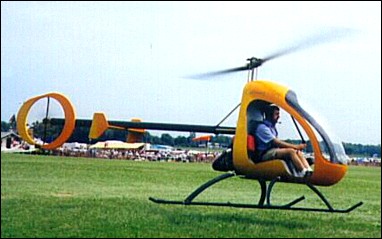
American Sportscopter (ASI) was formed in 1990 to produce an ultralight helicopter to FAR Part 103, which was designated Ultrasport 254. Design objective of 254 was basic weight not to exceed 115kg (254 lb) in order to comply with FAR Pt 103.
First flown on 24 July 1993 and publicly displayed at Oshkosh that year, it is a single-seater with a semi-enclosed composite fuselage structure, skid undercarriage and a tubular tailboom with tailplane and twin fins and a tail rotor enclosed in a large circular shroud. Two prototypes were built and tested.
The two-blade composites construction main rotor has tip weights for momentum conservation in the event of an engine failure, an 8 deg linear twist and infinite life. The tail rotor drive is carried in a narrow streamlined tailboom. A centrifugal sprag clutch for starting engages rotors at 2,000 engine rpm and automatically disengages in the event of engine failure.
Fitted with a 5 US gallon tank, and the 8 foot wide landing gear stressed for landings at up to 2.5g, and has optional floats (weight 18kg). A quick build kit requires 80 hours to assembly. An overhead control stick operates with same movements as joysticks. A floor-mounted cyclic option has available since 1998.
It is powered by a 55hp Hirth 2703 engine mounted behind the cockpit rear bulkhead. In 2003 the engine used was the 41.0kW Hirth 27G3 dual-carburettor two-stroke engine with pull starter and 12:1 planetary transmission. Normal fuel capacity 19 litres.
The Ultrasport 254 was available in 2003 for US$34,900.

Engine: 55 hp Hirth 2703 522cc.
Transmission: 12:1 planetary.
Speed max: 63 mph.
Cruise: 63 mph.
Range: 70 sm.
ROC: 1000 fpm.
Rotor blades: Composite 21’, 6.7” chord, metal tail rotor 40”.
Fuel cap: 5 USG.
Weight empty: 252 lbs.
Gross: 525 lbs.
Height: 7.5 ft.
Length: 16.67 ft.
Seats: 1.
Landing gear: skids.

Engines: 55hp Hirth 2703, 65hp Hirth 2706 is optional. Dual carb,Dual CDI.
Transmission 12:1 Planetary
Rotor Blades: Composite 21′ diameter, 7″ chord
Composite tail rotor 30′ diameter.
Cruise 63 mph
Top Speed 63 mph
Empty Weight 252 lbs
Useful Load 273 lbs
Gross Weight 525 lbs
Width 8′
Height 7’10”
Length 19’2″

Ultrasport 254
Main rotor diameter: 6.4m
Tail rotor diameter: 0.76m
Length with rotor blades folded: 5.84m
Height: 2.39m
Take-off weight: 238kg
Empty weight: 114kg
Max level speed: 101km/h
Max rate of climb: 305m/min
Hovering ceiling, IGE: 3290m
Hovering ceiling, OGE: 2135m
Range with normal fuel at 100km/h: 120km
American Helicopter XA-8 / XH-26

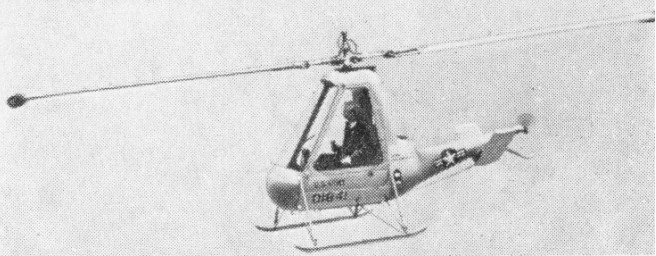
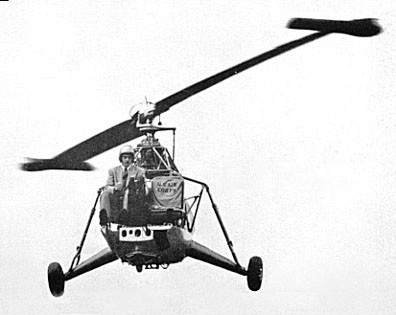
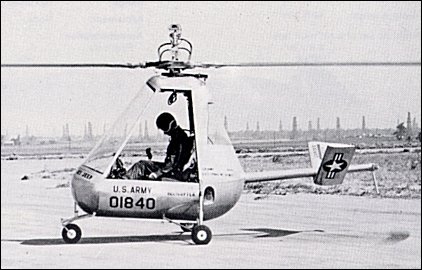
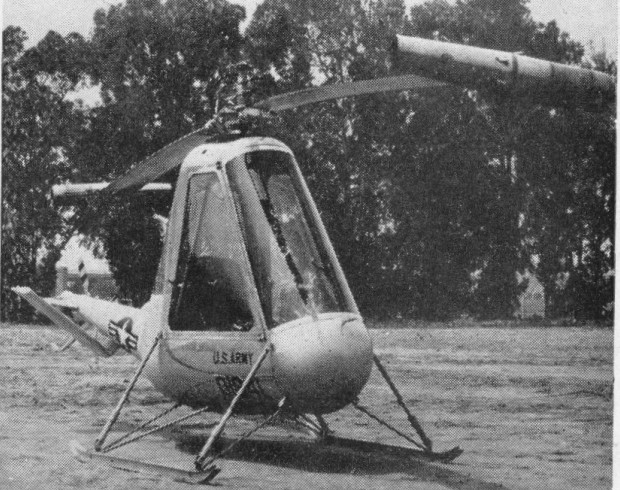
A 1950 Army specification called for a light, collapsible machine which could be used as both a light observation craft and as an air-droppable rescue vehicle for downed aircrew. American Helicopter responded with the Model XA-8 single-seat lightweight helicopter, design of which began in 1951 with the sponsorship of both the Army Transportation Corps and the USAF. American Helicopter was awarded a development contract in June 1951, and the first of a total of five XH-26s flew for the first time in June 1952.

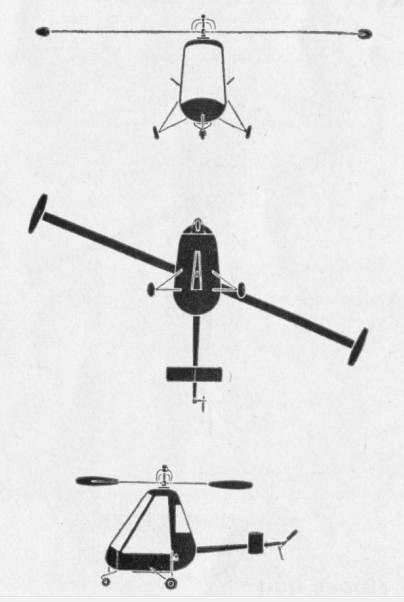
The XH-26 was designed from the beginning to be both collapsible and air-droppable and its construction and size reflected both requirements. Twelve feet long and six feet tall, the helicopter could be transported in a five foot by five foot by fourteen foot container and could be unpacked and assembled by two men in less than thirty minutes. The machine’s fuselage was built primarily of aluminum and fiberglass and featured a glazed, pyramid-shaped cockpit. The XH-26 was powered by two pulse-jet engines, one fixed to the tip of each main rotor blade, and could burn virtually any type of fuel.
The Army and Air Force jointly evaluated the five XH-26 prototypes from 1952 to 1954 but neither service procured the type in quantity.

American Helicopter H-26
Engine: 2 x American Helicopter XPJ49-AH-3 7.5 in pulse-jets, 16.2kg
Main rotor diameter: 8.23m / 27 ft
Rotors: 2-blade, tip-powered main; 2-blade tail.
Fuselage length: 3.73m
Height: 1.88m
Empty weight: 135kg
MAUW: 1,040 lb.
Max speed: 130km/h / 80 mph
Cruising speed: 110km/h
Service ceiling: 2280m
Range: 160km / 105 miles at 70 mph with normal load
Crew: 1

American Helicopter XA-5 Top Sargent

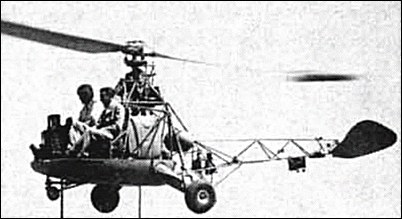
The first project of the American Helicopter company was the two-seat open-cockpit XA-5 “Top Sergeant”, which was based on the lower fuselage and undercarriage of a Sikorsky R-6 with an open rear boom and small rudder. It was driven by two tip-mounted 43kg AJ 8.75 pulse-jet engines driven by a fuselage-mounted compressor, and made its first flight in January 1949.

American Helicopter XA-5

Engines: 2 x 43kg AJ 8.75 pulse-jets
Seats: 2

American Helicopter Co

The American Helicopter Company was first formed in 1947 for research and development on XA-5 pulsejet-powered helicopter and later acquired by the Fairchild Engine and Airplane Corporation in April 1954.

Eugene M. Gluhareff was born in St. Petersburg, Russia in 1916 immigrating to the United States with his family via Finland in the early 1920’s.
An Aeronautical Engineer graduate of Rensselaer Polytechnic Institute in Troy, New York, he was a jet engine and helicopter designer and inventor. His extensive experience was acquired over many years of association with leading companies in the fields of design, research and development.
He has been a part of helicopter development since its beginning in 1940 with Sikorsky Aircraft Corporation in Bridgeport, Connecticut as a primary design engineer and project engineer. He worked directly under Mr. Igor I. Sikorsky and Mr. Igor A. Sikorsky, Chief of Aerodynamics. It was there he invented and developed the Pulse Jet Engine, a one-man single bladed jet helicopter which he test flew himself and also a Delta Wing Convertiplane for the United States Airforce.
In 1950 he moved to California and joined the American Helicopter Company in Manhattan Beach as a project engineer on a pulse jet powered helicopter (Top Sergeant). He was promoted to Chief of Preliminary Design and there designed the XH-26 One-Man-Jet Helicopter for the U.S.A.F.. Following this term with American Helicopter, he worked with Rotorcraft Corporation in Glendale, California as Design Engineer and was engaged in the redesign of a rocket powered one-man-helicopter for the U.S. Navy.

American Aircraft Penetrator

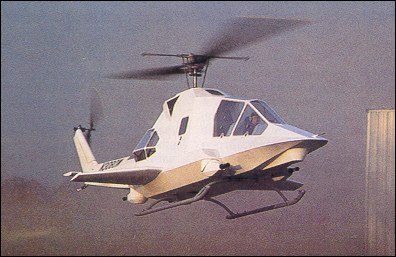
Bell UH-1B “Hueys” were stripped down to engine and transmission mounts, controls modified to tandem arrangement and re-covered with armored composite structure, containing troop-carrier compartment for six soldiers, two aft facing gunner turrets on either side of the engine and two forward facing turrets. The aircraft, named the “Penetrator”, was also outfitted with stub wings, which unloaded the main rotor in high-speed flight, increasing airspeed, and the aircraft’s aerodynamic fuselage minimizes profile drag. The basic model is an all-composite compounded helicopter with a gross take-off weight of 4280kg. To reduce the Penetrator’s drag, all the machine guns, cannons and some rocket launchers are carried internally.
The “Penetrator” offers the feature of a two-seat in tandem cockpit with the pilot positioned in the first seat for unobstructed vision and two forward-firing weapons operator is in the second seat, with the third and fourth weapons operators in seats aft of the main cabin to control rear-facing weapons. This firepower allows the “Penetrator” to perform as an excellent shock assault troop lift gunship with air-to-air, air-to-ground and ground-to-ground capability.
The Penetrator is fitted with a skid undercarriage (or optional retractable tricycle gear), a lower fuselage rear-facing gun turret and two forward-firing cannon. The “Penetrator” has 360 degrees of perimeter firepower and it’s composite construction of Kevlar reinforced by Nomex and the angular shape of its design afford the “Penetrator” ballistic resistance to small arms fire and low observability.

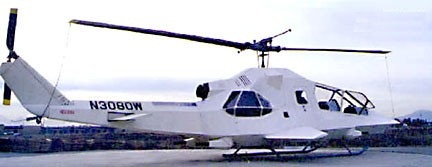
AAI Penetrator N3080W

Designed by William F Moody, the prototype (N3080W ex U.S.Army 63-8508) is powered by a 1300shp Avco Lycoming T52-L-13 turboshaft, and first flew in October 1991.

In 1990 American Aircraft fell into insolvency.

Engine: 1300shp Avco Lycoming T52-L-13
Rotor diameter: 48 ft 0 in
Length: 48 ft 0 in
Loaded weight: 4631 lb
Max speed: 195 mph
Cruise: 140 mph