Baumgartl Heliofly

Baumgartl Heliofly I

The Austrian engineer, Paul Baumgartl, concerned himself during the Second World War with the design of small single-seat helicopters, in the suburbs of Vienna. Baumgartl’s first product was the Heliofly I of 1941, which was little more than a strap-on autogyro glider for sporting use.

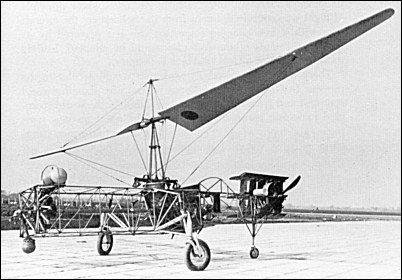
The Heliofly III-57 resulted from previous work. This had a rotor consisting of two co-axial contea-rotating single blades, each of which was to be driven by its own 8 hp Argus As 8 engine, which also acted as a counter-balance.

Baumgartl Heliofly III-59

When it became apparent that the Argus engines could not be readily obtained, the helicopter was redesigned in 1943 as the Heliofly III-59 to be powered by a single 16 hp engine. In this design, the engine drove and counterbalanced the lower blade and, through gearing, also drove the upper blade, so that torque was still counterbalanced by contra-rotation. A weight, instead of an engine, counterbalanced the upper blade, and the flapping rotor system had cyclic pitch control.
Heliofly III-59
Engine: 16 hp / 12kW
Rotor diameter: 6.10m
Max take-off weight: 120kg
Empty weight: 35kg
Crew: 1

Bauhauer Helicopter         

Dutchman A. G. von Baumhauer built a helicopter in 1925 that flew in a very limited fashion. Able to stay in the air only briefly, this unsuccessful machine had a single main rotor and a small vertical tail rotor to offset torque. It needed the weight of dangling chains at each corner to keep level. A separate engine powered the tail rotor, which operated independently of the main rotor.

Bahyl Helicopter

On 13 August 1895, Jan Bahyl was granted a patent numbered 3392 by emperor Franz Joseph. On the following years he made several attempts reaching a height of 0.5 meters in 1901, 1.5 in 1903 and on 5th May of 1905 at Pressburg he flew up using his petrol-engine helicopter to a height of 4 meters for over 1500 meters that was also recorded by the International Airship Organisation.

Bahyl, Jan           

Jan Bahyl, born in Zvolenska Slatina (Austro-Hungary) in 1845, graduated from the Banska Stiavnica Mining Academy with a diploma in technical drawing in 1869. During his year long army service, he was noticed by his superiors, having made some technical improvements for the Hungarian army, and was enrolled into the technical staff.
As well as being entrusted with complex building tasks while in the army, Bahyl was also able to study at the Vienna Military Academy, where he graduated in 1879 and was made a lieutenant.
During his time in the army Bahyl was able to work on a number of inventions, many of which involved hydraulics. His first notable invention, which he actually financed with his own money, was the Steam Tank. This was bought by the Russian army, the money from which enabled Bahyl to dedicate the rest of his life to inventing.
Bahyl was granted 7 patents in all, including the invention of the tank pump, air balloons combined with an air turbine, the first petrol engine car in Slovakia (with Anton Marschall) and a lift up to Bratislava castle. Perhaps, he is best remembered though for constructing a petrol motor-driven helicopter, which he himself flew up to 4 meters high and for over 1500 meters, in 1905.
On 13 August 1895, he was granted a patent numbered 3392 by emperor Franz Joseph. On the following years he made several attempts reaching a height of 0.5 meters in 1901, 1.5 in 1903 and on 5th May of 1905 at Pressburg he flew up using his petrol-engine helicopter to a height of 4 meters for over 1500 meters that was also recorded by the International Airship Organisation.

Aviolanda

AVIOLANDA MAATSCHAPPIJ VOOR VUEGTUIGBOUW NV
AC-pi / ML-sp
Founded December 1926. Before Second World War built under license Dornier Wai twin-engined flying-boats for Royal Netherlands Naval Air Service and Curtiss Hawk biplane fighters for East Indies Army Air Service. After war made assemblies for Gloster Meteor, Hawker Hunter, and Lockheed Starfighter. Made N.H.I. Kolibrie helicopter. Developed AT-21 pilotless drone and aircraft components (e.g. passenger ramps). Extensive repair and overhaul work also undertaken.
Aviolanda, De Schelde and Fokker were eventually to unite, but not until long after World War Two.

Aviaimpex Yanhol / Angel

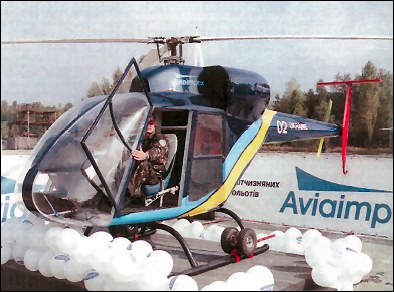
With the prototype structurally complete, the Aviaimpex Yanhol was displayed to the media on 31 August 2001. First flight was planned for June 2002.
Of pod-and-boom configuration, with T-tail and landing skids, the three seat helicopter has three-blade main and two-blade tail rotors.
COSTS: US$120.000 in Ukraine; US$150.000 export (2002),

Enghines: Two Rotax 912 ULS, 73.5kW.
Main rotor diameter: 8.28m
Tail rotor diameter: 1.30m
Length: 7.45m
Height: 2.475m
Max. take-off weight: 870kg
Empty weight: 524kg
Max. payload: 350kg
Max. speed: 184km/h
Max. cruising speed: 165km/h
Range max. fuel: 340km

Aviaimpex

Aviation division of TVT Corporation formed to introduce helicopter design and production to Ukraine. Initial liaison with Aerokopter Ltd of Poltava (formed 14 December 1999); however, on 3 May 2000 Aerokopter design bureau divided and both elements became autonomous.

Avicopter AC313 / Changhe AC313

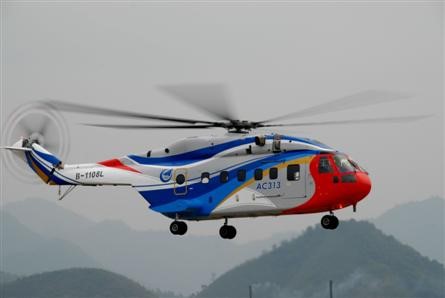
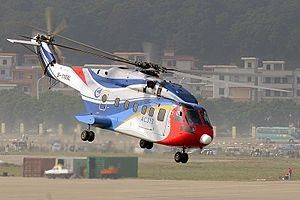
The 13.8t AC313 an updated design based on the earlier Harbin Z-8, itself a development of the Aérospatiale Super Frelon. The general designer of AC313 is Mr. Xu Chaoliang (徐朝梁), and the deputy general designer of AC313 is Mr. Li Jiayun (李家云). It is designed to carry 27 passengers, has a reported maximum range of 900 kilometres, and a maximum payload of 13.8 tonnes.

The rotorcraft has already been redesigned once to conform to updated certification standards—the CAAC refused the manufacturer’s application to certify the Z-8 for civil use in 2004. The CAAC determined then that an aircraft certified to military standards in China in the 1970s was not a candidate for civil use now. That appears to have sent the design authority, the China Helicopter Research and Development Institute, back to the drawing board to develop the considerably revised AC313.

The aircraft has new main and tail rotors, and a fuselage using composite material. With three Pratt & Whitney Canada PT6B-67A engines, the AC313 is a single-rotor helicopter with tail rotors, tandem pilot seating, and a non-retractable landing gear. Although based on a 1960s design, the AC313 has been developed to use composite materials for the rotor blade and titanium main rotor. Composite materials are used on 50% of the helicopter and titanium is used for the remainder. The interior comes equipped with a modern integrated digital avionics system and has a cabin height of 1.83 m and 23.5 cu.m in space. In terms of cargo, it can carry up to 4 tonne internally or 5 tonnes on a sling. AC313 is equipped with electronic flight instrument system.

The prototype first flew at Jingdezhen, Jiangxi on 18 March 2010 and made it first public demonstration flight at the Zhuhai Air Show in November 2010.

Built by Avicopter (AVIC Helicopter Company), the AC313 is only the second helicopter to be able to operate in the Qinghai-Tibet Plateau, first being Sikorsky S-70C Black Hawk. The flight testing period for the 13-tonne AC313 was conducted in Hulunbuir City, Inner Mongolia, starting in January 2011 where it was tested to operate in extremely low temperatures as low as minus 46degC marking the scope of Asia’s largest tonnage helicopter meeting the mission requirements of the cold climate and the Earth’s polar regions. The helicopter also set its speed record of 336 km per hour during the testing period. The AC313 became the first China-made aircraft authorized by China’s civil aviation authority in January to fly in high-altitude regions of over 4,500 meters above the sea level.

AC313 has received a Type Certificate issued by the Civil Aviation Administration of China (CAAC).

Following Chinese certification, the first 5 AC313 were to be delivered to Flying Dragon Special Aviation, in 2011. Avicopter has plans to certify the AC313 for sales in Europe and the United States. Xu Chaoliang, the chief designer of the helicopter, said the company has so far received 32 orders from national and international customers.

Like other Chinese aircraft, it has high-altitude operations as a key objective, so that it can fly from bases on the Tibet-Qinghai plateau. The CAAC has certified it to operate from fields as high as 4,500 meters (14,800 ft.).

Equipped with advanced instrument landing system, the helicopter can be used in blizzard weather in plateau regions. It can seat up to 27 passengers and two crew, has a maximum range of 900km (485nm) and is designed for transport, cargo, search and rescue, fire-fighting, offshore exploration and medical evacuation missions, Avicopter says.

CAIH, a wholly owned subsidiary of the China Aviation Industry Corp, was expected to produce 300 helicopters annually by 2015.

Gallery