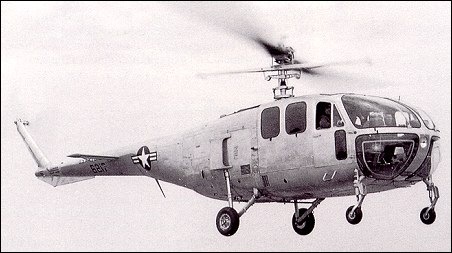
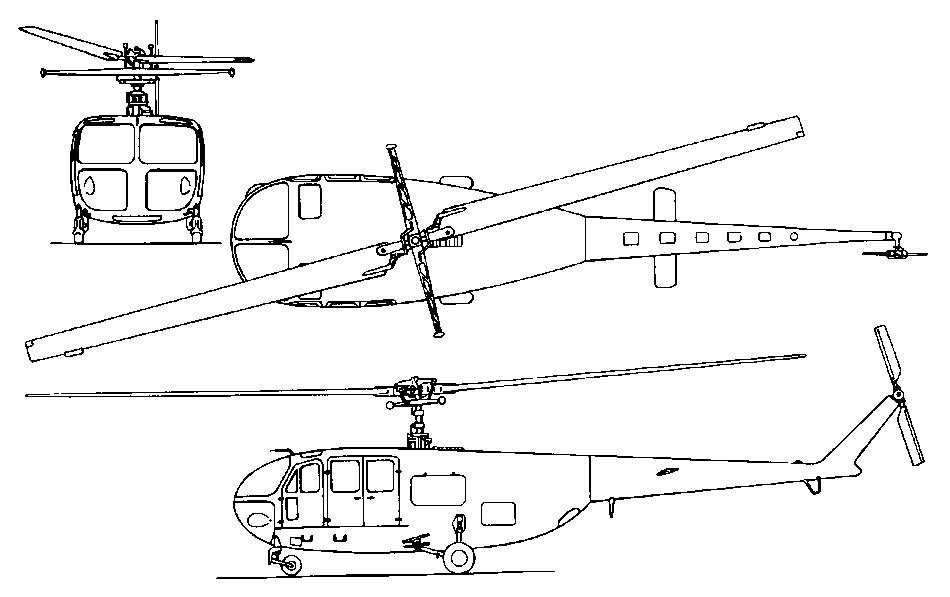
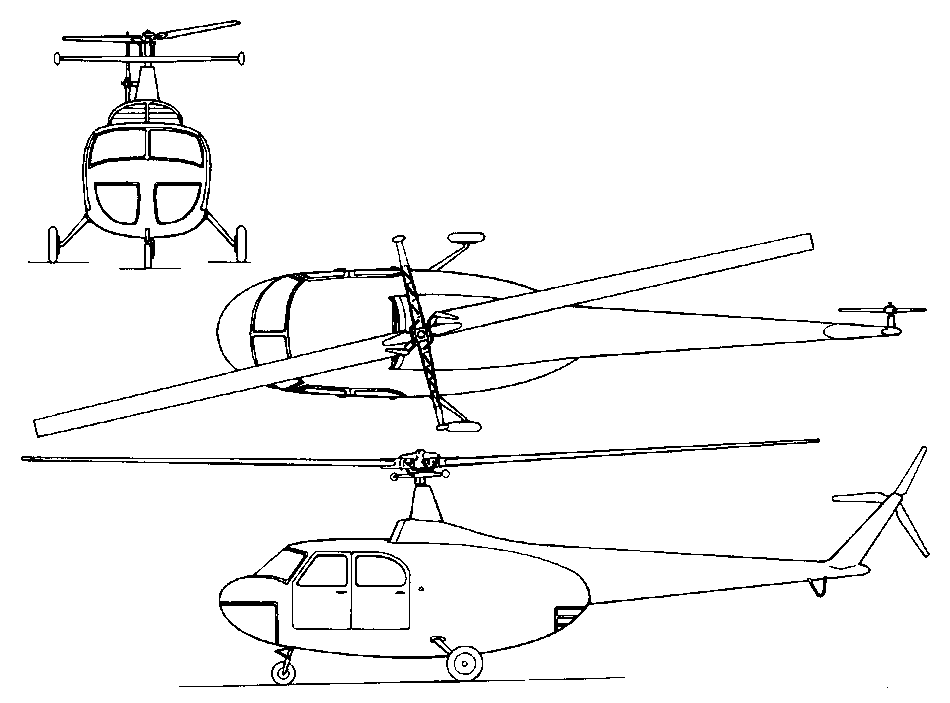
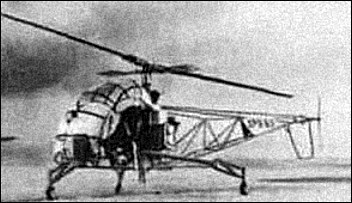
In 1946, Bell developed a new general utility helicopter of larger dimensions than the Model 47, as the Model 42, and a military version, the Model 48. The general configuration was a two-blade rotor with stabilising bar, three-wheel non-retractable undercarriage and five-seat cabin with car-like windscreen and doors. The engine was a 540hp Pratt & Whitney R-1340-AN-1 Wasp radial mounted horizontally in the rear fuselage with radiator air intake on top. Alternative equipment included flotation gear for water operation (which was tested on aircraft s/n 46-215), rescue hatch and hoist, litters and life rafts. The USAAF ordered two prototypes of a military derivative, the Model 48, designated XR-12-BE (s/n 46-214/215) as well as a static test airframe. A first production batch of thirty-four examples (R-12A-BE, s/n 47-491/524) was ordered but never built. This order was cancelled in 1947. Meanwhile, the USAAF had ordered a prototype of an enlarged variant, designated XR-12B-BE (s/n 46-216), able to carry up to ten people. This prototype, known as the Model 48A, was followed by a batch of ten similar service trials YR-12B-BE (s/n 46-217/226) with the more powerful 600hp Pratt & Whitney R-1340-5 5 Wasp. The YH-12B was different in shape and the undercarriage had four wheels (wheel base 3.30m; wheel track 2.13m). The wider cabin had separate doors for the crew and passengers and the nose was nearly all-glazed. Horizontal stabilisers were fitted each side of the tail boom. The anti-torque rotor was now located on the port side of the tail-boom end. At the time, the approximate cost of the YR-12, less government-furnished equipment, was estimated at $175,000. Initial deliveries of the YR-12 were scheduled for the summer of 1946. However, Bell was faced with serious engineering difficulties with the prototype. Serious blade weaving and rotor governor trouble were encountered in the main rotor system. In April 1946, Bell accepted the assistance of the Propeller Laboratory at Wright Field to overcome these problems. In May 1946, the USAAF considered that the YR-12 ‘was going to require considerable development and time delay before it was a successful ship’ and procurement of the heavier Sikorsky S-51 was then considered. Delivery of the first YR-12 was in September 1946. Flight tests went smoothly but no production batches of the H-12 were ordered. In 1948, the Bell Model 48 and 48A were respectively re-designated XH-12-BE, XH-12B-BE and YH-12B-BE. They were used for a variety of test programmes before being withdrawn from use. None of them is known to have survived.
Developed from the Model 30 (third prototype configuration), the Bell Model 47 was ordered for the US Army and Navy towards the end of World War II and first flew in 1945. The pre-production model had a 178 hp Franklin engine driving a two-blade wooden main rotor, two side-by-side seats, open cockpit (but later removable transparent bubble), four-leg wheel u/c, open frame rear fuselage with tail skid (later tubular tail rotor protector), ventral fin and and a car-type. The prototype (NC41962/NC1H) first flew on 8 December 1945. Only ten were built.
On 8 March 1946 this was awarded the first Approved Type Certificate issued for a civil helicopter anywhere in the world. Licensed by the Federal Government and manufactured under Helicopter Type Certificate One. The A and B models used the enclosed body In 1947 the USAAF procured 28 of the improved Model 47A, powered by 117kW (157-hp) Franklin O-335-1 piston engines, for service evaluation: 15 were designated YR-13, three YR-13As were winterised for cold-weather trials in Alaska, and the balance of 10 went to the US Navy for evaluation as HTL-1 trainers. Little time was lost by either service in deciding that the Model 47 was an excellent machine, and the orders began to flow in. The US Army’s first order was issued in 1948, 65 being accepted under the designation H-13B; all US Army versions were later named Sioux. Fifteen of these were converted in 1952 to carry external stretchers, with the designation H-13C. Two-seat H-13Ds with skid landing gear, stretcher carriers, and Franklin O-335-5 engines followed, and generally similar three-seat dual control H-13Es. The H-13G differed by introducing a small elevator, and the H-13H introduced the 186kW Lycoming VO-435 engine. Some of the H-13Hs were used also by the USAF, as were two H-13Js with 179kW Lycoming VO-435s acquired for the use of the US President. Two H-13Hs converted for trial purposes, with an increased-diameter rotor and 168kW Franklin 6VS-335 engine, were designated H-13K. In 1962 US Army H-13E, -G, -H and -K aircraft were redesignated with the prefix letter O, for observation. US Air Force H-13Hs and H-13Js were given the U prefix as utility helicopters. Later acquisitions were the three-seat OH-13S to supersede the OH-13H, and the TH-13T two-seat instrument trainer. US Navy procurement began with 12 HTL-2s and nine HTL-3s, but the first major version was the HTL-4, followed by the HTL-5 with an O-335-5 engine. HTL-6 trainers incorporated the small movable elevator. The HUL-1 was acquired for service on board ice-breaking ships, and the final HTL-7 version for the US Navy was a two-seat dual-control instrument trainer with all-weather instrumentation. In 1962 the HTL-4, HTL-6, HTL-7 and HUL-1 were redesignated respectively TH-13L, TH-13M, TH-13N and UH-13P The 47B-3, a utility and agricultural model, had an open sports-car style body and it was from this design that the goldfish bowl moulded canopy was derived.
Bell 47B
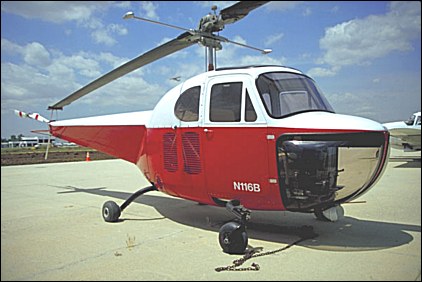
In parallel with production of military aircraft, by both Bell and its licencees, there were civil versions for a wide variety of purposes. These have included the Model 47B (equivalent to the military YR-13/HTL-1), and the agricultural/utility Model 47B-3 with open crew positions. Available in 1948, this model was the crop-dusting variant featuring a fully open cockpit and bins were affixed aft of the cabin and could carry 180kg of dust. The 47B was powered by a vertically mounted 175hp Franklin 6ALV-335 six-cylinder engine. The enclosed cabin, seating two side-by-side, featured two car-like doors. A total of 78 Model 47Bs (including 47B-3) were produced.
Two Bell 47B-3’s used by B.E.A. had plexiglass cabin, covered fuselage, and 178 hp Franklin 6V4-178-B32 engines.
Bell 47B-3
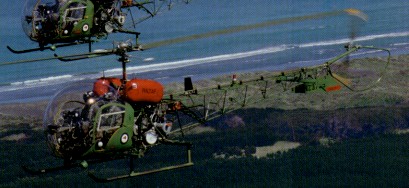
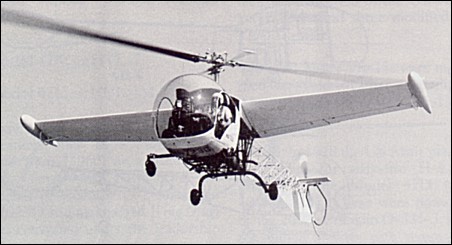
Early in 1948, the Model 47B was superseded by the Model 47D (FAA certified in February 1948) which incorporated improvements, including the plastic bubble-like cabin, the top of which could be removed to provide an open cockpit. In 1949, a new sub-variant appeared, the Model 47D-1 utility helicopter with an openwork tail boom capable of carrying three people or 225kg of payload. The same year, Bell helicopters began to be used on air mail services in Chicago and a Bell 47 set a new altitude record with 5654m as well as a new speed record with 215.45km/h. In 1950, a Bell 47D-1 became the first helicopter to fly over the Alps, and in Belgium the first European postal service by helicopter was set up by Sabena on 21 August, 1950. At the end of the same year, Bell 47s were used to take precise measurements over the Niagara Falls. On 17 September, 1952, Bell pilot, Eiton J. Smith set the world’s straight line distance record for helicopters without payload (Class-E) at the controls of a Model 47D-1 registered N167B, flying nonstop from Hurst (Texas) to Buffalo (New York): 1958.37km in 12hr 57min. On 2 September, 1956, at the National Aircraft Show in Oklahoma City, an H-13H flown by an Army pilot stayed in the air for 57hr and 50min, an unofficial world’s record. The introduction of the Model 47G (granted an FAA certificate in 1953) combined the three-seat capacity of the Model 47D-1 with a 149kW Franklin engine which, through a two-stage planetary transmission system, drove a main rotor of laminated wooden blades with steel leading edges, a tail rotor and a cooling fan. This helicopter had a synchronized elevator directly linked to the cyclic pitch control lever, an improvement which gave better stability and an increased margin of centre-of-gravity travel. The landing gear consisted of two skis 2.88 metres apart, and, if needed, quick-change flotation gear could be fitted. In the former case, two small wheels assisted handling on the ground. The service designations were H-13G in the United States Air Force, HTL-6 in the United States Navy. The designation 47G-1 is that given to the prototype of the 47J equipped with a Lycoming 250hp derated engine.
A Bell 47G-2 landed on the summit of Mt.Blanc (15,770 ft) with two occupants.
Bell 47G-3B-1
Substitution of the similarly powered Avco Lycoming VO-435 resulted in the Model 47G-2 (H-13H). A 179kW VO-435 engine brought the changed designation Model 47G-2A, followed in 1963 by the wider cabin Model 47G-2A-1 with improved rotor blades and increased fuel capacity. Other engine installations included a 168kW supercharged Franklin 6VS-335-A (Model 47G-3); 209kW turbocharged Avco Lycoming TVO-435 (47G-3B); and normally aspirated Avco Lycoming VO-540 and VO-435 engines in the three-seat utility Model 47G-4 and Model 47G-5 respectively. A two-seat agricultural version of the latter was known as the Ag-5, and a civil version of the USAF’s H-13J VIP transport was marketed as the Model 47G-4 and Model 47G-5 respectively.
Bell 47G-2 Wing Ding
The Model 47G-2 registered N6723D and nicknamed “Wing Ding” was converted under the leadership of Jan Drees and flown by Floyd Carlson and Lou Hartwig in 1963. The purpose of the Wing Ding programme was to develop an aircraft which would lift very large payloads in excess of its hover capability, taking advantage of running take-offs and landings. In addition to the wing the rotor’s mast angle could be varied in flight.
Bell 47H
Introduced in 1955, the Model 47H was a deluxe version of the Model 47G. It had an enclosed sound-proofed, 3 seat cabin. The cabin had leather upholstery throughout as well as a leather covered dashboard grouping all electrical switches and carburettor controls. The metal monocoque tail boom contained a luggage compartment. The cabin’s width has been increased to 1.52 metres, so that motor vehicle-size seats can be used. With a 200hp engine, the Bell 47H was not a commercial success.
Bell 47J-2A
First proposed in 1956, the Model 47J was a four-seat utility version of the Model 47G civil version of the USAF’s H-13J VIP transport, powered by a 220hp derated Lycoming VO-435. The enclosed cabin sat the pilot centrally in front and three passengers on a cross bench behind. This bench could be removed to allow the installation of two stretchers. The left door could also be removed for an internal electrically-powered hoist. Alternative skid or pontoon landing gear could be fitted and metal rotor blades were optional permitting a loaded weight of 1290kg. Larger capacity fuel tanks (182 litres) could also be installed providing an extended range of 400km. All the mechanical parts were the same as in the 47G-2. The soldered-tube tail is replaced in the 47J by a monocoque beam. The central section was still made of tubes, but was streamlined. This model was also built under licence by Agusta with 152 aircraft built. Sub-variants were:
Model 47J-1 – this sub-variant was similar to the Model 47J but was powererd by a Lycoming VO-435A.
Model 47J-2 and J-2A “Ranger” – introduced in 1960, this sub-variant was similar to Model 47J but had a 305hp (derated to 240hp) Lycoming VO-540-B1B, metal rotor blades, hydraulic power controls and a gross weight of 1290kg. The Model 47J-2A of 1964 was produced in Italy by Agusta.
Model 47J-3 “Super Ranger” – this variant, produced by Agusta, was powered by a Lycoming VO-540 derated to 260hp. It differed from the standard J-2A in having a modified main transmission able to absorb greater power input. A special ASW version was designed for the Italian Navy with new instrumentation, high efficiency rotor brake and armed with a single Mk.44 torpedo.
Model 47J-3B-1 – this sub-variant produced by Agusta was a high-altitude version powered by a 270hp Lycoming TVO-435-B1A and equipped with an exhaust-driven supercharger which maintained sea level conditions up to 4260m. This model also had a high-inertia rotor and servo-control on the pitch control systems.
1959 Bell 47J
The 1959 version of the Bell 47J Ranger had a modified tail-rotor control to simplify maintenance. Larger drag-links are required for the metal blades of the main rotor. B 1959, over 2000 Bell 47s had been built.
The 47J “Ranger” is the first helicopter to have crossed the Andes by way of the Christo Paso. This flight was made at a height of 5180m, with a total weight of approximately 68kg below the helicopter’s own maximum gross weight. HUL-1 is the U.S. Navy designation. Experimental versions have been numerous. Perhaps the two most important were the turbine Bell Model 201 (service designation XH-13F) and the armed Bell Model 207 Sioux Scout. Bell’s production of Model 47s eventually came to an end in late 1973, versions of the Model 47G-5 being the last to be built. 4,018 were built in 24 different basic configurations. Of the many different models built only two of the commercial versions, the Bell 47G-2 and the Bell 47G-3B-l, had production runs in excess of 300 (334 and 337 respectively).
In 1952 Agusta SpA of Italy was granted a licence to build the Bell 47 and produced its first 47G in 1954. Since then Agusta has built over 1000 G (from 1954 to 1976) and J marks. Agusta produced a three-seat version as the EMA 124.
Agusta-Meridionali EMA.124
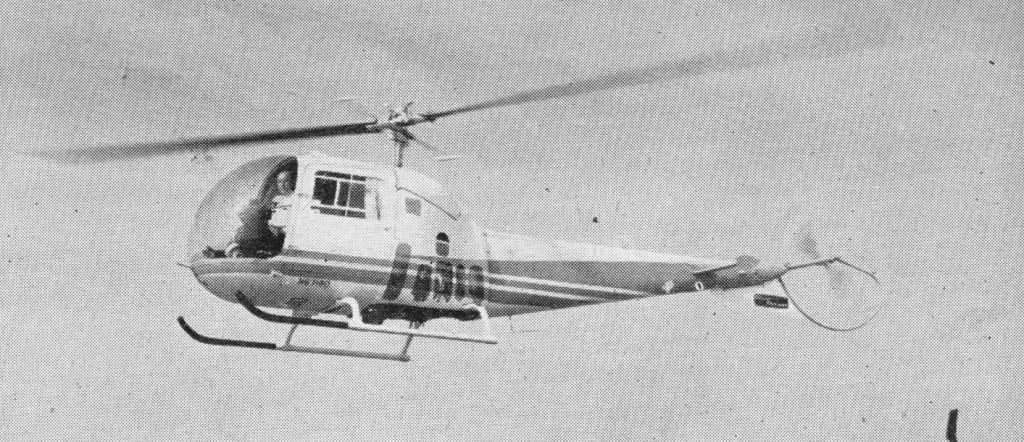
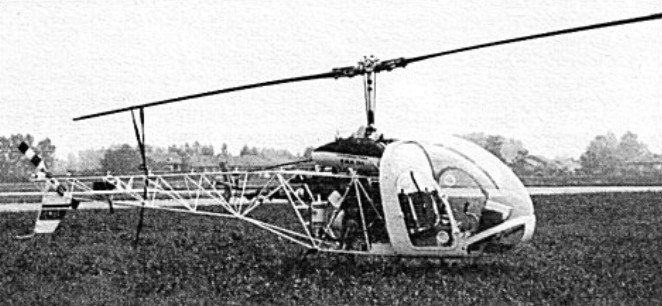
The Agusta-Meridionali EMA.124 Bell 47 derivative had three-seats, an open frame rear fuselage, skid u/c and one 305hp Textron Lycoming VO-540-B1B3 piston engine. Intended for production by Elicotteri Meridionali SpA, one prototype, I-EMAF, was built, first flown on 28 May 1970.
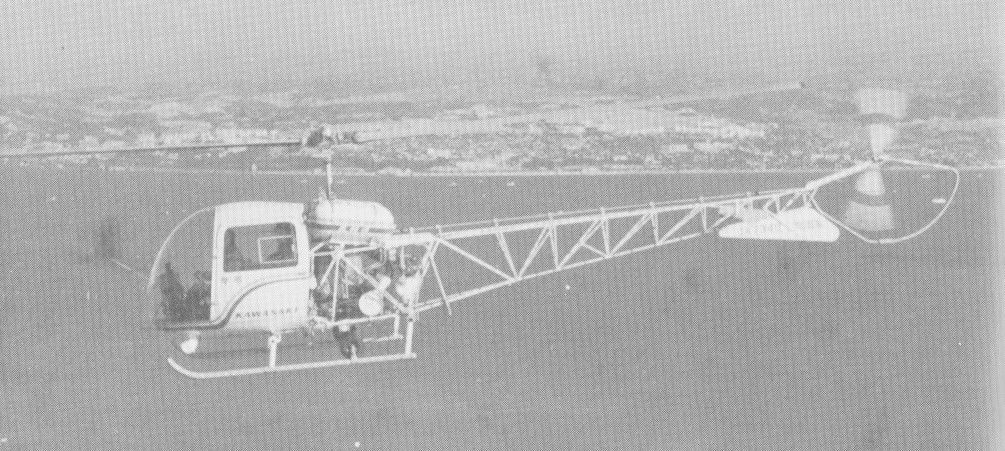
Kawasaki in Japan received a licence in 1953, and the Kawasaki-Bell 47G3B-KH-4 first flew as a type in 1962. Being a development of the Bell 47 G3B by Kawasaki, the type features a four-seat cabin layout, modified instrument and control systems, and a 260 hp Lycoming.
Kawasaki KH-4
In August 1964 it was reported that the British Army was buying 150 Bell 47G three-seat, similiar to the US Army OH-13S Sioux, but with 270 hp Lycoming TVO-435 engines. The first 50 were to be built in Italy by Agusta, and the next 100 by Westland Aircraft in Britain. The unit cost was about $50,000.
The Model 47 was built under licence by Westland in the UK (the 47G-2 for the British Army) with the name Sioux.
In addition there have been specialised conversions by at least two American companies, including a high-performance Carson Super C-4, and a number of El Tomcat agricultural aircraft developed by Continental Copters Inc. Turboshaft conversions of several models have been produced by Soloy in the USA.
47 Initial prototype, 10 built. Car-type cabin Engine: Franklin, 178 hp Main rotor: two-blade wooden, Seats: two side-by-side
47A / YR-13 / YH-13 / HTL-1 USAF version of Model 47 as YR-13 with enclosed rear fuselage and tail boom, powered by one 175hp Engine: Franklin O-335-1, 175hp 28 built.
47A / YH-13A Three YH-13 modified for cold weather operations. Engine: Franklin O-335-1, 117kW (157-hp)
47B Two-seat commercial Model 47 with enclosed tailboom, fully enclosed fuselage with stepped windshield, under-nose transparencies and two car-type doors, four-leg u/c. Prot NX41967. Engine: Franklin 6V4-178-B3, 178hp Rotor diameter: 10.26m Gross weight: 992kg Empty weight: 626kg Cruising speed: 128km/h Rate of climb: 290m/min Service ceiling: 2960m Range: 320km Seats: two side-by-side
47B-3 Model 47 for crop dusting with modified open cockpit, engine compartment fairing, and externally mounted dusting hoppers. Engine: Franklin 6V4-178-B32, 178hp Payload: 180kg of dust.
47C / H-13G U.S.A.F. version
47D Model 47B-3 with improved plexiglass, bubble canopy, new wheel installation with brakes, 24 volt electrical system, modified fuel system, optional float u/c (47D-S) and 178hp Franklin 6V4-178-B32 engine.
47D / H-13B Sioux / HTL-2 Military model similar to civil 47D with four-leg u/c, bubble canopy with removable top, covered rear fuselage and dual controls. 61 built. Engine: Franklin O-335-3, 200hp
47D / H-13C Sioux H-13B with uncovered rear fuselage and skid u/c with external medevac litter fittings. 16 built.
47D / H-13D Sioux H-13C with single pilot controls. 88 built. Engine: 200hp Franklin O-335-5 Rotor dia.: 35 ft. 11 in. Weight: 2,350 lb Max speed: 100 mph Seats: 2
47D / H-13E Sioux / OH-13E H-13D with dual controls, modified main and tail gearboxes and main transmission. 49 built. Engine: Franklin O-335-5B, 178hp Seats: 3
47D-1 Three-seat Model 47D with open frame fuselage, new canopy, gravity-feed fuel system, ventral fin, roller-bearing transmission, 29-USG fuel capacity, reduced equipment and increased useful load. 937kg TOGW.
47D-1 / HTL-4 / TH-13L US Navy version of Model 47D-1. Later TH-13L. 46 built. Rotor diameter: 10.72m Overall length: 12.56m Fuselage length: 8.33m Height: 2.79m Loaded weight: 943kg Empty weight: 626kg Maximum cruising speed SL: 147km/h Rate of climb: 313m/min Service ceiling: 3965m Hover ceiling in ground effect: 1920m Range (75% power): 342km Seats: 3 Fuel capacity: 29-USG
47D-1 / HTL-5 HTL-4 with 200hp Franklin O-335-5 engine. Payload: 225kg Seats: 3
Bell 47D-S Engine: Franklin 6V4-178-B32, 178hp Undercarriage: floats
47E / HTL-3 Two-seat Model 47D with 200hp Franklin 6V4-200-C32 engine, 1060kg TOGW, 33-USG fuel capacity, optional open cockpit.
47G Three-seat Model 47D with 200hp Franklin 6V4-200-C32AB engine, skid u/c, small tailplane with endplates, relocated battery, revised tail rotor gearbox, synchronised elevator and relocated 43-USG ‘saddle’ fuel tanks 1060kg TOGW. Entered production 1953
47G-2 Model 47G with 200hp Lycoming VO435-A1A engine, relocated cyclic hydraulic boost controls, bonded metal rotor blades and 1105kg TOGW. Also built by Kawasaki.
Bell 47G / H-13G Sioux / HTL-6 / TH-13M / OH-13G US Navy dual control training version of H-13G. Later TH-13M. Military model similar to 47G-2 with increased fuel and external stretcher fittings. 265 built. Engine: Franklin, 200 hp / 149kW Rotor diameter: 10.72m Overall length: 12.62m Fuselage length: 8.33m Height: 2.87m Loaded weight: 1067kg Empty weight: 651kg Maximum speed: 138km/h Cruising speed: 113km/h Initial rate of climb: 238m/min Service ceiling: 2718m Hover ceiling in ground effect: 1098m Range: 341km Seats: 3 landing gear two skis Skid width: 2.88 m
Bell 47G-1 Engine: Lycoming 250hp derated
Bell 47G-2 / H-13H Sioux / UH-13H H-13G with 250hp Lycoming VO-435-23 engine, improved skid u/c and all-metal bonded rotor blades. 468 built. Engine: Avco Lycoming VO-435-23, 250hp
47G-2A Three-seat Model 47G with 240hp Lycoming VO-435-A1E engine, 1285kg TOGW. Also Kawasaki model.
47G-2A-1 47G-2A with fuel capacity inc. from 43-USG to 61.6-USG.
Bell 47G-2 Wing Ding
Bell 47G-3 / H-13K Sioux Civil and military model 47G with 225hp Franklin 6VS-335-A engine, longer rotor blades and 14-inch longer tailboom. 1195kg TOGW. Engine: 225hp Franklin 6VS-335-A supercharged TOGW: 1195kg
47G-3B / OH-13S Sioux Civil and military Model 47G-3 with turbocharged 260hp Lycoming TVO-435-A1A and 1285kg TOGW. 576 built. Engine: 260hp Lycoming TVO-435-A1A Length : 31.562 ft / 9.62 m Height : 9.285 ft / 2.83 m Rotor diameter : 37.238 ft / 11.35 m Max take off weight : 2954.7 lb / 1340.0 kg Max. speed : 91 kt / 169 km/h Service ceiling : 17487 ft / 5330 m Range : 274 nm / 507 km Seats: 3
47G-3B1 Model 47G-3B with 270hp turbocharged Lycoming TVO-435-B1A engine, 8-inch wider 3-seat cabin, 61.6-USG fuel capacity. 1330kg TOGW. Built also by Westland and Agusta. Engine: Lycoming TVO-435-B1A, 260 hp Max speed: 105 mph Range: 273 sm Rotor: 2-blade, 11.32-rn (37 ft 2 in) Cruise @ 65%: 80 mph Endurance: 3 hr TOGW: 1330 kg Useful load: 470 lb Seats: 3 Fuel capacity: 61.6-USG
47G-3B2 Model 47G-3B1 with turbocharged 280hp Lycoming TVO-435-G1A. 1330kg TOGW. Engine: Lycoming TVO-435-G1B, 280 hp Rotor: 2-blade, 11.32-rn (37 ft 2 in) Max speed: 91 kt Cruise: 73 kt Range: 215 nm Empty wt: 858 kg MTOW: 1340 kg
47G-3B-2A Engine: Lycoming TVO-435-F1A, 280 hp Rotor dia: 37 ft 1.5 in / 11.32 m Fuselage length: 37 ft 7 in / 9.63 m Empty weight equipped: 1893 lb / 858 kg MTOW: 2950 lb / 1338 kg Cruise 5000 ft / 1525m: 73 kt / 84 mph / 135 kph ROC SL: 990 fpm / 302 m/min Service ceiling: 19,000 ft / 5790 m Range max fuel 6000ft / 1830m, no res: 214 nm / 247 mi / 397 km Seats: 3 side by side External cargo: 1000 lb / 454 kg
47G-3B2 / TH-13T Two/three seat military instrument trainer with extra IFR equipment. 417 built.
47G-3B2A Model 47G-3B2 with TVO-435-F1A engine and 11-inch wider cabin
47G-4 Model 47G with 260hp Lycoming VO-540-B1 B3 engine, 61.6-USG fuel, hydraulically assisted controls and 1330kg TOGW. Engine: Lycoming VO-540-B1 B3, 260hp TOGW: 1330 kg Fuel capacity: 61.6 USG Seats: 3
47G-4A Model 47G-4 with engine uprated to 280hp.
Bell 47G-4 Ag-5 agricultural version Engine: Lycoming VO-540-B1 B3, 260hp Fuel capacity: 61.6 USG Seats: 2
47G-5 / H-13J Economy 2-seat version of 47G-4 with 12 volt electrical system. 1285kg TOGW, 28-USG fuel capacity. Can be upgraded to 3-seat configuration with synchronised elevator mod. Engine: Avco Lycoming VO-435, 260 hp TOGW: 1285 kg Fuel capacity: 28 USG Seats: 2-3
47G-5A 3-seat Model 47G-5 with 61.6-USG fuel tanks and 11-inch wider cabin. Engine: Avco Lycoming VO-435-B1A, 198-kW (265-hp) Max speed at sea level: 196 km/h (105 mph) Cruise: 137 km/h (85 mph) at 1525m (5,000ft) Service ceiling: 3200m (10,500ft) Range max fuel: 412 km (256 miles) Empty equipped weight: 786 kg (1,732 lb) MTOW: 1293 kg (2,850 lb) Main rotor dia: 11.32m (37ft 1½ in) Tail rotor diameter: 1.78m (5ft 10in) Length, rotors turning 13.3m (43ft 7½in) Height: 2.84m (9ft 3¾ in) Main rotor disc area: 100.61 sq.m (1,083 sq ft). Seats: 3 Fuel capacity: 61.6 USG
Bell 47H Engine: 200 h.p. Franklin 6V4-200-C32 Rotor diameter: 35 ft. 1.5 in. Rotors: 2-blade main; 2-blade tail Fuselage length: 31 ft. 4 in Loaded weight: 2,350 lb. Max. speed: over 100 m.p.h. Ceiling: 10,600 ft. Typical range: over 200 miles at 95 mph with full load. Cabin width: 1.52 m Seats: 3.
47H-1 Model 47G with fully clad fuselage, wider three-seat deluxe cabin and rear baggage stowage locker, contoured 35-USG fuel tanks, modified skid u/c. 1060kg TOGW. Rotor diameter: 10.72m Overall length: 12.62m Fuselage length: 8.33m Height: 2.82m MTOW: 1067kg Empty weight: 681kg Fuel capacity: 35 USG Maximum speed: 161km/h Cruising speed: 142km/h Initial rate of climb: 250m/min Service ceiling: 3660m Hover ceiling in ground effect: 1310m Range: 339km Number of seats: 3
47J Formerly 47G-1 Four-seat development of Model 47H with single pilot seat and rear 3-place passenger seat. Powered by one 220hp Lycoming VO-435-A1B, 1157kg TOGW and 35-USG fuel capacity.
47J / H-13J Model 47J for USAF with 240hp Lycoming VO-435-21.
47J / HUL-1 Model 47J for US Navy with 260hp Lycoming VO-435-B1B. Later UH-13P. Also HUL-1G (HH-13Q) for USCG. 25 built.
Bell 47J / H-13J / UH-13J Engine: Lycoming VO-435-21, 240hp
47J-1 Model 47J with VO-435A engine. Engine: Lycoming VO-435-A1B, 220hp Fuel capacity: 35 USG Opt fuel tanks: 182 lt Length : 31.562 ft / 9.62 m Height: 9.285 ft / 2.830 m Rotor diameter: 37.238 ft / 11.35 m Max take off weight: 1157kg Metal rotor blades option MTOW: 1290kg Max. speed: 91 kt / 169 km/h Service ceiling: 17487 ft / 5330 m Range: 274 nm / 507 km Seats: 4
47J-2 Ranger Model 47J with 240hp VO-540-B IB engine, metal rotor blades, fixed stabiliser, hydraulic controls, blue tinted bubble and windows, 48-USG fuel capacity and 1285kg TOGW. Originally 47G-1 Engine: Lycoming VO-540-B1B, 305hp (derated to 240hp) Gross weight: 1290kg Fuel capacity: 48 USG Seats: 4
47J-2A Model 47J-2 with 260hp Lycoming VO-540-B 1 B3 engine, collective boost system and 1330kg TOGW. Built by Agusta.
47J-3 Naval Model 47J-2A with strengthened transmission, improved rotor brake and underslung torpedo. Agusta built.
Bell 47J-3 Super Ranger Engine: Lycoming VO-540 derated to 260hp
47J-3B1 Model 47J with turbocharged Lycoming TVO-435-B1A engine for high altitude operation and modified servo control system 1330kg TOGW. Lycoming TVO-435-B1A 270hp @ 4260m Rotor diameter: 11.32m Fuselage length: 9.87m Height: 2.83m Take-off weight: 1340kg Empty weight: 845kg Maximum speed at sea level: 169km/h Cruising speed at 1525m: 138km/h Initial rate of climb: 276m/min Service ceiling: 5340m Hover ceiling in ground effect: 5030m Hover ceiling out of ground effect: 3720m Range: 338km Seats: 4
47K / HTL-7 / TH-13N US Navy 2-seat trainer based on HUL-1 with modified cockpit and IFR instrumentation. 240hp Lycoming O-435-6 engine. 1157kg TOGW, 35-USG fuel capacity. Later TH-13N. 18 built. Engine: Lycoming O-435-6, 240hp TOGW: 1157kg Fuel capacity: 35 USG Seats: 2
47L / HUL-1M / UH-13R Experimental Model 47J with 250shp Allison YT-63-A-3 turboshaft and 1285kg TOGW. First a/c Bu. 149838 FF 6 Jan, 1961. Later UH-13R. 2 built.
Kawasaki-Bell 47G3B-KH-4 Engine: Lycoming TVO-435-D1A, 270 hp Main rotor diameter: 37 ft 1.5 in / 11.32 m Fuselage length: 32 ft 7.25 in / 9.93 m Empty weight: 1890 lb / 757 kg MTOW: 2850 lb / 1292 kg Cruise speed: 76 kt / 87 mph / 140 kph ROC S/L: 850 fpm / 260 m/min Range max fuel: 186 nm / 214 mi / 345 km Seats: 4
Continental Copters 47G-2 El Tomcat Agricultural conversion by Continental Copters with single seat cockpit and two large external hoppers plus underslung spray bars. Seats: 1
Texas Helicopters M-74 Wasp Conversion by Texas Helicopters
Texas Helicopters M-79T Hornet Conversion by Texas Helicopters
Agusta EMA 124 3 seat development of 46G Engine: VO-540, 250 hp Seats: 3
With the Model 47 in production Bell concluded that there was a market for a larger helicopter with seating for five or six people. The Model 42 was a streamlined all-metal helicopter which could carry five people: the pilot’s and co-pilot’s seat were situated in the front of the cabin, and a bench seat for three passengers was located in the rear. The Model 42 had a completely enclosed fuselage pod and boom and a fixed tricycle undercarriage, and a stabilising bar on the main rotor. It was powered by one 450hp Pratt & Whitney R-985 Wasp Junior engine, mounted horizontally behind the cabin driving a two-blade symmetrical aerofoil wooden rotor. Cooling was assured by a large airscoop located at the root of the main rotor mast. The rotor had a reduction gear ratio of 8.987:1. In addition to the free-wheeling coupling, the transmission included a rotor brake. A three-bladed anti-torque tail rotor, also made of laminated wood, was on the starboard side of the semi-monocoque tail boom. Access to the cabin was via two car-like doors. The undercarriage was of the fixed tricycle type and fuel capacity was 65 US gal. The Model 42 design was a monstrous tangle of cables winding around drums and full of unexpected difficulties, and responsibility of the development was transfered to the Gardenville team. After much work and re-design, Arthur Young and Bartram Kelley got most of the bugs out of the prototype (c/n 1, NX33540) and made it fly properly. In December 1946, the Model 42 was displayed at the Cleveland Air Show. Two more examples were assembled and tested (c/n 2, NX42063; and c/n 3) but no firm orders were placed and the development of the Model 42 came to a halt. Nevertheless, the characteristic silhouette of the Model 42 would re-appear months later with the military Model 48. None of the Model 42 seem to have survived.
Model 42 Engine: one 450hp Pratt & Whitney R-985 Wasp Junior Rotor diameter: 14.48m Maximum weight: 2315kg Useful load: 656kg Maximum speed at sea level: 200km/h Cruising speed 75% pwr: 160km/h Service ceiling: 3965m Range: 480km
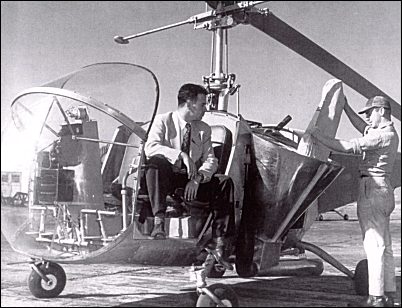
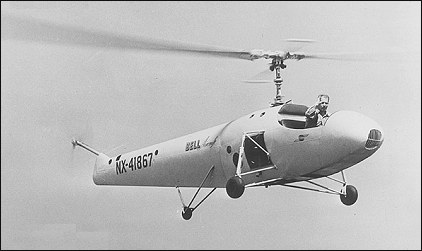
By the autumn of 1941, Arthur M Young had been testing helicopter scale-models on his farm in Pennsylvania for some thirteen years. After this period of research, many failures and his big breakthrough with the invention of the stabiliser bar, Young had perfected a design that would appeal to a manufacturer. Young’s first attempts at interesting aircraft companies in his machine met with little enthusiasm until one of his friends visited Bell’s factory. This led to an appointment for a demonstration on 3 September, 1941. Larry Bell and Arthur Young reached an agreement and, on 24 November, 1941, Young and his assistant, Bart Kelley, arrived at Bell to supervise the initial building of two prototypes as specified in the contract. On 23 June, 1942, Young and his team (some fifteen people) were installed in an old Chrysler agency and garage in Gardenville, a suburb of Buffalo. Dave Forman was assigned to supervise the project. The Model 30 structure was made of welded tubes with a four-legged undercarriage made of 3in aluminium tubing. The 160hp Franklin six-cylinder horizontally-opposed air-cooled engine was mounted vertically behind the cockpit within a steel-tube framework. The main two-blade rotor hub was mounted on a transmission mast by universal joint and was provided with a stabilising bar below and at right angles to the blades which were rigidly connected to the hub. This bar acted as a flywheel on a hinge. It kept the rotor blades level and independent from the movements of the fuselage, solving the problem of stability. The main rotor drive was done through a centrifugal clutch and a two-stage planetary transmission with a 9:1 reduction ratio. The blades, of symmetrical aerofoil section, were made of solid wood with a steel insert in the leading edge. The two-blade tail rotor (also made of solid wood) was mounted on a thin tube at the end of the fuselage. The roll-out of the first Model 30 (c/n 1, later to be registered NX41867) took place on 24 December, 1942; a secretary broke a bottle of champagne on the fuselage and the aircraft was named Genevieve. That day, the engine was run up at 150rpm. The first flight occurred on 29 December when Young flew the tethered Model 30 at an altitude of 1.5m; the same day Floyd Carlson also flew the aircraft. Early in January 1943, the prototype suffered an accident and its pilot, Bob Stanley, was badly hurt. The aircraft was repaired and on 26 June, 1943, the cable was removed and Carlson took Genevieve on its first free flight. The aircraft performed well and by July 1943 was flying at speeds of over 110km/h. At this time, a three-wheeled undercarriage was installed, the fuselage was covered and the aircraft was painted blue overall, so that it could be used for demonstration flights. While flights of the Model 30 No.1 were underway, aircraft No.2 was being built. Several modifications were introduced in this machine: new undercarriage, semi-monocoque fuselage and new tail rotor mounting, and an enclosed cockpit, with car-like doors, for the pilot and one passenger. Unfortunately a setback occurred in September 1943 when the No.1 crashed with Carlson at the controls. Carlson was unhurt but the badly damaged aircraft had to be rebuilt. It was flying again within six months. In late September 1943, aircraft No.2 (registered NX41868) replaced No.1 as the test vehicle. One of the first passengers to fly in this aircraft was Larry Bell. In 1944, Bell began a demonstration programme with aircraft No.2 which made its public debut in March 1944. On 10 May, Floyd Carlson flew the aircraft indoors in a Buffalo armoury before Civil Air Patrol pilots and cadets. By the spring of 1944, aircraft No.1 had been rebuilt and was designated No.1A. This helicopter was the star attraction at a soldier’s benefit show, staged at Buffalo’s Civil Stadium on 4 July 1944. On 5 January, 1945 the first rescue mission ever made by a Bell helicopter took place when Jack Woolams baled out of a P-59 Airacomet in trouble near Lockport. Floyd Carlson and Dr. Thomas C. Marriott took off in one of the Model 30s and, guided by Joe Masham flying a P-59, rescued the unfortunate pilot. But the first publicised rescue mission took place two months later, on 14 March, when two ice fishermen were rescued on Lake Erie. Carlson received the Treasury Department Silver Medal for this feat. The construction of a third aircraft introduced several improvements including a four-wheel undercarriage, an advanced instrument panel and a tubular tailboom, but it retained the open cockpit of No.1. This helicopter (c/n 3, registered NX41869) flew for the first time on 25 April, 1945, and performed well, so well that it proved to be the best of the trio to demonstrate, but the open cockpit was a real handicap. To overcome this Young had the idea of covering the cockpit with a Plexiglass bubble thus providing both comfort and outstanding visibility for pilot and passenger. The shape of this aircraft was now very near to that of the Model 47. Two of the Model 30s are still in existence: c/n 1A (NX41867) is on display at the National Air and Space Museum and c/n 3 (NX41869) is owned by Buffalo and Erie County Historical Society Museum, Amhurst, New York.
Model 30 Engine: 1 x Franklin 6-cylinder, 110.4kW / 160hp Main rotor diameter: 9.75m Main rotor: 2-blade wooden Length: 8.22m Height: 2.59m Empty weight: 518kg Crew: 1 Passengers: 1
A little-known fourth research helicopter was constructed, and used to evaluate the coaxial configuration employed successfully by Breguet in France and Hiller in California. A single-seat prototype with two counterrotating rotors on a common shaft briefly took flight. “With a torque corrected by a torque, it was much more precise in hover than a tail-rotor machine,” said Arthur Young, the only one to fly it. “It was just like standing on the floor; you could move it an inch or a half inch or whatever you wanted”. The coaxial helicopter was set aside a couple of days into testing when the transmission gears were found to be badly gouged. Although he had learned what he needed from this unusual prototype, Young was later distressed to find that it had been unceremoniously taken away and junked.
Bell was responsible for design and construction of the Model 47, the first helicopter to receive Approved Type Certificate from the U.S. Civil Aviation Authority (on March 8,1946), and which remained in production for more than 25 years. Later helicopters of particular importance included the UH-1 Iroquois (Model 204) military utility helicopter (first flown October 1956), and the world’s first purpose-designed tandem two-seat attack helicopter, the Model 209 (military AH-1 HueyCobra), first flown September 1965 and operated by the U.S. Army in Vietnam from 1967. Production of HueyCobra in the U.S.A. ended, but Fuji in Japan still produced examples in the AH-1S version. Bell programs include remanufacture of 180 AH-1W SuperCobras and 100 UH-1Ns of U.S. Marine Corps into AH-1Zs and UH-1Ys respectively under the H-1 Program, with upgrades common to both helicopter types including the installaton of General Electric T700 engines, four-blade composite hingless and bearingless rotors, and much more besides; upgrade and life-extension of UH-1Hs of other forces to UH-1H-II or Huey II standard (joint Bell and AlliedSignal program) by installation of AlliedSignal T53-L-703 turboshaft engine plus airframe improvements; production of the twin-turboshaft AH-1W SuperCobra for the U.S. Marine Corps (introduced 1986); and upgrade of 411 U.S. Army 0H- 58 Kiowa reconnaissance helicopters to OH-58D Kiowa Warrior armed configuration (also for Taiwan). Also development and production of the BA 609, a civil tiltrotor transport in association with Agusta of Italy, after Boeing’s share in the program was passed to Bell). Bell participates in the Bell Boeing V-22 Osprey military tiltrotor program (first flown March 1989) to provide the U.S. forces with a vertical-lift transport and multipurpose aircraft capable also of strike, rescue, amphibious combat assault, and anti-submarine work. Bell Helicopter Company, originally a division of Bell Aircraft, became a branch of Textron Inc. in 1960 and a fully-integrated subsidiary in January 1982. Bell Helicopter Textron Inc. is its current name; Bell has produced well over 33,000 helicopters. In 1986 commercial/civil helicopter production moved to Canada. Came to an agreement with IAR-SA Brasov in 1996 to allow license manufacture of AH-1W SuperCobra in Romania, tied with the purchase of a majority shareholding in IAR-SA Brasov. A subsidiary of Textron Inc in the USA and Canada. 1995: Bell Helicopter Textron, PO Box 482, Fort Worth, TX 76101, USA, and Bell Helicopter Textron Canada, 12800 Rue de l’Avenir, St Janvier, Quebec J7J 1R4, Canada. Bell Helicopter Canada was founded in 1984, with a production factory at Mirabel completed 1985 as a division of Textron Canada Ltd. Manufacture of Bell Helicopter Textron Inc. commercial/civil helicopters moved from U.S.A. to Mirabel 1986, leaving U.S. company free to concentrate on military types. Production encompasses Model 206B-3 JetRanger III five-seat light helicopter (first flown 1962 in original form and 1977 as JetRanger III) and its TH-67 military trainer variant; seven-seat Model 206L-4 LongRanger IV (first flown 1974 in original form and certificated 1992 as LongRanger IV); Model 206LT TwinRanger as twin-turboshaft variant of LongRanger (certified 1993); 15-seat Model 212, using twinned turboshafts; Model 230 intermediate- twin ten-seat helicopter (first flown August 1991); Model 407 extra-wide variant of LongRanger with a fourblade main rotor (first flown June 1995); Model 412EP 15-seat utility helicopter, also suited to specialized roles such as law enforcement, SAR, and medical (first flown 1979); Model 427 eight-seater (first flown December 1997) as a lengthened version of Model 407; and Model 430 derived from the Model 230 but with more engine power and a four-blade bearingless composite main rotor (first flown October 1995).
In 1952 Agusta was granted a license to build Bell Model 47 helicopters. First Agusta-built example flew May 1954, and over 1,200 were built before production ended in mid- 1970s. The company also produced Bell Iroquois models as Agusta-Bell 204B and 205, twin-engined Model 212 (still offered as AB-212 Naval/Skyshark) and Model 206 JetRanger (still offered as AB-206B JetRanger III) helicopters. In 1967, under Sikorsky license, production of SH-3D helicopters began, and in 1974 production of HH- 3F (S-61R); production of final HH-3F Combat SAR version lasted into mid-1990s. Together with Elicotteri Meridionali, SIAI-Marchetti, and other Italian companies, Agusta became involved in production of the Boeing Vertol CH-47C Chinook. Other license-built helicopters include AB-412EP/Griffon/Maritime Patrol versions of the Bell 412EP and Griffon, AMD-500E version of the McDonnell Douglas (now Boeing) MD 500E, and Agusta-Boeing 520N NOTAR helicopter.
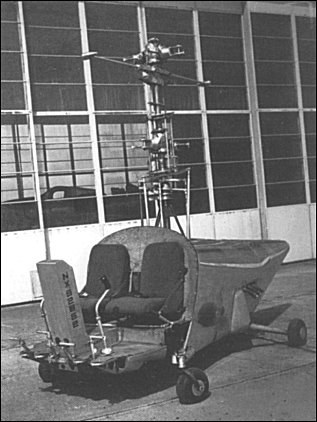
Paul Baumgarti was an Austrian who had worked on three helicopter designs during the war years before emigrating to Brazil. He experimented with a number of light helicopters in the 1950s and 1960s including the PB-64 which was an ultra-light single-seater with a minimal tubular fuselage structure.
The PB-64 had a pulse-jet propulsion arrangement with the two 13-kg ITA jets fitted to a transverse stabilising beam set at right angles to the rotor. The aircraft had no tail rotor but was fitted with a small, stainless steel, rudder. The blades have no taper or twist.
No production of any of these designs was undertaken.
Power: 2 x ITA pulse jet, 30 lb thrust Rotor dia: 21 ft 0 in Blade section: NACA 23012 Blade chord: 6.5 in Length: 15 ft 0 in Height: 7 ft 6 in Empty weight: 240 lb MAUW: 700 lb Max speed: 80 mph
Paul Baumgarti was an Austrian who had worked on three helicopter designs during the war years before emigrating to Brazil. He experimented with a number of light helicopters in the 1950s and 1960s including the single-seat PB-60 unpowered ground-towed rotor kite, and the PB-64 which was an ultra-light single-seater with a minimal tubular fuselage structure. Baumgarti subsequently built his PB-63 under Brazilian Air Ministry funding. After the first model with coaxial rotors, it was given a traditional two-blade articulated rotor. This was a conventional helicopter with a single seat and semi-enclosed cabin, powered by an 85hp Continental C.85 engine. No production of any of these designs was undertaken. The last of a family of experimental helicopters designed in Brazil by the engineer Paul Baumgarti.
PB-63 Engine: 1 x Continental C85-12, 85hp Rotors: 2-blade main; 2-blade tail Rotor diameter: 6.0m / 19 ft 8 in Gross weight: 360kg / 794 lb Empty weight: 238kg Cruising speed: 60 m.p.h. Ceiling: 2285m / 7,500 ft Seats: 1






 All Aero