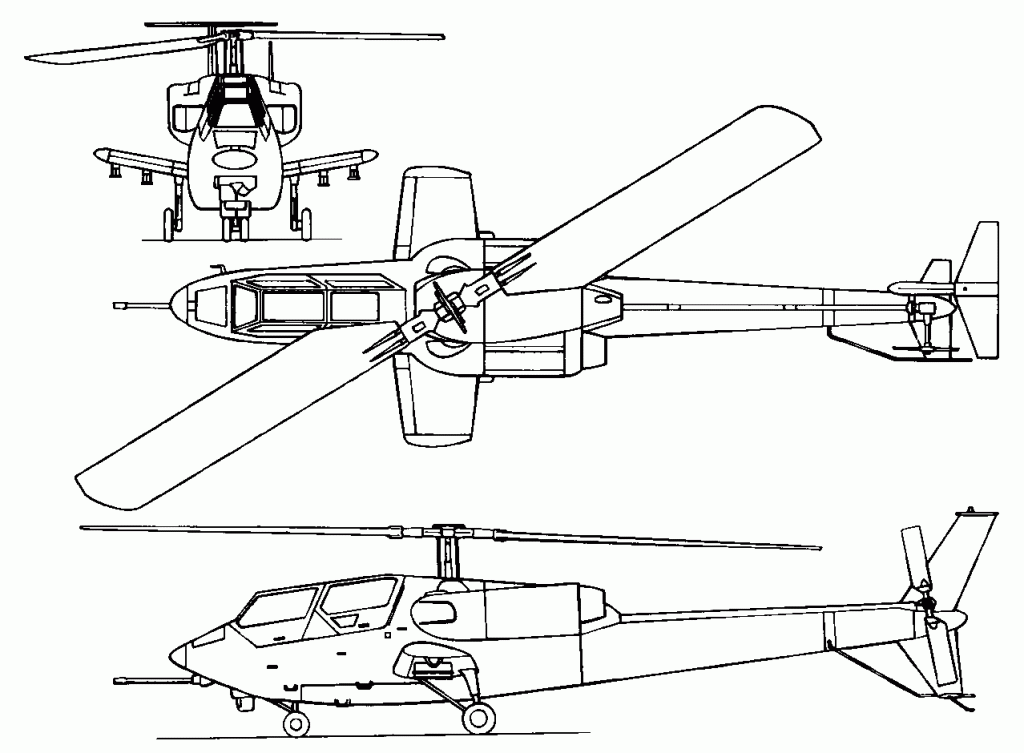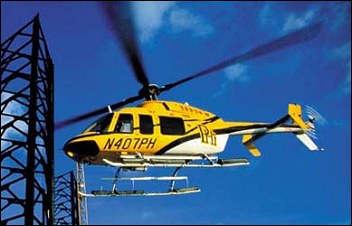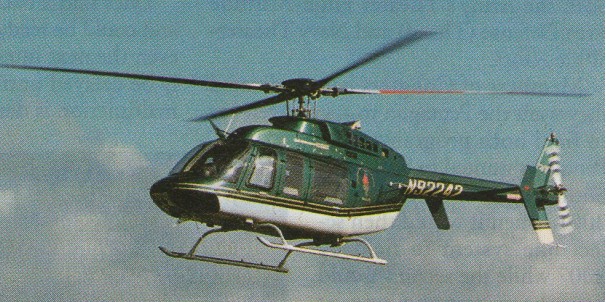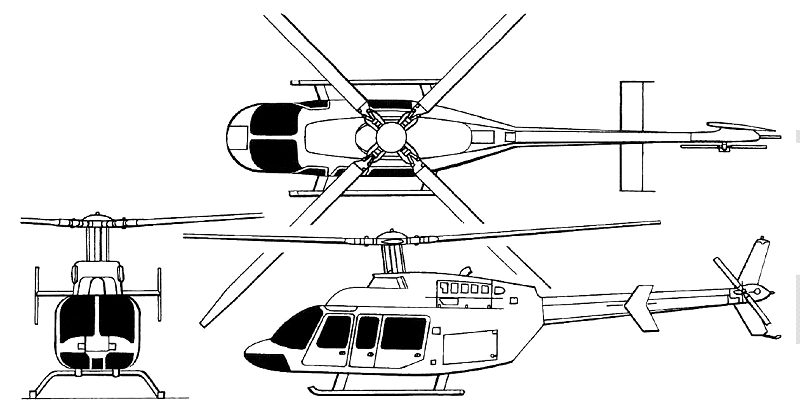
Bell 412

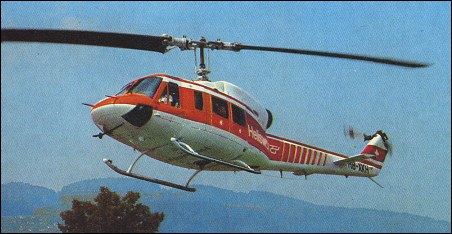
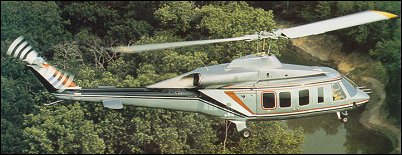
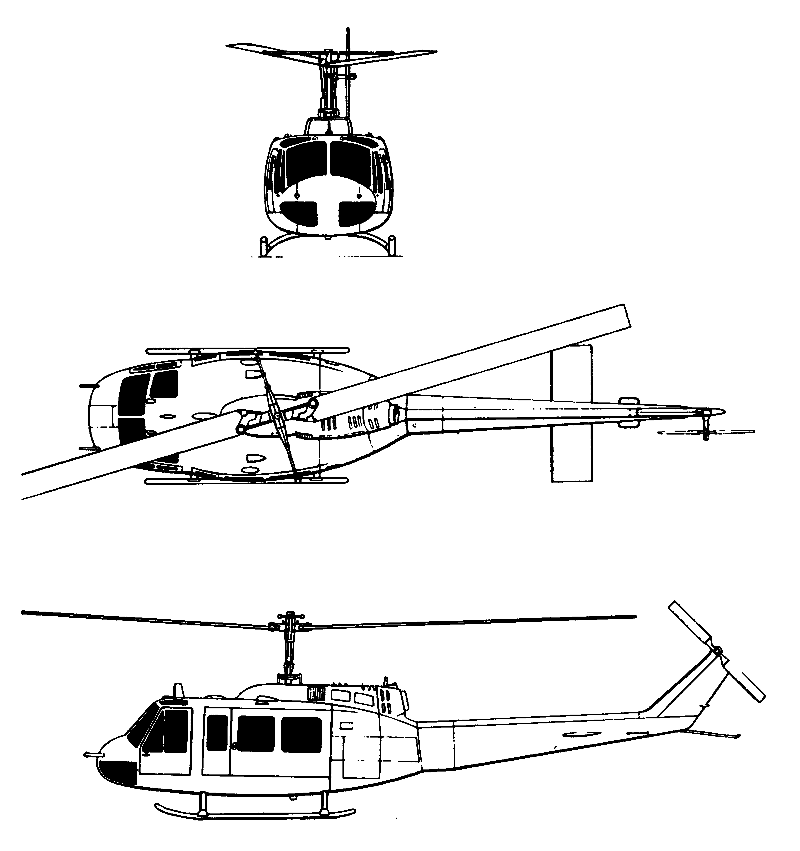
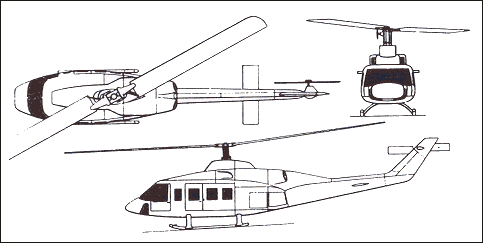
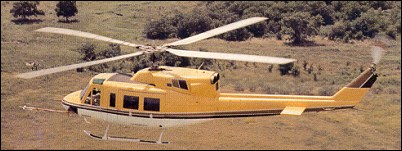
On 8 September, 1978, Bell announced its intention to develop a four-bladed variant of its twin-turbine Model 212. Designated Model 412, this helicopter was the first four-blade rotor helicopter to be produced by Bell. The rotor head had elastomeric bearings that eliminated both mechanical hinges and viscous dampers. In mid-1984, the internal vibration level was further lowered by the introduction of a pendulum damper kit on production aircraft, but this was also available independently for retrofit to earlier machines.

Bell 412 Article

Two newly built Model 212 airframes served as development prototypes and for the certification programme.
The Model 412 retained the same powerplant as the Model 212, the Pratt & Whitney Canada PT6-3B-1 Turbo Twin Pac delivering 1400hp for take-off and 1130hp for continuous operation. The blades, fitted with a Nomex honeycomb core, are bonded together by glassfibre wrapping incorporating anti-icing heater mats and are interchangeable. The rotor mast is shorter than the 212, with blades that can be folded ans a rotor brake as standard. The main rotor rpm is 314. Equipped with a two-blade tail rotor. The elastomeric bearings of the hub eliminate both mechanical hinges and heavy, viscous dampers. This improves the ride and also extends the rotor system life, while the flex beam yoke of the main rotor hub provides quick control response. The new bearings require no lubrication and require only a quick visual inspection to confirm integrity. In the drive system, five of the six-rotor drive shaft sections are interchangeable, reducing spares. Main transmission chip detectors help protect the system. The four composite blades have an unlimited life and span wise variation of their chord, twist and thickness of airfoils give added turning and aerodynamic efficiency.
Generally of conventional light metal. Main rotor blade spar unidirectional glass libre with 45degree wound torque casing of glass fibre cloth; Nomex rear section core with trailing-edge of unidirectional glass fibre; leading-edge protected by titanium abrasion strip and replaceable stainless steel cap at tip; lightning protection mesh embedded; provision for electric de-icing heater elements; main rotor hub of steel and light alloy; all-metal tail rotor.
The undercarriage is high skid, emergency pop-out float or non-retractable tricycle gear optional. Spats optional.
Fuel in in seven interconnected rupture-resistant fuel cells, with automatic shutoff valves (breakaway fittings), have a combined usable capacity of 1,249 litres. Two 76 or 310.5 litre auxiliary fuel tanks, many combination, can increase maximum total capacity to 1.870 litres. Single-point refuelling on starboard side of cabin.
The cabin hold a pilot and up to 14 passengers: one in front port seat and 13 in cabin. Dual controls optional. Accommodation heated and ventilated.
The first modified helicopter made its maiden flight in early August 1979, followed by the second machine in December of the same year.
FAA Pt 29 type approval was given on 9 January, 1981, and IFR certification came on 13 February, 1981.
The first deliveries had taken place on 18 January, 1981, ERA Helicopter Inc of Anchorage received its first aircraft (c/n 33001, N412EH), this company eventually acquiring up to nine Model 412s (c/n 33004/N164EH, 33007/ N414EH, 33009/N415EH, 33011/ N416EH, 33043/N419EH, 33068/ N422EH, 33069/N524EH and 33072/N356EH) to be operated alongside some sixteen Model 212s and fifty-two other Bell helicopters.
Two were delivered to the Venezuelan Air Force later in the year.
By the end of 1987, a total of 145 Model 412s had been delivered.
213 were built in USA before production (SP version) was transferred to Canada in February 1989.
A majority of the operators are civil. Only a few machines have been sold to military customers: two aircraft to Bahrain Defence Force Air Wing with codes BPS-03 and 04; two to the Venezuelan Air Force (one is c/n 33013); three TO the Botswana Defence Force (with two more on order); one to Panama (c/n 33091, serialled FAP-1101); four to Sri Lanka’s armed forces; two to the Nigerian Police Air Wing; an estimated seven to the Bangladesh Air Force and some aircraft to Peru to equip Escuadron 341 and Escuadrilla Presidencial.
An improved variant, the Model 412SP (SP for Special Performance), was later introduced. This Model had increased maximum take-off weight, a 55 per cent increase in fuel capacity and new interior seating options. The 412SP (Special Performance) is powered by Pratt & Whitney PT6T-3B-1 turbo Twin-Pacs developing around 1400shp and has a maximum speed of 260kph and a range of over 650km.This variant was also available in both civil and military configurations. Several military operators have ordered Model 412SPs: Bahrain (the Public Security Flying Wing operates two), Botswana (five aircraft to be supplemented by two more in 1991), Honduras (ten), Nigeria (the Police Air Wing received two aircraft), Sri Lanka (four), Venezuela (two) and Norway (eighteen).

In November 1982, a licence agreement was signed with IPTN for the partial manufacture and complete assembly of more than one hundred Model 412s. The first of these Indonesian-built aircraft (designated NBell-412) flew for the first time in April 1986. Among the customers are the Indonesian armed forces and several private operators.
Norway is assembling seventeen out of the eighteen machines ordered in Helikopter Services A/S workshops at Stavanger for the Royal Norwegian Air Force.

Agusta in Italy began production of the Model 412 in 1981, and manufactures the type as the AB 412SP, and has delivered over 75.
Agusta and has since developed its own military variant designated AB 412 Griffon. This variant includes a high-energy-absorbing undercarriage, energy attenuating seats and crash resistant self-sealing fuel tanks. Armament can include a wide range of external weapons such as an 12.7mm gun and 25mm Oerlikon cannon under a swivelling turret, four to eight TOW missiles, 70mm rocket launchers, air-to-air missiles and air-to-surface Sea Skua missiles. The Griffon prototype flew for the first time in August 1982 and deliveries began in the following January. Among military customers for the AB 412 are the Italian Army, Carabinieri and Special Civil Protection, Capitanerie di Porto (four AB 412SP for coastal patrol and SAR duties), Dubai Central Military Command (three aircraft), Finnish Coast Guards (two), Ugandan Army and Zimbabwe Air Force (ten).
In June 1986 Bell produced the 412 Attack Helicopter (AH) based on the Bell 412SP.

The demonstrator aircraft (c/n 33119, N412AH) was equipped with a 0.50m machine-gun (carrying 875 rounds) in a Lucas Aerospace undernose turret aimed through a Sperry Head Tracker helmet sight system (as on the AH-1S) and had provision for nineteen air-to-ground rockets on each side of the cabin. The 412AH has a maximum speed of 220kph.
By January 1989, 162 Model 412s had been delivered.
The Bell 412 is operated by the RAF as the Griffin. The Bell 412EP Griffin HT.1 being the training variant.
Some 635 Bell 412s of alI versions built in North America by early 2003, including 26 delivered in 1999 and in 2000; 22 in 2001 (including five to El Salvador) and in 2002 (including five to Saudi Arabia).
Military deliveries include Venezuelan Air Force (two), Botswana Defence Force (three), Public Security Flying Wing of Bahrain Defence Force (two), Sri Lankan armed forces (four), Nigerian Police Air Wing (two), Mexican government (two VIP transports), South Korean Coast Guard (one), Honduras (10), Royal Norwegian Air Force (19, of which 18 assembled by Helikopter Service, Stavanger, to replace UH-1Bs of 339 Squadron at Bardufoss and 720 Squadron at Rygge). Three 412EPs delivered to Slovenian Territorial Forces in 1995, for border patrol and rescue duties; four ordered by Philippine Air Force late in 1996, comprising two for VVIP transport and two SAR; first of nine 412EPs entered service in April 1997 as HT. Mk 1s with civilian-operated Defence Helicopter Flying School at RAF Shawbury, UK, within which they constitute No.60 (Reserve) Squadron, RAF; two more ordered in May 2002. together with four HAR. Mk 2s, latter replacing Wessex SAR helicopters of No.84 Squadron at Akrotiri, Cyprus, from April 2003. Four in SAR/utility fit delivered to Venezuelan Navy, 1999. Recent customers include the National Defence Secretariat of Mexico, which took delivery of four in mid-2002; Venezuelan Navy, which ordered four in SAR configuration in early 2002; and Khalifa Airways of Algeria, which took delivery of one 412EP in June 2002.
Costs: Bell 412EP, VFR-equipped US$4,895 million (1999); Bell 412EP, lFR-equipped US$5.12 million (1999).
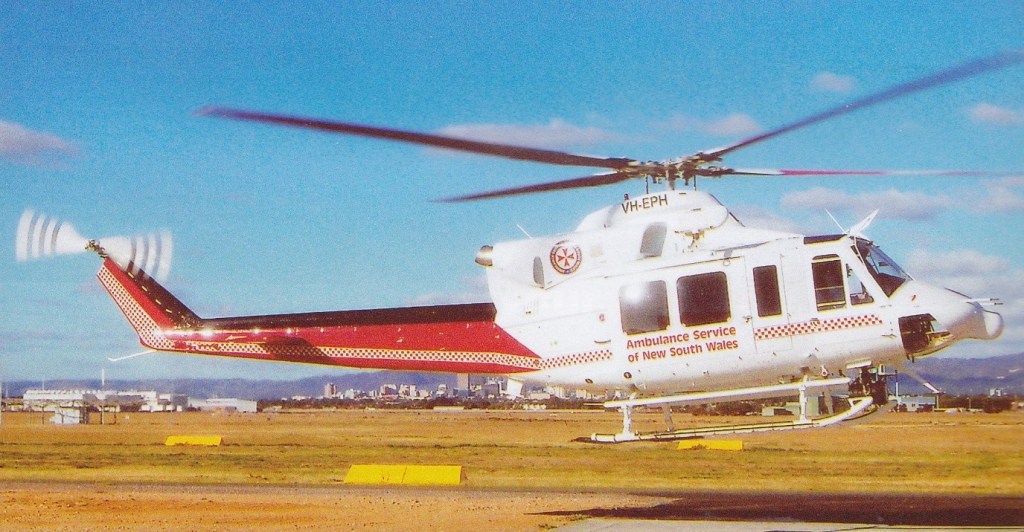
Bell 412EP VH-EPH

Bell 412 EMS Operation 1996

Versions:

412SP
Special Performance version with increased maximum T-O weight, new seating options and 55% greater standard fuel capacity. Superseded by 412HP early 1991.

Military 412
Announced by Bell June 1986; fitted with Lucas Aerospace chin turret and Honeywell Head Tracker helmet sight similar to that in AH-1S; turret carries 875 rounds, weighs 188kg and can be removed in under 30 minutes; firing arcs 110deg in azimuth, +15deg and –45deg in elevation; other armament includes twin dual FN Herstal 7.62mm gun pods, single FN Herstal 12.7mm pod, pods of seven or nineteen 70mm rockets, M240E1 pintle-mounted door guns, FN Herstal four-round 70mm rocket launcher and a 12.7mm gun or two Giat M621 20mm cannon pods.

412HP
Improved transmission giving better OGE hover; FAR Pt 29 certification 5 February 1991, first delivery (c/n 36020) later that month.

412EP (Enhanced Performance)
PT6T-3D engine, dual digital automatic flight control system (DDAFCS), three-axis in basic aircraft but customer option for four-axis and EFIS. Category A certification was imminent in late 1998. Also customer option for SAR fit.

412CF (CH-146) Griffon
Canadian Forces C$700 million contract for 100 CH-146s (modified Bell 412EP) placed in 1992. Duties include armed support, troop/cargo transport, medevac, ASW, SAR and patrol; first flight (146000) 30 April 1994; deliveries began 14 October 1994; completed early 1998. Generally as commercial Bell 4I2EP except for avionics and mission equipment. Empty weight 3.402kg; maximum weight as civil version.

412EP Sentinel
First of two modified in 1998 by Heli-Dyne Systems with quick-change ASV and ASW mission packages; intended for Ecuadorean Navy, but order cancelled and aircraft became demonstrator. ASV equipment comprises Honeywell RDR-1500B chin radar, Hughes Starburst searchlight, radar warning receiver, Wescam sensor turret and possibly Penguin Mk 2 Mod 7 ASMs; ASW fit is L3 Ocean Systems AN/AQS-18A dipping sonar and Raytheon Mk 46 torpedo.

412SA
First three of 16 ordered by Royal Saudi Air-Force built in 2001 for manufacturer’s trials. Equipment standard not disclosed, but sufficiently different from 412EP to warrant separate c/n sequence beginning 33501. Production continued in 2002-03.

412 Plus
Projected improved version under study in 1999 with MTOW increased to 5.647kg, uprated PT6C engines, new dynamic components and Rogerson-Kratos avionics. Development terminated in early 2001.

NBell-412
Indonesia’s Dirgantara has licence to produce up to 100 Model 412SPs.

AB.412 Griffon
Agusta’s multirole military development of the Bell 412 which first flew in August 1982, and is suitable for troop transport, fire-support, scout and reconnaissance, SAR, medevac and maritime surveillance. Armament options include 25mm Oerlikon cannon, machine-gun pods, rocket pods, and Sea Skua ASMs.

Specifications:

412
Engine: 2 x P&W PT6T-3B, 900 shp, 1342kW
TBO: 2500 hr
Main rotor: 46 ft / 14.02m
Seats: 15
Length: 56 ft
Length with rotors turning: 17.07m
Height: 10.7 ft
Max ramp weight: 11,600 lb
Max takeoff weight: 11,600 lb
Standard empty weight: 6267 lb / 2823kg
Max useful load: 5333 lb
Max landing weight: 11,600 lb
Max sling load: 5000 lb
Disc loading: 7 lbs/sq.ft
Power loading: 6.4 lbs/hp
Max usable fuel: 1455 lb
Service ceiling: 20,000 ft
Hover in ground effect: 4100 ft
Hover out of ground effect: 2000 ft
Max speed: 142 kt
Normal cruise @ 3000 ft: 125 kt
Fuel flow @ normal cruise: 758 pph
Endurance @ normal cruise: 1.7 hr

412EP
Engine: 1 x P&WC PT6T-3D Twin Pac, 1342kW for T-O / 1193kW max continuous
OEI ratings: 850kW for 2 1/2 min / 723kW for 30 min
Transmission rating: 1,022kW for T-O, 828kW max continuous
OEI rating: 850kW
Instant pwr: 1342 kW
Rotor dia: 14 m
MTOW: 5402 kg
Payload: 2319 kg
Useful load: 2271 kg
Max speed: 140 kt
Max cruise: 130 kt
Max range: 782 km
HIGE (@ MAUW): 10,200 ft
HOGE (@MAUW): 5200 ft
Service ceiling: 13,100 ft
Crew: 1
Seats: 14

412HP
Engine: 2 x P&WC PT6T-3BE
Instant pwr: 1340 kW
Rotor dia: 14 m
MTOW: 5400 kg
Payload: 2395 kg
Useful load: 2395 kg
Max speed: 140 kt
Max cruise: 130 kt
Max range: 745 km
HIGE (@MAUW): 10,200 ft
HOGE (@MAUW): 5200 ft
Service ceiling: 17,000 ft
Seats: 15

AB.412 Griffon
Engine: 1 x P&WC PT6T-3BE Twin Pac
Instant pwr: 764 kW
Rotor dia: 14 m
Fuselage length: 12.7 m
No. Blades: 4
Empty wt: 2840 kg
MTOW: 5400 kg
Payload: 2290 kg
Max speed: 125 kts
Max cruise: 122 kts
ROC: 440 m/min
Ceiling: 5180 m
Fuel cap (+aux): 820 lt ( 680 lt )
Range: 480 km
Max range: 656 km
HIGE: 10,200 m
HOGE: 5200 m
Crew: 1
Pax: 14

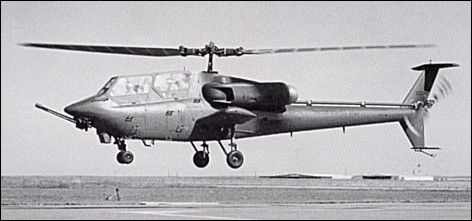
Bell 409 / YAH-63

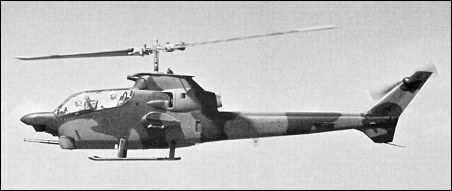
In November 1972 the Army called for design proposals for a new Advanced Attack Helicopter (AAH) intended for the all-weather anti-armor role. The Army’s specifications required that the aircraft be powered by twin General Electric T700 turboshaft engines and armed with up to sixteen Hellfire or TOW anti-tank missiles in addition to a single 30mm cannon. Preliminary design proposals were submitted by Boeing-Vertol, Bell, Hughes, Lockheed, and Sikorsky, and in June 1973 Bell and Hughes were selected as finalists and were each awarded contracts for the construction of two prototype aircraft. The contract was awarded to Bell on 22 June, 1973, for design, construction and qualification (Phase 1) of two flying prototypes (YAH-63A-BF) and a ground test vehicle (GTV).
Bell’s 409, military designation YAH-63, was based largely on the earlier 309 King Cobra. The YAH-63 seated its two man crew in tandem within a narrow fuselage, though Bell put the pilot in front in order to improve the aircraft’s low-level ‘nap-of-the-earth’ (NOE) flight capabilities.
In accordance with the Army’s specifications the YAH-63 was powered two widely separated 1536shp GE T700-GE-700 engines and was intended to carry its anti-tank ordnance load on short stub wings fixed to either side of the fuselage below the engine air intakes. The engines driving wide-chord, two-bladed semi-rigid main and tail rotors. Main rotor blade chord was 1.08m and an FX-69-H-083 aerofoil was used. The wide-chord had been selected mainly because it met performance requirements, permitted the spar separation required for 23mm survivability and was less complex by a factor of two. The ‘flat-pack’ transmission had large slow turning herringbone gears for increased survivability, reduced noise and a 30-minute fly-dry capability. The main rotor mast quickly retracted into the transmission for air transport. The YAH-63 had wheeled tricycle landing gear and a distinctive T-tail. The YAH-63 had a high flotation tricycle wheeled undercarriage with oleo struts equipped with ‘strut cutter’ crash energy absorber to meet the design impact velocity of 12.8m/sec.
The weapon ‘systems consisted of a chin turret-mounted triple-barrel 30mm XM-188 rotary cannon (fire rate 600 to 1800rpm) mounted ahead of the stabilised sight to minimize damaging muzzle blast effects, and up to sixteen Rockwell AGM-114A Hellfire air-to-ground missiles or seventy-six 70mm FFAR rockets could be carried on the four wing stores.
The first proroype YAH-63 (s/n 73-22246) first flew on 1 October, 1975, and the second prototype (s/n 73-22247) followed it into the air two months later. On 4 June, 1976, the first prototype experienced a heavy emergency landing and suffered minor damage. It was repaired in time to take part in the evaluation of the two contenders which was made at the Army Engineering Flight Activity (AEFA) from June to September 1976. The comparative tests between YAH-63 and YAH-64 led eventually to the selection of the Hughes design on 10 December, 1976. All flight testing with the YAH-63 then ceased and plans were made to continue work with the T700 powerplant.
One Bell YAH-63 (s/n 73-22247) survives and is preserved by the US Army Aviation Museum, at Fort Rucker, Alabama.

AH-63
Engine: 2 x General Electric T700-GE-700 turboshaft, 1145kW
Main rotor diameter: 15.54m
Length with rotors turning: 18.51m
Height: 3.73m
Take-off weight: 7237kg
Max speed: 325km/h
Hovering ceiling: 1980m
Crew: 2

Bell ARH-70 Arapaho

The Bell ARH-70 helicopter was developed for the US Army as a possible direct replacement to the successful but aged Kiowa Warrior series of light armed reconnaissance mounts. In an effort to keep production and acquisition costs down for the US Army, the project attempted to develop a product using existing yet proven components. The Bell ARH was essentially a militarized form of the Bell 407. The ARH-70 came from the US Army’s Armed Reconnaissance Helicopter (ARH) program after the official cancellation of the RAH-66 Comanche light attack helicopter. Initial production forms would have been given the designation of ARH-70A.

In December of 2004, the requirement was sent out by the US Army and interested parties responded with their proposals. Chief among the returns was the Bell Model 407 (billed as an upgraded OH-58 Kiowa Warrior) and a Boeing response. Bell eventually won out and was awarded the multi-billion dollar production contract on July 29th, 2005. The contract called for some 368 production examples and required two prototypes along with two preproduction samples, this later changed to require four pre-production examples instead.

First flight of a demonstrator ARH was achieved on June 3rd, 2005. Further flights ensued and ultimately included additional avionics, mission-specific systems and the selected Honeywell HTS900-2 series turboshaft engine. The engine was trialed only on demonstrators and on the ground to verify its base qualities to this point. After some program delays, the first true ARH-70 prototype (Prototype #2) went airborne on July 20th, 2006, less than one year since the awarding of the Army contract. Prototype #4 was of note for it was forced to make a crash landing at a gold course after suffering an engine failure, this recorded on February 21st, 2007. Though neither of the pilots was harmed in the crash, the airframe was deemed a complete loss and a setback for the ARH program.

Ultimately, delays and product costs soon crept up on the ARH-70. The US Army halted the project, giving Bell one month to get its act in order. For the interim, Bell used its own money to further develop the systems until the US Army agreed to pick up the project once again by the middle of 2007. The rising costs forced an automatic and direct DoD review of the program under the existing Nunn-McCurdy Act. In the 2008 Defense Budget, no money was deviated to furthering the ARH-70. A final attempt to offer the ARH-70 as an export product to help recover some cost fell to naught and the ARH-70 remained in limbo for the time being. At one point, it was expected that some 512 total systems could be purchased by the US military alone, the additional examples over the original agreed upon total being delivered for use by the Army National Guard to replace their aged AH-64 Apaches.

The ARH-70 program proved too much to be a viable option for the US Army, despite the mount reaching all required performance parameters. The Army Acquisition Executive Office for Aviation called for the DoD contract to be terminated in full. The US Department of Defense officially acknowledged the request and did not promote the multi-million dollar expenditure to the US Congress, effectively killing hope for Bell and their new little machine. By this time, a single ARH-70 example had nearly doubled in per-unit cost to an estimated $14.5 million USD. According to Bell, the contract was 53 percent complete at the time of its cancellation on October 16th, 2008, with some 1,500 test flight hours having been recorded.

Design of the ARH-70 followed suit with the OH-58 series family of light helicopters. The two-man crew was seated in a side-by-side arrangement well-forward in the fuselage. Each position featured redundant controls and large, transparent, bulging forward windshields offering excellent visibility. Each pilot maintained their own automobile-style doors, hinged at two points forward, for entry and exit into their respective cockpit seats. Optics and special mission equipment could be mounted externally under the chin portion of the fuselage. The passenger cabin was located directly behind the cockpit and accessed via side access doors. Weapon stub pylons emerged from the fuselage underside and could carry limited offensive munitions. Landing skids were affixed to either fuselage underside and supported at two fixed points. The single engine was fitted high atop the fuselage above and behind the crew cabin. Exhaust jettisoned upwards at the rear of the engine compartment. The engine drove a four-bladed main rotor and a two-bladed tail rotor. The empennage was raised at the rear of the crew cabin and engine compartment, capped by a tall vertical tail fin. Additional vertical fins were set along the sides of the tail system along horizontal planes. The tail rotor was set to face the portside of the aircraft.

Crew accommodations amounted to two pilots in the forward cockpit and up to six passengers in the main cabin.

Power for the ARH-70 was supplied from a single Honeywell HTS900-2 turboshaft engine of 970 shaft horsepower. This powerplant could supply the airframe a top speed of 161 miles per hour with a cruise speed of about 130 miles per hour. Her range was listed at 186 miles with a service ceiling equal to 20,000 feet. Empty weight registered at 2,598lbs with a maximum take-off weight equal to 5,000lbs.

As an armed reconnaissance helicopter and as in the OH-58D before it, the ARH-70 was intended to carry a rather modest arrangement of weaponry. Primary hitting power was to be supplied y a 1 x GAU-19 series 0.50 caliber Gatling gun fitted to an outboard pylon as well as Hydra 70 2.75-inch (70mm) rockets, also on an outboard pylon.

Although referred to in a few official media reports under the designation of ‘Arapaho’, this name was never officially assigned to the ARH-70 product.

Bell ARH-70A (Arapaho)
Engine: 1 x Honeywell HTS900-2 turboshaft, 970shp
Rotor: four-blade main rotor and two-blade tail rotor.
Length: 34.68ft (10.57m)
Height: 11.68ft (3.56m)
Empty Weight: 2,597lbs (1,178kg)
Maximum Take-Off Weight: 5,000lbs (2,268kg)
Maximum Speed: 161mph (259kmh; 140kts)
Maximum Range: 186miles (300km)
Service Ceiling: 20,000ft (6,096m)
Accommodation: 2 + 6
Hardpoints: 2

Bell 407

With the design definition launched in 1993, the Bell 407, developed from the 206L-4 offered wider cabin, 815 shp 250-C47B derated to 675 shp for takeoff and four main rotor blades. From the windscreen pillars the cabin swells outwards to a width 178 mm more than the LongRanger’s, not tapering in again until it meets the baggage compartment forward bulkhead. Aft of that it’s normal LongRanger, although with a different tail rotor system. The extra width is gained through curved door pillars and skins of carbon fibre composites. Cabin windows are greatly enlarged, coming down to the level of the windscreen and curving well up towards the cabin roof. The doors are interchangeable between 407s, handles are flush-mounted car-type.

The LongRanger’s extra left-hand cabin door is retained for loading a stretcher, with the aft-facing left-hand seat wider than its counterpart behind the pilot. The rear seat usually takes three passengers, but in the VIP configuration the centre space is taken by a folding armrest and there’s adequate room for four passengers in the main cabin. Lap and inertia reel shoulder harness is supplied for all passenger seats.

Bell used the four-blade main rotor and complete tail rotor drive train from the OH-58D Kiowa Warrior, and the transmis¬sion also comes from the OH-58D, with larger bearings and redesigned gears to increase fatigue life.
The four 255 mm chord composite blades (Nomex honeycomb core, glass fibre reinforced plastic spar and skin) have tapered tips and unlimited fatigue life, and are attached to a flexible GFRP yoke which accom-modates flapping motion, with elastomeric dampers and bearings for lead-lag and pitch-change motion. A Frahm damper on top of the hub takes care of rotor vibration, and the transmission is attached to the airframe by SAVITAD (system for attenuating vibration independent of tuning and damping) which comprises two beams with elastomeric mounts and retained by springs.

The “avoid curve” is at 800 ft or 70 kts, almost twice that of the JetRanger. The low-inertia rotor also leads to a restriction in climb rate to 2000 ft/min. Although the 407 is capable of much more, over 4000 ft/min.
Although the tail rotor system is taken from the OH-58D, the Kevlar/Nomex blades are longer and give enough authority to allow takeoffs in 35 kt winds from any direction. Tail rotor control is also hydraulic.
Normal MTOW is 2267 kg, increased to 2499 kg with an external jettisonable load, as the gross weight is dictated by the landing skids and structure. Maximum external load is 1200 kg, but for normal passenger use it can take full fuel and seven people with light baggage and still be under gross weight.

The Rolls-Royce Allison 250-C47B turboshaft is controlled by a full-authority digital engine control system, the first to be fitted to a single¬ turbine light helicopter.

The 407 can handle slopes 5 degrees nose down or 10 degrees nose up or to either side, due in part to a pivoted rear undercarriage cross member.

A proof of concept demonstrator featuring bulged cabin door, a four blade rotor system (off the 406) and Allison 250-C47 turboshaft. A Law Enforcement demostrator was demonstrated in 2002, with a Rolls-Royce/Allison 250-C47B engine.

The concept demonstrator 407 (N407LR) was first flown on 21 April 1994 (standard Bell 206L-3 modified with tailboom and dynamic system of military OH-58D, plus sidewall fairings to simulate broader fuselage), and the programme was first revealed at Heli-Expo ’95, Las Vegas, January 1995. Two prototype/ pre-production 407s (C-GFOS and C-FORS) were first flown on 29 June and 13 July 1995, respectively.

The first producrion airframe (C-FWQY/N407BT) was flown 10 November 1995 and Transport Canada certification was received on 9 February 1996 with FAA certification following on 23 February.
The first customer delivery was at Heli-Expo ’96, Dallas, in February 1996.
A MoU of June 1996 provided for licensed assembly and marketing by Dirgantara (formerly IPTN) of Indonesia.

After extensive flight testing in the wake of three accidents, Transport Canada and the FAA approved an increase in the Bell 407’s maximum speed to 130 kt. from 100 kt., and company officials expected to restore the light helicopter’s 140-kt. never exceed speed (Vne) by the third quarter of 1999.

The latest approval is predicated on compliance with a Bell Helicopter Textron Alert Service Bulletin (ASB) that calls for installation of a redesigned tail rotor hub and blades as well as addition of mechanical stops on the anti-torque pedals. A Bell official said the stops restrict left pedal travel to 20.75 deg. from 28 deg., but right pedal travel remains at 14 deg.

In addition, the hub design moves the tail rotor centerline outboard 0.86 in. and provides an additional 2.4 in. of clearance between the tail boom and the tail rotor blades at maximum flapping angle. The chief performance penalty is reduced tail rotor authority at high altitudes, a Bell official said. The company has begun incorporating the changes into production 407s at its facilities in Mirabel, Quebec.

Bell also plans to provide parts to complete the modifications at no expense to operators in the field. According to the official, there were more than 350 of the single-engine 407s in operation worldwide in 1999. The helicopter entered service in 1996.

Company engineers and test pilots developed ancl evaluated the latest fix during a series of special flight tests in March and April that exceeded normal Transport Canada certification requirements by a significant margin, the official said. The tests centered on flying a 407 at 130 kt. indicated airspeed and using each anti-torque pedal to its mechanical stop in less than 0.4 sec. Although the abrupt applications were applied repeatedly, the tail rotor blades did not contact the tail boom structure and several inches of clearance were maintained, he said.

The 130-kt. approval comes about two months after Bell began conducting a series of special flight tests to increase Vne above a 100-kt. limit imposed on the aircraft early in 1999. The restriction was imposed after the tail booms of three 407s were severed following left pedal inputs. The first accident occurred in 1997 in the U.S., the second in 1998 in South Africa, and the third occurred in Brazil.

According to a Bell official, investigation has revealed that each f the accidents was cause by a sudden, full input of the left tail rotor pedal at cruise airspeed.” The sudden input “caused exceptional flapping (deflection) of the tail rotor” blades that damaged pitch stops and the pitch control links. As a result, the blades struck the tail boom aft of the horizontal stabilizers, severing it. The cause of the pedal input, however, has not been fully explained but pilot error is not being ruled out.

To reinstate the 407’s original 140-kt. Vne, Bell was instrumenting a 407, at its Mirabel site, in preparation for beginning flight tests of a solenoid-operated airspeed sensing system that will automatically engage/disengage the pedal stops depending on airspeed. If the helicopter is flying below 50 kt. the stops will be retracted to permit 28 deg. of left pedal travel and maximum tail rotor authority. Above 55 kt., the solenoid will engage the stops and limit left pedal travel to 20.75 deg.

The system, which is redundant and features a mechanical override, will be standard equipment in the twin-engine Bell 427. That aircraft was completing certification by Transport Canada and FAA.

The 500th production Bell 407 was delivered in October 2001 to Pabst Air, Germany, and 550 had been delivered to operators in 45 countries by early 2003; fleet time then totalled more than 745,000 hours.
Total of 62 delivered in 1999, 62 in 2000, 47 in 2001 and 33 in 2002.
COSTS: US$1.37 million (1999) flyaway.
Development cost were estimated as US$50 million, of which US$9 million provided by Canadian government.

Bell 407
Engine: One Rolls-Royce 250-C47B turboshaft, 606kW for T-O, 523kW
Max continuous pwr: 630 shp
Transmission rating: 503kW for T-O, 470kW continuous op
Main rotor diameter: 10.7m
Rotor speed: 413 rpm
Length: 12.7m
Height: 3.7m
Take-off weight: 2267kg
Empty weight: 1178kg
Useful load: 1058 kg.
Standard usable fuel: 484 lt
Optional aux fuel: 72 lt
Max speed at sea level: 252km/h
Vne: 204km/h / 140 kts
Max cruise: 133 kt.
LR cruise: 121 kt
Hovering ceiling, OGE: 2470m / 12,200 ft
Hovering ceiling, IGE: 3440m / 10,450 ft
Service ceiling: 5460m
Max ROC: 2000 fpm
Range: 608km
Loiter @ 60 kt: 3.8 hr.
Internal payload: 1089kg
External payload: 1200kg
Crew: 1
Passengers: 6

Bell D-292 ACAP

In February 1981 the US Army’s Applied Technology Laboratory announced that Bell Helicopter and the Sikorsky Aircraft Division of United Technologies had both been awarded contracts for the design, construction, and initial flight testing of composite airframe research helicopters as part of the Advanced Composite Airframe Programme (ACAP). The programme is the development of an all-composite helicopter fuselage lighter and cheaper to build, per production airframe, than conventional machines. Bell and Sikorsky were each awarded contracts for the production of three machines; a tool-proof vehicle, a static test vehicle, and a flight test vehicle. Bell’s ACAP machine, which carries the company model number D292, made its first hover flight on 30 August, 1985. By mid-January 1986 the aircraft had completed twelve of its projected fifty flight test hours.

The D292 was based on Bell’s commercial Model 222 twin- turbine light helicopter and used that machine’s Avco Lycoming engines, transmission, and two-bladed main and tail rotors. The ACAP’s tailboom, vertical fin, and rotor pylon are almost identical in appearance to those of the 222, though the D292’s entire elongated pod-and-boom airframe is constructed of glass-reinforced plastic (GRP), graphite, and Kevlar. The use of a particular composite material for a specific aircraft component is determined by the strength, flexibility or other primary characteristic required of that component. The D292’s basic load-bearing structure is thus constructed primarily of graphite or graphite/epoxy, while the flooring and most of the craft’s exterior ‘skin’ is made of a more ballistically-tolerant Kevlar/ epoxy or glassfiber/epoxy blend. The seats for the helicopter’s two crew members and two passengers are of Kevlar/epoxy and are designed to absorb the high vertical loads of a forty-foot- per-second crash landing, as are the legs of the craft’s non-retracting tailwheel landing gear.
In addition to 15 hours of ground running and 50 hours of flight testing, which were completed in October 1985, the D-292 was used for shake testing and controls proof loading. A five-phase militarisation test and evaluation programme (MT&E) began in 1985 and was completed in 1988, following evaluation of undercarriage crashworthiness, lightning protection system, internal acoustics and additional repairability demonstrations. This programme included dropping the helicopter airframe from 12m in September 1987 at the NASA Langley Research Centre to demonstrate the capability of meeting stringent military crash survivability requirements. This included a 15m/s impact velocity at an aircraft attitude of ten degrees roll and ten degrees nose up pitch without any apparent serious injuries to the four dummy occupants (this impact velocity was comparable to a free fall from a three-storey building). Another major advancement demonstrated by the Bell ACAP design during these tests was the fuel system which totally contained the fuel during the drop test, thus reducing the risk of post-crash fires. But the main purpose of the ACAP programme was to achieve the US Army’s goal of reducing weight and cost, as well as improving military helicopter characteristics, by demonstrating the application of advanced composite materials. In this sphere, the Bell D-292 featured a weight reduction of 22% in the airframe structure, a 17% saving in cost, survivability in a vertical crash, and reduced radar signature. These comparisons were made possible because Bell and Sikorsky each also designed a duplicate aircraft of current conventional metal construction.

D292 ACAP
Engine: 2 x Avco Lycoming LTS 101-750C-1 turboshaft, 510kW
Main rotor diameter: 12.80m
Fuselage length: 12.32m
Height: 3.40m
Take-off weight: 3395kg
Empty weight: 2615kg
Crew: 2
Passengers: 2

Bell 400 / 440

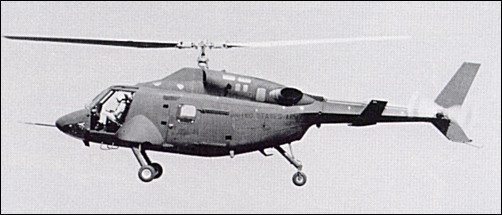
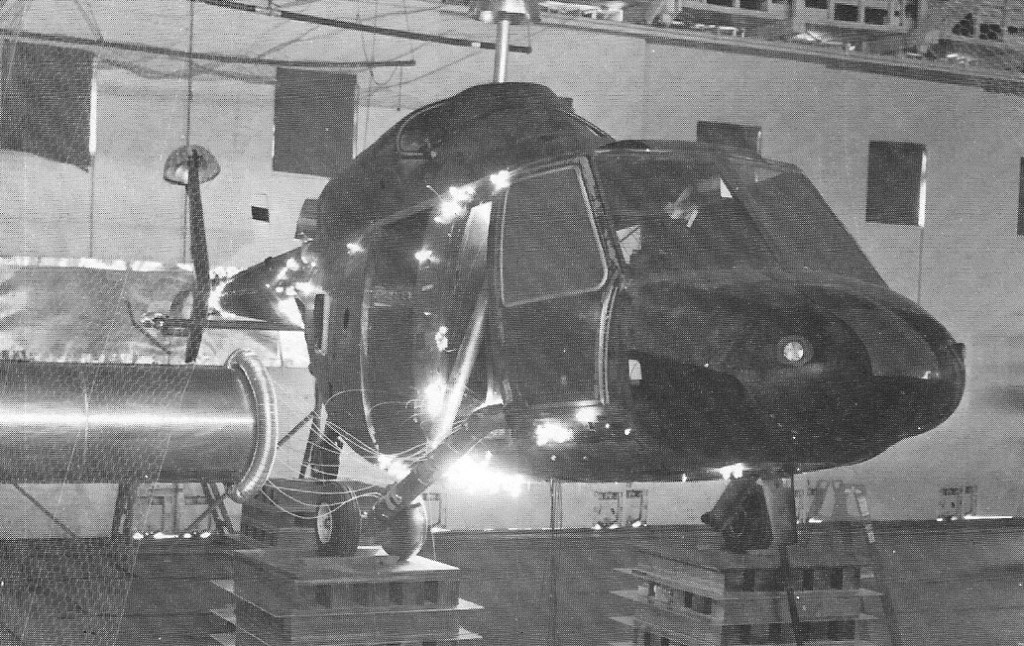
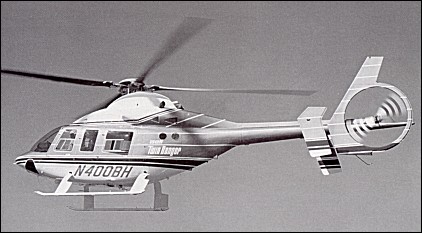
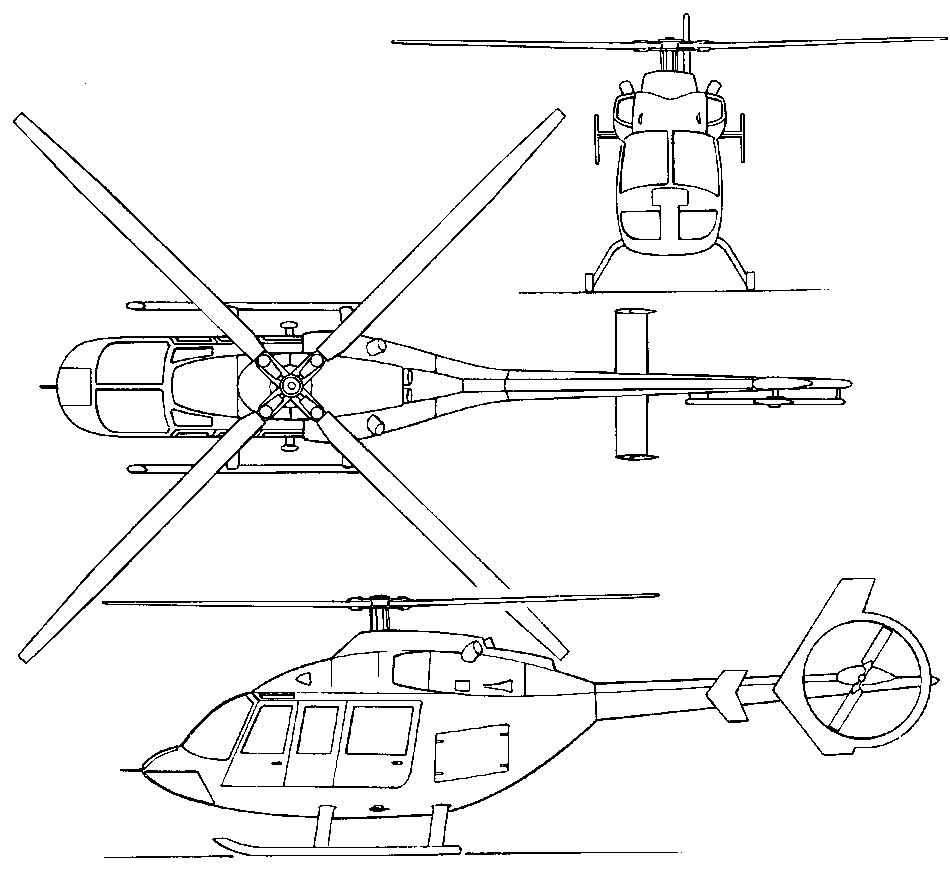
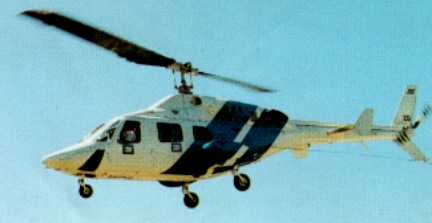
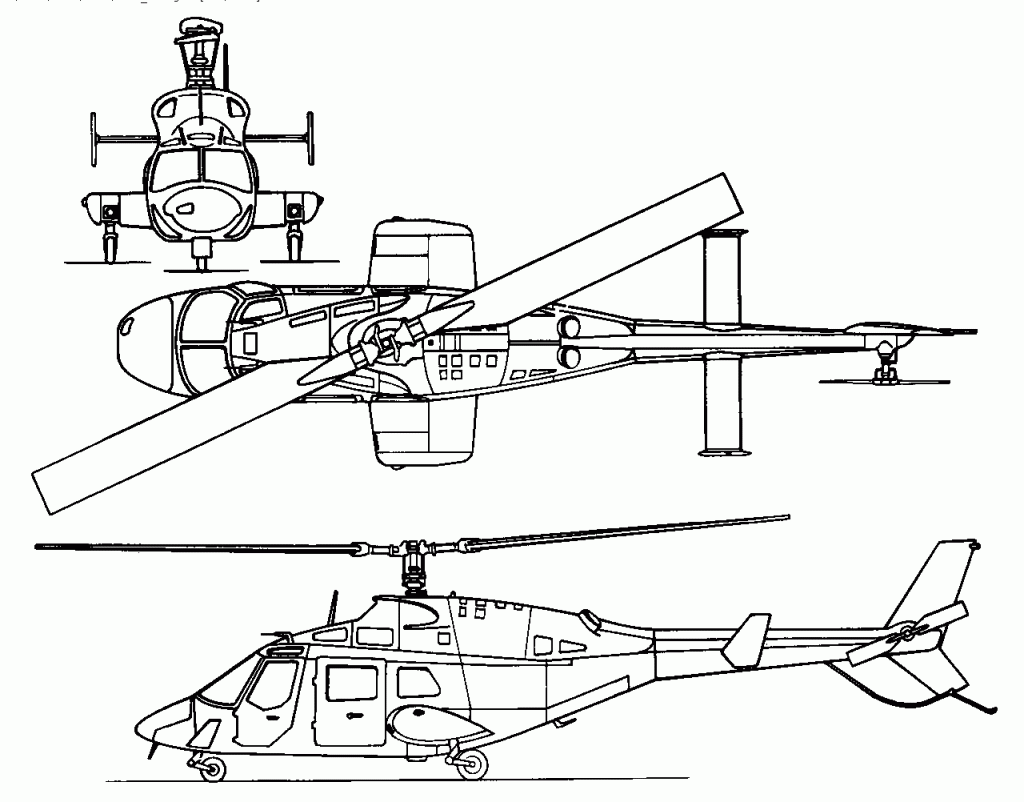
In February 1983, Bell announced the both commercial and military, single and twin-engined, Model 400 TwinRanger. This seven-seat aircraft was in the 1800-2700kg gross weight class. The Model 400 was powered by two 443shp Allison 250-C20R turboshaft engines, had a four-blade soft-in-plane main rotor, an advanced technology transmission and drive system with ‘run-dry’ capability.
The aircraft entered development in 1983 with wind-tunnel testing with a one-quarter scale model and flight testing of the dynamic components on a specially modified Model 206LM LongRanger (c/n 45003, N206N) which served as test-bed and flew in March 1983. This aircraft had the four-bladed OH-58D AHIP rotor, a strengthened tail boom, a ring guard tail rotor and a deepened fuselage to increase fuel capacity.
The first prototype Model 400 (c/n 48001, N3185K) flew on 30 June, 1984, powered by Allison engines.
Three pre-production Model 400 TwinRangers (c/n 48002/ 48004) were built, the first of which (N3185L) flew for the first time on 4 July, 1985, the second (N3185U) in May and the third (N400BH) in June 1985. The first aircraft was later used as a ground test vehicle.
It was expected that the Canadian factory, at Mirabel, Montreal, would undertake production of the Model 400 and develop the Model 400A, a variant of the Model 400 powered by a single 1000shp Pratt & Whitney Canada PW209T turboshaft engine, and employing major composites components.
The programme was suspended indefinitely pending a market situation that would support an annual sales rate of about 120 aircraft. The four existing aircraft have been cancelled from the register and put in storage by Bell Helicopter Textron Canada, at Mirabel.

Model 400
Rotor diameter: 11.30m
Overall length: 13.39m
Length of fuselage: 11.02m
Height overall: 3.56m
Maximum take-off weight: 2495kg
Empty weight: 1427kg
Maximum speed: 278km/h
Maximum cruising speed at 1525m: 244km/h
Initial rate of climb: 464m/min
Service ceiling: 6100m
Hover ceiling outside ground effect: 3110m
Hover ceiling in ground effect: 4360m
Maximum range: 834km

Bell 309 KingCobra

Bell announced the development of a new combat helicopter on 28 September 1971, derived from the Model 209 and 211, with company funds, with a 1.10m longer fuselage supporting a larger diameter rotor measuring 14.63m. Both the main and tail rotors had wider chord blades and the main rotor blades had double swept tips to reduce noise levels and improve performance at high speed. The nose was also modified to accept new apparatus, the available space for ammunition was increased, and the wing span was taken to 3.96m. A redesigned tail assembly was used with a lower fin for improved longitudinal stability. It also had the transmission, wide-chord two-blade main rotor and drive train of the Model 211 HueyTug. Design work was begun by a team led by Joe Tilley and construction started in January 1971.
Two prototypes of the Model 309 Kingcobra were built.
The first (c/n 2503, registered N309J), which flew on 10 September 1971 at Fort Worth with Gene Colvin at the controls, was offered to the Marines with Turbo Twin Pack T400-CP-400 engines, while the second prototype (which flew in January 1972) was offered to the Army with a 2890shp Lycoming T55-L7C turbine of the Model 211, derated to 2050 on take-off.
The KingCobra incorporated new avionics and systems to fulfill its anti-tank mission (inertial navigation system, APN-198 radar altimeter, fire-control computer, multi-sensor sight, head-up display, helmet sighting system, FL-33 FLIR, low-light level television and, of course TOW guidance system). Armament included provision for sixteen TOW missiles under extended stub wings and a General Electric chin-turret housing a three-barelled 20mm Gatling gun with 1345 rounds.
On 11 April 1972, the first prototype was damaged in an accident. To meet future Army needs it was decided to convert the twin-engined 309 into single-engined configuration. As expected, on 9 August, 1972, the Army finally cancelled the Cheyenne programme and in due course two helicopter manufacturers, Sikorsky and Bell, submitted proposals for a less sophisticated aircraft, the Model S-67 and the Model 309 respectively. Tests and demonstrations were successfully conducted with both aircraft, but the Army set up new requirements and opened a new contest within the Advanced Attack Helicopter programme (AAH) which would eventually lead to the selection of the MDD/Hughes AH-64 Apache.
The Bell Model 309 (N309J) is now preserved by the US Army Aviation Museum in Fort Rucker, Alabama.

Bell 309 Kingcobra
Engine: 1 x Lycoming T55-L7C turboshaft, 2155kW
Main rotor diameter: 14.63m
Length: 14.63m
Height: 4.11m
Take-off weight: 4510kg
Empty weight: 2890kg
Gross weight: 6350kg
Max speed: 330km/h

Bell 230 / 430

Bell 230

At the 1989 NBAA Convention, Bell announced its intention to develop an improved variant of its Bell 222. Powered by two 700shp Allison 250-C30-G2 turbines driving an advanced design two-blade rotor, the Model 230 could carry up to ten people in a 3.8cu.m passenger compartment. Internal fuel capacity had been increased to 930 litres with a maximum of 1359 litres with optional fuel tanks. A fixed skid undercarriage is also available and, from the 51st production aircraft, Bell will offer a variant powered by Lycoming LTS101-750 turbo-shafts. This helicopter is to be built at the company’s facility in Canada.

Bell 230 / 430 Article

Two prototypes were converted from Bell 222s at the Mirabel factory near Montreal and the first of these (registered C-GEXP) accomplished its maiden flight on 12 August, 1991. The type received Transport Canada type approval on 12 March 1992 and the production aircraft (C-GAHJ) first flew on 23 May 1992. Deliveries began on 16 November 1992. A total of 37 were delivered by January 1998. The second prototype (C-GBLL) flew on 3 October 1991. An initial order for twenty was placed by Bell’s Japanese representative Mitsui & Co, in Tokyo, with first deliveries due in August 1992.

A Military demonstrator (N230CN) was leased for six months by Chilean Navy 1993-94, equipped for shipboard evaluation with Indal ASIST deck recovery system, auxiliary fuel tanks, Breeze Eastern BL 1600 rescue hoist, AlliedSignal RDR 1500B radar, Teledyne AN/APX-101 transponder, AlliedSignal KHF-950 SSB transceiver, Magnavox AN/ARC-164 UHF, Rockwell AN/ARC-186 VHF, Spectrolab SX-5 Starburst searchlight, Agema thermal imager in Heli-Dyne turret, Honeywell EDZ-705 EFIS with SPZ-7000 AFCS, Trimble TNL 7880 GPS/Omega and Flight Visions FV2000 HUD.

The first 50 aircraft were powered by two Allison 250-C30G2 turboshafts, each rated at 522kW for 5 minutes for T-O, 464kW maximum continuous, 581kW OEI for 2.5 minutes and 553kW OEI for 30 minutes. Main transmission rated at 690kW for T-O, 652.5kW maximum continuous and 548kW for single-engined operation. Usable fuel capacity 935 litres in skid gear version, 710 litres in wheeled version. Optional 182 litres of auxiliary fuel for both versions.
Equipped with a two-blade main rotor with stainless steel spars and leading-edges, Nomex honeycomb trailing-edge with glass fibre skin, and glass fibre safety straps; tail rotor blades stainless steel. Aluminium alloy fuselage with integral tailboom and some honeycomb panels. The landing gear is a tubular skid type on Utility version. Executive version to have hydraulically retractable tricycle gear, single mainwheels retracting forward into sponsons; forward-retracting nosewheel fully castoring and self-centring; hydraulic disc brakes on main units.
Controls are fully powered hydraulic, with elastomeric pitch change and flapping bearings; fixed tailplane with leading-edge slats and endplate fins; strakes under sponsons; single-pilot IFR system without autostabilisation.
Standard layout has forward-facing seats for nine persons (2-2-2-3) including pilot(s). Options include eight-seat executive (rear six in club layout), six-seat executive (rear four in club layout with console between each pair), or 10-seat utility (2-2-3-3, all forward-facing). Customised Emergency Medical Service (EMS) versions also available, configured for pilot-only operation plus one or two pivotable stretchers and four or three medical attendants/sitting casualties respectively. Two forward-opening doors each side. Entire interior ram air ventilated and soundproofed. Dual controls optional.
The main and tail rotors substantially same as Bell 222, former having Wortmann 090 blade section with 8 per cent thickness/chord ratio and swept tips. Independent (hydraulic) rotor brake. Short span sponson each side of fuselage houses mainwheel units and fuel tanks, and serves as work platform.

Bell 430
Preliminary design began in 1991 for a four-blade rotor, higher-powered and stretched variant of Bell 230, The programme was launched in February 1992 and two prototypes were modified from Bell 230 airframes: first prototype (C-GBLL; wheel-equipped) flown 25 October 1994; second prototype (C-GEXP; skid-equipped, with complete avionics suite) flown 19 December 1994. The first flight of a production 430 (C-GRND) was in 1995 and deliveries began on 25 June 1996 after Canadian type approval on 23 February.
The second production aircraft, N4300 circumnavigated the world in a record time of 17 days 6 hours 14 minutes, landing back at Fairoaks, UK, on 3 September 1996.
Neiman Marcus Special Edition was introduced in 2001 for Neiman Marcus store’s 75th Christmas catalogue, featuring three-colour custom metallic exterior paint scheme with NM signature. Italian leather and rosewood interior, sculpted carpets with NM logo, passenger refreshment centre, Blaupunkt AM/FM/CD entertainment centre. JetMap cabin information system with moving map displays on two ceiling-mounied monitors. Motorola cellphone and two computer ports.
The first delivery, on 25 June 1996, was the sixth production aircraft (N6282X) handed over to IPTN (now Dirgantara) of Indonesia in eight-seat executive configuration. Thirteen were delivered in 1996; followed by eight, 15 and 18 in 1997-99, 11 in 2000, 14 in 2001 and seven in 2002.

430

Optimised for high cruising speed with (retractable) wheel landing gear, although traditional skids optional; inclined towards executive transport market. Bell 230 fuselage lengthened by 0.46m plug; Bell 680 all-composites four-blade bearingless, hingeless main rotor; approximately 10% power increase over Bell 230; uprated transmission; and optional EFIS. Short-span sponson each side of fuselage houses mainwheel units and fuel tanks, and serves as work platform.
Fully powered hydraulic, with elastomeric pitch change and flapping bearings; fixed tailplane with leading-edge slats and endplate fins; strakes under sponsons; single-pilot IFR system without auto-stabilisation.
Semi-monocoque fuselage of light alloy, with limited use of light alloy honeycomb panels. Fail-safe structure in critical areas. One-piece nosecone tilts forward and down for access to avionics and equipment bay. Short span cantilever sponson set low on each side of fuselage, serving as main landing gear housings, fuel tanks and work platforms. Section NACA 0035. Dihedral 3deg 12min. Incidence 5deg. Sweepback at quarter-chord 3deg 30min.
Fixed vertical fin in sweptback upper and lower sections. Tailplane, with slotted leading-edge and endplate fins, mounted midway along rear fuselage. Small skid below ventral fin for protection in tail-down landing. Four-blade main rotor with stainless steel spars and leading-edges. Nomex honeycomb trailing-edge with glass fibre skin, and glass fibre safety straps; tail rotor blades stainless steel. Rotors shaft-driven through gearbox with rwo spiral bevel reductions and one planetary reduction. Main blade and hub life, 10.000 hours.
Tubular skid type on Utility version. Executive version has hydraulically retractable tricycle gear, single mainwheels retracting forward into sponsons; forward-retracting nosewheel fully castoring and self-centring; hydraulic disc brakes on main units. Mainwheel tyre size 18×5.5, nosewheel 5.00-5. Emergency floats optional.
Two Rolls-Royce 250-C40B turboshafts, each rated at 603kW for T-O and 518kW maximum continuous. OEI ratings 701kW for 30 seconds, 656kW for 2 minutes, 623kW for 30 minutes and 602kW continuous. Chandler Evans FADEC. Transmission rating 779kW for 5 minutes for T-O, 737kW maximum continuous. Power train TBO, 5,000 hours. Usable fuel capacity 935 litres in skid version, 710 litres in wheeled version; provision in both versions for 182 litre auxiliary tank. Fuel system is rupture resistant, with self-sealing breakaway fittings.
Standard layout has forward-facing seats for nine persons (two-two-two-three) including pilot. Options include 10-seat layout (two-two-three-three); eight-scat executive (rear six in club layout), six-seat executive (rear four in club layout with console between each pair); and five- and four-seat executive with one or two refreshment cabinets; seat pitches vary between 86cm and 91cm. Pilots on crashworthy (energy attenuating) seats, which are optional for passengers. Customised emergency medical service (EMS) versions also available, configured for pilot-only operation plus one or two pivotable stretchers and four or three medical attendants/sitting casualties respectively. Two forward-opening doors each side; EMS version has optional stretcher door between forward and rear doors on port side. Entire interior ram air ventilated and soundproofed. Dual controls optional.
Standard equipment includes rotor and cargo tiedowns, ground handling wheels for skid version, retractable 450W search/landing light. Options include dual controls, auxiliary fuel tankage, force/feel trim system, more comprehensive nav/com avionics, 272kg capacity rescue hoist, 1587kg capacity cargo hook, emergency flotation gear, heated windscreen, particle separator and snow baffles.
The programme cost US$18 million, 35% financed by Canadian Defence Industry Productivity Program (DIPP) and repayable as royalty on each sale.

Bell 230
Engine: 2 x Allison 250-C30G/2, 720 shp each, dual max: 690 kW.
Instant pwr: 520 kW.
Rotor dia: 13.8 m.
Empty wt: 2270 kg.
MTOW: 3813 kg.
Payload: 1472 kg.
Useful load: 1270 kg.
Max speed: 140 kts.
Vne: 150 kts.
Max cruise: 135 kts.
Max range: 705 km.
HIGE (@MAUW): 12,400 ft.
HOGE (@MAUW): 7300 ft.
Service ceiling: 14,100 ft.
Opt fuel cap: 1359 lt
Crew: 1/2.
Seats: 8/10.
Rescue hoist capacity: 136kg
Cargo hook capacity: 1,270kg

Bell 430
Engine: Allison 250-C40.
Instant pwr: 582 kW.
Rotor dia: 13.8 m.
MTOW: 5443 kg.
Max cruise: 135 kts.
Vne: 150 kts.
Max range: 705 km.
Seats: 8/10.

230
430

Bell 222

In March 1974 Bell decided to commit its own resources to the development of a new twin-turbine, ten-seat helicopter. This helicopter was evolved from studies begun in the late 1960s which had led, in 1973, to the Design D-306, a twin-turboshaft helicopter. The engines were to be either the 500shp Allison 250-C28, the 590shp Lycoming LTS-101 or the 650shp Pratt & Whitney Canada PT7B driving the Bell classic two-blade main rotor. The D-306 could accommodate two pilots and eight passengers (four passengers in executive configuration).
In January 1974, a full-scale mock-up of the D-306 was displayed at the Helicopter Association of America (HAA) convention in order to study the market potential and to gather the would-be customers remarks in order to upgrade the project.
The reactions were so promising that, on 20 April, 1974, Bell announced its decision to go ahead with the Model 222, five prototypes of which were to be built and which were quite similar to the D-306 (the windscreen was improved and the fuselage lengthened by a few inches). The Model 222 was the first completely new Bell design to reach production status since the JetRanger and the Model 222 was described then as ‘the first American made light twin-turbine helicopter’. It had a semi-monocoque light alloy fuselage with a hydraulically retractable tricycle undercarriage. The two Avco Lycoming turboshafts drove a two-blade main rotor through a gearbox with two spiral bevel reductions and one planetary reduction.
The maiden flight of the prototype was expected by the end of 1975 but, in fact, the first prototype (c/n 47001, N9988K) got into the air on Friday 13 August, 1976, with Donald Bloom at the controls. Certification by the FAA under FAR Part 29 was received on 16 August, 1979, followed by approval for VFR operation on 20 December of the same year. On 15 May, 1980, the Model 222 received FAA approval for single-pilot IFR operation.
The Bell 222 has a light alloy structure, and a fuselage built around a large cabin which can seat two pilots and five or six passengers in the executive trim. In all configurations, there is a bench seat at the back for three, which fits into the L-shape of the fuel tank behind it. The executive Bell 222 is sold with full IFR capability. One alternative is the offshore configuration for ferrying eight passengers to offshore oil platforms.
The large main rotor with two wide blades is of steel with a honeycomb core. The blades are held to the rotor hub by standard Bell elastomeric bearings. The tail rotor is also metal with two blades. The twin Lycoming LTS-101-650 engines are mounted side-by-side above the fuselage and have integral particle separators. The fuel is contained in three tanks, one in the fuselage and two in the sponsons into which the main landing gear members retract.
During flight tests several improvements were introduced on the prototypes, the most obvious being a completely new tail configuration. With the fourth prototype (c/n 47004, N680L) a new tail layout was adopted: the T tail was replaced by tailplanes and end-plate fins fixed forward of the rear fuselage. The main rotor diameter has been increased by 12 in (30,5 cm) and a slightly more powerful version of the Lycoming turboshaft engine has been adopted, to off-set some weight growth attributable to the new tailplane and larger rotor.
The fifth prototype (c/n 47005, N2228X), representative of the production aircraft, was presented at the Paris Air Show in June 1978. In fourteen months, the five prototypes logged more than 600 flying hours and by December, 1977, the figure of 700 hours was reached. The first for Petroleum Helicopters were delivered in January 1980.

Bell 222 ZK-HFQ

Production was launched with a backlog of orders for some 140 aircraft and Bell had to boost its planned production from 125 machines the first year to 137. On 16 January 1980, Petroleum Helicopters Inc (New Orleans) received the first of its sixteen machines soon followed by Schiavone Construction which received an aircraft in executive configuration. Heliflight Systems (Houston), Aerogulf Sales Co (Dubai), Bemor Agencies (Bermudas), CSE Aviation Ltd (UK) and Astra Helicopters (South Africa) were among the main customers. On 18 January 1981, Bell Helicopters delivered its 25,000th helicopter, a Model 222, to Omniflight Helicopters.
The Model 222 and 222A, first production variants were powered by two 592shp Avco-Lycoming LTS 101-650C-3 engines, their dry weight of only 110kg each providing a maximum power/ weight ratio of 4.58kW/kg at maximum rating.
The Model 222B was the second main production variant with accommodation for seven to nine passengers. The Model 222B incorporates numerous improvements such as a taller main rotor mast, increased diameter narrow-chord blades, larger tail rotor and lengthened tail boom. The powerplant consists of two 684shp Textron Lycoming LTS 101-750C-1 turboshafts. The fuel is contained in five crash resistant tanks located in the fuselage as well as in the sponsons, with a total capacity of 710 litres.
The Model 222B Executive is the luxury variant for five or six people with complete systems and avionics such as IFR, Sperry coupled automatic flight control system and VOR/LOC. Luxury equipment includes automatic temperature control, fluorescent and reading lights and window curtains. A stereo system and refreshment cabinet are optional.
In 1982, the Model 222B became the first transport category helicopter to be certificated by the FAA for single-pilot IFR flight without stability augmentation. Model 222U and 222UT: the Model 222UT (UT for Utility Twin) variant is externally recognisible by its tubular skid undercarriage in place of the usual retractable wheels. It can accommodate up to eight passengers and could have a fuselage mounted flotation system. The powerplant is the same as for the Model 222B but fuel capacity has been increased to 930 litres. This variant received VFR and single-pilot IFR certification during the spring of 1983.
The basic Model 222B feature include:
ROTOR SYSTEM: Two-blade main rotor. Blade section Wortmann 090. Thickness chord ratio 8 per cent. Each blade has a stainless steel spar with bonded glass fibre safety straps to retard crack propagation and offer secondary load path; replaceable stainless steel leading-edge; and afterbody of Nomex honeycomb covered with glass fibre skin. Each blade is attached to the rotor head by two chordwise bolts. Small trim tab on each blade. Completely dry titanium main rotor hub has conical elastomeric bearings. Two-blade tail rotor of stainless steel construction, with preconing, underslung feathering axis and skewed flapping axis. Rotor blades do not fold. A rotor brake is standard.
ROTOR DRIVE: Rotors shaft driven through gearbox with two spiral bevel reductions and one planetary reduction. Transmission rating (two engines) 690kW. Single-engine rating 548kW. Main rotor engine rpm ratio 1:27.4; tail rotor engine rpm ratio 1:5.08.
SPONSONS: Short-span cantilever sponson set low on each side of fuselage, serving as main landing gear housings, fuel tanks and work platforms. Section NACA 0035. Dihedral 3deg 12min. Incidence 5deg. Sweepback at quarter-chord 3deg 30min. All-metal structure of light-alloy sheet and honeycomb. No movable surfaces.
FUSELAGE: Semi-monocoque structure of light alloy, with limited use of light-alloy honeycomb panels. Fail-safe structure in critical areas. One-piece nosecone tilts forward and down for access to avionics and equipment bay.
TAIL UNIT: Cantilever structure of light alloy. Fixed vertical fin in sweptback upper and lower sections. Tailplane, with slotted leading-edge and endplate fins, mounted midway along rear fuselage. Small skid below ventral fin for protection in tail-down landing.
LANDING GEAR: Hydraulically retractable tricycle type. All units retract forward, mainwheels into sponsons. Free-fall extension in emergency. Oleo-pneumatic shock-absorbers, with scissored yoke. Self-centring nosewheel, swivelling through 360degrees. Single wheel and tyre on each unit. Mainwheel tyres size 6.00-6, pressure 5.18 bars. Nosewheel tyre size 5.00-5, pressure 4.14 bars. Hydraulic disc brakes. New-type water-activated emergency pop-out floats optional. Model 222UT has skid-type landing gear and lock-on ground handling wheels, with fuselage-mounted flotation system optional.
POWER PLANT: Two Textron Lycoming LTS 101-750C-1 turboshafts, each rated at 510kW for take-off, mounted in a streamline housing above the cabin and aft of the rotor pylon. Bell focused pylon with nodalisation. Fuel contained in five crash-resistant internal bladders, in fuselage and sponsons, with total capacity of 710 litres in Model 222B. Model 222UT has maximum fuel capacity of 931 litres. Rear seat fuel tank, capacity 246 litres, and parcel shelf fuel tank, capacity 181 litres, optional on both models. Single-point refuelling on starboard side of fuselage. Oil capacity 6.5 litres per engine.
ACCOMMODATION: Pilot and seven passengers in standard 2-3-3 layout, alternatively pilot, co-pilot and six passengers. Two additional passengers can be accommodated in a high-density 2-2-3-3 arrangement. Energy attenuating seats, all with shoulder harness in Model 222B. Crew door at forward end of cabin on each side; cabin door on each side immediately forward of wing. Space for 1.05cu.m of baggage aft of cabin, with external door on starboard side. Ventilation standard; air conditioning and heating optional.
First deliveries of the Model 222UT were in September 1983. Among the main operators are the New York City Police Department, the Port Authority of New York, Michigan State Police, West Virginia State Police and Lloyd Helicopters.
From 1982, the fourth prototype (N680L) served as test bed for the Model 680 four-blade composite bearingless rotor system, designed to improve performance and reduce noise. On 10 November, 1987, this Model 222 flew with a digital control system developed by Bell and Lucas Aerospace which gave the engine the ability to adapt its characteristics in flight.
To 1992, one hundred and fifty-six Model 222Bs and seventy-two 222UTs have been delivered, mainly on the civil market. Only two aircraft are known to have been taken on charge by military customers: one by the Uruguayan Air Force and the other by the Uruguayan Navy.
Production ceased in 1989.

Versions:

222A
Initial production model powered by twin 462kW Lycoming LTS 101 650C-3 turboshaft engines. Replaced from late 1982 by the Model 222B. Total 82 built.

222B
Standard production model from late 1982. More powerful, 510kW Lycoming LTS 101 750C-1 engines; fuselage increased by 0.43m and main rotor diameter 0.69m larger. Strakes added to sponsons. First flight 1 August 1981; FAA certification 30 June 1982. On 29 July 1982, the 222B became the first transport category helicopter to be certified by the FAA for single-pilot IFR flight without stability augmentation. Total of 26 produced between 1982 and 1987.

222B Executive
Fully equipped for both single- and dual-pilot IFR flight. Honeywell coupled automatic flight control system to provide stability augmentation and automatic hold for attitude, altitude, heading and airspeed, plus VOR/LOC course and glide slope hold during approach. Collins Pro Line avionics include dual VHF com, dual VOR nav with glide slope. ADF, marker beacon receiver, transponder, DME and area navigation. Luxury accommodation for five or six passengers, with automatic temperature control, fluorescent and reading lights, window curtains and ceiling speakers. Optional stereo system and refreshment cabinet.

222UT (Utility Twin)
Utility version, incorporating the improvements and power plant detailed for the Model 222B. Retractable tricycle landing gear replaced by tubular skid gear with lock-on ground handling wheels. Fuselage-mounted flotation system optional. Standard seating for a pilot and six or seven passengers. Optional layout for a pilot and eight passengers. First flight 7 September 1982. VFR and single-pilot IFR certification received in Spring 1983; customer deliveries began in September 1983. Total of 80 built up to 1989.

Specifications:

Bell 222
Power Plant: Two Lycoming LTS 101-650C2 turboshafts each with a contingency rating of 675 shp, take-off rating of 615 shp and continuous rating of 590 shp.
TBO: 2400 hr
Max continuous speed, 173 mph (278 km/h) at sea level
Normal cruise @ 3000 ft: 135 kts.
Long-range cruising speed, 150 mph (241 km/h) at sea level
Hovering ceiling (OGE), 8,200 ft (2500 m) in ISA and 4,000 ft (1 220 m) in ISA plus 20 deg C
Hovering ceiling (IGE), 13,000 ft (3962 m) in ISA and 10,000 ft (3050 m) in ISA plus 20 deg C
Single-engine ceiling, 9,000 ft (2743 m) in ISA and 5,100 ft (1555 m) in ISA plus 20 deg C
Range with 20-mm reserve, 400 mls (644 km) at 8,000 ft (2440 m)
Max rate of climb: 1580 fpm.
Service ceiling: 12,800 ft.
FAA empty weight, 4,250 lb (1930 kg)
Standard empty weight: 4860 lb
Useful load, 2,950 lb (1 340 kg)
Take-off gross weight, 7,200 lb (3270 kg)
Fuel flow @ normal cruise: 482 pph.
Endurance @ normal cruise: 2.5 hr.
Max ramp weight: 7850 lb
Max useful load: 2990 lbs.
Max landing weight: 7850 lbs.
Max sling load: 2100 lbs.
Disc loading: 6.3 lbs/sq.ft.
Power loading: 6.4 lbs/hp.
Max usable fuel: 1287 lbs.
Main rotor diameter, 40 ft 0 in (12,19 m)
Overall length, 47 ft 9 in (14,55 m)
Overall height, 11 ft l .5 in (3,39 m)
Fuselage length: 10.98m
Undercarriage ¬track, 9ft (2,74 m)
Wheelbase, 11 ft 9 12 in (3,59 in)
Span over sponsons, 14 ft (4,27 m).
Accommodation: Up to 10 including pilot.
Baggage capacity, 43 cu ft (1,22 cu.m) in aft cabin and fuselage baggage compartment.

Bell 214

At the beginning of the 1970s a more powerful variant of the Model 205 (UH-1H) had been studied in which a 1,900shp Lycoming T53-L-702 turboshaft had replaced the standard 1,400shp T-53-L13 unit. The version, designated Model 214 HueyPlus, also retained the main rotor and tail rotor drive systems and the larger two-blade rotor of the Model 309 KingCobra (composite elasto¬meric), these offering better high speed and weight performance as well as reduced noise. The airframe was also strengthened including the pylon structure and fuselage.
The Model 214 prototype flew for the first time at Arlington in October 1970 powered by a 2185kW Avco Lycoming LTC4B-8D turboshaft engine. Development of the HueyPlus progressed steadily until 1972 when Iranian Army Aviation approached Bell for the design of a UH-1 derivative which could be operated in hot and high conditions. Several hundreds of this new type of helicopter would be delivered together with some two hundred AH-1J Cobras. A $500 million contract for 293 machines was signed on 22 December, 1972, by the US Army, acting on Iran’s behalf.
During the first phase of this programme, Bell built three additional prototypes of the Model 214. These were powered by 2,050shp Avco Lycoming T55-L-7C turbo-shafts, and in August 1972, one of them was shipped to Iran for evaluation. The tests were considered successful and Bell moved on to the Model 214A which was the production model. On this variant, power was increased further by the installation of a 2,930shp Avco Lycoming LTC4B-8D turboshaft which permitted operation at a greater gross weight. Three prototypes of the Model 214A were prepared by Bell (c/n 27001/27003), the first (N214J) making its maiden flight on 13 March, 1974. The second prototype flew in April 1974 and the third in May. Flight testing and certification were resumed in the following year.
The first production 16-seat Model 214A (c/n 27004) was taken in charge by the Iran Imperial Army Aviation (IIAA) on 26 April, 1975, which gave them the name Isfahan. Three days later, on 29 April, this aircraft with Maj-Gen Manouchehr Khosrowdad, commander of the IIAA, and Clem A Bailey, Bell’s assistant chief production test pilot, at the controls, established five new world records in the FAI Class E-1e. The helicopter reached a maximum altitude of 9070m and sustained a horizontal altitude of 9010m for 30 seconds. It also climbed to 3000m in 1min 58sec; to 6000m in 5min 13.2sec and to 9000m in 15min 05sec.
Subsequently, 39 generally similar aircraft, but with specific equipment for SAR operations, were delivered to the Iranian Air Force under the designation Bell Model 214C. The second batch was ordered in February 1976, and delivered between January 1977 and March 1978. A third batch of six Model 214As was ordered in March 1977 and this order was completed by the autumn of 1978.
The last Model 214A of the first batch was completed on 19 December, 1975.
Known as Model 214B BigLifter, this helicopter received FAA type certification on 27 January, 1976, but saw limited success and no more than seventy were produced. The Model 214B was externally similar to the Model 214A with the exception of an additional window in the side sliding door. Other differences included a fire-fighting system and new avionics. The Model 214B-1 variant was certificated under a different weight specification.
In its Isfahan plant, Iran intended to produce a larger and more powerful variant of the Model 214A capable of carrying up to 16 people and incorporating a stretched and widened fuselage. A Model 214A was modified by Bell with the installation of two 2,250shp General Electric T700/T1C turbo-shafts and tested in Iran in February 1977. The definitive Model, known as Model 214ST (ST stood for ‘Stretched Twin’, but this was later modified to ‘Super Transport’), had its fuselage stretched by 2.44m. Bell assembled three prototypes (two for commercial certification and one of the military variant, c/n 18401/ 18403).
Bell initiated the production of a first batch of 100 Model 214ST in November 1979. The first prototype (c/n 18401, N214BH) flew on 21 July, 1979. The production examples were powered by 2,930shp Avco Lycoming LTC4B-8Ds driving a large five-blade rotor with Noda-Matic head. In 1982, the Model 214ST received FAA and CAA type certification for VFR and IFR operations. The 214ST is fully IFR certified and has a computer-controlled fly-by-wire automatic elevator trim system, plus a stability and augmentation control system and main rotor blade in-flight tracking system. A version with wheel undercarriage was certificated in March 1983.
Designed for long-range offshore oil operations with cruise speeds of 140 knots, the 214ST operates to 650 kilometres range with 45 minutes reserve. Bell’s Super Transport can lift over three tons even on hot days at high altitudes. The Super Transport General Electric CT7-2A engine modules are designed for mechanical simplicity, requiring only 12 basic tools for line maintenance and module replacement. Options such as life rafts, pop-out floats, internal hoist or two 310 litre auxiliary tanks can be added.

Bell 214ST

Two versions were available, and the standard Model 214B was intended for a variety of purposes. They included operation as a 14-passenger transport with a crew of two; as a cargo lifter, with an external cargo hook certificated to carry a maximum load of 3629kg; in an agricultural role, carrying a very similar chemical load; or as a firefighter able to drop a total 2725 litres of fire retardant, carried in cabin and under-fuselage tanks. The alternative Model 214B-1 was certificated to different standards that allowed for operation at a lower gross weight with an internal load. The Model 214B was available to commercial operators from the receipt of certification on 27 January 1976 until production ceased in 1981.

The 214B BigLifter is derived essentially from the 204 and 205, and was specifically designed to better the lift capacity of any contemporary civil helicopter of the same power. The key to the type’s considerable lifting ability is the use of a 2930shp Lycoming T5508D turboshaft (the civil version of the T55-LTC4B-8D turboshaft powering the 214A and its search-and-rescue derivative, the 214C), flat-rated to 2250shp maximum output. The rotor and transmission are identical with those of the 214A, the transmission being capable of accepting up to 2050shp at take-off and 1850shp for continuous running.
The rotor system is of an advanced type, the blades having swept tips and the hub featuring elastomeric bearings on the flapping axis. The twin-blade tail rotor has a hub which needs no lubrication. Other advanced features of the type are the use of an automatic flight-control system, with the capability of altitude maintenance and augmented stability; dual hydraulic systems; a nodalized suspension (Bell’s patented ‘Noda- Matic’ concept of 1972, by which the fuselage is suspended from points of no relative motion in the engine mounting) to reduce fuselage vibration by about 80%; and an engine decking that is also used as a maintenance platform for the engine, transmission and rotor hub.
The 214B BigLifter carries to an extreme the Bell design philosophy of a twin-blade wide-chord main rotor, each of the blades having a chord of no less than 88.9cm. The transmission and rotor-drive systems are well proved by earlier use in the 214A, after development in the experimental KingCobra gunship helicopter.
Although it is intended mainly as a weight-lifter, the 214B can carry up to 14 passengers in addition to its crew of two. As a weight-lifter, however, the 214B can carry up to 1814kg internally, or up to 3175kg externally on its cargo hook, which is cleared for flight with loads weighing up to 3629kg. This weight-lifting capacity is also useful in the agricultural role, in which up to 3629kg of chemicals or 3023 litres of liquid can be uplifted. The considerable liquid-carrying capability of the 214B is also useful for fire-fighting.
The Model 214B-1 is intended for different certification standards, and is thus limited in the internal load-carrying role to a maximum take-off weight of 5670kg.
Production began in 1981, deliveries started in 1982 and by the beginning of 1984, some twenty machines were in service and seventy-eight had been delivered by early 1988. Among the first operators were British Caledonian Helicopters (c/n 28109/28110; G-BKFN and G-BKFP) which operated offshore in the North Sea and People’s Republic of China. By 1992 some two hundred Model 214STs have been sold. The bulk of the Model 214ST production has found its way on to the civil market and only a few have been delivered to military customers: Brunei (one), Peru (eleven), Thailand (nine) and Venezuela (four) and Sultan of Oman’s Air Force which operated eight Model 214B/STs from Salalah during the war against Iraq in January/February 1991.
The Bell 214ST features:
ROTOR SYSTEM: Two-blade advanced technology main rotor. Each blade has a unidirectionally laid glass fibre spar, with a 45degree wound torque casing of glass fibre cloth. The trailing-edge is also of unidirectional glass fibre, and the space between spar and trailing-edge is filled by a Nomex honeycomb core. The entire blade is then bonded together by glass fibre wrapping, with the leading-edge protected by a titanium abrasion strip and the tip by a replaceable stainless steel cap. Two-blade tail rotor; interchangeable blades, each with a stainless steel leading-edge spar and covering, aluminium honeycomb core and glass fibre trailing-edge strip. Main rotor head incorporates elastomeric bearings. Second-generation Noda-Matic nodal suspension system. Nodal beam requires no lubrication. Main rotor brake standard.
ROTOR DRIVE: Main transmission has a maximum rating of 1,752kW, maximum continuous rating of 1,454kW, and single-engine rating of 1,286kW. Combining, intermediate and tail rotor gearboxes, each with 1 hour run-dry capability.
FUSELAGE: Conventional all-metal semi-monocoque structure, incorporating rollover protection ring.
TAIL SURFACE: Electronically controlled elevator, which minimises trim changes with alterations of power and CG, and improves longitudinal stability.
LANDING GEAR: Choice of energy absorbing non-retractable tubular skid-type or tricycle-type wheeled landing gear.
POWER PLANT: Two 1,212kW General Electric CT7-2A turboshafts, connected to a combining gearbox. In the event of an engine failure, the remaining engine is capable of developing 1,286kW to provide continued flight capability. Standard fuel capacity 1,647 litres, contained in seven interconnected rupture-resistant cells, arranged to provide two independent fuel systems as required by FAR Pt 29. Single-point refuelling. Auxiliary fuel system optional, consisting of two tanks in rear of cabin, each of 329 litres capacity; 95 litre underseat auxiliary fuel tanks also available. Engine anti-icing and inlet screens standard.
ACCOMMODATION: Standard seating for pilot, co-pilot and up to 18 passengers. Dual controls standard. Crew seats adjustable. Passenger seats in three rows across cabin plus a two-place bench seat on each side of rotor mast. Standard configuration offers utility or de luxe interiors with contemporary or energy attenuating seats. Jettisonable crew door each side. Large cabin door on each side for passengers or easy loading of cargo. Glass windscreens, with standard anti-icing system. Two emergency exits on each side. Baggage space aft of cabin, capacity 1.84cu.m. Passenger seating removable to provide 9.23cu.m of cargo capacity. Cabin heated and ventilated.

It was reported in July 1982 that Bell had obtained FAA certification for an increase from 16 to 18 passengers that can be carried in the 214ST Super Transports (plus two pilots).

Versions:

214A
Powered by a 2,185kW (2,930 shp) Lycoming LTC4B-8D turboshaft engine, an improved version of the T55-L-7C fitted to the original Model 214A demonstrator when it went to Iran. It has the 1,528kW (2,050 shp) transmission and rotor drive system developed for the KingCobra experimental gunship helicopter and embodies Bell’s NodaMatic nodalised beam concept to minimise vibration. 296 delivered to the Iranian Imperial forces.

214B BigLifter
Commercial version of the 214A, announced on 4 January 1974, providing better lift capability than any commercial helicopter then in production. Powered by a 2,183kW (2,930 shp) Lycoming T5508D turboshaft, it has the same rotor drive and transmission system as the 214A. The engine is flat-rated at a maximum 1,677kW (2,250 shp) and the transmission at 1,528kW (2,050 shp) for take-off, with a maximum continuous power output of 1,379kW (1,850 shp). Advanced rotor hub with elastomeric bearings on the flapping axis; raked tips to main and tail rotors. Other features include an automatic flight control system with stability augmentation and attitude retention; nodalised suspension; separate dual-hydraulic systems; a large engine deck which serves as a maintenance platform; addition of an engine fire extinguishing system; push-out escape windows in the cargo doors, and commercial avionics.

214B-1
As 214B, but with restricted internal gross weight of 5,669kg (12,500 lb).

214C
Search and rescue variant of 214A. Total of 39 delivered to Iran.

214ST
Stretched twin-engined military version originally developed for production and service in Iran; but later transformed into commercial transport.

Specifications:

Bell Model 214B
Engine: 1 x Avco Lycoming T5508D turboshaft, 2185kW, 2050 hp
Main rotor diameter: 15.24m
Disc loading: 7 lb/sq.ft.
Pwr loading: 4.7 lb/hp.
Take-off weight: 6260k g / 13,800 lb
Empty wt: 7696 lb
Equipped useful load: 6059 lb.
Payload max fuel: 3595 lb.
Range max fuel/ cruise: 223 nm/ 1.5 hr.
Range max fuel / range: 256 nm/ 2.0 hr.
Service ceiling: 20,000 ft.
Max cruise: 146 kt.
Max range cruise: 131 kt.
ROC: 2280 fpm.
HIGE: 15,200 ft.
HOGE: 10,700 ft.
Max sling load: 8000 lb.
Standard fuel capacity 772 litres
Max fuel aux tank: 1,434 litres.
Accommodation: One or two pilots and 14 to 15 passengers.

Bell Model 214ST Super Transportghts
Engine: 2 x General Electric CT7-2 turboshaft, 1212kW, 1195 shp
Rotor diameter : 52.165 ft / 15.9 m
No. Blades: 2.
Disc loading: 8.2 lbs/sq.ft.
Power loading: 5.4 lbs/hp
Max take off weight : 17507.7 lb / 7940.0 kg
Weight empty : 10143.0 lb / 4600.0 kg
Max ramp weight: 17,500 lbs
Max useful load: 7987 lbs.
Max landing weight: 17,500 lbs.
Max sling load: 8000 lbs.
Length with rotors turning: 18.95m / 62.1 ft
Fuselage length : 50.197 ft / 15.3 m
Height : 15.748 ft / 4.8 m
Max. speed : 140 kt / 259 km/h
Normal cruise @ 3000 ft: 139 kts.
Fuel flow @ normal cruise: 906 pph.
Endurance @ normal cruise: 3 hr.
Initial climb rate : 1771.65 ft/min / 9.0 m/s
Service ceiling : 12598 ft / 3840 m
Hover in ground effect: 7800 ft
Range : 463 nm / 858 km
Hovering ceiling, IGE: 3170m
Fuel capacity : 435 gal / 1647 l
Crew : 2
Passengers : 18

Bell 214ST