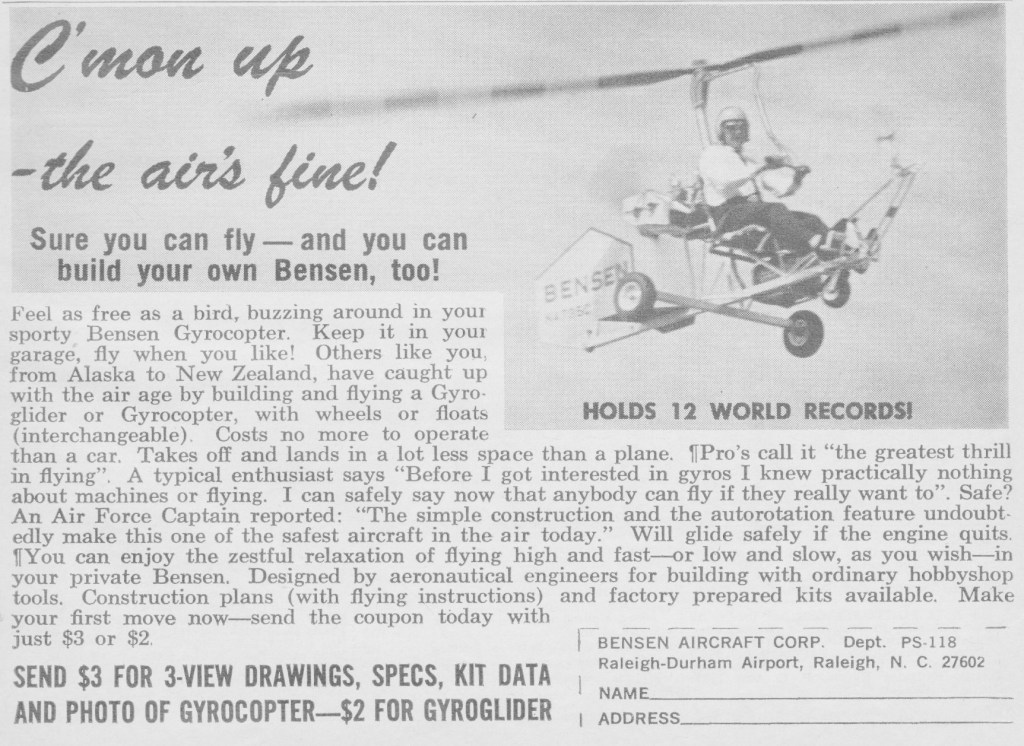
Founded by Dr. Igor B. Bensen, formerly chief research engineer of the Kaman Corporation, to develop a series of lightweight autogyros. Examples built and supplied to USAF for research purposes, but marketed primarily in kit form for amateur construction. Also attempted to develop Cargolifter as multi-helicopter lifting platform, with eight-rotor sub-scale prototype flown in early 1980s.
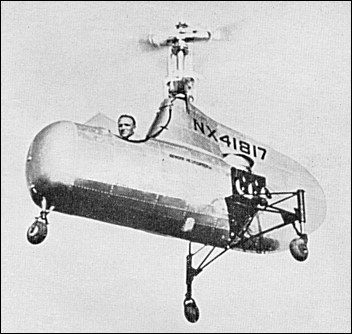
The Bendix Model J was followed by the Model K – with an enclosed tube and fabric fuselage but with a much smaller 100hp Continental C-100 engine. The Model K (NX41817) made its maiden flight in June 1945, but Bendix eventually ceased operations in 1949 without achieving certification.
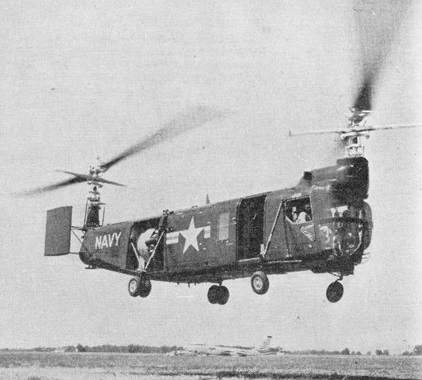
In 1944, Vincent Bendix (of washing machine fame) established Bendix Helicopters (later renamed Helicopters Inc.). The Bendix designer, Martin Jensen, devised the Bendix Model J single-seater which used a system of coaxial rotors and was driven by a 450hp Pratt & Whitney R-985 piston engine. This was followed by the Model K. Gyrodyne acquired rights to the five-seat Helicopters Inc. (Bendix) Model J and developed this as the Gyrodyne GCA-2.
USA Designed and built in 1947 a single-seat experimental helicopter designated Bendix Model K. A development, the Model J, had completed over 100 hours of flight testing in early 1948 and was to be revised before the start of production.
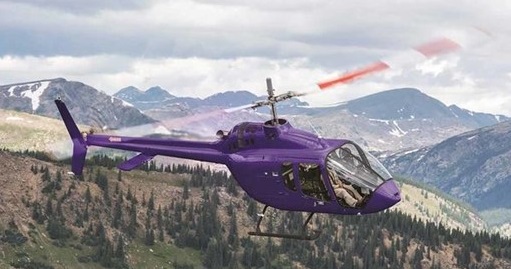
The Bell 505 features the Safran Helicopter Engines Arrius 2R engine incorporating dual-channel fadec that delivers good performance and reduces pilot workload and Garmin G1000H avionics. Top speed is 125 knots and useful load 1,500 pounds. When announced in 2013, the price was set at $1.07 million.
The five-seat Bell 505 Jet Ranger X received FAA certification six months after notching Canadian approval of the light single, Bell Helicopter announced in June 2017. Deliveries of the five-seat light single to U.S. customers were to begin immediately.
Bell was continuing to work with other certification authorities around the world to bring the 505 to more markets. The Bell Helicopter Training Academy was also prepared for entry into service with customer training and flight training device and coursework on track.
The first delivery of the Bell 505 occurred in March 2017 to Pylon Aviation. Bell confirmed delivery of the 200th Bell 505 Jet Ranger X to Austria-based operator Hubi-fly Helikopter GmbH in August 2019 with the global fleet of 200 aircraft flying across six continents.
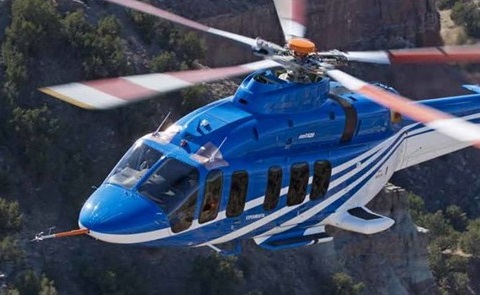
Designed to seat up to 20 passengers, the 525 is the first commercial helicopter with a fly-by-wire system, featuring BAE Systems’ flight control computers. The ARC Horizon flight deck is built around the Garmin G5000H integrated touch screen enabled avionics suite, incorporating four LCD screens and two touchscreen controllers into the wide instrument panel.
Powered by two electronically controlled GE CT7-4F1 engines putting out 1,979 shp on takeoff, the 525 is designed to cruise at speeds up to 160 knots with a max range of 560 nm and a useful load of 8,200 pounds.
“Bell Helicopter has worked with the NTSB and FAA since the accident and we are confident in the resumption of flight test activity,” said Bell’s president and CEO Mitch Snyder.
While the final report from the NTSB regarding the accident has not yet been released, the preliminary report said the helicopter broke up in flight. Both test pilots died as a result of the ensuing crash. Before the crash, the flight test program had accumulated more than 260 flight hours for the 525 and Bell hopes to finalize its certification next year.
The FAA has awarded experimental certificate renewal to the Bell 525 Relentless, allowing Bell Helicopter to resume the flight test program after a 2016 crash. Bell Helicopter was to resume testing the 525 Relentless following the FAA’s awarding of experimental certificate renewal. Certification for 20-passenger fly-by-wire helicopter is expected in 2018.
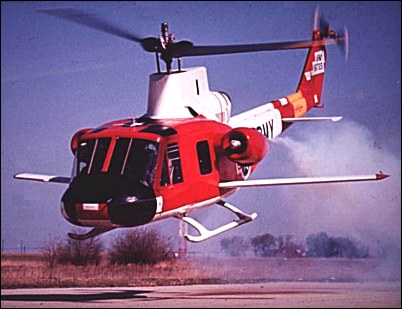
In 1959, the TRECOM (United States Army’s Transportation Research Command) set up a programme in order to determine various rotor systems and methods of drag reduction for helicopters. For this programme, Bell modified the first YH-40-BF service test model (s/n 56-6723) as a research test-bed which was known at Bell as the Model 533. Reworking was done on the airframe in order to reduce drag, including a cambered vertical tail surface to unload the tail rotor, streamlined fairing for the rotor head, flush air intakes located on each side of the new rotor fairing, redesigned cross-tubes for landing skids, and new hinges for the doors. The stabilising bar was removed and replaced by a variable-tilt rotor mast in order to maintain the fuselage in low-drag attitude. The 1400shp Lycoming T53-L-13 turboshaft was retained. Tests in NASA’s Ames wind tunnel showed that the aerodynamics of the airframe had been improved to such an extent that the equivalent flatplane area of the Huey had been reduced from 2.3sq.m to 1sq.m. Still with its original US Army serial number, the Model 533 made its maiden flight on Friday 10 August, 1962, and flight tests were conducted at Fort Worth in late 1962. In March 1963, the Model 533 flew at 278km/h and 302km/h was attained in a shallow dive. Several rotor types were tested (two-blade UH-1B-like rotor and rigid three-blade rotors) and two 765-kg Continental J69-T-9 turbojets were installed on each side of the fuselage. Take-off weight of the aircraft was now 3880kg. On 17 January, 1964, the helicopter achieved a speed of 338km/h in level flight using only 780shp from the 1100shp Lycoming T53-L-9A shaft-turbine, plus 568kg from the J69s. The next modification consisted of fitting two small sweptback fixed wings to convert the aircraft into a compound helicopter. On 11 May, 1964, it flew at 357km/h. The aircraft was then flown to San Antonio to have its J69-T-9s replaced by 765-kg J69-T-29s, and, on 15 October, 1964, the Model 533 was the first helicopter to break the 200 knots (370km/h) barrier by attaining 380km/h. On 6 April, 1965, the Model 533 flew at 402km/h in level flight and 409km/h in a shallow dive. It showed also its outstanding manoeuvrability in performing 2g turns and 60deg banks at speeds around 320km/h, and a Mach number of 0.985 was recorded by the advancing blades of the rotor. Early in 1968, a subsequent phase of the programme was the installation of two 1490-kg Pratt & Whitney JT12A-3 turbojets at the end of short stub wings. The first flight in this configuration was made in 1968, the machine gradually recording still higher speeds and, in May 1969, Bell announced that 508km/h had been attained.
Model 533 Rotor diameter: 13.41m Length of fuselage: 12.98m Normal take-off weight: 4173kg Maximum speed: 508km/h
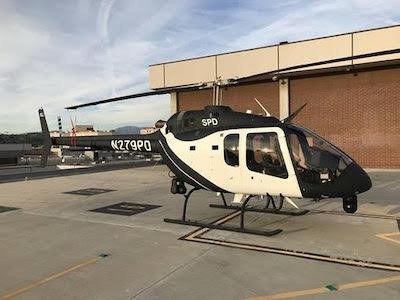
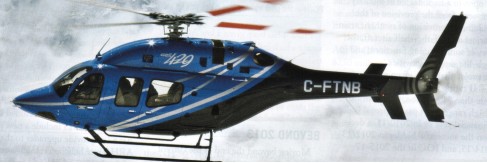
The Bell 429 was the first model designed from scratch, since the Bell 222. A light-medium twin helicopter which received certification from Transport Canada Civil Aviation and the FAA on 1 July 2009. Five prototypes were used during certification. The first delivery was on July 7, in Iowa.
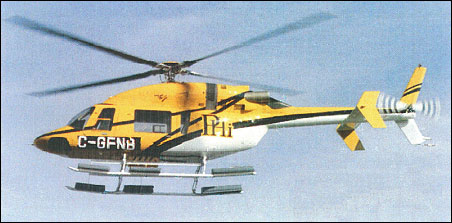
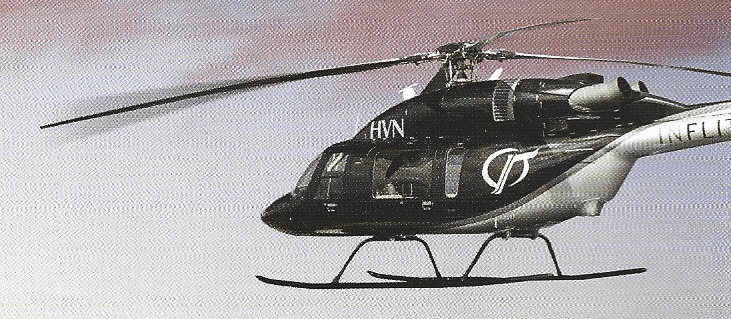
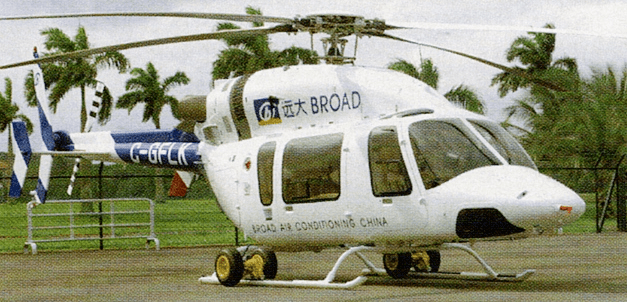
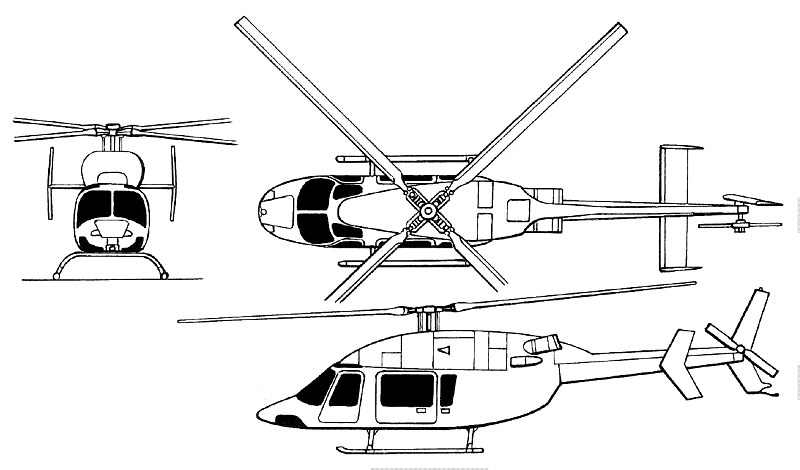
Launched as the New Light Twin (NLT) in February 1996 on signature of collaborative agreement with Samsung Aerospace Industries of South Korea. The Bell 427 prototype assembly began early 1997. An enlarged and lengthened by 13 inches version of Model 407 with wider cabin, centre-section fuel tank, OH-58D composite four-blade main rotor, and 2705kg TOGW, powered is from two 600shp Pratt & Whitney PW206D turboshafts. The first flight of the first prototype (C-GBLL) was on 11 December 1997 at Mirabel, Quebec. The second prototype (C-FCSS) was completed in February 1998 and the two prototypes undertook flight test programme, gaining Transport Canada certification on 19 November 1999, FAA VFR certification achieved in 24 January 2000, followed by Dual Pilot IFR (DPIFR) Category A certification on 24 May 2000. The first production aircraft (C-GDEJ) was flown in June 1998. Compared with prototypes, the production 427 has longer exhausts and revised upper surface contours. Similar in appearance to the Bell 407, with a cabin stretch of 33cm, the 427 is all-new design, incorporating twin-engine safety margins. Flight dynamics are based on the four-blade rotor system of Bell OH-58D Kiowa, allied to tail rotor of Bell 407, and folding main blades. A purpose-designed ‘flat pack’ main transmission, with direct input from both engines, has only four gear meshes to simplify design and operation. The transmission is attached to the airframe by four liquid-inertia vibration eliminators. It was the first Bell helicopter designed entirely with use of computer (Dassault CATIA programme).
The structure is generally as for the Bell 206, but extensive use of carbon/epoxy composites reduces airframe parts count by some 33%. Cabin floor and roof are flat panels for ease of manufacture; minimal use of curved panels elsewhere. Composites main and tail rotors; main blades have nickel-plated stainless steel leading-edges. Soft-in-plane hub of main rotor employs a composites flexbeam yoke and elastomeric joints, eliminating lubrication and maintenance requirements. Brake and main rotor blade folding optional. Composites cabins and rolled aluminium tailbooms built by Samsung; assembly in Canada, except for sales to Korea and China; Hexcel honeycomb as stiffener. The landing gear is twin skids with dynamically tuned cross tubes to reduce ground resonance. Low skids standard; optional high skids and emergency floats. Fuel is contained in three crash-resistant tanks; two forward, one aft, with a total usable capacity of 770 litres. One forward fuel tank can be removed in EMS configurations to provide additional stretcher space in cabin or to permit stretcher to extend into port side of cockpit. Oil capacity (total, both engines) 10.2 litres. Standard accommodation is for two crew in cockpit, on 20g energy-attenuating seats, and six passengers in cabin on two rows of three, seats in club configuration (all-forward-facing scats optional); all scats equipped with inertia-reel shoulder harnesses. Optional EMS interiors provide for carriage of one or two stretchers with up to two medical attendants, affording either full patient or head-only in-flight access, with single- or two-person crew. In cargo configuration, with all passenger seats removed, an optional removable flat cargo floor can be installed, equipped with integral tie-downs. Two forward-hinged doors each side; cabin doors, both sides, are forward-hinged, but port unit can be replaced by optional rearward-sliding door for cargo handling. External door on starboard side to rear baggage hold.
Orders for 22 were placed during the mockup’s first public display at Farnborough Air Show 1996, and 85 were on order by May 2000 from 50 customers. Deliveries began 2000 five delivered that year, 15 in 2001 and five in 2002.
Engines: Two Pratt & Whitney Canada PW207D turboshafts with FADEC, each 529kW for T-O (5 min) or 466kW max continuous OEI ratings: 611kW for 30 sec, 582kW for 2 min, 559kW for 30 min or 529kW max continuous. Twin-engine transmission rating: T-O & max continuous: 597kW. OEI transmission rating: 485kW for 30 sec: 451kW for 2 min; 343kW max continuous. Main rotor rpm: 395 Tail rotor rpm: 2,375 Main rotor diameter: 11.28m Fuselage length: 10.9m Take-off weight: 2722kg Empty weight: 1581kg Max speed at sea level: 252km/h Cruising speed at sea level: 240km/h Hovering ceiling, OGE: 4235m Hovering ceiling, IGE: 4940m Range at sea level: 663km Crew: 1 Passengers: 6-7
 All Aero