Emile, a German immigrant living in Washington D.C., was already a prodigious inventor when he began to dabble in aviation. He received a number of notable patents for substantial improvements he made to the design of gramophones, phonographs, and telephone transmitters. In 1903, he became fascinated with powered flight and experimented with a large rocket-powered model airplane.
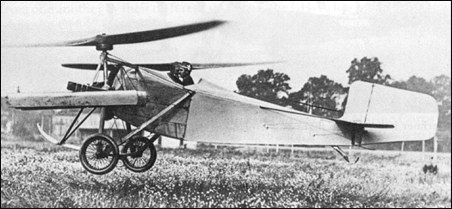
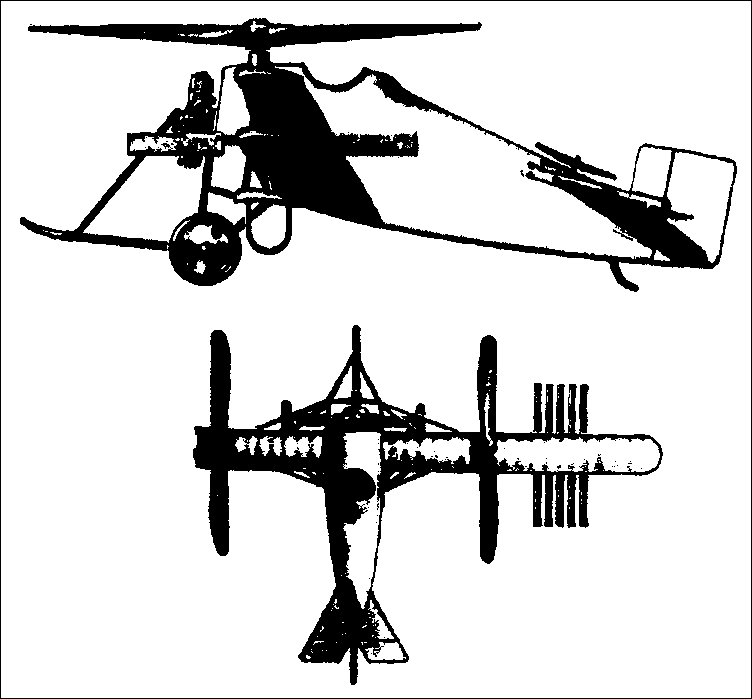
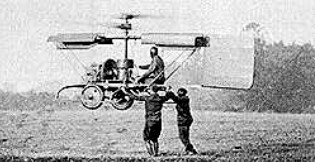
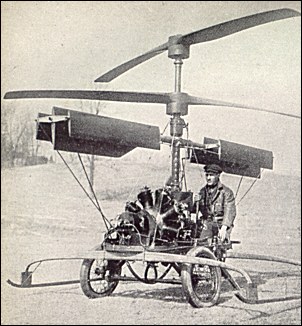
In 1907, Emile began work on a helicopter with a tandem intermeshing-rotor system. The father-and-son team of Emile and Henry Berliner became the first Americans to make any significant progress towards the creation of a practical helicopter. Before 1926, they pioneered a number of experimental helicopters with only moderate success.
On July 11, 1908, Berliner’s first “test-rig” helicopter design demonstrated that it had the potential to lift twice its own empty weight.
However, the Berliners’ final versions displayed the best performance of any American helicopter project until Igor I. Sikorsky unveiled his VS-300 fifteen years later.
Emile then constructed a larger version with a 55-hp motor, which he dubbed the Aeromobile. Simultaneously, Berliner cooperated with J. Newton Williams on a coaxial design. Neither effort progressed very far as the demands of operating the Gyro Motor Company distracted Emile’s attention. However, this did not prevent him from conceiving new approaches to the problem of vertical flight. In 1910, Berliner began to consider the use of a vertically mounted tail rotor to counteract torque on his single main rotor design.
In 1923, Henry Berliner left the Air Service becoming sales rep in America for Morane Saulnier, a job that lasted two years. He joined Curtiss Wright as a pilot and three years later, was a test pilot for Vought Aircraft, demonstrating the Corsair to the Mexican gov¬ernment.
Henry Berliner formed the Berliner Aircraft Co. of Alexandria, Pennsylvania, in 1926 and was developing his direct lift machine when Lindbergh made his flight. Suddenly, the world was interested in airplanes – -high wing monoplanes, not things that tried to go straight up. H. A. Berliner was the son of Emile Berliner, designer of an aero engine, a helicopter and a record player.
At this time, Henry Berliner was looking for a partner who could sell his ideas. He found him in Temple Joyce. Berliner was the solid thinker, a man with his feet on the ground; Joyce, the gregarious salesman/pilot. The combination was a natural.
Temple Joyce entered the Air Service soon after graduation and was sent to France but never saw action. At the Air Service base in Issoudun, he served as a test pilot testing both new Allied aircraft and captured enemy aircraft. He was cited by General Pershing in April of 1919 for his excellent work. Before leaving France, he completed a record 300 consecutive loops.
The Berliner/Joyce Aircraft Corp. was organised in 1928 with a capital of $1,000,000 and the assets of the former Berliner Aircraft Co.
By mid 1930, Henry Berliner had left the company, though Joyce remained as an executive test pilot until late in 1934. During the early 1930s, a series of stock manipulations threatened the existence of the company. In 1933, North American Aviation Co., Inc., took over the assets of Berliner/Joyce, changing its corporate name to the B/J Co. At this time, North American did not manufacture any airplanes; it was a holding company division of General Motors which had absorbed Atlantic Fokker as General Aviation.
In December of 1934, Congress passed a law requiring companies to manufacture a product. This was one of Franklin Roosevelt’s lesser known acts aimed at spurring employment. North American, faced with the pros¬pect of having to go to work or go out of business, elected to scrap all B/J activities and relocate in Southern California where the climate was bet¬ter. The B/J Co. ceased to operate.
Henry Berliner was the founder of Berliner Aircraft Company, and founder of Engineering Research Corporation, Riverdale, Maryland, in 1930 – producer of the Ercoupe.

 All Aero