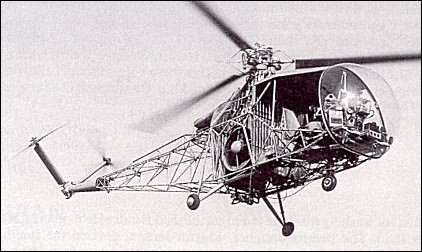
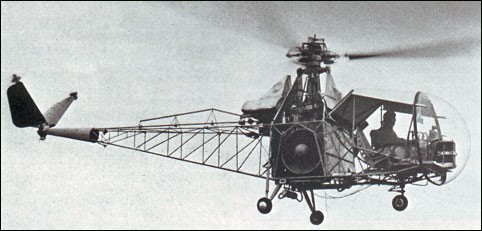
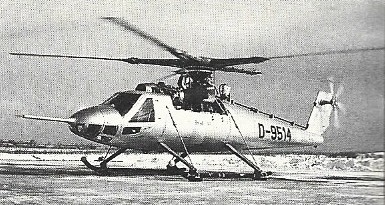
The German car manufacturer, Borgward set up a helicopter division in 1956 under the leadership of Prof. Heinrich Focke, whose Focke-Wulf Fw.61 aircraft of 1937 was one of the earliest successful helicopters. The Kolibri I is the first helicopter of German design to have flown since the war.
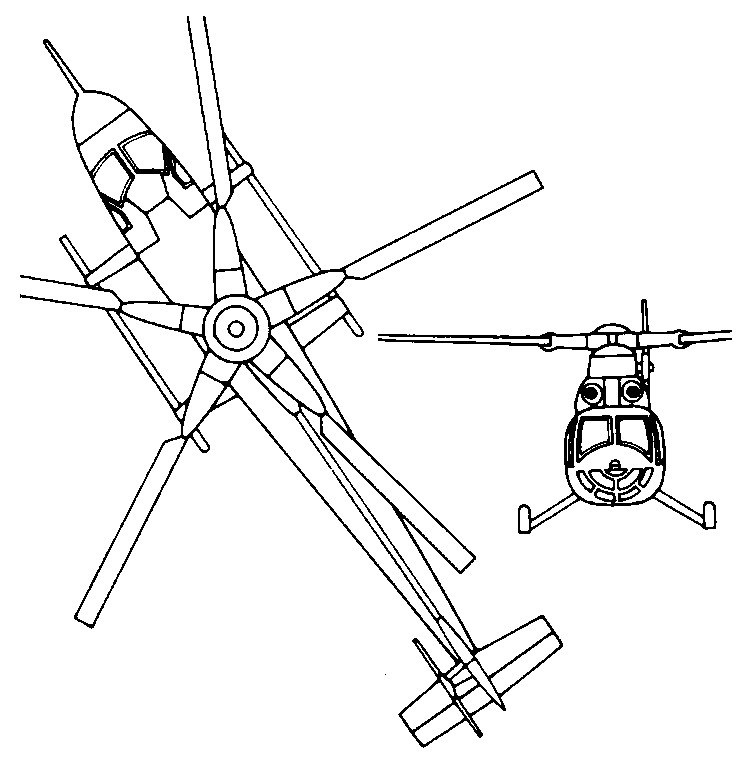
A light three-seat helicopter, the Kolibri I, was designed with a three-blade main rotor. Blades have steel-tube spar, with plastic-bonded plywood covering. Fully-articulated hub with adjustable friction dampers. Main rotor drive is via two-stage cam-wheel. Tail rotor drive via hollow steel-tube shaft and two bevel-gears. Two tail rotors, inclined at 45° to horizontal, at extremities of tail stabilisers. Tail rotor blades of plastic-bonded plywood.
The uncovered steel-tube girder fuselage had a conventional tail boom and a tricycle type landing gear. Shock-absorption by torsion spring and Borgward hydraulic damper. Fuel tank aft of rear fire-wall.
Normal seating for three persons, with a central seat behind and on a higher level than front two seats, with a forward cockpit enclosed with bubble canopy. Alternative loads can include up to 300kg of freight slung from an under-fuselage hook.
The prototype had a 260hp Lycoming VO-435-A1B engine in the centre section.
The prototype made its first free flight on July 8, 1958, piloted by Herr Ewald Rohlfs, who set up several international helicopter records in the pioneer Fw.61 in 1937. Airworthiness trials were progressing satisfactorily in the Spring of 1959, and plans are being made to put the Kolibri in production.
Kolibri I Engine: 1 x Lycoming YO-435-A1B, 260hp Main rotor diameter: 9.40m Main rotor blade area (each) 1.28 sq.m Main rotor disc area 70 sq.m Length of fuselage: 8.30m Height to top of main rotor head: 3.05m Weight empty: 800kg Weight loaded: 1200kg Fuel capacity: 180 litre Wheel track 1.93m Wheel base 1.80m Tail rotor diameter: 1.66m Tail rotor disc area (total) 4.3 sq.m. Main rotor/engine r.p.m. ratio 1 : 10 Tail rotor/engine r.p.m. ratio 1 : 6.75. Max speed (est.): 160km/h Cruising speed (est.): 140km/h Rate of climb at sea level (est.): 240m/min Vertical rate of climb at sea level (est.): 60m/min Absolute ceiling (est.): 4500m Hovering ceiling OGE (est.): 600m Endurance: 3.0h
The Bo.108 is a flight test vehicle for advanced systems This also includes subsystems integrated into a new airframe. The first of two prototypes (D-HBOX) first flew on 15 October 1988 powered by two Allison 250-C20R turboshafts. The helicopter initially undertook a flight test programme to assist in the advance of helicopter technology particularly in rotor technology, and the development of dynamic systems, anti-resonance isolation systems, composite structures, electrical and avionic systems, cockpit installations and engine integration.
Fitted with higher-powered Turbomeca TM-319 Arrius IBs engines and equipped with a single-pilot EFIS-based IFR system, the second prototype, nominally stretched by 15cm, flew in June 1991.
The Bo.108 was equipped with two Allison 250 C20-R engines but the engine compartment had been designed to allow other power units such as the Turbomeca TM319 or the Pratt & Whitney PW205B/1.
Bo-108 Engine: 2 x Allison 250-C20R-3 turboshaft, 335kW Main rotor diameter: 10m Length rotors turning: 10.6m Height: 3m Take-off weight: 2500kg Empty weight: 1225kg Cruising speed: 270km/h Ceiling: 5000m Range max fuel: 800km
First flown on 25 September 1973 (Prototype D-HDCI), the BO 106 is generally similar to the BO 105 but has the cabin widened by 50cm to seat two or three persons in front and four on the rear bench. Its uprated Allison 250-C20B engines each develop a maximum of 420shp and give 50shp more than the 250-C20 at ISA + 20°C. This gives the BO 106 a performance simflar to that of the BO 105.
An uprated transmission caters for a twin-engine power output of up to 692shp, and single-engine output of 380shp, compared with 636 and 370shp respectively for the BO 105 transmission.
The prototype was developed with government aid (60%). It is hoped to make available kits to convert existing BO 105s to BO 106 standard, as well as new production aircraft.
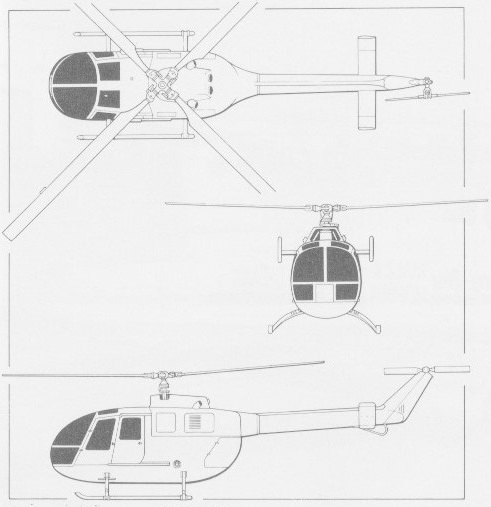
Design of the Bo.105 lightweight, general purpose helicopter was begun in July 1962 utilising basic experience gained by the company in the preceding few years in building the Bo.102 and Bo.103. The former was a non-flying, ultra-light helicopter trainer, and the Bo.103, flown for the first time on 9 September 1961, was essentially the same aircraft minus its fixed base. An enlarged version of the Bo.103 was proposed as the Bo.104, but this project was supplanted by the more promising Bo.105.
Under German government contract, ground rig testing of its radical rigid rotor and construction of the first prototypes began in 1964. The first prototype airframe (V-1) was ready for ground testing September 1969, powered by two Allison 250-C18 turboshaft engines and using the hinged-rotor from a Westland Scout, was destroyed on the ground at an early date by resonance problems. The second prototype, first flown on 16 February 1967 at Ottobrunn (Munich), was the first to take to the air with hingeless titanium rotor hub and composite rotor blades. Powered by twin Allison 250-C18 turboshaft engines, the non-articulated rotor, whose fold-able blades are reinforced with glassfibre, has been developed over several years by Bolkow in association with Sud-Aviation and has been adopted by the French company for its own SA.341 light helicopter.
Further changes and modifications led to the third prototype — the V-3 fitted with two German-built MAN-Turbo 6022 turbines (first flown on 20 December 1967), and to two pre-production models, the Bo.105 V-4 and V-5, the first of which made its maiden flight on 1 May 1969. Two Allison 250-C20 turbines were later installed on the V-4, which thus became the prototype of the definitive Bo.105C. Meanwhile, from spring 1970, new “droop snoot” design blades, which had a marked downward curvature on the leading edge, were introduced. These were made by MBB, the Messerschmitt-Bolkow-Blohm und Voss group — of which Bolkow and its affiliates had become part.
In 1972, the Bo.105 went into full-scale production at the company’s Donauwörth facility in Germany, and was offered with either Allison 250-C18 turbine engines or the more powerful C20. The helicopter was approved by the German Federal Authority LBA with the first power-plant in October 1970, after successfully completing autorotation trials in the autumn of 1969. Approval by the US Federal Aviation Administration followed in March 1971 and was extended to the C20 engines in August 1972, while the Canadian authorities certified the Bo.105 in April 1973. The German helicopter also received a British Certificate of Airworthiness in July 1973 and was recognized by the Italian Aeronautical Register in March 1974.
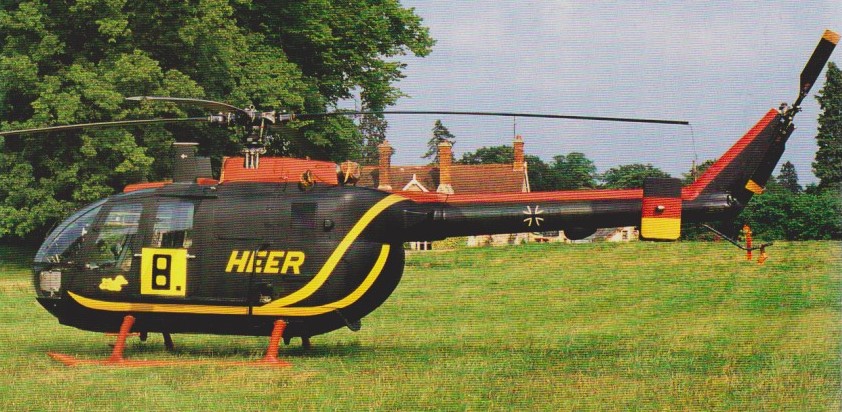
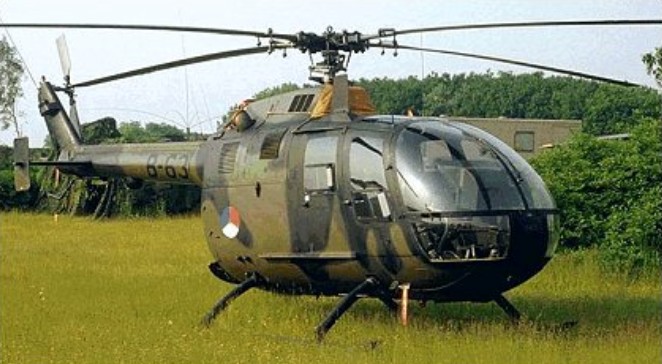
The German government ordered 20 for its “Katastrophenschutz” programme, to ensure rapid assistance in the event of a disaster. The military version differs little from the civil one. The antitank version can carry six HOT missiles, three on either side of the cabin, with a stabilized sight on the port side.
Bo 105 80+13, June 1986
The Federal German government authorised production of a total of 439 BO 105s for service with the German army. These comprised 227 of the BO 105 M(VBH), a liaison and light observation version of which deliveries began in 1980; and 212 of the BO 105 P(PAH-1) anti-tank version, each able to carry six Euromissile HOT missiles. Initial deliveries of this latter version, to Heeresfliegerregiment 16, began in December 1980. MBB has also developed an anti-tank version able to deploy eight Hughes TOW missiles.
Other military operators include the Mexican navy with six radar-equipped versions used for maritime patrol, and the Spanish army with 60 BO 105Ps, 57 of them assembled by CASA. The Spanish company is also assembling 80 105s for other customers, and there are active licence-assembly programmes underway in Indonesia as the Nurtanio NBO 105, and Chile. BO 105 LS helicopters produced at Eurocopter’s Fort Erie facility in Ontario, Canada.
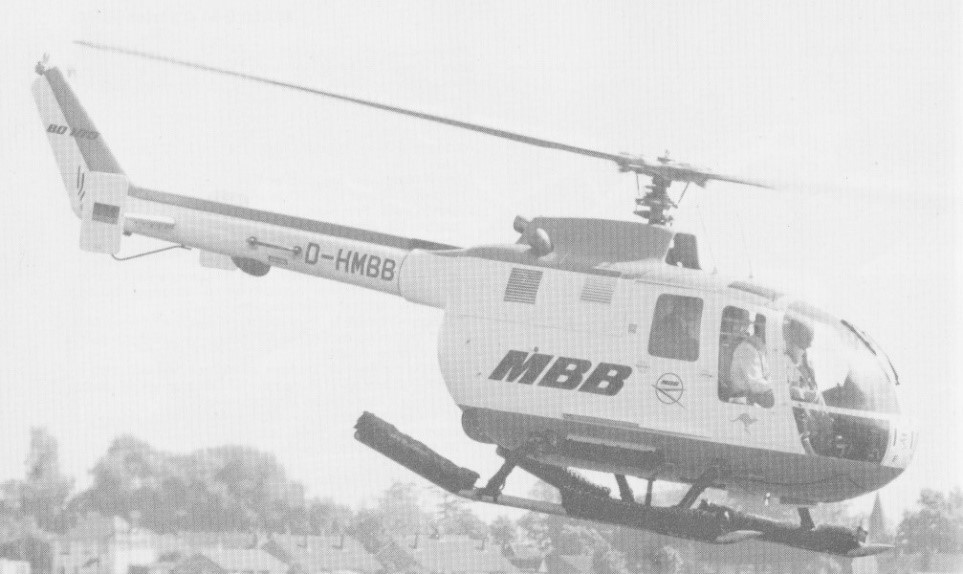
MBB Bo.105C
Others are in use in Brunei, Canada, Ciskei, Colombia, Holland, Iraq, Nigeria, Peru, Sierra Leone and Sweden. Sweden operates an unarmed SAR version known as the HR 9B. By 1991 more than 1,300 BO 105s had been delivered to 37 countries.
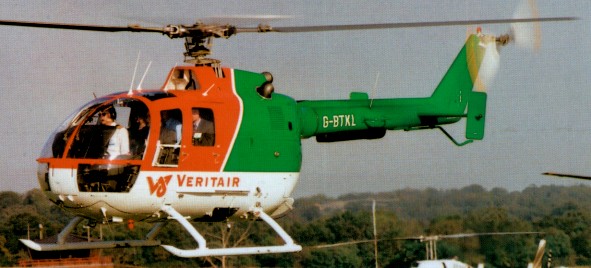
The civil version has also been a major export success and was initially marketed through Boeing in the United States before MBB set up its own US facilities. The BO 105C was superseded in 1975 by the BO 105 CB which became the standard production version.
By the end of 1981, total production of the Bo.105 exceeded 1100. More than 100 Bo.105s were in operation in the United States and these were joined in 1982 by the Bo.105CBS Twin Jet II variant, with 420shp Allison 250-C20B turbines, which, apart from having better flying capabilities, has 20 per cent more cabin room. The BO.105CB-3 variant of the standard production CB and CBS versions has a longer fuselage.
The Messerschmitt-Bolkow-Blohm GmbH Bölkow Bo.105 DBS-4 version has the 10-inch fuselage stretch at the rear of the cabin and the extra small rear side windows.
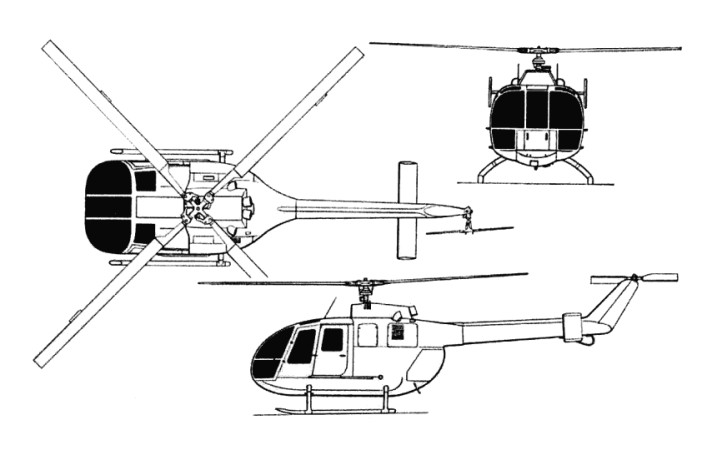
Further development of the Bo.105CBS led to the introduction in 1981 of the Bo.105LS (Lift Stretch) which combines the enlarged cabin with the uprated transmission of the military version and more powerful 550shp Allison 250-C28C engines to provide a much improved hot/high performance and external lift capability. Bo.105 LSA3 is a stretched cabin version. Featuring two Allison C28B engines, each with a separate drive to the main transmission, separate fuel and lubrication systems and dual hydraulic boost system. Providing the lift and directional control is a hingeless four-bladed main rotor and a semi-rigid two-blade tail rotor, all of fibre reinforced composite material.
The rear-loading clamshell cargo compartment is rigged to al-low accommodation of bulky cargos or stretchers by removing the rear bulkhead behind the passenger compartment.
Sales total more than 1300 to 37 countries by 1990. Navalised BO.105s are fitted with Sperry Primus 500 search radars and other maritime equipment, and have folding main rotor blades for shipboard stowage.
Messerschmitt-Bolkow-Blohm Bo.105HGH
An BO 105 fitted with a rear fuselage fairing, rotor head fairing and four small individual landing gear skids, was developed under a high-speed research programme. Known as the BO 105HGH, this aircraft attained a speed of 372km/h in a shallow dive at max AUW in September 1973. Flight testing was continued in 1974 after the addition of 6.00m fixed wings with an NACA 230 section varying from 15% thickness/chord ratio at the roots to 12% at the tips. Airbrakes are mounted above and below the leading-edge of each wing, and a shorter-legged landing gear is fitted.
The HGH programme (Hochgeschwindigkeits Hubschrauber / High Speed Helicopter) ended on 4 March 1975 with a flight in which the aircraft attained a max speed of 404km/h; max blade tip speed was Mach 0.97. The BO 105HGH, which was converted from a pre-production BO 105 airframe, was to continue in use as a rotor blade testbed.
BO 105 CBS-4 description except where indicated:
DESIGN FEATURES: Four-blade main rotor, comprising rigid titanium head and GFRP blades, with titanium anti-erosion strip and pendulous vibration damper on each blade. NACA 23012 lifting aerofoil with drooped leading-edge and reflexed trailing-edge. Two-blade semi-rigid tail rotor. Tail rotor gearbox on fin. Main rotor 424 rpm. Tail rotor 2,220 rpm. Main transmission utilises two bevel gear input stages with freewheeling clutches and a spur collector gear stage. Planetary reduction gear; three auxiliary drives for accessories. Main transmission rated for twin-engine input of 257kW per engine, or a single-engine input of 283kW. Uprated transmission and Allison 250-C28 engines in BO 105 LS for exceptional hot-and-high performance. EC Super Five has new main rotor blades and performance improvements, including 150kg more rotor lift; better stability; and airframe vibration reduced to less than 0.1g.
FLYING CONTROLS: Main rotor has roller bearings for pitch change. Main rotor brake standard. Dual controls standard on EC Super Five.
STRUCTURE: Folding of two main rotor blades optional. Tail rotor blades of GFRP, with stainless steel anti-erosion strip. The fuselage is a conventional light-alloy semi-monocoque structure of pod and boom type. Glass fibre reinforced cowling over power plant. Titanium sheet engine deck. Horizontal stabiliser of conventional light-alloy construction with small endplate fins.
LANDING GEAR: Skid type, with cross-tubes designed for energy absorption by plastic deformation in the event of a heavy landing. Inflatable emergency floats can be attached to skids.
POWER PLANT: BO 105 CBS: Two 313kW Allison 250-C20B turboshafts, each with a maximum continuous rating of 298kW. Bladder fuel tanks under cabin floor, capacity 580 litres, of which 570 litres are usable. Fuelling point on port side of cabin. Auxiliary tanks in freight compartment available optionally. Oil capacity: engine 12 litres, gearbox 11.6 litres. EC Super Five additionally has scavenge oil filter and one-handed engine starting arrangement. BO 105 LS A-3: Two Allison 250-C2BC turboshafts, each rated at 410kW for 2.5 minutes, and with 5 minute T-O and maximum continuous power ratings of 373kW and 368kW respectively. Main transmission, type ZF-FS 112, rated for independent restricted input of 310kW per engine at T-O power or 294kW per engine for maximum continuous operation; or single-engine restricted input of 368kW at maximum continuous power, or 410kW for 2.5 minutes at T-O power. Fuel capacity as for CB/CBS. Oil capacity 4.5 litres per engine.
ACCOMMODATION: Pilot and co-pilot or passenger on individual longitudinally adjustable front seats with safety belts and automatic locking shoulder harnesses. Optional dual controls. Bench seat at rear for three or four persons, removable for cargo and stretcher carrying. A full EMS version is available. Both cabin and cargo compartment have panelling, sound insulation and floor covering. Entire rear fuselage aft of seats and under power plant available as freight and baggage space, with access through two clamshell doors at rear. Two standard stretchers can be accommodated side by side in ambulance role. One forward-opening hinged and jettisonable door and one sliding door on each side of cabin. Ram air and electrical ventilation system. Heating system optional.
SYSTEMS: Tandem fully redundant hydraulic system, pressure 103.5 bars, for powered main rotor controls. System flow rate 6.2 litres/min. Bootstrap/oil reservoir, pressurised at 1.7 bars. Electrical system powered by two 150A 28V DC starter/generators and a 24V 25Ah Ni/Cd battery; external power socket; stability augmentation system standard on BO 105 LS A-3, with hoist, firefighting kit, weapons fittings, mast-mounted sight and floats optional; EC Super Five has improved hydraulic system.
Variants:
BO 105C: Initial production version offered with either 236kW Allison 250-C18 or 298kW 250-C20 turboshaft engines.
BO 105 CB: Standard production version from 1975, with two Allison 250-C20B engines, operable in air temperatures ranging from -45 to +54°C. LBA certification received in November 1976.
BO 105 CBS-5: Military army/naval version for armed and non-armed missions; can be equipped with anti-tank missiles, rocket launchers. Gun pod or turret. First 12 ordered by the Republic of Korea Army; most assembled from kits by Daewoo. Include Boeing IR/optical sights and defensive aids suite.
BO 105 CBS: version with slightly lengthened fuselage to provide increased seating or cargo capacity
BO 105 CBS-4 / Twin Jet II: Version with increased rear seat leg room in a cabin extended by a 0.25m plug. Available in five-seat executive or six-seat high-density configurations. Identified by small additional window aft of rear door on each side. Marketed in the USA by MBB Helicopter Corporation under the name Twin Jet II. First CBS version certified in early 1983 by FAA for IFR operation in accordance with SFAR Pt 29-4, requiring two pilots, radar, Loran C and a separate battery, but not a stability augmentation system, although SAS was an option.
BO 105D: UK CAA-certified offshore version with modified equipment, supplied to customers in the UK and Nigeria
BO 105 LS: Canadian-built version of BO 105 CBS with increased power for ‘hot-and-high’ operation. Combining the larger cabin of the BO 105 CBS with two Allison 250-C28C turboshafts each with a maximum take-off rating of 373kW. First flight 23 October 1981, German LBA certification July 1984, followed by FAA and Canadian DOT type approval. In Spain, CASA assembled 57 of an initial 60 for the Spanish Army.
BO 105 LSA-3: Hot-and-high version, certified 7 July 1986 and first delivered February 1987. Uprated transmission and Allison 250-C28 turboshaft engines, rated at 410kW for 30 seconds. Built solely by Eurocopter Canada at its Fort Erie, Ontario plant.
BO 105 LSA-3 Super Lifter: Optimised for external load and heavylift missions; max T-O weight 2,850kg; upgraded tail rotor derived from BK 117C-1. Type certification granted October 1995. Built solely by Eurocopter Canada.
BO 105 LS B-1: One-off testbed C-FMCL, powered by two 307kW Pratt & Whitney Canada PW 205B turboshafts, made first flight 13 October 1988.
BO 105 M (VBH): Liaison and light observation helicopter for the Federal German Army, with strengthened transmission gearing, reinforced rotor components, a tail rotor with improved thrust and performance, a rupture-proof fuel system and a landing gear able to absorb higher energy levels. Production of 100 approved by the Federal government, to replace Alouette II. Deliveries completed in 1984.
BO 105 P (PAH-1): Anti-tank version of the BO 105 M, with same airframe improvements as BO 105 M, outriggers to carry six Euromissile HOT missiles, a stabilised sight above the co-pilot and a Singer AN/ASN-128 Doppler navigation system. The Federal German government gave its approval for the procurement of 212 PAH-1s for the Federal German Army. Deliveries began on 4 December 1980 and were completed in mid-1984.
EC Super Five: High-performance version of BO 105 CBS-4, derived from German Army PAH-1 upgrade programme; certified late 1993. New main rotor blades, improved performance and reduced vibration; dual flying controls as standard.
KWS-1 upgrade programme implemented in late 1980s, including installation of a digital weapon system, reduction in launcher weight, improved cooling unit, newly developed main rotor blades, and an increase in MTOW to 2,500kg.
BO 105C Engine: Allison 250 C20, 400 shp maximum, 385 shp continuous. TBO: 1,500 hrs. Rotor: four blade, semi rigid, glass fiber and reinforced plastic. Length: 38 ft. 11 in. Height: 9 ft. 7 in. Main rotor diameter: 32 ft. Disc loading: 6.22 lbs./sq.ft. Seats: 5. Empty weight: 2,698 lbs. Useful load: 2,372 lbs. Payload with full fuel: 1,339 lbs. Gross weight: 5,070 lbs. Power loading: 7.9 lb/hp. Fuel capacity (std.): 153 USG/1,033 lbs. Fuel capacity (opt,): 258 USG/1,742 lbs. Baggage capacity: 660 lbs. Baggage area: 57.5 cu. ft. Maximum sling load: 1,984 lbs. Rate of climb: 1,250 fpm. Service ceiling: 17,000 ft. Single engine service ceiling: 4,200 ft. Maximum speed: 167 mph/145 knots. Cruise: 140 mph/122 knots. Econ cruise: 124 mph/108 knots. Range @ max cruise (45 min res., std. tanks): 385sm/335nm. Range @ econ cruise (45 min res., std. tanks): 350sm/304nm. Duration @ max cruise (no res., std. tanks): 3.5 hrs. HIGE: 7,900 ft. HOGE: 5,850 ft. Single engine HIGE: 2,200 ft.
BO.105CB Engine: 2 x Allison 250-C20B turboshaft, 313kW Installed pwr: 600 kW. Rotor dia: 9.8 m. Fuselage length: 8.6 m. Length rotors turning: 11.86m No. Blades: 4. Height: 3m Empty wt: 1276 kg. MTOW: 2500 kg. Payload: 1000 kg. Max speed: 270 kph. Cruising speed: 270km/h ROC: 420 m/min. Ceiling: 5180 m. HIGE: 2560 m. HOGE: 1615 m. Fuel cap (+aux): 580 lt (400 lt ). Range with max payload: 658km Crew: 1. Pax: 4.
BO.105 CBS Engine: 2 x Allison 250-C20B, 420 shp. TBO: 3500 hrs. Main rotor: 32.2 ft. Seats: 5/6. Length: 38.9 ft. Height: 9.8 ft. Max ramp weight: 5291 lbs. Max takeoff weight: 5291 lbs. Standard empty weight: 2780 lbs. Max useful load: 2511 lbs. Max landing weight: 5291 lbs. Max sling load: 1984 lbs. Disc loading: 6.5 lbs/sq.ft. Power loading: 7.6 lbs/hp. Max usable fuel: 1008 lbs. Max rate of climb: 1476 fpm. Service ceiling: 17,000 ft. Hover in ground effect: 8,400 ft. Hover out of ground effect: 5300 ft. Max speed: 145 kts. Normal cruise @ 3000 ft: 126 kts. Fuel flow @ normal cruise: 355 pph. Endurance @ normal cruise: 2.6 hr.
BO.105EC Super Five Engine: 2 x Allison 250-C20. Instant pwr: 313 kW. Rotor dia: 9.8 m. MTOW: 2500 kg. Payload: 1180 kg. Max speed: 250 kts. Max cruise: 130 kts. Max range: 564 km. Crew: 1. Pax: 4/5.
BO.105 LS Engines: 2 x Allison 250-C28C, 500 shp. Main rotor dia: 32.4 ft. Height: 12.5 ft. Skid width: 8.5 ft. Length: 38.9 ft. MTOW: 5732 lbs. Std empty wt: 3153 lbs. Max useful load: 2579 lbs. Max ldg wt: 5732 lbs. Disc loading: 7 lbs/sq.ft. Pwr loading: 5.7 lbs/shp. Std usable fuel: 150 USG/1005 lbs. Optional usable fuel: 106 USG/706 lbs. Max ROC: 1810 fpm. Service ceiling: 20,000 ft. Hover IGE: 11,500 ft. Hover OGE: 8370 ft. Vne: 130 kts. Cruise: 129 kts. Fuel flow at cruise: 335 pph. Endurance at cruise: 3 hr. Seats: 5/6.
BO.105P1 Engines: 2 x 420 hp / 313 kW 250-C20B Gross weight: 5291 lb / 2400 kg Max speed: 187 mph / 270 kph
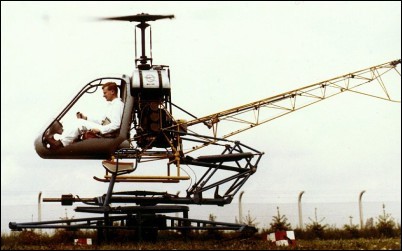
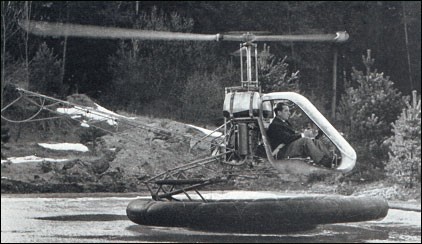
Rolled out in 1959, the Helicopter Trainer was powered by a Hirth 40hp ILO piston engine and had a twenty-one foot counterbalanced fibreglass rotor blade.
Developed in land and water based versions, both of were semi-captive. This feature allowed the helicopter to rise to a height of 0.6m, turn around a vertical axis and dip at up to 6° but prevented it from flying outside these limits.
In all eighteen of these HeliTrainers were built operating throughout Europe, training military helicopter pilots. Although unable to fly, they were ideal for the teaching of hovering techniques and were replaced by dual trainer helicopters.
Bo-102 Engine: 1 x Hirth ILO, 40 hp / 30 kW Main rotor diameter: 6.58m Length: 5.68m Take-off weight without a platform: 325kg
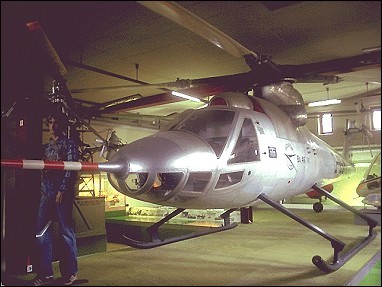
The Bolkow Bo.46, three experimental prototypes of which were built for the German Ministry of Defense, served as a flying test-bed for the Derschmidt semi-rigid rotor. The first model, built jointly with SIAT, began test flights in January 1964. The Derschmidt rotor underwent a long series of wind tunnel tests, for each blade had a hinge about half-way along its radius, enabling the outer section of the blade to rotate 40° backwards or forwards in relation to the inner section connected to the hub. This enabled the movement of the advancing blade to be “delayed,” thereby considerably reducing the tip speed. Conversely, by “accelerating” the movement of the outer portions, quite high rotational speeds could be achieved. However the complexity of this system prevented the Bo.46 from passing the experimental stage.
This company was founded on May 1,1956 by Ludwig Bolkow, becoming established at Ottobrunn bei Munchen in 1958. Until January 1,1965 was known as Bolkow Entwicklungen KG. Boeing acquired a one-third interest in the business. Bolkow held a 25% interest in Entwicklungsring Sud EWR). Aircraft produced include the Bo 207 four-seat light aircraft, BO 208 C Junior (a license-built version of the Malmo MFI-9) and the BO 105 five-seat light helicopter, which featured a rigid main rotor of glassfiber-reinforced plastics. This helicopter continued in production under the designation MBB BO 105, signifying that it was then built by Messerschmitt-Bolkow-Blohm, and most recently it became a Eurocopter product.
Messerschmitt joined with Bolkow in 1970 to form Messerschmitt-Bolkow. The Bolkow company was absorbed into Messerschmitt-Bolkow-Blohm which by 1990 was part of Deutsche Aerospace.
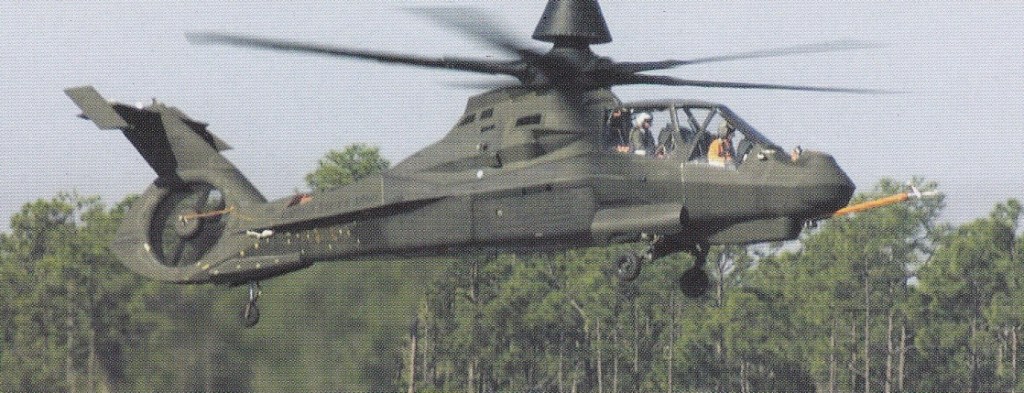
A LHX request for proposals was issued 21 June 1988 as the centerpiece of the U.S. Army’s aviation modernization plan with the main goal of replacing the entire OH-58s and AH-1 Cobras fleet. Boeing and Sikorsky began collaboration on what later became the RAH-66 in June 1985 and received a 23 month demonstration/validation contract for the demonstration/validation programme on 5 April 1991. The contract was to build four YRAH-66 demonstration/validation prototypes in a 78 month programme, plus static test article (STA) and propulsion system testbed (PSTB). LHTEC T800 engine specified October 1988. LHX designation changed to LH early 1990, then US Army designation RAH-66 Comanche in April 1991. The prototype critical design review, completed in December 1993, authorised production of three YRAH-66 prototypes (the first item for which manufactured in September 1993). At same time, however, further R&D economies under study; December 1994 decision reduced dem/val phase to two prototypes (lacking Longbow/Hellfire capability). Prototype construction began 29 November 1993 with the forward fuselage at Sikorsky, Stratford; Boeing built aft fuselage in Philadelphia. STA airframe delivered to Stratford 1994, at which time PSTB under construction there. PSTB trials commenced in 1995 at West Palm Beach, with 100% torque from both engines achieved during first 10 hours of running. PSTB subsequently suffered failure of left input bevel gear, which disintegrated and punched hole in main gearbox housing during 110% power test; resonance was blamed for the failure. In early 2002, Boeing Sikorsky announced selection of Bridgeport, Connecticut, as the final assembly location for the production RAH-66. Also in 2002, the Joint Program Office moved from Huntsville, Alabama, to Bridgeport. The front and rear sections of the prototype were joined at Stratford on 25 January 1995, and the completed helicopter (94-0327) rolled out on 25 May 1995. Following transfer to Sikorsky’s Development Flight Test Center in West Palm Beach, Florida, during June 1995, the first flight was accomplished on 4 January 1996. Prototype retired from flight test duty on 30 January 2002, by which time it had accumulated 387.1 flight hours in 318 sorties. Aft fuselage section of second prototype (95-0001) was delivered by Boeing to Stratford in early December 1996 for mating with forward fuselage, and the completed helicopter was exhibited at Army Aviation Association’s annual meeting in April 1998 and then to West Palm Beach. Made international debut when displayed statically at Famborough Air Show in September 1998; flew for first time on 30 March 1999. Completed initial test schedule in April 1999, recording 4.9 hours in five sorties before temporary lay-up, due to funding constraints; also used for vertical rate of climb demonstration later in year and will test integrated mission equipment package (ÌÅÐ), including digital avionics, communications, navigation and target acquisition systems. By mid-December 2000, had logged almost 53 flight hours in 50 sorties; these figures had risen to 93 and 103.5 respectively in May 2001 when it was removed from flight status to be prepared for flight testing and validation of ÌÅÐ. This phase of development began on 23 May 2002, when second prototype made first flight with ÌÅÐ and new engines installed. Near-term objectives to be achieved by the second prototype include flight with the night vision pilotage system by October 2002, as well as completion of total weapon system critical design review in May 2003, including the Lockheed Martin Electro-Optical Sensor System (EOSS), which due for delivery in first half of 2003. Engineering and Manufacturing Development (EMD) officially began 1 June 2000, following RAH-66 meeting (on 4 April 2000) seven key Defense Acquisition Board Milestone 2 criteria, including a 107m/min vertical climb rate, a specified detection range for the FLIR sensors, a radar cross-section specification, ballistic vulnerability and tolerance specifications and tower-testing of the selected FCR. Weight reduction effort under way in late 2000, to reduce from current level of about 4,310kg to target weight of 4,218kg. Under original plan, EMD expected to take six years and include production of five RAH-66 specifically for EMD testing, followed by further eight for initial operational test and evaluation (IOT&E) by the US Army. However, EMD contract and plan restructured in mid-2002, at which time IOC forecast to occur in September 2009. The new plan includes a start of low-rate initial production (LRIP) in 2007, with full-rate production set at 60 per year from 2011-12 onwards. First EMD RAH-66 expected to fly in March 2005. In meantime, second YRAH-66 will assume increasing burden of test duty. Production of components for the first EMD RAH-66 began at Boeing’s Philadelphia factory in early 2003, with work on assembling the first empennage beginning on 21 April 2003; on completion, this shipped to Bridgeport and mated with Sikorsky-produced elements. First -801 growth version of T800 turboshaft began bench runs in March 1994; -801 preliminary design review completed May 1993; critical design review March 1995; prototypes originally fitted with less powerful T800-LHT-800 engines, but first flight with definitive -801 engine made on 1 June 2001 by first prototype. Same engine subsequently installed on second prototype in time for resumption of flight test duty in May 2002.
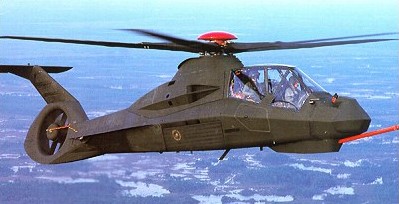
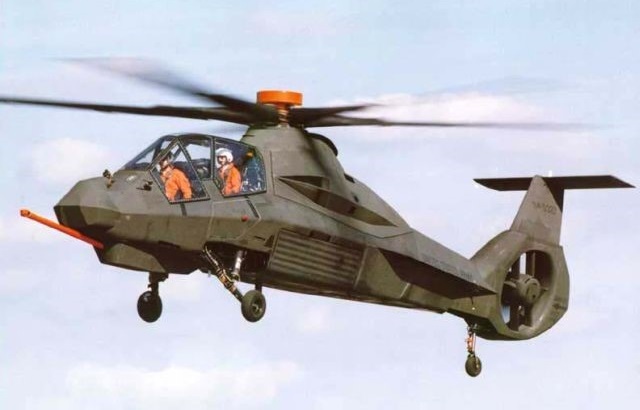
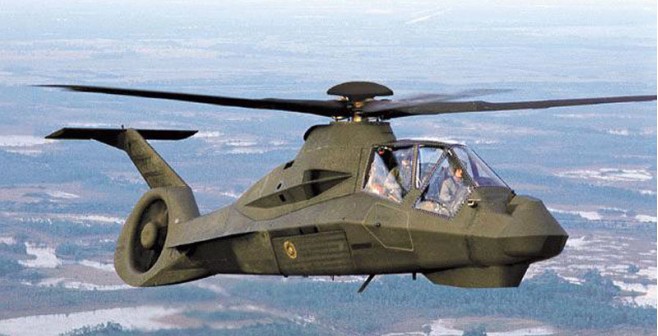
The first combat helicopter designed from outset to have “stealth” features and target acquisition radar. Embodies low-observable (LO) attributes and stated to have radar cross-section (RCS) lower than that of Hellfire missile; frontal RCS reportedly 360 times smaller than AH-64, 250 times smaller than OH-58D and 32 times smaller than OH-58D with mast-mounted sight. Also has quarter of AH-64D’s IR emissions and is six times quieter, head-on. Maximum avionics commonality required with USAF Lockheed Martin F/A-22 Raptor programme. RAH-66 specified empty weight of 3,402kg increased to 3,522kg by early 1992, as result of Army add-ons, including allowance for Longbow radar; mission equipment package has maximum commonality with F/A-22 Raptor technology. Design has faceted appearance for radar reflection; downward-angled engine exhausts; T tail with endplates; eight-blade fan-in-fin shrouded tail rotor; and five-blade all-composites bearingless main rntor system, with latter increased in diameter by 0.3m and gaining noise-reducing anhedral tips on forthcoming EMD aircraft. New rotor incorporating anhedral tips flown for first time on first prototype on 20 July 2001. RAH-66 also features internal weapon stowage. Split torque transmission, obviating need for planetary gearing. Upper part of T tail folds down for air transportation. Detachable stub-wings for additional weapon carriage and/or auxiliary fuel tanks (EFAMS: external fuel and armament management system). Radar, infra-red, acoustic and visual signature requirements set to defeat threats postulated by US Army. Eight deploy able inside Lockheed C-5 Galaxy or four in Boeing C-17 Globemaster III with only removal of main rotor; ready for flight 20 minutes after transport lands. Combat turnround time 13 minutes. Flight controls wree dual triplex fly-by-wire, with sidestick cyclic pitch controllers and normal collective levers. Main rotor blades removable without disconnecting control system. A largely composites airframe and rotor system. Fuselage built around composites internal box-beam; non-load-bearing skin panels, more than half of which can be hinged or removed for access to interior (for example, weapons bay doors can double as maintenance work platforms). Eight-blade Fantail rear rotor operable with 12.7mm calibre bullet hits; or for 30 minutes with one blade missing. Main rotor blades and tail section by Boeing, forward fuselage and final assembly by Sikorsky. Tailwheel type, retractable landing gear, with single wheel on each unit; main units retract aft, with tailwheel retracting forward. Main units can ‘kneel’ for air transportability.
A stealthy multi-sensor platform able to carry out scouting and attack missions, shoot down enemy helicopters and pass data directly to the Longbow Apache attack helicopter, slow funding of the programme encouraged more roles and capabilities to be added, increasing the weight and cost. An early plan envisaged procurement of as many as 5023 Comanches, later reduced to 1400, then 1213 and finally 650. As the numbers fell, the per-unit cost rose from $12.1 million to $58.9 million. Armament was a General Dynamics stowable XM-301 three-barrel 20mm cannon in Giat undernose turret, with up to 500 rounds (320 rounds normal for primary mission) and either 750 or 1,500 rounds per minute firing rates. Aiming coverage of gun is +15 to -45° in elevation and ±120° in azimuth. Integrated retractable aircraft munitions system (IRAMS) features side-opening weapons bay door in each side of fuselage, on each of which can be mounted up to three Hellfire or six Stinger missiles or other weapons. Four more Hellfires or eight Stingers can be deployed from multiple carriers under tip of each optional stub-wing, or auxiliary fuel tank for self-deployment. Will be compatible with Starstreak and Mistral air-to-air missiles. Maximum of 56 Hydra 70mm FFARs or Sura D or Snora 81mm equivalents. All weapons can be fired, and targets designated, from push-buttons on collective and sidestick controllers. Crewed by a Pilot (in front) and WSO in identical stepped cockpits, pressurised for chemical/biological warfare protection. Crew seats resist 11.6m/s vertical crash landing. Powered by two LHTEC T800-LHT-801 turboshafts, each rated at 1,165kW. Transmission rating 1,639kW. Internal fuel capacity 1,142 litres. Two external tanks totalling 3,407 litres for self-deployment; total fuel capacity 4,548 litres. Additional fuel to be contained in two 424 litre tanks in side weapon bays, which in preliminary development in mid-1999. Main rotor tip speed 221m/s; 355rpm. The Comanche had Stealth characteristics achieved by retractable undercarriage and weapons stubs, an angular shape and engine exhaust slots under the fuselage. The propeller hub was entirely covered, and the tail rotor was a ducted fan. The tail surfaces went through many changes to avoid problems with buffeting, eventually being reduced in size and having endplate fins. The ‘flowerpot’ on top of the second prototypes’ main rotor hub contained a version of the Longbow radar.
By February 2001 Boeing had flown a re-designed version of the RAH-66. The new empennage featured vertical and horizontal stabilisers with endplates mounted on the existing shrouded fantail. The entire process took only ten months from initial design to December 2000 first flight.
The US Department of Defence decided to keep the RAH-66 at the technology demonstrator level only. The US Army cancelled the program on 24 February 2004 and give Bell a contract to build the ARH-70 based on the Bell 407. In the end, the expenditure of $8 billion only achieved two flying prototypes and a partially completed test programme.
Courtesy John Gwin
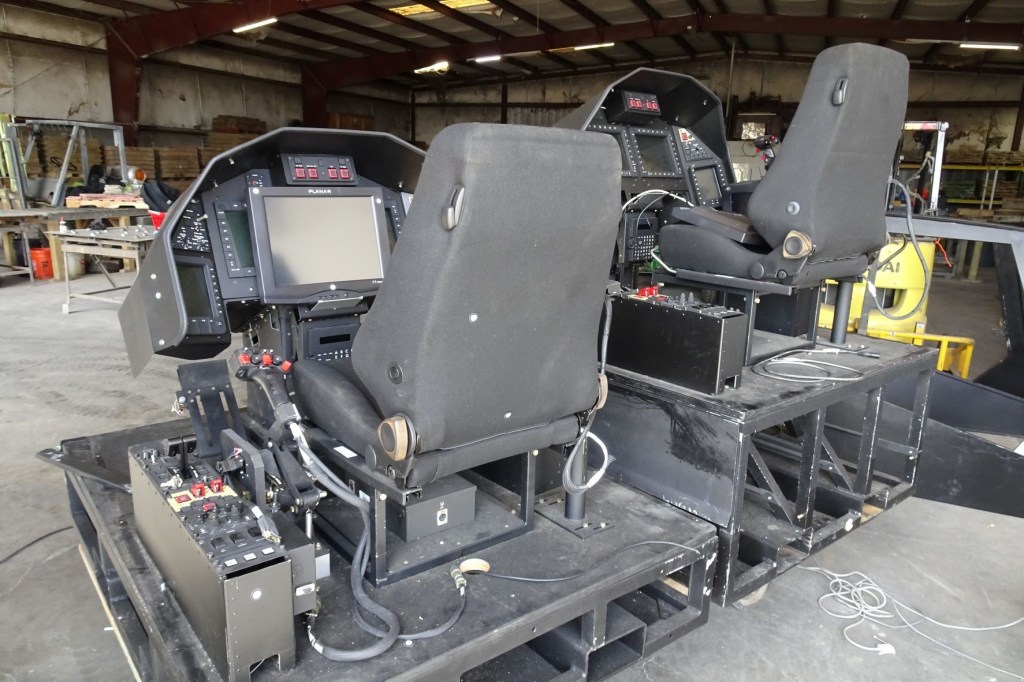
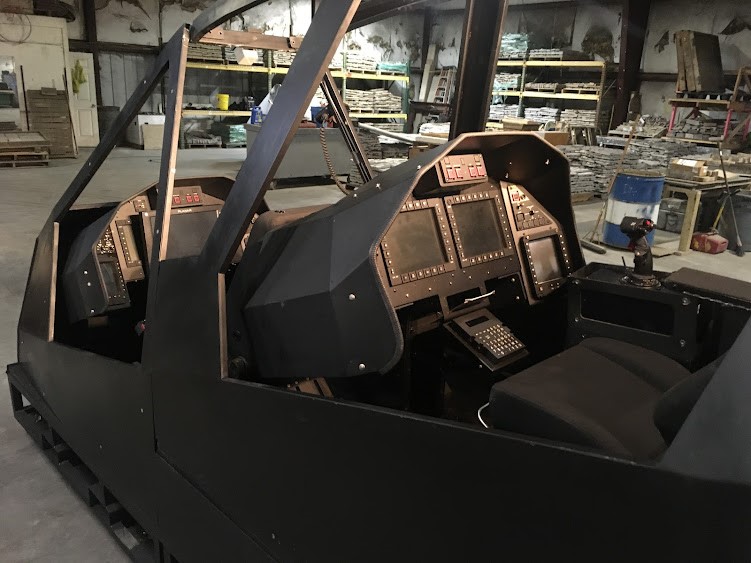
One of the Comanche Portable Cockpits used during the RAH-66 resides in a warehouse in Panama City Beach, FL. In 2022.
Courtesy John Gwin
RAH-66 Engines: 2 x LHTEC T800-LHT-801 turboshafts, 1,165kW. Transmission rating 1,639kW. Main rotor diameter: 12.19m Main rotor tip speed: 221m/s Main rotor rpm: 355rpm. Tail rotor diameter: 1.37m Overall length, rotors turning: 14.28m Fuselage length, excl gun barrel: 13.20m Height over tailplane: 3.37m Empty weight: 4,218kg Max useful load: 2,296kg Internal fuel capacity 1,142 lt / 870kg External fuel capacity: 3,407 litres Max fuel capacity: 4,548 litres Take-off weight, primary mission: 5601kg Take-off weight, max alternative: 5850kg Take-off weight (self deployment): 7896kg Max level speed (without radar): 324km/h Max level speed (with radar): 307km/h Cruising speed (without radar): 306km/h Cruising speed (with radar): 276km/h Rate of climb (without radar): 273m/min Rate of climb (with radar): 152m/min Hovering ceiling IGE: 2,745m Hovering ceiling OGE: 1,220m Operational radius, internal fuel: 278km Ferry range with external tanks: 2222km
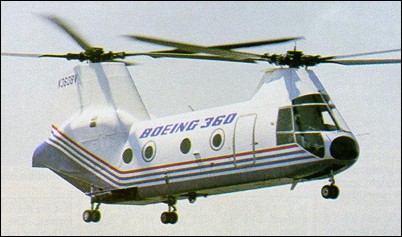
First flown on 10 June 1987, the Model 360 is a privately developed advanced technology rotorcraft, designed to research the company’s other rotorcraft programs. The helicopter features advanced aerodynamics and extensive use of composite materials including the fuselage, rotor shafts, blades and hubs. Powered by twin Avco-Lycoming AL5512 engines (4200shp) the Model 360 has a 370km/h cruise speed. The aircraft’s advanced cockpit features cathode ray tube displays, multi-function callouts, digital automatic flight control system and other improvements to reduce pilot workload. Only one model 360 was built (N360BV).
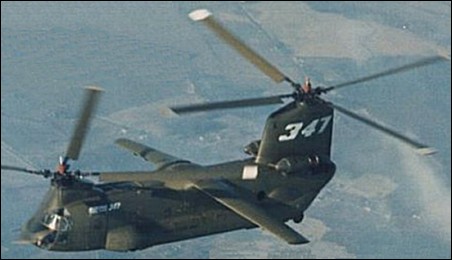
First flown on May 27, 1970, the Boeing Vertol 347 was a CH-47A modified for research with wings, four-blade rotors, retractable u/c, and fly-by-wire controls. The aft was pylon taller. The CH-47A was Boeing c/n 164 / US Army Serial number 65-7992.




 All Aero