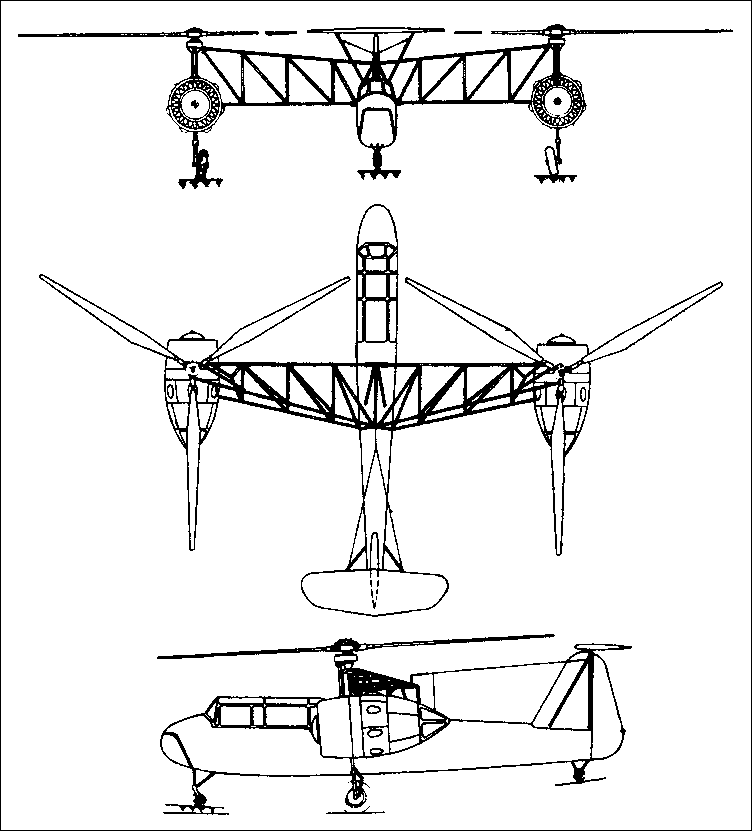
Breguet-Richet Helicopter No.2

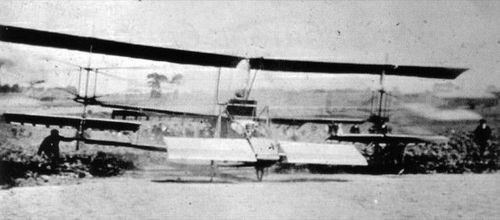
In 1908 the Breguet-Richet collaboration produced a No.2 Gyroplane, powered by a 55hp Renault engine and having two forward-tilting 2-blade rotors with a diameter of 7.85m and, in addition, fixed wings giving an extra 50sq.m of lifting surface.

On July 22, 1908, it rose vertically to the height of 4.5m and flew for a short period of time, apparently under control, but the machine was completely wrecked upon landing, but was rebuilt and flew again next spring.

It was later morphed into the No.2 bis.

Breguet-Richet Gyroplane No.1

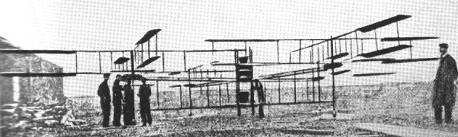
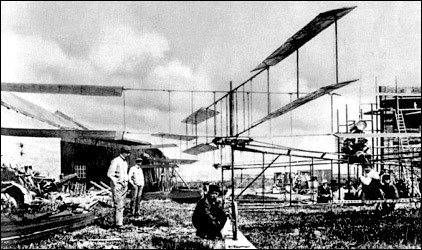
The first manned helicopter to make a successful ascent, though only with ground assistance, took to the air at Douai in France on 29 September 1907. It was built by brothers Louis and Jacques Breguet in association with Professor Charles Richet. They called it Gyroplane. Authorities differ over the date of the Breguet machine’s first flight at Douai, 24 August and 19 September 1907 being quoted with equal assurance; on this occasion the aircraft rose to about 0.60m. Take-off to some 1.50m was achieved during a test on 29 September, and similar heights were reached in several subsequent tests, but the Breguet-Richet aircraft was neither controllable nor steerable in a horizontal plane.

The machine consisted of a rectangular central chassis of steel tubing supporting the powerplant and the pilot; from each corner of this chassis there radiated an arm, also of steel tube construction, at the extremity of which was mounted a fabric-covered 4-blade biplane rotor, making a total of 32 small lifting surfaces driven by a 40 hp Antoinette engine. One pair of diagonally opposed rotors rotated in a clockwise direction, the other pair moving anti-clockwise.

Despite its weight, with pilot, of 577 kg (1273 lb), the Gyroplane rose 60 cm (2 ft) in the air, sup¬ported by four poles held by ground handlers, who dared not let go because the helicopter had no form of control save for an engine throttle. The pilot, M.Volumard, was reputedly chosen at least partly because of his small stature – he weighed only 68kg. The Gyroplane was eventually damaged after crashing into a beetroot field, and Louis Breguet turned to fixed wing craft, returning to helicopters only some 30 years later.

Engine: Antoinette, 45 hp / 29kW
Rotors: 4
Rotor diameter: 8.0m
Take-off weight: 578kg
Empty weight: 340kg
Crew: 1

Breguet G.II Gyroplane / G.III Gyroplane

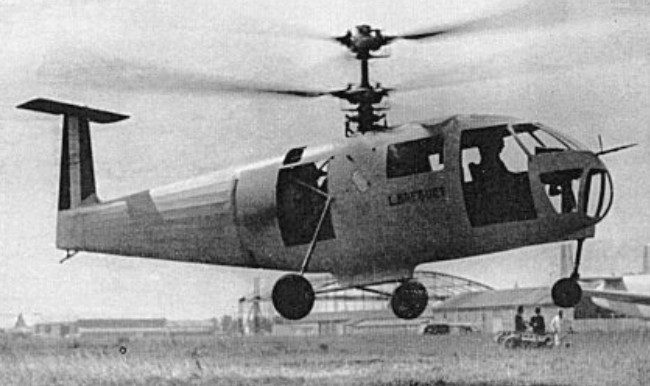
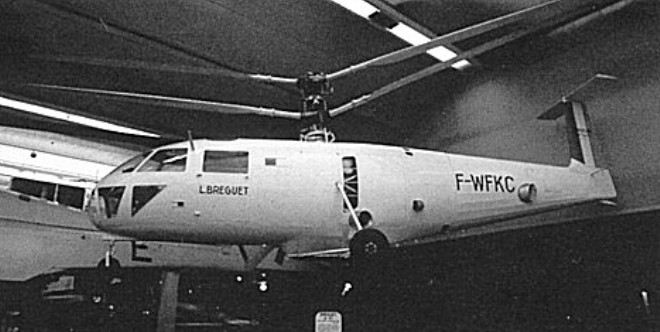
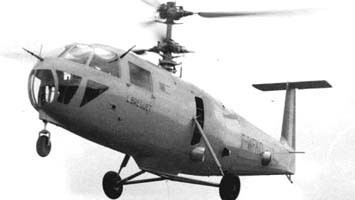
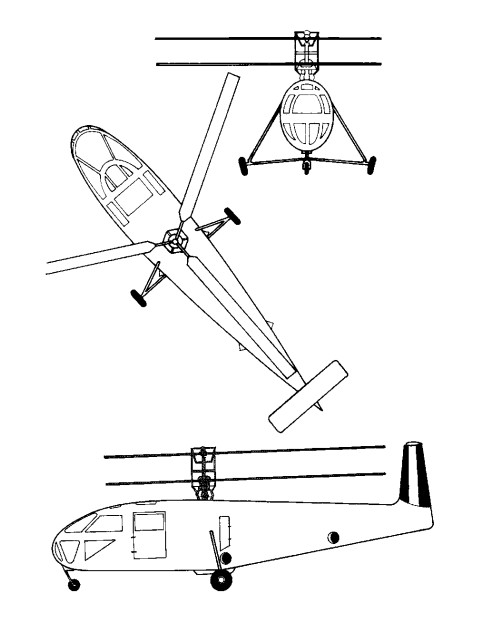
Louis Breguet produced his third “Gyroplane” in 1949; the Model G.IIE. The GIIE had a streamlined fuselage and T-tail and cabin space for a pilot and four passengers. Constructed on behalf of the Societe Francaise du Gyroplane by Breguet, the prototype had an all-metal fuselage with a tall fin and small T-tailplane. It had a cabin for five people and a fixed tricycle undercarriage. The 240hp Potez 9E engine was buried in the fuselage behind the cabin, and three-bladed all-metal rotors were used.

First flew on 21 May 1949, at Villacoublay-Velizy to the south of Paris, the G.IIE was found to be underpowered and it was re-engined with a 450hp Pratt & Whitney Wasp Junior – in which form it became the G.III, first flown in 1950.

Following testing in 1951 development was discontinued and F-WFKC was donated to the Musee de l’Air.

Bréguet G.III

Gallery

G.IIE
Engine: 1 x Potez 9E, 240 hp
Rotor diameter: 9.60m
Length with rotors turning: 9.70m
Height: 4.24m
Max take-off weight: 2100kg
Empty weight: 1473kg
Max speed: 215km/h
Hovering ceiling, IGE: 1600m
Service ceiling: 4600m
Range: 470km
Seats: 3

G.III
Engine: 1 x Pratt & Whitney R-985, 335kW
Rotor diameter: 31.58 ft
Fuselage length: 31.85 ft
Empty weight: 3241 lb
Max take-off weight: 4620 lb
Max speed: 133 mph
Cruise speed: 107 mph
Ceiling: 15,000 ft
Range: 291 miles

Breguet Gyroplane Laboratoire

Towards the end of the 1920s Louis Breguet returned to the study of helicopters and in 1929-30 took out patents for systems for stabilising aircraft of this type while in flight. In 1931 Louis Breguet formed the Syndicat d’Etudes du Gyroplane, with Rene Dorand (who had joined the Breguet company in 1924) as technical director, and began the design and construction of an experimental machine known as the Gyroplane Laboratoire.

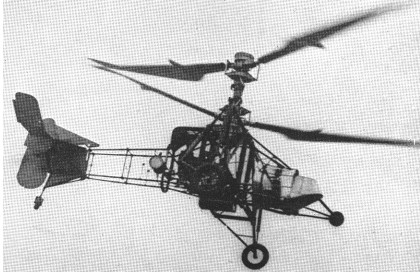
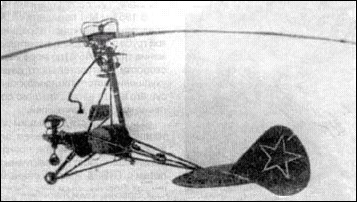
In 1935, with the cooperation of René Dorand, Louis Breguet completed the coaxial Gyroplane Laboratoire, which was the first helicopter to meet the aviation industry’s control and performance expectations for a practical design. Returning to his lifelong fascination with helicopters, an older Louis Breguet oversaw but did not participate directly in the construction and testing of this compact single-seater.

Intended originally to be powered by a 240hp Breguet-Bugatti engine, it consisted basically of a steel-tube open framework supporting the engine, fuel tank, flight controls and pilot, with rear booms carrying the plywood-covered tail surfaces. An unusually wide track main undercarriage was mounted on outriggers from the central framework, with a small tailwheel and a nosewheel to prevent the machine tipping forward on landing. The transmission from the big radial engine drove a pair of co-axial, counter-rotating, 2-blade metal rotors whose blades had an aerofoil section and an unusually large diameter. One rotor shaft turned inside the other, each rotor thus cancelling out the torque created by the other. Novel features for the time were the use of a cyclic pitch control for lateral and longitudinal movement, and collective pitch for movement in the vertical plane.

The Gyroplane was badly damaged in a ground accident at the end of 1933. Rebuilt with extensive modifications and tested conservatively on the ground, it resumed flight tests in June 1935. Breguet then committed it to maneuvering, speed, altitude, and endurance requirements far in excess of anything so far accomplished by a helicopter.

The Gyroplane Laboratoire set four world records in 1936 when test pilot Maurice Claisse flew the craft at 98 kph (61 mph) (September 11), to a height of 158 m (518 ft), over a distance of 43 km (27 miles), and for a duration of 62 minutes.

In 1937 (after a similar achievement by the Fw 61 in Germany) it made its first ‘engine off’ landing using autorotation. The Gyroplane was badly damaged in June 1939 during autorotation tests. It was subsequently destroyed by Allied bombing of historic Villacoublay Airfield in 1943.

It is not certain whether the Bugatti engine was ever installed; the aircraft did most or all of its flying with the more powerful Hispano engine.

Engine: Hispano-Suiza, 225kW
Rotor diameter: 15.89m
Length: 8.92m
Height: 2.79m
Max take-off weight: 1950kg
Empty weight: 1430kg
Speed: 98 kph (61 mph)
Ceiling: 158 m (518 ft
Range: 43 km (27 miles)
Endurance: 62 minutes.
Crew: 1
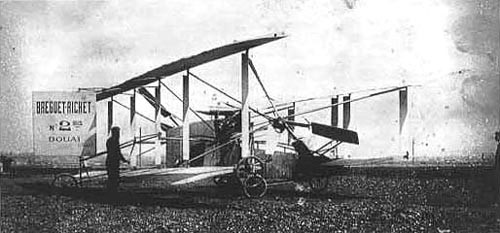
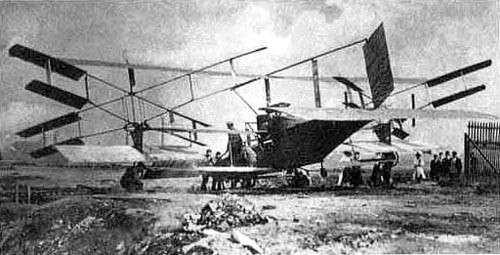
Breda Nardi Costruzioni Aeronautiche SpA

Breda Nardi Costruzioni Aeronautiche SpA was established on February 15,1971 by Nardi SA per Costruzioni Aeronautiche, and Breda, a member company of the EFIM state-owned financial group, each with a 50 percent holding. Initiated manufacture of helicopters under a license granted by Hughes Helicopters, and is building the Hughes 300C, 500C, 500D, and 500M under the respective designations of Breda Nardi NH-300C, NH- 500C, NH-500D, and NH-500M-D (TOW). The last is a multirole military helicopter armed with TOW missiles.

Bratukhin B-11

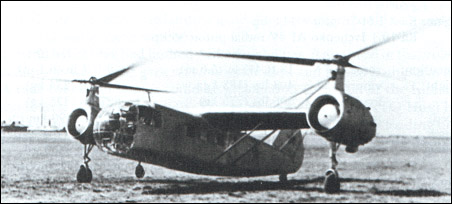
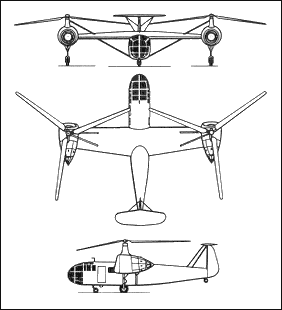
The last design authorised from OKB-3 was to provide comparision against Mil and Yak single-rotor submissions to VVS requirement for a three-seat all-weather communications helicopter. Dynamic parts were as previous Bratukhin except for hydraulic rotor-hub dampers and faired masts with oil-cooler inlets. Wing of lifting section are set at zero incidence. The fuselage had improved form, with round instead of polyhedral top and bottom. The tail was basically as the B-5. The pilot was in B-5 type nose, main cabin for two seats, with space at rear for freight ot two stretchers (in lieu of passengers) loaded through enlarged door. Improved differential rotor controls with reduced friction were fitted. The B-11 was equipped for blind flight.
Two prototypes were completed in April 1948, flying in June and September. Progress was made with measured performance, sustained (47 min) single-engine flight, autorotative landings and in eradication of various faults stemming mainly from vibration was achieved. One problem was lack of wing lift resulting from incidence setting, causing the rotors to stall at high forward speeds. A further snag was hydraulic leaks difficult to rectify. On 13 Decemeber 1948 first machine shed a blade from the right rotor, killing Ponomaryov and I.G.Nilus.
After several modification, including installation of new engines (same series), it was presented on an Aviation Parade.
The favored scheme of twin-rotor helicopter became “The Flying Banana” (due to less drag), and the transversal scheme was not used again until the Mil Mi-12.

B-11
Engine: 2 x AI-26GRF, 575hp
Rotor diameter: 10.0m
Take-off weight: 4150kg
Empty weight: 3398kg
Max speed: 155km/h
Service ceiling: 2550m
Range: 328km
Crew: 3
Passengers: 1-3

Bratukhin B-10

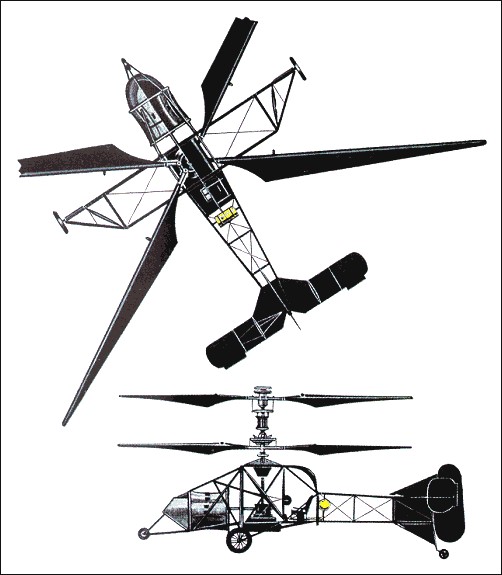
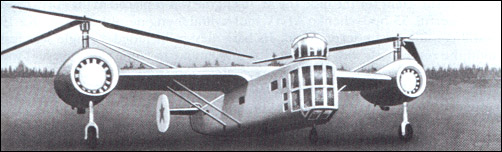
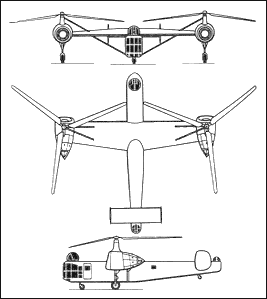
Also designated VNP (Vozdushni Nabludatyelnii Punkt – aerial observation point), its original role was to replace the AK in artillery spotting. The Bratukhin helicopter had become larger and potentially more capable and the VNP was to be a multi-role machine able to fly recon, tactical supply and even casevac missions. Engines were fully boosted AI-26 version, and dynamic parts were essentially the same as the B-9. Wings were of the same plan and section as the B-9 but with a pair of bracing struts from the bottom of two main-spar frames in the fuselage to the spar booms at 60% semi-span, and two bracing struts from the upper spar booms at same location to the top of rotor masts. The fuselage was an entirely new dural monocoque with a glazed nose seating the pilot on the left and navigator on the right under a large observation dome. An was also in the tail, again with large observation dome. A new tail with a variable-incidence tailplane mounted on the fuselage carrying endplate fins(latter possibly rudders). Usual four-wheel landing gear. The central fuselage was available for additional loads: three passengers, or two stretchers (room for more but weight-limited) or 200kg cargo or various radio or photographic equipment. Entrance door on left.
A single example was built and flown 1947. Behaviour was satisfactory, and complete performance measurements were taken. Later fitted ShKAS at nose and tail. At the time on the ‘decision-making level’ attention was shifted to competing schemes of helicopters (under influence of Western designs). Despite B-10 was performing well, it failed to catch any interest in the ‘High Circles’.
According to Shavrov 1947-48 saw general disillusionment with helicopters and especially with twin lateral rotor configuration.

B-10
Engine: 2 x AI-26GRF, 575hp
Rotor diameter: 10.0m
Take-off weight: 3900kg
Empty weight: 3019kg
Max speed: 218km/h
Service ceiling: 6550m
Hovering ceiling: 2200m
Range: 440km
Crew: 3
Passengers: 2-3

Bratukhin B-5

A scaled-up derivative of the G-4, with slightly more powerful model of same engines.
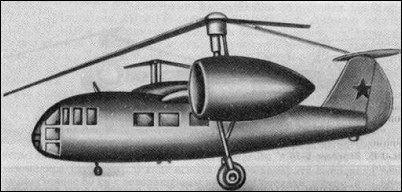
The first helicopter designated for Bratukhin himself, the transmission and other dynamic parts were identical but the new airframe had a lifting aerofoil wing instead of space-frame outriggers and large passenger fuselage.
Designed as a duralumin semi-monocoque (not steel tube as has been reported) with a level floor and door on the right side. A total of 7 seats, intended as two crew and 5 passenger seats, with an aisle along the right wall. Wings were also of light-alloy stressed-skin construction with lifting profile to carry about 25% of the weight in cruise. Fixed tricycle gear with bumber tail-wheel.
A single example was completed in 1947 powered by supercharged version of the AI-26GR engine, but only limited testing was undertaken because of inadequate wing stiffness.

B-5
Engines: 2 x AI-26GRF, 550hp
Rotor diameter: 10.0m
Take-off weight: 4032kg
Empty weight: 2932kg
Max speed: 236km/h
Service ceiling: 6400m
Hovering ceiling: 2280m
Range: 595km
Crew: 2
Passengers: 5

Bratukhin G-4

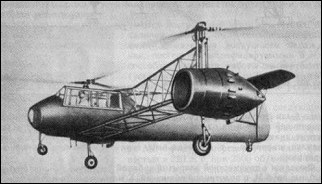
The first Soviet helicopter with the engines purposely designed, with cooling fan and front gearbox giving vertical and lateral outputs for the rotor and for transverse coupling shaft. The transmission was provided with centrifugal clutch; overall drive ratio 0.27 (540 rotor rpm). The main rotor had an inbuilt twist of 6 deg 45 min along the blade, and blade spar were extruded instead of folded sheet. Two prototypes were built, the first flown in October 1947 by M.K.Baikalov and second a month later. In January 1948 the first G-4 was damaged in the course of autorotational descents and deadstick landings typically at 12 m/s descent along 15.5-16 deg glide path.
The first prototype did not meet expectations (some calculated parameters were not reached). The second prototype had an improved rotor blade airfoil passed the extended test program without problems. Gliding (autorotation) rate was 12m/s, with gliding angle 16°. In this case landing speed was 80-90km/h with 10-15m roll.
The second G-4 was the first helicopter in the Soviet Union to meet its stipulated life for dynamic parts (in this case 100h). A small series constructed 1947-48, according to one account four flying out of ten ordered.
A G-4 and two G-3s participated in Aviation Parade in 1947.

G-4
Engine: 2 x AI-26GR pistone engine, 370kW
Rotor diameter: 7.7m
Take-off weight: 3002kg
Empty weight: 2364kg
Max speed: 148km/h
Ceiling: 2400m
Range: 233km
Crew: 1